Bread Moulder
ProductOverview
The bread moulder (or dough shaper) is an automated machine that transforms pre-scaled, fermented dough pieces into uniform cylindrical loaves. It is the workhorse of high-volume bread production, replacing hand-shaping labor and improving consistency.
Unlike a laminator or sheeter (which produces thin sheets), the moulder combines three steps into one continuous action: flattening a round dough ball, rolling it into a cylinder, and sealing the seam. The result is a shaped dough with even cross-section, a sealed bottom, and trapped air bubbles that ensure good oven spring.
The moulder is essential for pan breads (white loaves, whole-wheat loaves), baguette-style products, and some artisan applications. It handles dough with 60–75% hydration efficiently, producing 30–120 loaves per minute depending on dough size and line speed.
Three-Stage Process
1. Sheeting
The Sheeting Unit comprises twin Sheeting Rollers rotating in opposite directions at 20–60 rpm. As a pre-scaled dough ball enters between them, the rollers flatten it into a rectangular sheet (typically 3–6 mm thick, 150–250 mm wide, and 200–300 mm long). The Gap Adjuster controls the final sheet thickness; a hydraulic or mechanical mechanism adjusts the top and bottom rollers.
The Roller Shaft and Roller Bearings are sized to handle the compressive load of hundreds of pieces per hour without deflection or vibration.
2. Curling & Rolling
The flattened sheet travels onto the Curling System. A stainless-steel Curling Chain (40–50 mm pitch) moves the dough at 10–30 m/min over a Curling Board, a stationary curved or angled guide. As the chain advances the sheet, the angled board creates mechanical resistance, rolling the dough into a cylinder. The Drive Sprocket and Chain Tensioner maintain consistent chain speed and tension (10–20 mm sag).
The curling action encapsulates any remaining fermentation gas, creates surface tension that helps with oven spring, and tightens the gluten network.
3. Sealing
At the completion of the curling stage, the shaped dough passes under the Pressure System. Two Pressure Cylinders (pneumatic, 50–80 mm bore) lower a Pressure Plate onto the dough seam with 1–2 tons force, welding the edges together and creating an airtight seal. The Pressure Regulator limits system air pressure to 2–5 bar, preventing dough blowout. The sealed seam faces downward as the dough enters the Exit Conveyor, which transports shaped loaves away at 15–40 m/min.
Mechanical Integration
The Main Drive Motor (2–5.5 kW, three-phase) supplies all motion. A Main Gearbox reduces the motor's 1200–1500 rpm output to 50–150 rpm. A Belt Pulley distributes torque to the sheeting rollers, curling chain, and conveyor belt via independent belt drives or clutches. The Control Panel houses a VFD (variable-frequency drive) allowing operators to adjust overall speed from 20–100%, and a Pressure Gauge showing air pressure.
Dough Handling Characteristics
Optimal moulder performance depends on dough condition:
- Temperature: Dough should be 24–27°C. Cold dough resists shaping; warm dough tears or compacts.
- Hydration: Doughs with 60–75% hydration shape smoothly. Higher hydration (>78%) is difficult; lower hydration (<55%) may not accept roll-sealing pressure.
- Fermentation: Pre-fermented or bulk-fermented dough enters more easily than cold-retarded dough (which may require gentle pre-warming).
Maintenance & Wear Items
The Sheeting Rollers accumulate flour and dough residue, requiring daily steam cleaning to prevent buildup. The Curling Chain and Chain Tensioner should be checked weekly for wear; roller chain typically lasts 12–24 months under continuous use. The Pressure Cylinders seals may degrade after 2–3 years, requiring seal replacement.
The Main Gearbox should be oil-level checked monthly; gearbox fluid change is recommended every 2000 operating hours.
Sizing for Production
A 60-loaf-per-minute moulder can process ~3600 loaves per hour (8-hour shift = ~28,800 loaves/day). For a bakery producing 5000–10,000 loaves daily, one 60–80-loaves-per-minute machine is standard. Larger operations (20,000+ loaves/day) require multiple machines or 100+ lpm units.
Many bakeries run their moulders at 60–80% speed to extend component life and allow buffer time for fermentation cycles upstream.
Bread Moulder parts and their functions
7 top-level parts · 32 parts in total · full bill of materials below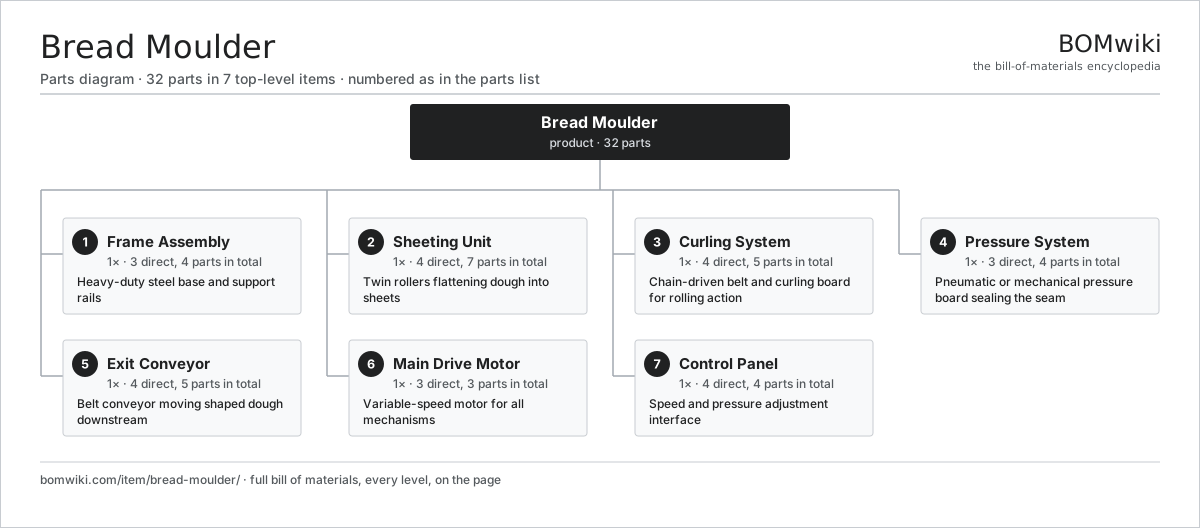
| # | Part | Qty | What it does |
|---|---|---|---|
| 1 | Frame Assembly 3 parts | 1× | Heavy-duty steel base and support rails |
| 2 | Sheeting Unit 4 parts | 1× | Twin rollers flattening dough into sheets |
| 3 | Curling System 4 parts | 1× | Chain-driven belt and curling board for rolling action |
| 4 | Pressure System 3 parts | 1× | Pneumatic or mechanical pressure board sealing the seam |
| 5 | Exit Conveyor 4 parts | 1× | Belt conveyor moving shaped dough downstream |
| 6 | Main Drive Motor 3 parts | 1× | Variable-speed motor for all mechanisms |
| 7 | Control Panel 4 parts | 1× | Speed and pressure adjustment interface |
3D model
No 3D model yet. Have a CAD file of this? Add a 3D model. STL renders right on this page; STEP, FreeCAD, and OpenSCAD sources are welcome too (openly licensed, like all 3D models on BOMwiki).
Build & assembly graph
expand / collapse · shared sub-assemblies converge · links to related products · est. labourTap an assembly to expand/collapse · tap a part to open it · use “Open page” for any node · drag to pan, scroll to zoom.
Bill of materials for Bread Moulder
7 top-level lines · 32 rows shown · 32 parts total · indented to 3 levels| # | Item / sub-assembly | Part no. | Qty/assy | Ext. qty | Parts | Type |
|---|---|---|---|---|---|---|
| 1 | Frame Assembly 3 parts | bread-moulder-frame | 1× | 1 | 4 | assembly |
| 1.1 | Frame Base | bread-moulder-frame-base | 1× | 1 | · | part |
| 1.2 | Frame Rails | bread-moulder-frame-rails | 2× | 2 | · | part |
| 1.3 | Fastener Set | fastener-set | 1× | 1 | · | part |
| 2 | Sheeting Unit 4 parts | bread-moulder-sheeting-unit | 1× | 1 | 7 | assembly |
| 2.1 | Sheeting Rollers | bread-moulder-sheeting-rollers | 2× | 2 | · | part |
| 2.2 | Roller Bearings | bread-moulder-roller-bearings | 2× | 2 | · | part |
| 2.3 | Gap Adjuster | bread-moulder-roller-gap-adjuster | 1× | 1 | · | part |
| 2.4 | Roller Shaft | bread-moulder-roller-shaft | 2× | 2 | · | part |
| 3 | Curling System 4 parts | bread-moulder-curling-system | 1× | 1 | 5 | assembly |
| 3.1 | Curling Chain | bread-moulder-curling-chain | 1× | 1 | · | part |
| 3.2 | Curling Board | bread-moulder-curling-board | 1× | 1 | · | part |
| 3.3 | Drive Sprocket | bread-moulder-chain-drive-sprocket | 2× | 2 | · | part |
| 3.4 | Chain Tensioner | bread-moulder-chain-tensioner | 1× | 1 | · | part |
| 4 | Pressure System 3 parts | bread-moulder-pressure-system | 1× | 1 | 4 | assembly |
| 4.1 | Pressure Plate | bread-moulder-pressure-plate | 1× | 1 | · | part |
| 4.2 | Pressure Cylinders | bread-moulder-pressure-cylinders | 2× | 2 | · | part |
| 4.3 | Pressure Regulator | bread-moulder-pressure-regulator | 1× | 1 | · | part |
| 5 | Exit Conveyor 4 parts | bread-moulder-conveyor | 1× | 1 | 5 | assembly |
| 5.1 | Conveyor Belt | bread-moulder-conveyor-belt | 1× | 1 | · | part |
| 5.2 | Conveyor Rollers | bread-moulder-conveyor-rollers | 2× | 2 | · | part |
| 5.3 | Conveyor Motor | bread-moulder-conveyor-motor | 1× | 1 | · | part |
| 5.4 | Drive Belt | drive-belt | 1× | 1 | · | part |
| 6 | Main Drive Motor 3 parts | bread-moulder-drive-motor | 1× | 1 | 3 | assembly |
| 6.1 | Main Motor | bread-moulder-main-motor | 1× | 1 | · | part |
| 6.2 | Main Gearbox | bread-moulder-main-gearbox | 1× | 1 | · | part |
| 6.3 | Belt Pulley | bread-moulder-belt-pulley | 1× | 1 | · | part |
| 7 | Control Panel 4 parts | bread-moulder-control-panel | 1× | 1 | 4 | assembly |
| 7.1 | VFD Unit | bread-moulder-vfd-unit | 1× | 1 | · | part |
| 7.2 | Pressure Gauge | bread-moulder-pressure-gauge | 1× | 1 | · | part |
| 7.3 | Relay | relay | 1× | 1 | · | part |
| 7.4 | Connector | connector | 1× | 1 | · | part |
Something wrong in this list? Report a problem with this BOM.
Related products
same domain, ranked by shared parts Bottle Washing Machine
2,388 parts · shares 2 with this page
Brine Chilling System
239 parts · shares 2 with this page
Bottle Washing Machine
2,388 parts · shares 2 with this page
Brine Chilling System
239 parts · shares 2 with this page
 Can Seaming Machine
658 parts · shares 2 with this page
Candy Slab Cutter
84 parts · shares 2 with this page
Can Seaming Machine
658 parts · shares 2 with this page
Candy Slab Cutter
84 parts · shares 2 with this page
Sourcing: possible vendors
Browse the supplier directory → Prices, MOQ, and lead times are algorithmic estimates, not quotes, and not claims about these companies. Company mappings are curated by keyword; est. price band $1k–$500k. How estimates work| Vendor | HQ | Specialty | MOQ | Lead time |
|---|---|---|---|---|
| gea.com ↗ | Düsseldorf, DE | Process technology | 20 units | 12–20 wks |
| buhlergroup.com ↗ | Uzwil, CH | Food & materials processing | 20 units | 12–20 wks |
| tetrapak.com ↗ | Pully, CH | Food packaging & processing | 20 units | 12–20 wks |
| jbtc.com ↗ | Chicago, US | Food processing equipment | 20 units | 12–20 wks |
| alfalaval.com ↗ | Lund, SE | Heat transfer & separation | 20 units | 12–20 wks |
739-word article