Brick Making Machine
ProductOverview
A brick making machine is an industrial-scale production system that transforms raw clay into finished green (unfired) bricks at rates of 300–500 bricks per hour. The process integrates clay preparation, high-pressure forming, precision cutting, and automated conveying. Modern machines produce clay bricks, concrete bricks, or interlocking pavers depending on material and mold configuration. A single plant with 2–3 machines and a kiln dryer can supply bricks for 50–100 residential buildings per year in a large city.
The machine cycle is rapid: clay from overhead hoppers falls into the pug mill, where it is mixed with water and conditioned to correct consistency (17–22 % moisture content). The conditioned clay is then forced through the Press Assembly under 300 bar pressure, forming a rough brick shape. The formed brick is immediately ejected onto a cutter table, where multi-wire cutters simultaneously slice the brick to precise dimensions. The finished green brick slides onto the main conveyor, which feeds it into a dryer kiln (a separate system) or stacks it for air drying.
Production rates depend on clay type, moisture content, and mold design. Fine clays (brick-grade clay deposits) allow 15,000 bricks per shift; coarser or variable clays limit output to 6000–8000 per shift due to longer consolidation times. Downtime is common: clay lump blockages in the auger, wire breakage in the cutter, or conveyor jams. Maintenance crew availability is critical, every hour of downtime costs €500–1000 in lost production.
How it works
The hopper is filled with raw clay (dug from a pit or delivered by truck). A vibrating gate discharges clay into the pug mixing barrel. The pug shaft rotates at 30–50 rpm, grinding clay lumps against the barrel wall and mixing it thoroughly. Water is sprayed by the nozzles during mixing; the operator adjusts spray duration and volume based on clay moisture content (checked by periodic hand samples). Well-mixed clay is a plastic dough, free of large lumps and pockets of air.
The mixed clay is pushed down the Extrusion Auger, which tapers toward the Press Assembly inlet. The auger rotates continuously at 30 rpm, forcing clay into the press chamber at a controlled rate. The press piston descends, compressing clay into the mold cavity at pressures reaching 300 bar over 2–3 seconds. Entrapped air is expelled through small vent holes in the mold. Once the piston reaches the bottom of its stroke, the ejector piston activates, pushing the newly formed brick out of the mold onto the Ejection Conveyor.
The brick emerges in semi-rigid form, still plastic but self-supporting. It slides onto the cutter table. Four horizontal cutting wires, 120 mm apart, and two vertical wires descend simultaneously, slicing the brick to final dimensions (240 × 120 × 100 mm) in approximately 1 second. The cutter motor retracts the wires, and an air cylinder ejects the finished brick onto the main conveyor.
The accumulator conveyor spaces bricks 200–300 mm apart, encoding each brick with a unique serial number (optional). This spacing prevents bricks from touching as they travel to the kiln; touching bricks stick together and must be separated manually, a labor-intensive defect correction. The main conveyor carries bricks 30–50 m to the kiln entrance, moving at 0.5–1.5 m/min depending on drying kiln speed.
The entire cycle, from clay entering the pug to the finished brick leaving the cutter, takes 8–15 seconds depending on clay type and mold design. A machine running continuously at a 10-second cycle produces 360 bricks per hour, or 2,880 per 8-hour shift.
Clay preparation and conditioning
The Clay Preparation System system is critical. Many clay deposits contain stones, shells, and root fragments that damage the press. Large stones jamming the auger cause the motor to stall and trip the electrical overload relay. Manual extraction of a jammed stone takes 20–40 minutes and resets production.
Moisture content is the most important control parameter. Clay with 15 % moisture is too dry: it compacts poorly, leaving voids, and cracks during drying. Clay with 25 % moisture is too soft: bricks sag after ejection, and the cutter wires bend rather than slice cleanly. Optimum moisture is 18–20 %, achieved through careful spray control and mixing time.
The Pug Shaft is subject to severe wear. Abrasive clay grains act as a grinding medium; the shaft's hardened coating erodes over 2000–3000 operating hours. A new shaft costs €8,000–12,000 and requires a one-day machinery swap. Shaft life is extended by using clay from the same pit (consistent mineral composition) and by cleaning the pug after each shift to prevent dried clay buildup.
Press and mold technology
The Press Assembly applies pressure in two phases:
Filling phase (0.5–1.0 s): The auger fills the mold cavity while the press piston remains at the top. Pressure is low (<50 bar).
Compression phase (1.5–2.5 s): The piston descends, compressing clay and expelling air. Pressure rises to 300 bar. This phase controls brick density and strength; higher pressures yield denser bricks (compressive strength 25–50 MPa) but extend cycle time and wear the press faster.
Molds are interchangeable and change-out takes 20–30 minutes. Different brick sizes (240 × 120 × 100, 240 × 115 × 75, perforated designs) require different molds. A plant typically stocks 3–4 mold sets for rapid format switching.
Brick perforation is controlled by mold cavity design. Holes in the mold (typically 30–50 % of brick area) reduce clay volume, making bricks lighter and faster-drying, while improving thermal and acoustic performance. Perforated bricks command a 10–20 % price premium.
Cutter system and wire maintenance
The wire cutter must maintain precision despite constant impact. The piano wires are under tension (approximately 50 N per wire) to stay taut. As wires cut thousands of bricks, they dull and occasionally snap.
A snapped wire causes bricks to exit with one dimension incomplete (e.g., a partial cut). Operators detect this by visual inspection or weight check; defective bricks are crushed and recycled (clay is reusable). A broken wire must be re-tensioned and replaced within 1–2 hours, or production must pause.
Wire life is approximately 5000–8000 cuts, depending on clay hardness. A machine producing 10,000 bricks per shift (each requiring one cut pass) consumes one full wire set per shift. Replacement cost is €1500–2500 per set. Some plants run night shifts with less-critical molds to extend wire life.
Conveyor operations
The accumulator table is a precision component. Bricks must be spaced exactly to prevent sticking in the kiln. Some designs use mechanical pushers synchronized to press cycle timing; others use sensor-driven variable-speed sections. Any misalignment (bricks touching) cascades through the kiln, causing defects.
Conveyor belts wear rapidly from wet clay; replacement every 2–3 years is typical. Moisture and clay dust ingress into bearing housings, requiring frequent lubrication. A bearing failure in the conveyor often shuts down the entire plant, as bricks back up into the cutter.
Production scheduling and downtime
A typical production target for a 10,000 brick/shift machine is 80 hours per week (two 8-hour shifts on a 5-day week). Actual utilization is often 60–70 % due to:
- Scheduled maintenance: Pug shaft inspection, bearing lubrication, mold cleaning (6–8 hours per week).
- Unplanned downtime: Stone jams, wire breaks, conveyor jams (2–4 hours per week on average).
- Format changes: Switching molds for different brick sizes (1–2 hours per change, 2–4 changes per week).
A downtime cost of €750/hour × 40 hours/month = €30,000/month motivates preventive maintenance and spare parts inventory.
Environmental considerations
Brick making is water-intensive: a machine consuming 30 L/min water runs 8 hours = 14,400 L/day = 5.2 million liters per year. Water must be potable or treated (clay particles settle out quickly). Some plants recirculate wastewater through settling tanks, reducing freshwater demand by 40–60 %.
Dust control is mandated by industrial hygiene standards. Clay dust contains silica (10–30 % crystalline), classified as a carcinogen under OSHA. Plants must provide dust collection hoods at the pug discharge and cutter area, feeding into bag filters (changing every 3–6 months). Operators wear N95 masks, and annual lung function testing is required in many jurisdictions.
Standards and certification
Bricks produced by the machine must meet ASTM C62 (fired clay brick), ASTM C55 (concrete brick), or equivalent regional standards. Testing includes compressive strength, water absorption, and freeze-thaw durability. Most plants send samples to independent labs quarterly. A failed batch (e.g., bricks with <15 MPa strength) must be crushed and recycled, consuming 8–12 hours and reducing weekly output by 3–5 %.
Machinery safety is covered by ISO 4413 (hydraulic systems) and the machinery directive 2006/42/EC. Guards must protect operators from moving pug shafts, moving press platens, and rotating conveyor rollers. Emergency stop buttons must be within 2 m of any operator position.
Brick Making Machine parts and their functions
7 top-level parts · 50 parts in total · full bill of materials below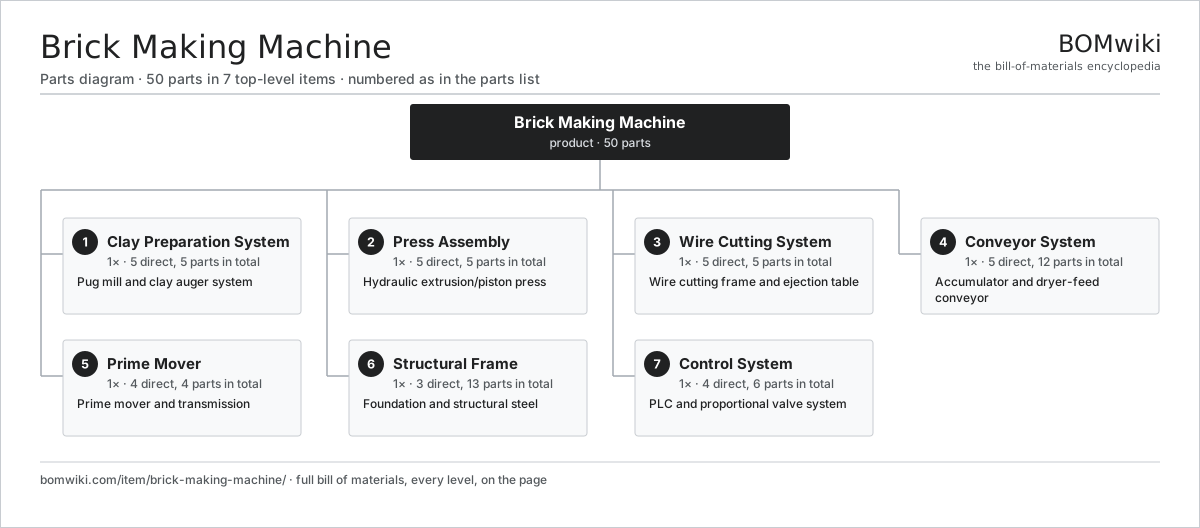
| # | Part | Qty | What it does |
|---|---|---|---|
| 1 | Clay Preparation System 5 parts | 1× | Pug mill and clay auger system |
| 2 | Press Assembly 5 parts | 1× | Hydraulic extrusion/piston press |
| 3 | Wire Cutting System 5 parts | 1× | Wire cutting frame and ejection table |
| 4 | Conveyor System 5 parts | 1× | Accumulator and dryer-feed conveyor |
| 5 | Prime Mover 4 parts | 1× | Prime mover and transmission |
| 6 | Structural Frame 3 parts | 1× | Foundation and structural steel |
| 7 | Control System 4 parts | 1× | PLC and proportional valve system |
3D model
No 3D model yet. Have a CAD file of this? Add a 3D model. STL renders right on this page; STEP, FreeCAD, and OpenSCAD sources are welcome too (openly licensed, like all 3D models on BOMwiki).
Build & assembly graph
expand / collapse · shared sub-assemblies converge · links to related products · est. labourTap an assembly to expand/collapse · tap a part to open it · use “Open page” for any node · drag to pan, scroll to zoom.
Bill of materials for Brick Making Machine
7 top-level lines · 38 rows shown · 50 parts total · indented to 3 levels| # | Item / sub-assembly | Part no. | Qty/assy | Ext. qty | Parts | Type |
|---|---|---|---|---|---|---|
| 1 | Clay Preparation System 5 parts | brick-making-clay-prep | 1× | 1 | 5 | assembly |
| 1.1 | Feed Hopper | brick-making-feeder-hopper | 1× | 1 | · | part |
| 1.2 | Pug Mixing Barrel | brick-making-pug-barrel | 1× | 1 | · | part |
| 1.3 | Pug Shaft | brick-making-pug-shaft | 1× | 1 | · | part |
| 1.4 | Extrusion Auger | brick-making-extrusion-auger | 1× | 1 | · | part |
| 1.5 | Water Spray System | brick-making-water-injection | 1× | 1 | · | part |
| 2 | Press Assembly 5 parts | brick-making-press | 1× | 1 | 5 | assembly |
| 2.1 | Press Cylinder | brick-making-press-cylinder | 1× | 1 | · | part |
| 2.2 | Forming Mold | brick-making-press-mold | 1× | 1 | · | part |
| 2.3 | Ejector Piston | brick-making-press-ejector | 1× | 1 | · | part |
| 2.4 | Mold Shuttle | brick-making-press-shuttle | 1× | 1 | · | part |
| 2.5 | Press Base | brick-making-press-base | 1× | 1 | · | part |
| 3 | Wire Cutting System 5 parts | brick-making-cutter | 1× | 1 | 5 | assembly |
| 3.1 | Cutter Frame | brick-making-cutter-frame | 1× | 1 | · | part |
| 3.2 | Cutting Wires | brick-making-cutter-wires | 1× | 1 | · | part |
| 3.3 | Cutter Drive Motor | brick-making-cutter-drive | 1× | 1 | · | part |
| 3.4 | Cutter Ejector | brick-making-cutter-ejector-piston | 1× | 1 | · | part |
| 3.5 | Ejection Conveyor | brick-making-ejection-table | 1× | 1 | · | part |
| 4 | Conveyor System 5 parts | brick-making-conveyor | 1× | 1 | 12 | assembly |
| 4.1 | Accumulator Table | brick-making-accumulator-table | 1× | 1 | · | part |
| 4.2 | Main Conveyor Frame | brick-making-main-conveyor | 1× | 1 | · | part |
| 4.3 | Conveyor Roller | brick-making-roller-assembly | 8× | 8 | · | part |
| 4.4 | Conveyor Belt | brick-making-belt | 1× | 1 | · | part |
| 4.5 | Conveyor Drive Motor | brick-making-conveyor-motor | 1× | 1 | · | part |
| 5 | Prime Mover 4 parts | brick-making-engine | 1× | 1 | 4 | assembly |
| 5.1 | Prime Mover Motor | brick-making-engine-block | 1× | 1 | · | part |
| 5.2 | Hydraulic Pump | brick-making-pump | 1× | 1 | · | part |
| 5.3 | Motor Coupling | brick-making-motor-coupling | 1× | 1 | · | part |
| 5.4 | Reduction Gearbox | brick-making-gearbox | 1× | 1 | · | part |
| 6 | Structural Frame 3 parts | brick-making-frame | 1× | 1 | 13 | assembly |
| 6.1 | Main Frame | brick-making-frame-main | 1× | 1 | · | part |
| 6.2 | Support Legs | brick-making-frame-legs | 4× | 4 | · | part |
| 6.3 | Isolation Mount | brick-making-vibration-isolator | 8× | 8 | · | part |
| 7 | Control System 4 parts | brick-making-controls | 1× | 1 | 6 | assembly |
| 7.1 | PLC Controller | brick-making-plc | 1× | 1 | · | part |
| 7.2 | HMI Display | brick-making-hmi-panel | 1× | 1 | · | part |
| 7.3 | Proportional Amplifier | brick-making-proportional-amplifier | 3× | 3 | · | part |
| 7.4 | E-Stop Module | brick-making-emergency-stop | 1× | 1 | · | part |
Something wrong in this list? Report a problem with this BOM.
Sourcing: possible vendors
Browse the supplier directory → Prices, MOQ, and lead times are algorithmic estimates, not quotes, and not claims about these companies. Company mappings are curated by keyword; est. price band $15k–$2M. How estimates work| Vendor | HQ | Specialty | MOQ | Lead time |
|---|---|---|---|---|
| caterpillar.com ↗ | Irving, US | Construction & mining equipment | made to order | 16–28 wks |
|
🇯🇵Komatsu
komatsu.com ↗
|
Tokyo, JP | Construction & mining equipment | made to order | 16–28 wks |
|
🇸🇪Volvo CE
volvoce.com ↗
|
Gothenburg, SE | Construction equipment | made to order | 16–28 wks |
|
🇨🇭Liebherr
liebherr.com ↗
|
Bulle, CH | Cranes & heavy equipment | made to order | 16–28 wks |
|
🇨🇳XCMG
xcmg.com ↗
|
Xuzhou, CN | Construction machinery | made to order | 16–28 wks |
1,560-word article