Armored Bridge Layer
ProductOverview
The Armored Bridge Layer is a self-propelled military engineering vehicle designed to rapidly construct crossing points over rivers, ditches, and other obstacles in forward areas. Unlike traditional bridging which requires external cranes and multiple vehicles, the bridge layer carries and deploys its own load-bearing span using onboard hydraulic machinery. The vehicle is built on an all-terrain tracked chassis that provides mobility across soft ground and rubble, while the hydraulic launch system provides the mechanical power to unfold and position the bridge sections.
The design integrates a high-displacement variable piston pump, directional control manifold, and paired hydraulic cylinders that work in concert to unroll the folded bridge sections and extend them across the obstacle. A pilot-operated control manifold allows the operator to manage the deployment sequence smoothly, preventing shock loads and spill damage. The bridge sections themselves are welded steel trusses with aluminum deck plates for weight reduction; they hinge and lock together to form a rigid, continuous load-bearing surface. The vehicle sits above the bridge footprint using outrigger legs that lock down and distribute the launch reaction forces into the ground, ensuring the chassis does not lift or tilt during deployment.
The control cabin is armor-protected and mounted above the engine, giving the two-person crew clear visibility of the deployment area. Launch is managed through simple lever controls connected to the manifold spools, with pressure gauges and flow visualizers providing real-time feedback. A diesel turbocharged engine drives the main pump via power take-off (PTO), enabling sustained operation in contested environments where fuel resupply may be intermittent.
How it works
The operator positions the vehicle so that the bridge will span the obstacle, then engages the stabilization legs and lowers them to lock position. The legs sink slightly under the vehicle's own weight, anchoring it against the reaction forces to come. The diesel engine starts and runs at idle until the operator signals ready for launch.
The driver then moves the engine throttle to 1200 rpm (pump speed), and the main pump begins circulating hydraulic fluid at low pressure. The operator begins the deployment sequence by opening the directional spool valve that feeds high pressure to both launch cylinders simultaneously. Fluid flows from the pump, through the pilot-operated porting of the control manifold, and into the cylinder caps. The paired cylinders extend in synchrony, pushing on the mechanical linkage arms that form a scissor-like drive. The linkage arms rotate about their hinge points and transmit mechanical advantage to the bridge folding hinges, unfurling the first bridge section.
As the first section reaches full extension, proximity sensors or mechanical stops signal the operator to shift the control spool to a hold position, where the manifold pilot pressure balances the load and prevents drift. The operator then cycles the secondary launch cylinders (if present) to extend the second bridge section and allow it to hinge up to align with the first. Once both sections are in plane, the locking pins engage, creating a unified 12-meter-long load-bearing span.
The hydraulic cylinders then retract fully, retracting the linkage arms back to their neutral position and allowing the vehicle to back away. The bridge remains in place, locked and load-tested, ready to accept vehicle and foot traffic. Retrieval follows the inverse sequence: the vehicle re-positions, engages the linkage to the hinge pins, and the launch cylinders extend in reverse to fold the sections back into their stowed configuration. The operator must monitor all four pressure gauges throughout the operation to detect any cylinder imbalance, hose leak, or manifold drift that could jam the bridge or cause uneven loading.
Design rationale
The all-terrain tracked chassis was chosen over wheels because soft ground and broken terrain are common in military engineering zones. The articulated suspension and wide track footprint distribute the 45-ton vehicle weight over a large area, allowing crossing of marshy approaches and shell-crater fields without bog-down. The turbocharged diesel engine provides enough power to run the main pump at continuous displacement without dropping rpms, ensuring steady flow to the control manifold even under adverse conditions.
The variable displacement pump (rather than a fixed pump with pressure relief) saves fuel by matching flow to demand: during slow positioning, the pump swashplate angles low and delivers only a few liters per minute; during the final deployment push, the pump delivers its full 40 cc displacement at 210 bar. This hydraulic architecture is standard in military earthmoving equipment because it reduces spill losses and extends engine life under sustained load cycles.
The Control Manifold is the critical component: it uses pilot-operated spools to achieve smooth, controllable deployment without shock pressures. A simple open-center system would slam the cylinders hard and risk jamming the bridge sections or breaking the hinge pins; the pilot-operated design allows the operator to meter flow gradually by feel. The four-channel cavity allows independent control of forward launch, retrieval, and secondary positioning functions, giving the crew fine-grained authority over each deployment phase.
The outrigger legs and ground pads are sized to handle a 3× safety factor on the maximum horizontal reaction force. During launch, the extended cylinders are pushing down and forward on the linkage arms, which creates a reaction moment trying to lift the back of the vehicle. The legs must anchor this moment and prevent the vehicle from pitching. Field experience in past campaigns showed that undersizing the outrigger system led to vehicle uplift and dropped bridges, so the design conservatively rates each leg for 300 tons.
Maintenance and field repair
The hydraulic system requires regular filtration and fluid sampling due to the high pressures and extended duty cycles. Military units operating bridge layers are issued portable hydraulic flush carts and testing kits; oil sampling is conducted every 100 operating hours to check for water content and particle count. The Diesel Engine uses military-spec diesel fuel with corrosion inhibitors, and fuel polisher suction provisions allow cleaning the fuel tank in the field if microbial contamination occurs during extended storage.
The Truss Frame is inspected visually for stress cracks along the welded grid, especially at the hinge attachment points. If a crack is found, the bridge is tagged and removed from service; field welding repairs are not approved due to the dynamic loading profile and the need to maintain exact load ratings. Replacement truss frames are held in theater supply and swapped in by the crew using simple lifting lugs and hoist equipment.
The drive linkage requires greasing at four pin joints every 50 operating hours. A grease fitting on each joint allows a hand pump or low-pressure grease gun to inject fresh grease, flushing out accumulated dirt and moisture. Worn bushings are a common wear item and are replaced by removing the hinge pin and sliding the bushing out; spare bushings and pins are included in the vehicle toolkit.
Armored Bridge Layer parts and their functions
7 top-level parts · 219 parts in total · full bill of materials below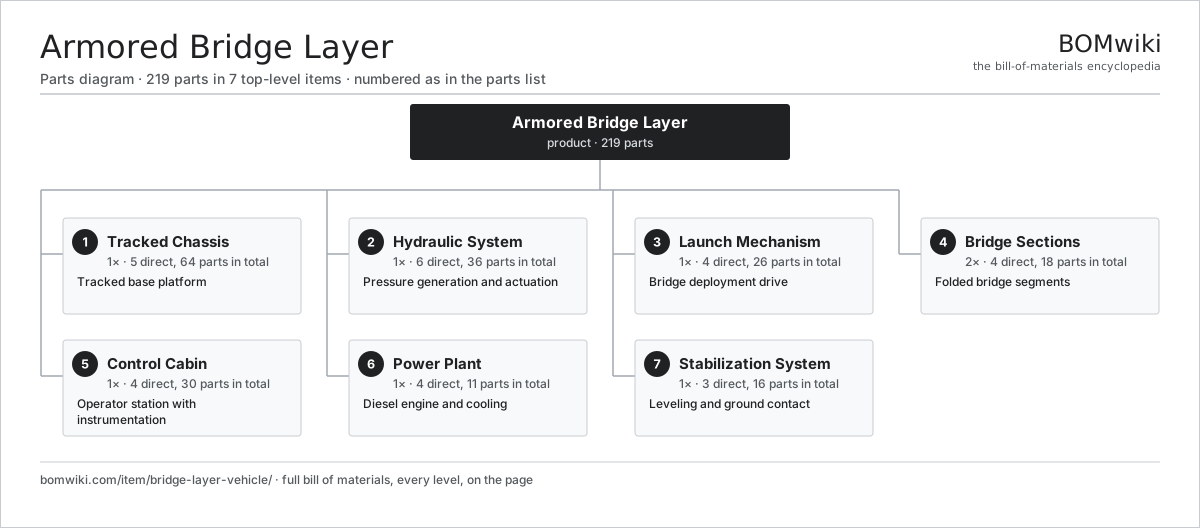
| # | Part | Qty | What it does |
|---|---|---|---|
| 1 | Tracked Chassis 5 parts | 1× | Tracked base platform |
| 2 | Hydraulic System 6 parts | 1× | Pressure generation and actuation |
| 3 | Launch Mechanism 4 parts | 1× | Bridge deployment drive |
| 4 | Bridge Sections 4 parts | 2× | Folded bridge segments |
| 5 | Control Cabin 4 parts | 1× | Operator station with instrumentation |
| 6 | Power Plant 4 parts | 1× | Diesel engine and cooling |
| 7 | Stabilization System 3 parts | 1× | Leveling and ground contact |
3D model
No 3D model yet. Have a CAD file of this? Add a 3D model. STL renders right on this page; STEP, FreeCAD, and OpenSCAD sources are welcome too (openly licensed, like all 3D models on BOMwiki).
Build & assembly graph
expand / collapse · shared sub-assemblies converge · links to related products · est. labourTap an assembly to expand/collapse · tap a part to open it · use “Open page” for any node · drag to pan, scroll to zoom.
Bill of materials for Armored Bridge Layer
7 top-level lines · 42 rows shown · 219 parts total · indented to 3 levels| # | Item / sub-assembly | Part no. | Qty/assy | Ext. qty | Parts | Type |
|---|---|---|---|---|---|---|
| 1 | Tracked Chassis 5 parts | bridge-layer-vehicle-chassis | 1× | 1 | 64 | assembly |
| 1.1 | Wheel Assembly 5 parts | wheel-assembly | 4× | 4 | 9 | assembly |
| 1.1.1 | Alloy Wheel | alloy-wheel | 1× | 4 | · | part |
| 1.1.2 | Tire | tire | 1× | 4 | · | part |
| 1.1.3 | TPMS Sensor | tpms-sensor | 1× | 4 | · | part |
| 1.1.4 | Lug Nut | lug-nut | 5× | 20 | · | part |
| 1.1.5 | Valve Stem | valve-stem | 1× | 4 | · | part |
| 1.2 | Drive Belt | drive-belt | 2× | 2 | · | part |
| 1.3 | Sheet Metal Panel | sheet-panel | 6× | 6 | · | part |
| 1.4 | Fastener Set | fastener-set | 12× | 12 | · | part |
| 1.5 | Ball Bearing | ball-bearing | 8× | 8 | · | part |
| 2 | Hydraulic System 6 parts | bridge-layer-vehicle-hydraulic-system | 1× | 1 | 36 | assembly |
| 2.1 | Main Pump | bridge-layer-vehicle-main-pump | 1× | 1 | · | part |
| 2.2 | Pressure Sensor | pressure-sensor | 4× | 4 | · | part |
| 2.3 | Control Manifold | bridge-layer-vehicle-control-manifold | 1× | 1 | · | part |
| 2.4 | Fastener Set | fastener-set | 8× | 8 | · | part |
| 2.5 | O-Ring Set | oring-set | 20× | 20 | · | part |
| 2.6 | Wire Bundle | wire-bundle | 2× | 2 | · | part |
| 3 | Launch Mechanism 4 parts | bridge-layer-vehicle-launch-mechanism | 1× | 1 | 26 | assembly |
| 3.1 | Cylinder Pair | bridge-layer-vehicle-cylinder-pair | 2× | 2 | · | part |
| 3.2 | Linkage Arm | bridge-layer-vehicle-linkage-arm | 4× | 4 | · | part |
| 3.3 | Fastener Set | fastener-set | 16× | 16 | · | part |
| 3.4 | Ball Bearing | ball-bearing | 4× | 4 | · | part |
| 4 | Bridge Sections 4 parts | bridge-layer-vehicle-bridge-sections | 2× | 2 | 18 | assembly |
| 4.1 | Truss Frame | bridge-layer-vehicle-truss-frame | 2× | 4 | · | part |
| 4.2 | Deck Plate | bridge-layer-vehicle-deck-plate | 2× | 4 | · | part |
| 4.3 | Hinge Assembly | bridge-layer-vehicle-hinge-assembly | 2× | 4 | · | part |
| 4.4 | Fastener Set | fastener-set | 12× | 24 | · | part |
| 5 | Control Cabin 4 parts | bridge-layer-vehicle-control-cabin | 1× | 1 | 30 | assembly |
| 5.1 | Sheet Metal Panel | sheet-panel | 8× | 8 | · | part |
| 5.2 | Control Panel | bridge-layer-vehicle-control-panel | 1× | 1 | · | part |
| 5.3 | LCD Panel | lcd-panel | 1× | 1 | · | part |
| 5.4 | Fastener Set | fastener-set | 20× | 20 | · | part |
| 6 | Power Plant 4 parts | bridge-layer-vehicle-power-plant | 1× | 1 | 11 | assembly |
| 6.1 | Diesel Engine | bridge-layer-vehicle-diesel-engine | 1× | 1 | · | part |
| 6.2 | Radiator | radiator | 1× | 1 | · | part |
| 6.3 | Fuel Tank | bridge-layer-vehicle-fuel-tank | 1× | 1 | · | part |
| 6.4 | Fastener Set | fastener-set | 8× | 8 | · | part |
| 7 | Stabilization System 3 parts | bridge-layer-vehicle-stabilization-system | 1× | 1 | 16 | assembly |
| 7.1 | Outrigger Leg | bridge-layer-vehicle-outrigger-leg | 4× | 4 | · | part |
| 7.2 | Ground Pad | bridge-layer-vehicle-ground-pad | 4× | 4 | · | part |
| 7.3 | Fastener Set | fastener-set | 8× | 8 | · | part |
Something wrong in this list? Report a problem with this BOM.
Related products
same domain, ranked by shared parts Military Water Purification Unit
203 parts · shares 10 with this page
Military Water Purification Unit
203 parts · shares 10 with this page
 Armored Personnel Carrier
221 parts · shares 8 with this page
Armored Personnel Carrier
221 parts · shares 8 with this page
 Field Kitchen Trailer
221 parts · shares 7 with this page
Field Kitchen Trailer
221 parts · shares 7 with this page
 Minesweeper
1,296 parts · shares 5 with this page
Minesweeper
1,296 parts · shares 5 with this page
 X-Ray Baggage Scanner
167 parts · shares 3 with this page
X-Ray Baggage Scanner
167 parts · shares 3 with this page
 Military Light Utility Vehicle
287 parts · shares 3 with this page
Military Light Utility Vehicle
287 parts · shares 3 with this page
Sourcing: possible vendors
Browse the supplier directory → Prices, MOQ, and lead times are algorithmic estimates, not quotes, and not claims about these companies. Company mappings are curated by keyword; est. price band $200–$100M. How estimates work| Vendor | HQ | Specialty | MOQ | Lead time |
|---|---|---|---|---|
| smithsdetection.com ↗ | London, GB | Security screening | made to order | 24–52 wks |
|
🇺🇸Leidos
leidos.com ↗
|
Reston, US | Security & screening | made to order | 24–52 wks |
|
🇺🇸Rapiscan
rapiscansystems.com ↗
|
Torrance, US | X-ray screening | made to order | 24–52 wks |
|
🇫🇷Thales
thalesgroup.com ↗
|
Paris, FR | Defense electronics | made to order | 24–52 wks |
| baesystems.com ↗ | London, GB | Defense | made to order | 24–52 wks |
1,164-word article