Stacker-Reclaimer
ProductOverview
A bucket-wheel stacker-reclaimer (BSR) is a large, bridge-mounted machine that excavates material from one location (reclaiming phase) and redeposits it in another location (stacking phase). The machine features a rotating bucket-wheel mounted on an articulated boom that can slew 360 degrees and reach heights up to 40 meters. Widely used in aggregate stockpile management and bulk material handling, BSRs move 100–500 tonnes per hour with minimal operator effort and no labor-intensive manual handling.
Operational Concept
The bucket-wheel excavation process works in continuous cycles:
- Positioning: Operator rotates boom to position bucket-wheel at desired location in stockpile
- Digging: As wheel rotates, buckets scoop material from stockpile face
- Lifting: Material-filled buckets are carried upward by wheel rotation
- Discharging: At the wheel apex (top), buckets tip and discharge material into a discharge chute
- Conveying: Material flows down chute into a belt conveyor or directly to stockpile
- Repeating: Empty buckets continue down the wheel's back side, returning to the digging face
This cycle repeats continuously, with 100–500 tonnes moving per hour depending on:
- Bucket size: 0.5–2 m³ (larger buckets = higher capacity)
- Wheel speed: 8–20 rpm (faster speed = higher capacity)
- Material bulk density: Ore (3000 kg/m³) yields double the tonnage of aggregate (1600 kg/m³)
- Excavation resistance: Loose material digs faster than compacted or cemented stockpiles
Major Components
Bucket-Wheel Assembly
The bucket-wheel is the excavation heart. A rotating steel wheel 3–5 meters in diameter carries 12–20 steel buckets (0.5–2 m³ capacity) around its perimeter. Buckets are fixed to the wheel with cutting blades on the leading edge, similar to a dredge bucket but harder-wearing.
As the wheel rotates at 8–20 rpm (controlled by a electric motor with gearbox), buckets sequentially dig into the stockpile face, lift material upward, reach the wheel's apex, and discharge into the chute. The large bearings at the wheel axle support the combined weight of wheel + buckets + excavated material (total force: 300–500 tonnes).
Boom Assembly
The articulated boom extends from the bridge structure to position the bucket-wheel. The boom typically comprises two or three articulated sections:
- Base section: Mounted to a slew bearing permitting 360° rotation
- Mid section: Articulated via a hydraulic cylinder controlling boom angle
- Tip section: Carries the bucket-wheel
A slew motor drives the boom to any azimuth (compass direction). A hoist motor (hydraulic or electric winch) raises and lowers the boom to vary dig height from 0–40 meters above ground.
The operator controls slew, hoist, and wheel speed independently via proportional joysticks in the operator cabin. Modern machines employ joystick mapping allowing single-stick operation:
- Push forward: Lowers boom to dig
- Pull back: Raises boom to discharge
- Turn joystick left/right: Slews boom to dig location
- Rotate joystick: Varies bucket-wheel speed
Bridge and Travel System
The bridge structure spans the width of the stockpile (40–80 meters), usually a cantilever design using a main I-beam or welded box section. This allows the bucket-wheel to reach the full width without central support columns obstructing material flow.
The bridge itself travels laterally along rails using powered wheels (usually 4 wheels, 2 per side). A travel motor drives wheels at 0.5–2 m/minute, allowing the entire machine to traverse the full length of a stockpile (often 100–500 meters or longer). This lateral capability lets a single BSR manage an entire ore or aggregate storage field without relocating.
Power Delivery and Controls
Power distribution is centralized at a fixed substation mounted on the bridge. High-voltage cables (typically 400V three-phase) run to soft-start motor starters for each major function:
- Bucket-wheel motor: 30–75 kW for digging
- Slew motor: 30–75 kW for boom rotation
- Hoist motor: 15–30 kW for boom height control
- Travel motor: 15–30 kW for lateral movement
A PLC (programmable logic controller) manages all sequences. For example, an automated "dig and stack" routine might:
- Move to dig location (travel motor)
- Lower boom to stockpile face (hoist motor)
- Rotate bucket-wheel at digging speed (bucket motor)
- After X seconds, raise boom (hoist motor)
- Rotate boom to discharge location (slew motor)
- Increase wheel speed to empty buckets quickly
- Return to dig location and repeat
Operational Modes
Reclaim Mode
Material is excavated from stockpile and discharged via chute onto a belt conveyor or apron feeder for transport to processing. The operator positions the bucket-wheel against the stockpile face, digs continuously, and discharges to the conveyor. High production rates (200–500 t/h) are achieved by:
- Using large bucket-wheels (1.5–2 m³ buckets)
- Increasing wheel speed to 15–20 rpm
- Stacking the boom close to the face for minimal spillage
Stacking Mode
Material from a source (hopper, conveyor, or feed system) arrives at the BSR's discharge chute. The machine simply raises its boom to the desired stockpile location and lets material flow from the chute into an ever-growing pile. Pile height and angle are controlled by:
- Boom height (controls pile elevation)
- Boom slew angle (controls lateral pile edge)
- Wheel speed (controlled discharge rate when material arrives in bursts)
Stacking mode is passive, the wheel may rotate slowly (5–10 rpm) just to move arriving material through the chute, not to excavate.
Maintenance and Service
Bucket Wear
Buckets are subject to impact and abrasion as they dig. Bucket blades typically last 500–2000 hours before replacement, depending on material hardness. Blade wear is inspected quarterly by visual inspection (look for >5 mm wear depth). Replacement takes 2–4 hours per bucket.
Bearing and Seal Maintenance
The large bearings supporting the bucket-wheel experience massive loads (500+ tonnes weight + dynamic swinging forces). Bearing relubrication schedules are every 250–500 operating hours using high-temperature grease. Seal inspection is monthly; worn seals are replaced immediately to prevent water or dust ingress.
Structural Inspection
Welds in the boom and bridge are subject to cyclic fatigue as the machine operates. Annual ultrasonic or visual inspection of high-stress welds is standard. Cracks exceeding 10 mm are typically repaired immediately via re-welding and stress relief.
Electrical and Control System
Soft-start drives on motors protect against inrush current but wear over years of use. Replacement every 5–10 years is typical. The PLC typically operates 15+ years without failure if protected from dust and moisture.
Environmental Considerations
Modern BSRs incorporate dust suppression:
- Water spray systems on the boom and bucket-wheel reducing dust generation during digging
- Enclosed chutes with rubber baffles minimizing spillage
- Noise enclosures reducing impact and motor noise from 90 dB (unenclosed) to 80 dB (enclosed)
In sensitive areas, misting systems can reduce dust by 30–50% compared to dry operation.
Economics
Capital cost: $5–20 million (depending on size and automation) Operating cost: $0.05–0.20 per tonne handled (electricity, maintenance, labor) Service life: 15–30 years (typical mine or quarry lifetime)
Payback period is 2–5 years for high-tonnage operations (>1 million tonnes per year). Advantages over shovel+truck systems:
- Continuous operation (no truck travel time)
- No labor cost for truck operators
- Reduced dust (truck traffic generates dust)
- Predictable, high throughput
Disadvantages:
- High capital cost
- Fixed location (can't follow ore grade changes)
- Requires sophisticated maintenance (electrical, hydraulic, mechanical)
- Long lead time for manufacturing and installation
In modern large-scale operations, multiple BSRs are installed in parallel, each handling a different ore type or stockpile zone, allowing flexible management of inventory and product grades.
Stacker-Reclaimer parts and their functions
9 top-level parts · 75 parts in total · full bill of materials below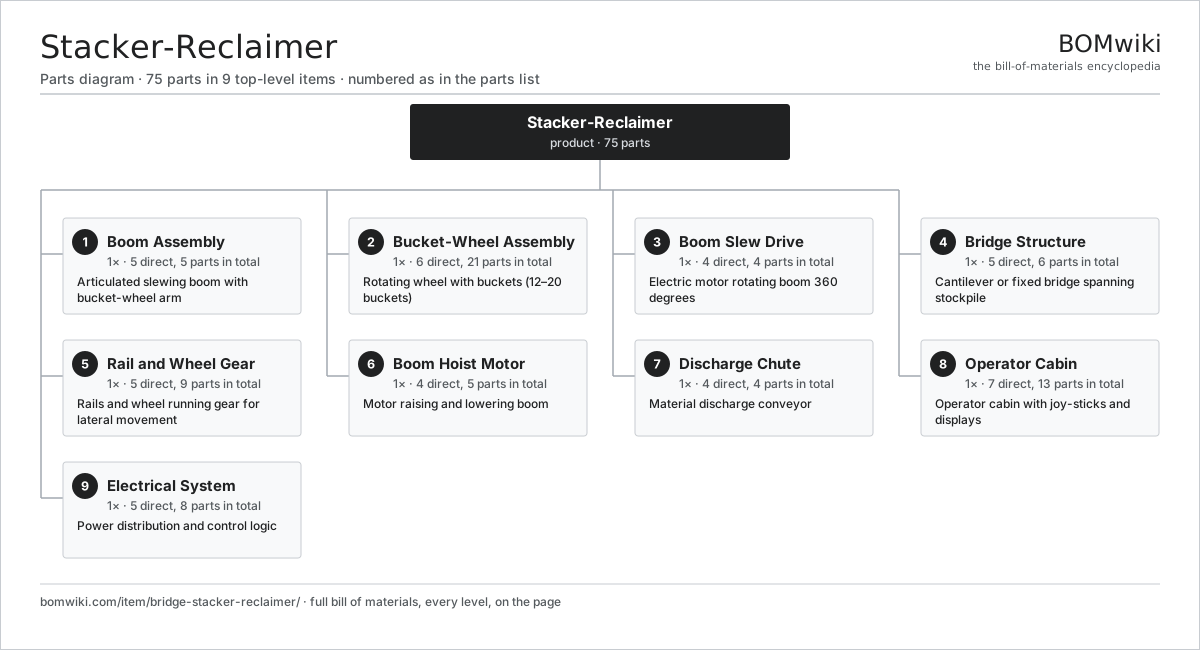
| # | Part | Qty | What it does |
|---|---|---|---|
| 1 | Boom Assembly 5 parts | 1× | Articulated slewing boom with bucket-wheel arm |
| 2 | Bucket-Wheel Assembly 6 parts | 1× | Rotating wheel with buckets (12–20 buckets) |
| 3 | Boom Slew Drive 4 parts | 1× | Electric motor rotating boom 360 degrees |
| 4 | Bridge Structure 5 parts | 1× | Cantilever or fixed bridge spanning stockpile |
| 5 | Rail and Wheel Gear 5 parts | 1× | Rails and wheel running gear for lateral movement |
| 6 | Boom Hoist Motor 4 parts | 1× | Motor raising and lowering boom |
| 7 | Discharge Chute 4 parts | 1× | Material discharge conveyor |
| 8 | Operator Cabin 7 parts | 1× | Operator cabin with joy-sticks and displays |
| 9 | Electrical System 5 parts | 1× | Power distribution and control logic |
3D model
No 3D model yet. Have a CAD file of this? Add a 3D model. STL renders right on this page; STEP, FreeCAD, and OpenSCAD sources are welcome too (openly licensed, like all 3D models on BOMwiki).
Build & assembly graph
expand / collapse · shared sub-assemblies converge · links to related products · est. labourTap an assembly to expand/collapse · tap a part to open it · use “Open page” for any node · drag to pan, scroll to zoom.
Bill of materials for Stacker-Reclaimer
9 top-level lines · 54 rows shown · 75 parts total · indented to 3 levels| # | Item / sub-assembly | Part no. | Qty/assy | Ext. qty | Parts | Type |
|---|---|---|---|---|---|---|
| 1 | Boom Assembly 5 parts | bridge-stacker-reclaimer-boom | 1× | 1 | 5 | assembly |
| 1.1 | Boom Base Section | bridge-stacker-reclaimer-boom-base | 1× | 1 | · | part |
| 1.2 | Boom Mid Section | bridge-stacker-reclaimer-boom-mid | 1× | 1 | · | part |
| 1.3 | Slew Bearing | bridge-stacker-reclaimer-slew-bearing | 1× | 1 | · | part |
| 1.4 | Articulation Cylinder | bridge-stacker-reclaimer-articulation-cylinder | 1× | 1 | · | part |
| 1.5 | Boom Pin | bridge-stacker-reclaimer-boom-pin | 1× | 1 | · | part |
| 2 | Bucket-Wheel Assembly 6 parts | bridge-stacker-reclaimer-bucket-wheel | 1× | 1 | 21 | assembly |
| 2.1 | Wheel Shell | bridge-stacker-reclaimer-wheel-shell | 1× | 1 | · | part |
| 2.2 | Bucket | bridge-stacker-reclaimer-bucket | 15× | 15 | · | part |
| 2.3 | Bucket Blade | bridge-stacker-reclaimer-bucket-blade | 1× | 1 | · | part |
| 2.4 | Wheel Motor | bridge-stacker-reclaimer-wheel-motor | 1× | 1 | · | part |
| 2.5 | Wheel Bearing | bridge-stacker-reclaimer-wheel-bearing | 2× | 2 | · | part |
| 2.6 | Wheel Gear | bridge-stacker-reclaimer-wheel-gear | 1× | 1 | · | part |
| 3 | Boom Slew Drive 4 parts | bridge-stacker-reclaimer-boom-drive | 1× | 1 | 4 | assembly |
| 3.1 | Slew Motor | bridge-stacker-reclaimer-slew-motor | 1× | 1 | · | part |
| 3.2 | Slew Gearbox | bridge-stacker-reclaimer-slew-gearbox | 1× | 1 | · | part |
| 3.3 | Slew Coupling | bridge-stacker-reclaimer-slew-coupling | 1× | 1 | · | part |
| 3.4 | Motor Brake | bridge-stacker-reclaimer-motor-brake | 1× | 1 | · | part |
| 4 | Bridge Structure 5 parts | bridge-stacker-reclaimer-bridge | 1× | 1 | 6 | assembly |
| 4.1 | Bridge Beam | bridge-stacker-reclaimer-bridge-beam | 1× | 1 | · | part |
| 4.2 | Bridge Column | bridge-stacker-reclaimer-bridge-column | 2× | 2 | · | part |
| 4.3 | Bridge Diagonal | bridge-stacker-reclaimer-bridge-diagonal | 1× | 1 | · | part |
| 4.4 | Bridge Cable | bridge-stacker-reclaimer-bridge-cable | 1× | 1 | · | part |
| 4.5 | Bridge Platform | bridge-stacker-reclaimer-bridge-platform | 1× | 1 | · | part |
| 5 | Rail and Wheel Gear 5 parts | bridge-stacker-reclaimer-rail-system | 1× | 1 | 9 | assembly |
| 5.1 | Rail | bridge-stacker-reclaimer-rail | 1× | 1 | · | part |
| 5.2 | Travel Wheel | bridge-stacker-reclaimer-wheel | 4× | 4 | · | part |
| 5.3 | Wheel Motor | bridge-stacker-reclaimer-wheel-motor | 1× | 1 | · | part |
| 5.4 | Travel Brake | bridge-stacker-reclaimer-travel-brake | 1× | 1 | · | part |
| 5.5 | End Bumper | bridge-stacker-reclaimer-bumper | 2× | 2 | · | part |
| 6 | Boom Hoist Motor 4 parts | bridge-stacker-reclaimer-hoist | 1× | 1 | 5 | assembly |
| 6.1 | Hoist Motor | bridge-stacker-reclaimer-hoist-motor | 1× | 1 | · | part |
| 6.2 | Hoist Cable | bridge-stacker-reclaimer-hoist-cable | 1× | 1 | · | part |
| 6.3 | Hoist Pulley | bridge-stacker-reclaimer-hoist-pulley | 2× | 2 | · | part |
| 6.4 | Hoist Brake | bridge-stacker-reclaimer-hoist-brake | 1× | 1 | · | part |
| 7 | Discharge Chute 4 parts | bridge-stacker-reclaimer-discharge-chute | 1× | 1 | 4 | assembly |
| 7.1 | Chute Panel | bridge-stacker-reclaimer-chute-panel | 1× | 1 | · | part |
| 7.2 | Chute Liner | bridge-stacker-reclaimer-chute-liner | 1× | 1 | · | part |
| 7.3 | Chute Vibrator | bridge-stacker-reclaimer-chute-vibrator | 1× | 1 | · | part |
| 7.4 | Discharge Conveyor | bridge-stacker-reclaimer-conveyor-belt | 1× | 1 | · | part |
| 8 | Operator Cabin 7 parts | bridge-stacker-reclaimer-control | 1× | 1 | 13 | assembly |
| 8.1 | Cabin Frame | bridge-stacker-reclaimer-cabin-frame | 1× | 1 | · | part |
| 8.2 | Cabin Window | bridge-stacker-reclaimer-cabin-window | 4× | 4 | · | part |
| 8.3 | Cabin Door | bridge-stacker-reclaimer-cabin-door | 1× | 1 | · | part |
| 8.4 | Joystick | bridge-stacker-reclaimer-joystick-set | 3× | 3 | · | part |
| 8.5 | Display Unit | bridge-stacker-reclaimer-display | 1× | 1 | · | part |
| 8.6 | Camera | bridge-stacker-reclaimer-camera | 2× | 2 | · | part |
| 8.7 | Audible Alarm | bridge-stacker-reclaimer-horn | 1× | 1 | · | part |
| 9 | Electrical System 5 parts | bridge-stacker-reclaimer-electrical | 1× | 1 | 8 | assembly |
| 9.1 | Substation | bridge-stacker-reclaimer-substation | 1× | 1 | · | part |
| 9.2 | Motor Starter | bridge-stacker-reclaimer-motor-starter | 4× | 4 | · | part |
| 9.3 | PLC | bridge-stacker-reclaimer-plc | 1× | 1 | · | part |
| 9.4 | Emergency Stop | bridge-stacker-reclaimer-emergency-stop | 1× | 1 | · | part |
| 9.5 | Cable Reel | bridge-stacker-reclaimer-cable-reel | 1× | 1 | · | part |
Something wrong in this list? Report a problem with this BOM.
Sourcing: possible vendors
Browse the supplier directory → Prices, MOQ, and lead times are algorithmic estimates, not quotes, and not claims about these companies. Company mappings are curated by keyword; est. price band $200k–$5M. How estimates work| Vendor | HQ | Specialty | MOQ | Lead time |
|---|---|---|---|---|
| caterpillar.com ↗ | Irving, US | Construction & mining equipment | made to order | 20–36 wks |
|
🇯🇵Komatsu
komatsu.com ↗
|
Tokyo, JP | Construction & mining equipment | made to order | 20–36 wks |
|
🇸🇪Sandvik
rocktechnology.sandvik ↗
|
Stockholm, SE | Mining & rock technology | made to order | 20–36 wks |
|
🇸🇪Epiroc
epiroc.com ↗
|
Stockholm, SE | Mining & drilling equipment | made to order | 20–36 wks |
|
🇫🇮Metso
metso.com ↗
|
Helsinki, FI | Crushing & minerals processing | made to order | 20–36 wks |
1,378-word article