Brite Tank
ProductOverview
A brite tank (or "bright beer tank") is a jacketed pressure vessel used in breweries as the final holding and serving tank for finished beer. Unlike a fermentation vessel, which must tolerate vigorous yeast activity and CO2 generation, a brite tank is designed for passive carbonation injection, settling, and cold storage. The tank consists of a stainless-steel cylindrical Pressure Vessel enclosed in a Jacket Temperature Control for temperature control, a Carbonation Stone Assembly for CO2 diffusion, multiple Valve Assembly for sampling and drainage, and support Support Structure. Instrumentation monitors temperature, pressure, and liquid level.
How it works
After fermentation is complete in an upstream fermentation tank, the finished beer is racked (transferred) into the brite tank via the Product Inlet at the top, using gravity or a low-pressure transfer pump. The Inlet Check Valve prevents backflow into the fermentation tank. As beer flows in, the Automatic Gas Vent automatically opens to vent displaced air and prevent vacuum formation.
Once filled, the beer settles for 6–24 hours. During this rest, any remaining yeast cells and suspended particles gradually fall to the Bottom Head and collect in the drain sump, while the beer above clarifies. The Jacket Temperature Control circulates chilled glycol or water (typically 35–50°F) through the double-wall jacket, maintaining product temperature and preventing unwanted fermentation or microbial growth.
Carbonation is then introduced via the Carbonation Stone Assembly, a sintered stainless cartridge mounted low in the tank. A controlled gas line from a CO2 cylinder, regulated to 10–15 psi, is fed through the Stone Control Valve into the Stone Check Valve, and then to the stone. As CO2 gas bubbles up through the stone's fine pores, it diffuses into the beer. The dissolved CO2 gradually accumulates until the target carbonation level (e.g., 2.5 volumes) is reached, monitored by sampling via the Sample Valve.
Throughout the process, the Pressure Gauge displays internal pressure. If CO2 pressure builds excessively (e.g., due to overcarbonation or a faulty regulator), the Relief Valve automatically vents excess gas, protecting the tank from overpressure. The Temperature Gauge confirms that the jacket is maintaining temperature, and the Sight Glass shows product level.
Once carbonated and chilled, the beer is ready to serve. A tap line connects to the Main Isolation Valve at the bottom, and a pressure-balancing CO2 line connects to the top to maintain serving pressure as product is withdrawn. The serving pressure is typically 10–15 psi, slightly above the carbonation pressure, to support dispensing through draft lines and faucets.
At the end of the tank's service life (when empty or when switching products), the Drain Valve is opened and remaining yeast and sediment collected at the bottom are purged. The tank is then flushed with hot water (CIP protocol) and refilled for the next cycle.
Key design features
- Double-wall jacket: Provides uniform temperature control without requiring immersion in a cold bath.
- Pressure-rated vessel: ASME-certified to 3 bar allows safe CO2 injection and serving pressure.
- Diffusion stone: Fine pores ensure rapid, uniform carbonation and prevent large bubbles that would agitate settled yeast.
- Sample valve: Easy access for testing carbonation level and clarity without opening the top.
- Automatic vent valve: Prevents vacuum on empty-down, protecting the vessel and preventing coring (siphon) effects.
- Relief valve: Protects against overpressure from excess CO2.
- Conical bottom: Promotes settling and allows complete drainage of sediment.
Comparison with fermentation tanks
While fermentation tanks must tolerate active gas generation and vigorous yeast metabolism, brite tanks are simpler: they assume quiescent conditions and serve primarily as a holding and dispensing vessel. This allows brite tanks to be taller and narrower (to reduce surface area and minimize oxygen pickup) and to have lower headspace requirements.
Brite Tank parts and their functions
6 top-level parts · 40 parts in total · full bill of materials below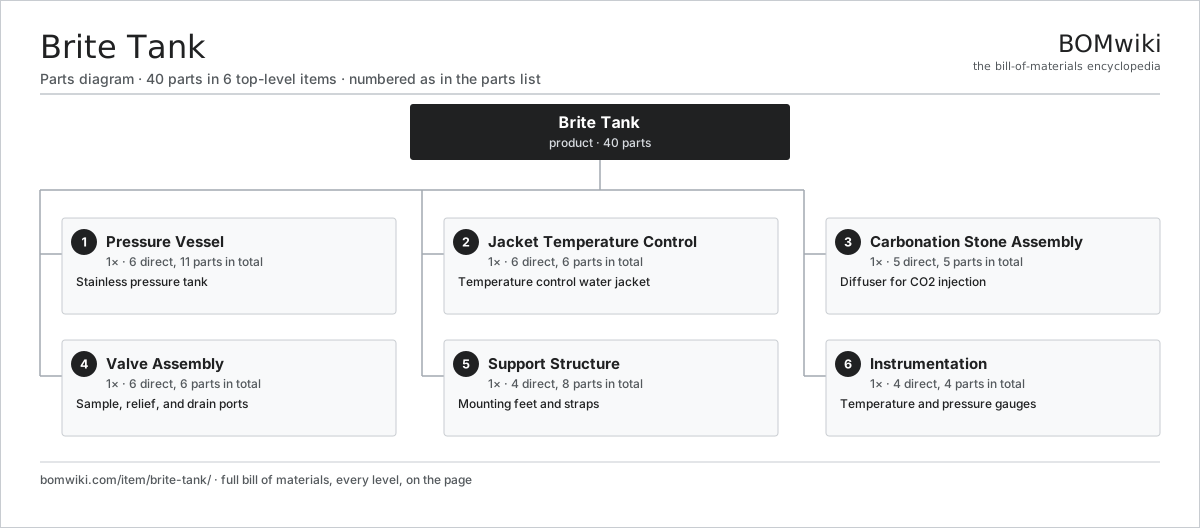
| # | Part | Qty | What it does |
|---|---|---|---|
| 1 | Pressure Vessel 6 parts | 1× | Stainless pressure tank |
| 2 | Jacket Temperature Control 6 parts | 1× | Temperature control water jacket |
| 3 | Carbonation Stone Assembly 5 parts | 1× | Diffuser for CO2 injection |
| 4 | Valve Assembly 6 parts | 1× | Sample, relief, and drain ports |
| 5 | Support Structure 4 parts | 1× | Mounting feet and straps |
| 6 | Instrumentation 4 parts | 1× | Temperature and pressure gauges |
3D model
No 3D model yet. Have a CAD file of this? Add a 3D model. STL renders right on this page; STEP, FreeCAD, and OpenSCAD sources are welcome too (openly licensed, like all 3D models on BOMwiki).
Build & assembly graph
expand / collapse · shared sub-assemblies converge · links to related products · est. labourTap an assembly to expand/collapse · tap a part to open it · use “Open page” for any node · drag to pan, scroll to zoom.
Bill of materials for Brite Tank
6 top-level lines · 37 rows shown · 40 parts total · indented to 3 levels| # | Item / sub-assembly | Part no. | Qty/assy | Ext. qty | Parts | Type |
|---|---|---|---|---|---|---|
| 1 | Pressure Vessel 6 parts | brite-tank-vessel | 1× | 1 | 11 | assembly |
| 1.1 | Side Wall | brite-tank-side-wall | 1× | 1 | · | part |
| 1.2 | Top Head | brite-tank-top-head | 1× | 1 | · | part |
| 1.3 | Bottom Head | brite-tank-bottom-head | 1× | 1 | · | part |
| 1.4 | Weld Seam | brite-tank-weld-seam | 1× | 1 | · | part |
| 1.5 | Nozzle Port | brite-tank-nozzle-ports | 6× | 6 | · | part |
| 1.6 | Tank Volume | brite-tank-volume | 1× | 1 | · | part |
| 2 | Jacket Temperature Control 6 parts | brite-tank-jacket-system | 1× | 1 | 6 | assembly |
| 2.1 | Jacket Outer Wall | brite-tank-jacket-outer-wall | 1× | 1 | · | part |
| 2.2 | Jacket Inlet | brite-tank-jacket-inlet-port | 1× | 1 | · | part |
| 2.3 | Jacket Outlet | brite-tank-jacket-outlet-port | 1× | 1 | · | part |
| 2.4 | Jacket Return Line | brite-tank-jacket-return-line | 1× | 1 | · | part |
| 2.5 | Jacket Thermometer Pocket | brite-tank-jacket-thermometer-pocket | 1× | 1 | · | part |
| 2.6 | Jacket Drain Valve | brite-tank-jacket-drain-valve | 1× | 1 | · | part |
| 3 | Carbonation Stone Assembly 5 parts | brite-tank-carbonation-stone | 1× | 1 | 5 | assembly |
| 3.1 | Diffuser Stone | brite-tank-stone-head | 1× | 1 | · | part |
| 3.2 | Stone Housing | brite-tank-stone-housing | 1× | 1 | · | part |
| 3.3 | CO2 Inlet Tube | brite-tank-stone-co2-inlet-tube | 1× | 1 | · | part |
| 3.4 | Stone Control Valve | brite-tank-stone-valve | 1× | 1 | · | part |
| 3.5 | Stone Check Valve | brite-tank-stone-check-valve | 1× | 1 | · | part |
| 4 | Valve Assembly 6 parts | brite-tank-valves | 1× | 1 | 6 | assembly |
| 4.1 | Relief Valve | brite-tank-valve-relief | 1× | 1 | · | part |
| 4.2 | Sample Valve | brite-tank-valve-sample | 1× | 1 | · | part |
| 4.3 | Drain Valve | brite-tank-valve-drain | 1× | 1 | · | part |
| 4.4 | Main Isolation Valve | brite-tank-valve-isolation-main | 1× | 1 | · | part |
| 4.5 | Product Inlet | brite-tank-valve-product-inlet | 1× | 1 | · | part |
| 4.6 | Automatic Gas Vent | brite-tank-valve-gas-vent | 1× | 1 | · | part |
| 5 | Support Structure 4 parts | brite-tank-legs-supports | 1× | 1 | 8 | assembly |
| 5.1 | Tank Leg | brite-tank-legs | 4× | 4 | · | part |
| 5.2 | Leg Brace | brite-tank-leg-braces | 2× | 2 | · | part |
| 5.3 | Safety Strap | brite-tank-safety-strap | 1× | 1 | · | part |
| 5.4 | Drain Sump | brite-tank-drain-sump | 1× | 1 | · | part |
| 6 | Instrumentation 4 parts | brite-tank-instrumentation | 1× | 1 | 4 | assembly |
| 6.1 | Pressure Gauge | brite-tank-pressure-gauge | 1× | 1 | · | part |
| 6.2 | Temperature Gauge | brite-tank-temperature-dial | 1× | 1 | · | part |
| 6.3 | Sight Glass | brite-tank-sight-glass | 1× | 1 | · | part |
| 6.4 | Inlet Check Valve | brite-tank-check-valve-inlet | 1× | 1 | · | part |
Something wrong in this list? Report a problem with this BOM.
Sourcing: possible vendors
Browse the supplier directory → Prices, MOQ, and lead times are algorithmic estimates, not quotes, and not claims about these companies. Company mappings are curated by keyword; est. price band $1k–$500k. How estimates work| Vendor | HQ | Specialty | MOQ | Lead time |
|---|---|---|---|---|
| gea.com ↗ | Düsseldorf, DE | Process technology | 20 units | 12–20 wks |
| buhlergroup.com ↗ | Uzwil, CH | Food & materials processing | 20 units | 12–20 wks |
| tetrapak.com ↗ | Pully, CH | Food packaging & processing | 20 units | 12–20 wks |
| jbtc.com ↗ | Chicago, US | Food processing equipment | 20 units | 12–20 wks |
| alfalaval.com ↗ | Lund, SE | Heat transfer & separation | 20 units | 12–20 wks |
662-word article