Bumper Boats
ProductOverview
Bumper boats are small, individually powered watercraft designed for low-speed, non-drowning collision play in shallow pools. Riders manually steer and control throttle, maneuvering to bump other boats while avoiding the perimeter. The boats are equipped with elastomer bumper rings that absorb collision impacts safely. Power is provided by either electric batteries (recharged at a dock) or small gasoline engines. Bumper boats appeal primarily to children and teens but attract adults as well, combining skill-based boat handling with playful contact.
Unlike bumper cars (which operate on hard ground), bumper boats require water recirculation, buoyancy engineering, and propulsion systems suitable for wet environments. This makes them more complex mechanically but offers the aesthetic appeal and physical sensation of water-based play.
How It Works
Boat Propulsion and Control
Each bumper boat is powered independently, either by an electric motor or small gasoline engine. Electric boats are more common in indoor parks and waterpark chains due to quiet operation and low emissions. Riders operate a hand throttle or lever to control motor speed and adjust direction via a steering wheel or tiller linked to a rudder.
Electric models draw power from onboard batteries (typically lithium polymer or lead-acid). The motor is a brushless DC unit (1–3 kW) coupled to a jet-pump impeller. As the impeller spins, it draws water from an intake below the hull and ejects it through a nozzle at the stern, propelling the boat forward. Throttle response is immediate and intuitive. Typical boat speed is 8–15 km/h, fast enough for fun maneuvering but slow enough to be controllable by novice operators.
Gasoline-powered boats use small marine outboard engines (5–10 hp) or inline jet-pump engines, offering longer range and more power but requiring fuel refills and generating exhaust. These are more common in larger waterparks or outdoor attractions.
Bumper Ring Design
The collision-absorption system is the key safety feature. A bumper ring consists of a pneumatic (air-filled) or closed-cell foam tube surrounding the boat's perimeter at the waterline. The ring is 0.3–0.5 meters in diameter and typically 0.2–0.3 meters thick.
When two boats collide, the bumper rings compress, converting kinetic energy into elastic deformation rather than rigid impact. The foam or pneumatic design allows 30–50 % compression before bottoming out. Collision forces are thus limited to 5–10 kJ (equivalent to a 2–3 mph car bumper impact), well within safe limits for accidental contact between boats.
The bumper ring is bolted to the hull at 8–12 attachment points, allowing quick replacement if the ring becomes permanently compressed or torn.
Pool Infrastructure
The pool is a shallow concrete or fiberglass basin, typically 0.5–1.2 meters deep. Shallow depth prevents drowning risk (children can stand upright) while providing enough water to allow free boat movement without grounding.
Pool surface area ranges from 300–600 m², depending on desired boat count and maneuverability. Larger pools allow higher-speed chases; smaller pools create more frequent collisions and are better for younger children.
A centrifugal pump (5–10 kW) continuously circulates water through a sand or cartridge filter, removing algae, silt, and debris. Typical flow rate is 100–500 L/min. The pool is filled to a constant level maintained by a float valve; drain plugs allow complete emptying for cleaning and maintenance.
Electric Battery Charging
Electric boats use onboard battery packs (typically 24–48 V DC), which are recharged at a docking station after each session. The charging dock has 8–12 dedicated charger ports, each outputting 500–1000 W at 24–48 V DC.
Charging time is typically 15–30 minutes for a full cycle, allowing batteries to be swapped between boats. Modern lithium-polymer batteries offer energy density of 150–250 Wh/kg, allowing 1–2 hour runtime per charge. Lead-acid batteries are heavier and have lower energy density but are cheaper and more robust for beginner-heavy environments.
A battery management system (BMS) onboard each boat monitors cell voltage, temperature, and discharge rate, cutting off the motor if temperature or voltage goes out of spec. This prevents overheating and cell damage.
Operator Safety and Control
A PLC monitors:
- Operator presence: A dead-man switch (pressure pad or sensor) confirms that someone is actively operating the boat. If released for > 5 seconds, the boat motor automatically cuts off.
- Battery charge state: Onboard sensors report voltage; the PLC can disable boats below a threshold to prevent mid-pool power loss.
- Pool water level: A sensor in the sump confirms normal water level; if water is too shallow or high, the dispatch system prevents new boats from launching.
- Autonomous shutdown timer: Boats are programmed to shut down after 15–20 minutes of continuous operation, allowing operator to collect boats and clear the pool for maintenance or guest changeover.
Operators typically stand at the dock and monitor all boats via visual surveillance. Modern parks add video cameras and audio announcements for safety messaging.
Ride Experience and Rules
Riders enter the pool via a dock or ramp. A lifeguard or operator assists with seating and provides a safety briefing: stay in the boat, keep your hands inside, avoid aggressive ramming (gentle bumping only).
Once all riders are seated and the dead-man switches are confirmed active, the operator launches the session. Riders steer and accelerate freely for 15–20 minutes, bumping each other in a playful, non-competitive manner. Some parks add scoring systems (bumps count as points) or competitive rounds (last boat moving wins).
At the end of the session, riders exit, and boats are guided back to the dock for battery recharging (electric models) or refueling (gasoline models).
Mechanical Design Details
Hull Materials and Construction
Modern boat hulls are made from rotationally molded polyethylene (rotomolded plastic) or hand-laid fiberglass. Rotomolded hulls are lightweight (40–60 kg), durable, and reparable. Fiberglass hulls are heavier (70–100 kg) but offer smoother finishes and longer lifespan.
The hull is designed with:
- Closed-cell foam filling: Air-filled chambers provide buoyancy, so the boat floats even if the hull cracks or takes on water.
- Drain plug: Allows water to be emptied from interior compartments during maintenance.
- Mounting bosses: Integrated features where the thruster, seat frame, and bumper ring are bolted.
- Smooth surface: Rounded edges and soft exterior to minimize injury risk during collisions.
Typical hull draft is 0.3–0.5 meters when loaded with two passengers and equipment. This shallow draft minimizes propeller drag and allows operation in water as shallow as 0.6 meters.
Thruster and Jet-Pump Design
The thruster is typically a jet-pump assembly: a rotating impeller inside a cast-iron or aluminum pump housing. Water enters via an intake strainer below the hull, passes through the impeller, and is expelled through a discharge nozzle at the stern.
Jet pumps are preferred over open propellers in bumper-boat applications because:
- Safety: No exposed propeller to injure riders or spectators.
- Shallow water operation: No propeller blade extension below the hull, allowing operation in very shallow water.
- Directional control: Steering nozzle deflects the jet left or right for maneuvering.
The impeller rotates at 1500–5000 rpm (depending on motor and gearing). Typical thrust is 200–500 kg-force at full throttle, allowing rapid acceleration and responsive handling.
Battery and Motor System
Electric boats use onboard battery packs mounted low in the hull for stability. Lithium-polymer (LiPo) batteries are preferred for their high energy density and lightweight, but require careful management (balancing, thermal monitoring).
The motor is a brushless DC unit (BLDC), electronically commutated and reversible. It offers:
- Smooth, quiet operation (no brush noise or spark).
- High efficiency (80–90 % electrical-to-mechanical).
- Integrated temperature sensing and over-current protection.
A motor controller (essentially a variable-frequency drive for DC) accepts throttle input (0–5 V analog or pulse-width-modulated signal) and outputs proportional current to the motor. This allows smooth acceleration and fine-speed control.
Rudder and Steering Linkage
Simple mechanical steering uses a cable linkage connecting the steering wheel (or tiller) to the jet-pump nozzle or rudder. The relationship is typically 2:1 or 3:1 (steering wheel rotation of 90° produces 30–45° nozzle deflection), providing responsive but not overly sensitive steering.
Some modern boats use electric steering (solenoid-actuated nozzle) with servo control, but mechanical linkage is more robust for high-usage environments with novice operators.
Pool Water Quality and Maintenance
Filtration
A sand or cartridge-type filter removes particles (algae, silt, debris) down to 20–50 µm. Filtration helps prevent:
- Algae blooms in warm climates.
- Pump wear from abrasive particles.
- Cloudiness reducing visibility for operator monitoring.
Filter pressure is monitored; when pressure differential exceeds 0.3–0.5 bar, the filter media is backwashed (water flow reversed through the filter) to flush out trapped particles. Backwash occurs every 1–2 weeks depending on usage and environmental contamination.
Chemical Treatment
Chlorine (1–3 ppm) is dosed daily to disinfect the water and prevent bacterial growth. pH is maintained at 7.2–7.8 using acid or base adjustments. In warm climates, algaecide (5–10 ppm) may be added weekly.
Some parks use ozone or UV disinfection as alternatives to or in addition to chlorine, especially in covered indoor pools where chlorine odor is a concern.
Drain and Cleaning
The pool is typically drained and cleaned every 1–4 weeks depending on usage. The basin is scrubbed to remove algae buildup on walls, and then refilled. Drain water is discharged to sewer or treatment system according to local regulations.
Variants and Innovations
Remote-Controlled Boats
Some installations provide remote-control options for younger children who are too small to operate a full-sized boat. These are miniature boats (1–1.5 m length) controlled by an adult via a wireless joystick, allowing direct parent-child participation.
Bumper Boat Racing
Competitive variants include timed races or obstacle courses. Boats navigate around buoys or through gates, with scoring based on time or contact avoidance.
Heated Pools
Year-round indoor installations often include pool heaters (electric or gas) to maintain water temperature at 25–28°C, ensuring comfort in cold climates.
Soft-Sided Floats
Some parks combine bumper boats with inflatable floats (rafts, rings) for variety, expanding the attraction to non-drivers.
Standards and Safety
Bumper boats are governed by ASTM F24 (F2291, F2374) and international EN 13814. Key requirements:
- Collision testing: Bumpers must limit impact force to < 5 kJ at 5 mph closure speed.
- Stability: Boats must not capsize when one side is loaded with 1.5 × rated passenger weight (simulating a child standing on the edge).
- Electrical safety: All electrical systems are isolated from water contact via waterproof connectors and enclosures (IP67 or better).
- Water quality: Pool water must meet local health department standards (chlorine residual, pH, clarity).
- Emergency procedures: Operators must be trained in water rescue and CPR. Life rings and rescue poles are positioned at regular intervals.
Operational Economics
A typical bumper-boat pool with 8–10 boats costs $200,000–$600,000 to construct and equip (including pool, boats, dock, and electrical). Annual operating costs are $50,000–$150,000 (primarily labor, utilities, chemical treatment, and maintenance).
Revenue potential is $100,000–$400,000 per season, depending on park location and ticket pricing. Bumper boats attract families and generate high throughput (200–400 riders per hour).
Bumper boats are especially popular in:
- Waterpark chains (secondary attraction alongside wave pools and slides).
- Indoor waterparks in cold climates (year-round operation).
- Family amusement parks (low-thrill, high-engagement attraction).
- Holiday parks and resort destinations (part of a larger recreation package).
The appeal lies in the combination of water play, skill-based boat handling, and safe collision interaction, all at a lower operational complexity and cost than full-scale rides like coasters or log flumes.
Bumper Boats parts and their functions
6 top-level parts · 268 parts in total · full bill of materials below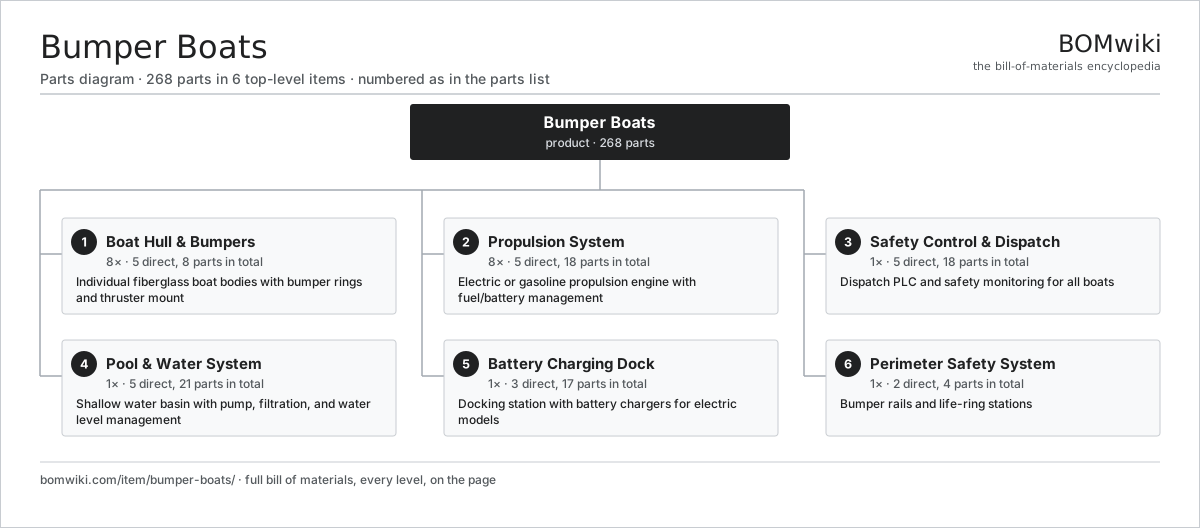
| # | Part | Qty | What it does |
|---|---|---|---|
| 1 | Boat Hull & Bumpers 5 parts | 8× | Individual fiberglass boat bodies with bumper rings and thruster mount |
| 2 | Propulsion System 5 parts | 8× | Electric or gasoline propulsion engine with fuel/battery management |
| 3 | Safety Control & Dispatch 5 parts | 1× | Dispatch PLC and safety monitoring for all boats |
| 4 | Pool & Water System 5 parts | 1× | Shallow water basin with pump, filtration, and water level management |
| 5 | Battery Charging Dock 3 parts | 1× | Docking station with battery chargers for electric models |
| 6 | Perimeter Safety System 2 parts | 1× | Bumper rails and life-ring stations |
3D model
No 3D model yet. Have a CAD file of this? Add a 3D model. STL renders right on this page; STEP, FreeCAD, and OpenSCAD sources are welcome too (openly licensed, like all 3D models on BOMwiki).
Build & assembly graph
expand / collapse · shared sub-assemblies converge · links to related products · est. labourTap an assembly to expand/collapse · tap a part to open it · use “Open page” for any node · drag to pan, scroll to zoom.
Bill of materials for Bumper Boats
6 top-level lines · 45 rows shown · 268 parts total · indented to 3 levels| # | Item / sub-assembly | Part no. | Qty/assy | Ext. qty | Parts | Type |
|---|---|---|---|---|---|---|
| 1 | Boat Hull & Bumpers 5 parts | bumper-boat-hull | 8× | 8 | 8 | assembly |
| 1.1 | Hull Shell | bumper-boat-hull-shell | 1× | 8 | · | part |
| 1.2 | Bumper Ring 2 parts | bumper-boat-bumper-ring | 1× | 8 | 2 | assembly |
| 1.2.1 | Fastener Set | fastener-set | 1× | 8 | · | part |
| 1.2.2 | Connector | connector | 1× | 8 | · | part |
| 1.3 | Seat Frame | bumper-boat-seat-frame | 1× | 8 | · | part |
| 1.4 | Fastener Set | fastener-set | 2× | 16 | · | part |
| 1.5 | Ball Bearing | ball-bearing | 2× | 16 | · | part |
| 2 | Propulsion System 5 parts | bumper-boat-thruster-system | 8× | 8 | 18 | assembly |
| 2.1 | Thruster Motor & Pump 3 parts | bumper-boat-thruster-unit | 1× | 8 | 4 | assembly |
| 2.1.1 | Blower Motor | blower-motor | 1× | 8 | · | part |
| 2.1.2 | O-Ring Set | oring-set | 2× | 16 | · | part |
| 2.1.3 | Fastener Set | fastener-set | 1× | 8 | · | part |
| 2.2 | LiPo Cell | lipo-cell | 4× | 32 | · | part |
| 2.3 | Li-ion Cell, 18650 | li-cell-18650 | 8× | 64 | · | part |
| 2.4 | Pressure Sensor | pressure-sensor | 1× | 8 | · | part |
| 2.5 | Connector | connector | 1× | 8 | · | part |
| 3 | Safety Control & Dispatch 5 parts | bumper-boat-control-system | 1× | 1 | 18 | assembly |
| 3.1 | Microcontroller | mcu | 1× | 1 | · | part |
| 3.2 | Relay | relay | 4× | 4 | · | part |
| 3.3 | Pressure Sensor | pressure-sensor | 2× | 2 | · | part |
| 3.4 | Hall Sensor | hall-sensor | 8× | 8 | · | part |
| 3.5 | Connector | connector | 3× | 3 | · | part |
| 4 | Pool & Water System 5 parts | bumper-boats-pool-infrastructure | 1× | 1 | 21 | assembly |
| 4.1 | Blower Motor | blower-motor | 1× | 1 | · | part |
| 4.2 | Pressure Sensor | pressure-sensor | 2× | 2 | · | part |
| 4.3 | Filter Cartridge | water-filter-cartridge | 1× | 1 | · | part |
| 4.4 | Pipe Fitting Assembly | pipe-fitting-assembly | 3× | 3 | · | part |
| 4.5 | Swing / Wafer Check Valve 9 parts | check-valve | 1× | 1 | 14 | product |
| 4.5.1 | Valve Body | check-valve-body | 1× | 1 | · | part |
| 4.5.2 | Swing Check Valve Disc and Hinge 3 parts + deeper › | check-valve-disc-assy | 1× | 1 | 3 | assembly |
| 4.5.3 | Spring Check Valve Poppet 3 parts + deeper › | check-valve-poppet-assy | 1× | 1 | 3 | assembly |
| 4.5.4 | Seat Ring | check-valve-seat-ring | 1× | 1 | · | part |
| 4.5.5 | Access Cover | check-valve-cover | 1× | 1 | · | part |
| 4.5.6 | Arm & Stop 2 parts + deeper › | check-valve-arm-stop | 1× | 1 | 2 | assembly |
| 4.5.7 | Flange Set | check-valve-flange-set | 1× | 1 | · | part |
| 4.5.8 | O-Ring Set | oring-set | 1× | 1 | · | part |
| 4.5.9 | Fastener Set | fastener-set | 1× | 1 | · | part |
| 5 | Battery Charging Dock 3 parts | bumper-boats-charging-dock | 1× | 1 | 17 | assembly |
| 5.1 | Power Supply | power-supply | 8× | 8 | · | part |
| 5.2 | Connector | connector | 8× | 8 | · | part |
| 5.3 | Fastener Set | fastener-set | 1× | 1 | · | part |
| 6 | Perimeter Safety System 2 parts | bumper-boats-perimeter-safety | 1× | 1 | 4 | assembly |
| 6.1 | Fastener Set | fastener-set | 2× | 2 | · | part |
| 6.2 | Connector | connector | 2× | 2 | · | part |
Something wrong in this list? Report a problem with this BOM.
Related products
same domain, ranked by shared parts Log Flume Ride
486 parts · shares 23 with this page
Log Flume Ride
486 parts · shares 23 with this page
 Dark Ride System
1,005 parts · shares 6 with this page
Dark Ride System
1,005 parts · shares 6 with this page
 Alpine Coaster
1,850 parts · shares 5 with this page
Alpine Coaster
1,850 parts · shares 5 with this page
 Roller Coaster
657 parts · shares 6 with this page
Roller Coaster
657 parts · shares 6 with this page
 Drop Tower Ride
308 parts · shares 5 with this page
Drop Tower Ride
308 parts · shares 5 with this page
 Animatronic Toy
202 parts · shares 4 with this page
Animatronic Toy
202 parts · shares 4 with this page
Sourcing: possible vendors
Browse the supplier directory → Prices, MOQ, and lead times are algorithmic estimates, not quotes, and not claims about these companies. Company mappings are curated by keyword; est. price band $20–$3k. How estimates work| Vendor | HQ | Specialty | MOQ | Lead time |
|---|---|---|---|---|
|
🇩🇰LEGO
lego.com ↗
|
Billund, DK | Construction toys | 2,000 units | 6–10 wks |
|
🇺🇸Mattel
mattel.com ↗
|
El Segundo, US | Toys | 2,000 units | 6–10 wks |
|
🇺🇸Hasbro
hasbro.com ↗
|
Pawtucket, US | Toys & games | 2,000 units | 6–10 wks |
| bandainamco.co.jp ↗ | Tokyo, JP | Toys & amusement | 2,000 units | 6–10 wks |
| spinmaster.com ↗ | Toronto, CA | Toys | 2,000 units | 6–10 wks |
2,001-word article