Bumper Car
ProductOverview
The bumper car (dodgem) is the one vehicle designed so that crashing is the intended use. Each car is a heavy steel Chassis & Bumper Ring wrapped in a continuous inflated Bumper Ring, driven by an electric Drive Unit and steered through a full circle, with a fibreglass Body Shell over the top. Classic floors power the cars at around 90 V DC through a charged ceiling mesh reached by the Pole Collector, returning current through a conductive steel floor; newer installations replace the pole with battery packs or a segmented floor, but the car architecture is otherwise unchanged. A ride floor runs ten to thirty cars simultaneously under a single operator who can cut power to the whole grid.
Power pickup
In the pole system the ceiling over the floor is a grid of energised mesh and the floor plates are the return conductor. The Contact Pole rises from the rear deck, pivoting in an insulated Pole Base so the live conductor never touches the chassis; a Pole Spring presses the graphite Contact Head against the ceiling with a few kilograms of force, enough to ride over joints without arcing, and a flexible Wire Bundle drops the current to the controller. Under the car, a sprung Floor Contact Brush completes the circuit to the floor. The familiar sparking at the ceiling is the contact head crossing mesh joints under load. 90 V DC became the industry convention early, high enough to push a kilowatt through modest currents, low enough that the floor-and-ceiling pair could be insulated practically.
Drive and steering
The defining trick of the dodgem is that thrust and steering are the same part. The single rubber-tyred Drive Wheel, its Helical Gear Pair reduction in a Gearbox Housing, and the Traction Motor all sit on a rotating Drive Turret carried in Ball Bearing slew races. The Steering Wheel connects to the turret by a Steering Chain with no lock stops, so the driver can rotate the drive unit through 360°: point it backwards and the car reverses at full thrust, spin it while moving and the car pirouettes. Two free-swivelling Rear Castor wheels at the rear corners follow whatever the drive wheel does. The motor is a brushed DC machine of 0.5-1 kW, Stator Assembly, wound Rotor Assembly with its Copper Winding, and serviceable Brush Gear, chosen because a series-wound brushed motor delivers maximum torque at stall, which is exactly the condition in a pile-up. Brushes and the floor contact are the two consumables; ride operators replace them on schedule.
Collision system
Impact energy management is split between the bumper and the rider's restraint. The Bumper Ring is an air-filled rubber tube (some designs use solid cellular rubber) running the full perimeter at a standard height so any two cars meet bumper-to-bumper; it compresses over roughly 50-100 mm, spreading a collision into a soft shove. The Chassis Frame behind it is welded rectangular tube sized for fatigue, not just strength, because a car takes hundreds of impacts per operating day. A steel Bumper Skirt closes the gap to the floor so feet and debris cannot pass under a car. Inside, the Cockpit Pad coaming pads the shell rim, the Seat Assembly provides a padded bench with a lap belt, and typical closing speeds are held under about 10 km/h by motor gearing, the collisions feel dramatic because both cars are free to recoil, not because energies are high.
Control and operation
The driver's only control besides the wheel is the Foot Pedal, a sprung deadman switch: pressing it closes the Relay contactor and puts the motor across the supply, releasing it opens the circuit and the car coasts to a stop on floor friction. There is no service brake. A Fuse Box protects the motor circuit and suppresses contactor arcing. Ride-level control belongs to the operator, who starts and ends each cycle by switching the entire ceiling grid, every car on the floor loses power at once, which is the ride's emergency stop. EN 13814 in Europe and ASTM F2291 in the US govern the structural, electrical, and restraint requirements; daily checks cover bumper pressure, pole contacts, brushes, belts, and the Fastener Set hardware holding the Shell Moulding to the chassis.
Body and styling
The Body Shell carries no structural load. It is a gel-coated fibreglass moulding with airbrushed flake and graphics, a moulded Dash Panel, and riveted Trim Strip brightwork, deliberately automotive styling cues at two-thirds scale. Shells crack and fade long before chassis wear out, so operators commonly re-shell twenty-year-old chassis, which is why vintage dodgem floors can run with bodies far newer than the running gear beneath them.
Bumper Car parts and their functions
8 top-level parts · 69 parts in total · full bill of materials below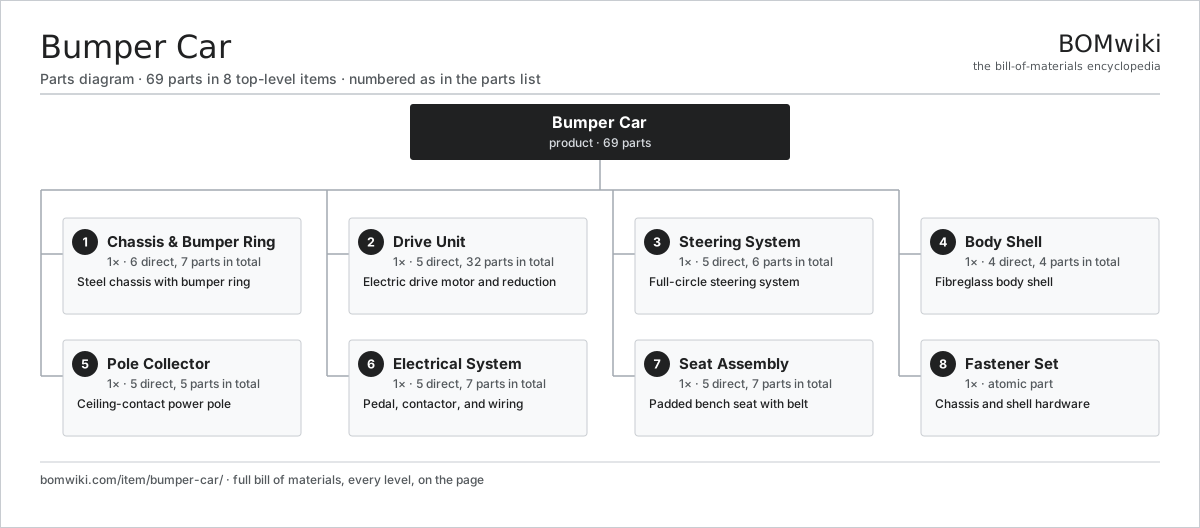
| # | Part | Qty | What it does |
|---|---|---|---|
| 1 | Chassis & Bumper Ring 6 parts | 1× | Steel chassis with bumper ring |
| 2 | Drive Unit 5 parts | 1× | Electric drive motor and reduction |
| 3 | Steering System 5 parts | 1× | Full-circle steering system |
| 4 | Body Shell 4 parts | 1× | Fibreglass body shell |
| 5 | Pole Collector 5 parts | 1× | Ceiling-contact power pole |
| 6 | Electrical System 5 parts | 1× | Pedal, contactor, and wiring |
| 7 | Seat Assembly 5 parts | 1× | Padded bench seat with belt |
| 8 | Fastener Set | 1× | Chassis and shell hardware |
3D model
No 3D model yet. Have a CAD file of this? Add a 3D model. STL renders right on this page; STEP, FreeCAD, and OpenSCAD sources are welcome too (openly licensed, like all 3D models on BOMwiki).
Build & assembly graph
expand / collapse · shared sub-assemblies converge · links to related products · est. labourTap an assembly to expand/collapse · tap a part to open it · use “Open page” for any node · drag to pan, scroll to zoom.
Bill of materials for Bumper Car
8 top-level lines · 49 rows shown · 69 parts total · indented to 3 levels| # | Item / sub-assembly | Part no. | Qty/assy | Ext. qty | Parts | Type |
|---|---|---|---|---|---|---|
| 1 | Chassis & Bumper Ring 6 parts | bumper-car-chassis | 1× | 1 | 7 | assembly |
| 1.1 | Chassis Frame | bumper-car-frame | 1× | 1 | · | part |
| 1.2 | Bumper Ring | bumper-car-bumper-ring | 1× | 1 | · | part |
| 1.3 | Bumper Skirt | bumper-car-bumper-skirt | 1× | 1 | · | part |
| 1.4 | Floor Contact Brush | bumper-car-floor-brush | 1× | 1 | · | part |
| 1.5 | Rear Castor | bumper-car-castor | 2× | 2 | · | part |
| 1.6 | Fastener Set | fastener-set | 1× | 1 | · | part |
| 2 | Drive Unit 5 parts | bumper-car-drive-unit | 1× | 1 | 32 | assembly |
| 2.1 | Traction Motor 6 parts | bumper-car-traction-motor | 1× | 1 | 27 | assembly |
| 2.1.1 | Motor Housing | motor-housing | 1× | 1 | · | part |
| 2.1.2 | Stator Assembly 3 parts + deeper › | stator-assembly | 1× | 1 | 3 | assembly |
| 2.1.3 | Rotor Assembly 4 parts + deeper › | rotor-assembly | 1× | 1 | 19 | assembly |
| 2.1.4 | Copper Winding | copper-winding | 1× | 1 | · | part |
| 2.1.5 | Ball Bearing | ball-bearing | 2× | 2 | · | part |
| 2.1.6 | Brush Gear | bumper-car-brush-gear | 1× | 1 | · | part |
| 2.2 | Helical Gear Pair | gear-pair | 1× | 1 | · | part |
| 2.3 | Gearbox Housing | gearbox-housing | 1× | 1 | · | part |
| 2.4 | Drive Wheel | bumper-car-drive-wheel | 1× | 1 | · | part |
| 2.5 | Ball Bearing | ball-bearing | 2× | 2 | · | part |
| 3 | Steering System 5 parts | bumper-car-steering | 1× | 1 | 6 | assembly |
| 3.1 | Steering Wheel | bumper-car-steering-wheel | 1× | 1 | · | part |
| 3.2 | Steering Column | bumper-car-steering-column | 1× | 1 | · | part |
| 3.3 | Steering Chain | bumper-car-steering-chain | 1× | 1 | · | part |
| 3.4 | Drive Turret | bumper-car-turret | 1× | 1 | · | part |
| 3.5 | Ball Bearing | ball-bearing | 2× | 2 | · | part |
| 4 | Body Shell 4 parts | bumper-car-body-shell | 1× | 1 | 4 | assembly |
| 4.1 | Shell Moulding | bumper-car-shell-moulding | 1× | 1 | · | part |
| 4.2 | Cockpit Pad | bumper-car-cockpit-pad | 1× | 1 | · | part |
| 4.3 | Dash Panel | bumper-car-dash-panel | 1× | 1 | · | part |
| 4.4 | Trim Strip | bumper-car-trim-strip | 1× | 1 | · | part |
| 5 | Pole Collector 5 parts | bumper-car-pole-collector | 1× | 1 | 5 | assembly |
| 5.1 | Contact Pole | bumper-car-pole | 1× | 1 | · | part |
| 5.2 | Contact Head | bumper-car-contact-head | 1× | 1 | · | part |
| 5.3 | Pole Spring | bumper-car-pole-spring | 1× | 1 | · | part |
| 5.4 | Pole Base | bumper-car-pole-base | 1× | 1 | · | part |
| 5.5 | Wire Bundle | wire-bundle | 1× | 1 | · | part |
| 6 | Electrical System 5 parts | bumper-car-electrical | 1× | 1 | 7 | assembly |
| 6.1 | Foot Pedal | bumper-car-foot-pedal | 1× | 1 | · | part |
| 6.2 | Relay | relay | 1× | 1 | · | part |
| 6.3 | Fuse Box | bumper-car-fuse-box | 1× | 1 | · | part |
| 6.4 | Wire Bundle | wire-bundle | 1× | 1 | · | part |
| 6.5 | Connector | connector | 3× | 3 | · | part |
| 7 | Seat Assembly 5 parts | seat-assembly | 1× | 1 | 7 | assembly |
| 7.1 | Seat Frame | seat-frame | 1× | 1 | · | part |
| 7.2 | Seat Foam | seat-foam | 2× | 2 | · | part |
| 7.3 | Seat Cover | seat-cover | 1× | 1 | · | part |
| 7.4 | Seat Motor | seat-motor | 2× | 2 | · | part |
| 7.5 | Seat Heater Mat | seat-heater | 1× | 1 | · | part |
| 8 | Fastener Set | fastener-set | 1× | 1 | · | part |
Something wrong in this list? Report a problem with this BOM.
Related products
same domain, ranked by shared parts Coin-Operated Kiddie Ride
91 parts · shares 19 with this page
Coin-Operated Kiddie Ride
91 parts · shares 19 with this page
 Dark Ride System
1,005 parts · shares 17 with this page
Dark Ride System
1,005 parts · shares 17 with this page
 Roller Coaster
657 parts · shares 10 with this page
Roller Coaster
657 parts · shares 10 with this page
 Drop Tower Ride
308 parts · shares 9 with this page
Drop Tower Ride
308 parts · shares 9 with this page
 Ferris Wheel
3,547 parts · shares 8 with this page
Ferris Wheel
3,547 parts · shares 8 with this page
 Log Flume Ride
486 parts · shares 8 with this page
Log Flume Ride
486 parts · shares 8 with this page
Sourcing: possible vendors
Browse the supplier directory → Prices, MOQ, and lead times are algorithmic estimates, not quotes, and not claims about these companies. Company mappings are curated by keyword; est. price band $20–$3k. How estimates work| Vendor | HQ | Specialty | MOQ | Lead time |
|---|---|---|---|---|
|
🇩🇰LEGO
lego.com ↗
|
Billund, DK | Construction toys | 2,000 units | 6–10 wks |
|
🇺🇸Mattel
mattel.com ↗
|
El Segundo, US | Toys | 2,000 units | 6–10 wks |
|
🇺🇸Hasbro
hasbro.com ↗
|
Pawtucket, US | Toys & games | 2,000 units | 6–10 wks |
| bandainamco.co.jp ↗ | Tokyo, JP | Toys & amusement | 2,000 units | 6–10 wks |
| spinmaster.com ↗ | Toronto, CA | Toys | 2,000 units | 6–10 wks |
841-word article