Fiber Cable Blowing Machine
ProductOverview
Cable blowing machines revolutionized fiber optic installation by eliminating the need to manually pull cables through underground ducts. Traditional hand-pulling of long cable runs (1–2 km) requires large crews, significant tension (500–1000 lb), and risks cable damage or breakage. A Fiber Cable Blowing Machine uses compressed air at 50–100 psi to propel loose fiber optic cable through conduit, reducing operator strain and installation time by 50–70%.
The machine consists of a Drive Unit (electric or diesel compressor), a Air Chamber (pressure vessel), a Cable Feed System system (motorized reel), and a Control Panel (gauges and safety interlocks). The cable is loaded on a motorized spool, fed into a guide tube, and launched through the duct by a jet of compressed air. The air stream surrounds the cable, reducing friction and carrying it forward. Pressure and speed are monitored and adjusted to prevent excessive tension (which can damage fiber) or insufficient flow (which stalls the cable).
Most blowing machines are portable, mounted on trailers or industrial casters, allowing rapid deployment between job sites. A typical crew of two operators can install 1–2 km of cable per day, compared to 0.2–0.5 km per day for manual pulling.
How It Works
The Motor drives the Compressor, which continuously supplies compressed air to the Air Chamber pressure tank. The operator adjusts the Regulator to set outlet pressure (typically 60–80 psi for 1.5 inch fiber cable).
The cable is loaded onto the Feed Reel, which is held by the Reel Brake. The operator starts the Feed Motor, which slowly rotates the reel, feeding cable into the Guide Tube. The cable passes through the Inlet Clamp, which seals around the cable, and enters the pressurized blowing chamber.
Inside the duct, the compressed air jet creates a pressure difference at the cable tip, propelling it forward. The Tension Sensor in the feed path monitors the load: if tension exceeds 100 lb (indicating stalled cable), the feed motor automatically reduces speed or stops. The operator monitors the Ammeter and pressure gauges; if current spikes or pressure drops, the cable may be stuck, and the operator stops and resets.
At the destination, a second crew member at the duct exit retrieves the cable as it emerges. The entire process is monitored remotely if the duct is long (>300 m), with voice communication via radio between launch and exit points.
Cable Types and Specifications
Not all cables can be blown. Loose-tube fiber cables (1.5–2 inches OD) with a smooth polyester or HDPE sheath are ideal: they slide easily through ducts and are less prone to jamming. Tight-buffer cables, armored cables, and cables over 2 inches OD are difficult or impossible to blow.
Maximum blow distance depends on duct diameter, cable diameter, number of bends, and air pressure:
- Duct bends greater than 45° add significant friction; multiple bends reduce range
- Smaller ducts (2 inch) and larger cables (2 inch) reduce range from 500 m to 200–300 m
- Duct cleanliness is critical: debris, dirt, or sand in the duct can jam the cable or scratch it
Maintenance and Safety
Air desiccation is essential: moisture in compressed air condenses in cool ducts, potentially trapping cables or causing freezing in winter. The Desiccant Dryer removes moisture, maintaining a dew point of –40°F.
Safety interlocks prevent operator injury: the Emergency Stop button de-energizes all motors, halting cable feed and air pressure. Relief valves on the Air Chamber protect against tank overpressure. Hoses and fittings are rated for the maximum system pressure (150 psi) with a safety factor of 3.
Noise levels from the compressor and motor are typically 85–95 dB(A); hearing protection is recommended for extended operation. Vibration isolation dampers reduce structure-borne vibration to nearby buildings.
The machine requires daily maintenance: the tank Drain Valve must be drained of condensed moisture and oil. Desiccant cartridges are replaced every 6–12 months depending on humidity. Hoses and couplers are inspected for leaks and replaced if damaged.
Fiber Cable Blowing Machine parts and their functions
6 top-level parts · 25 parts in total · full bill of materials below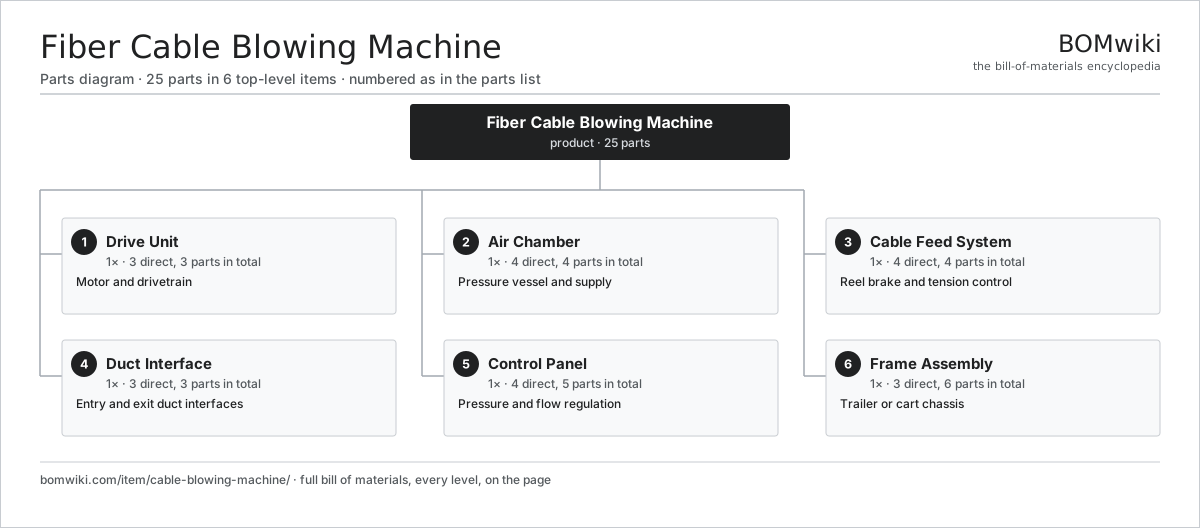
| # | Part | Qty | What it does |
|---|---|---|---|
| 1 | Drive Unit 3 parts | 1× | Motor and drivetrain |
| 2 | Air Chamber 4 parts | 1× | Pressure vessel and supply |
| 3 | Cable Feed System 4 parts | 1× | Reel brake and tension control |
| 4 | Duct Interface 3 parts | 1× | Entry and exit duct interfaces |
| 5 | Control Panel 4 parts | 1× | Pressure and flow regulation |
| 6 | Frame Assembly 3 parts | 1× | Trailer or cart chassis |
3D model
No 3D model yet. Have a CAD file of this? Add a 3D model. STL renders right on this page; STEP, FreeCAD, and OpenSCAD sources are welcome too (openly licensed, like all 3D models on BOMwiki).
Build & assembly graph
expand / collapse · shared sub-assemblies converge · links to related products · est. labourTap an assembly to expand/collapse · tap a part to open it · use “Open page” for any node · drag to pan, scroll to zoom.
Bill of materials for Fiber Cable Blowing Machine
6 top-level lines · 27 rows shown · 25 parts total · indented to 3 levels| # | Item / sub-assembly | Part no. | Qty/assy | Ext. qty | Parts | Type |
|---|---|---|---|---|---|---|
| 1 | Drive Unit 3 parts | cable-blowing-machine-drive-unit | 1× | 1 | 3 | assembly |
| 1.1 | Motor | cable-blowing-machine-motor | 1× | 1 | · | part |
| 1.2 | Compressor | cable-blowing-machine-compressor | 1× | 1 | · | part |
| 1.3 | Desiccant Dryer | cable-blowing-machine-desiccant-dryer | 1× | 1 | · | part |
| 2 | Air Chamber 4 parts | cable-blowing-machine-air-chamber | 1× | 1 | 4 | assembly |
| 2.1 | Pressure Tank | cable-blowing-machine-tank | 1× | 1 | · | part |
| 2.2 | Relief Valve | cable-blowing-machine-relief-valve | 1× | 1 | · | part |
| 2.3 | Regulator | cable-blowing-machine-regulator | 1× | 1 | · | part |
| 2.4 | Drain Valve | cable-blowing-machine-drain-valve | 1× | 1 | · | part |
| 3 | Cable Feed System 4 parts | cable-blowing-machine-cable-feed | 1× | 1 | 4 | assembly |
| 3.1 | Feed Reel | cable-blowing-machine-feed-reel | 1× | 1 | · | part |
| 3.2 | Reel Brake | cable-blowing-machine-reel-brake | 1× | 1 | · | part |
| 3.3 | Feed Motor | cable-blowing-machine-feed-motor | 1× | 1 | · | part |
| 3.4 | Tension Sensor | cable-blowing-machine-tension-sensor | 1× | 1 | · | part |
| 4 | Duct Interface 3 parts | cable-blowing-machine-duct-clamps | 1× | 1 | 3 | assembly |
| 4.1 | Inlet Clamp | cable-blowing-machine-inlet-clamp | 1× | 1 | · | part |
| 4.2 | Outlet Clamp | cable-blowing-machine-outlet-clamp | 1× | 1 | · | part |
| 4.3 | Guide Tube | cable-blowing-machine-guide-tube | 1× | 1 | · | part |
| 5 | Control Panel 4 parts | cable-blowing-machine-control-panel | 1× | 1 | 5 | assembly |
| 5.1 | Pressure Gauge | cable-blowing-machine-pressure-gauge | 2× | 2 | · | part |
| 5.2 | Flow Controller | cable-blowing-machine-flow-controller | 1× | 1 | · | part |
| 5.3 | Emergency Stop | cable-blowing-machine-emergency-stop | 1× | 1 | · | part |
| 5.4 | Ammeter | cable-blowing-machine-amp-meter | 1× | 1 | · | part |
| 6 | Frame Assembly 3 parts | cable-blowing-machine-frame | 1× | 1 | 6 | assembly |
| 6.1 | Frame Structure | cable-blowing-machine-frame-structure | 1× | 1 | · | part |
| 6.2 | Wheels | cable-blowing-machine-wheels | 4× | 4 | · | part |
| 6.3 | Vibration Dampers | cable-blowing-machine-vibration-dampers | 1× | 1 | · | part |
Something wrong in this list? Report a problem with this BOM.
Sourcing: possible vendors
Browse the supplier directory → Prices, MOQ, and lead times are algorithmic estimates, not quotes, and not claims about these companies. Company mappings are curated by keyword; est. price band $30–$50k. How estimates work| Vendor | HQ | Specialty | MOQ | Lead time |
|---|---|---|---|---|
|
🇺🇸Cisco
cisco.com ↗
|
San Jose, US | Networking | 500 units | 8–14 wks |
|
🇺🇸Juniper
juniper.net ↗
|
Sunnyvale, US | Networking | 500 units | 8–14 wks |
| arista.com ↗ | Santa Clara, US | Networking | 500 units | 8–14 wks |
|
🇫🇮Nokia
nokia.com ↗
|
Espoo, FI | Telecom equipment | 500 units | 8–14 wks |
|
🇨🇳Huawei
huawei.com ↗
|
Shenzhen, CN | Networking & telecom | 500 units | 8–14 wks |
728-word article