Caliper Inspection Pig
ProductOverview
Pipeline dents, metal loss (corrosion), and ovality (out-of-roundness) are leading causes of in-service pipeline failure. Traditional inspection required pig launches every 10–20 years at significant cost (~$50K–$500K per run, depending on pipeline length and complexity).
The caliper inspection pig (CIP) is an unmanned robot that travels inside a pressurized pipeline, continuously measuring the internal pipe wall radius at multiple points around the circumference. Four spring-loaded Radial Caliper Arm and Sensor arms extend radially inward, each equipped with a displacement transducer; as the pig travels, the arms track pipe ID variations caused by dents, buckles, and corrosion thinning.
The pig's Internal Data Recording System stores millions of sensor readings on an internal SD card, creating a high-resolution profile of the entire pipeline. Post-run data is downloaded, analyzed via software, and flagged for locations exceeding damage thresholds, enabling targeted repair or replacement before failure.
Typical pipeline operators perform caliper pigging every 10–20 years as part of integrity management, combined with pressure testing and visual walking surveys to maintain a 50+ year pipeline service life.
How It Works: Pipeline Traversal and Measurement
Pig Preparation: The pig is assembled with fresh batteries (Power Battery System), and the SD card (Data Storage Memory) is formatted. Software is loaded onto the Data Acquisition Board with the expected pipeline profile (diameter, routing, known dents or repairs), so the pig can detect unexpected anomalies.
Launcher Insertion: The pig is manually inserted into a pipeline launcher (pig trap), pressurized with the main pipeline (10–1,500 psi). The Sealing Cup Assembly (four elastomer friction cups) expand against the pipe ID, creating a pressure-tight seal. The pig is held in place via the Radial Caliper Arm and Sensor and magnetic Nose Cone Guidance System, which prevents backward rolling.
Launch Push: Pipeline pressure differential (main line pressure vs. trap pressure) or a manual pressure pulse in the trap line accelerates the pig into the main line, starting its journey.
Pig Transit: The pig is carried by the pipeline flow/pressure, traveling at 0.5–5 mph (operator sets flow rate). As it moves:
- The Distance-Measuring Odometer Wheels (non-driven distance-measuring wheels) roll on the pipe ID, sending encoder pulses to the Data Acquisition Board. Each pulse represents a fixed distance (~0.1 feet typical).
- The four Radial Caliper Arm and Sensor arms continuously press outward against the pipe wall. Each arm's spring load (~1–5 lbf) keeps the contact button (hardened steel tip) in contact with the inner wall.
- The Displacement Transducer (LVDT or capacitive transducer) on each arm measures the arm displacement (0–2 inch range). As a dent deforms the pipe inward, the arm compresses, reducing its sensor voltage; as the pipe expands (or as a smooth section passes), the arm extends, increasing voltage.
- The Data Acquisition Board ADC (analog-to-digital converter) samples all four arm sensors at 1–10 Hz, time-stamped and distance-tagged via the odometer encoder.
Navigation Around Bends: The pig's Nose Cone Guidance System (aerodynamic or magnetic) guides it through pipe bends. The Inertial Measurement Unit (IMU) (IMU with accelerometer, gyroscope, magnetometer) measures the pig's orientation (heading, pitch, roll), allowing post-processing software to correlate sensor readings to physical locations on the bent pipeline (e.g., "dent at north side of 45-degree bend at mile 5.3").
Receiver Trap: At the pipeline terminus, the pig exits the main line into a reception trap (similar to launch trap), where it is stopped by a [spring cushion and collected by crew. The [caliper-pig-battery-pack is still fresh, but power is de-energized to preserve data.
Sensor Arm Operation and Dent Detection
Each of the four Radial Caliper Arm and Sensor arms is positioned 90 degrees around the pig's circumference (top, bottom, left, right). As the pig passes over a dent:
- Dent Geometry: A sharp dent might be 4 inches wide and 0.5 inches deep.
- Arm Response: As the pig enters the dent region, the bottom arm (closest to dent) compresses ~0.5 inches (dent depth). The side arms compress ~0.25 inches (dent flanks). The top arm remains nearly full-extension (opposite side of pipe is round).
- Signal Signature: The Data Acquisition Board records a transient: 100+ data points showing the smooth drop (compression) and rise (recovery) across the dent width.
- Data Interpolation: Post-processing software fits the four measurements to a 3D pipe wall profile, reconstructing the true dent shape, depth, and circumferential extent.
A typical 0.5 inch deep dent (3% of pipe wall thickness) is clearly detected with 0.01 inch resolution. Stress-based damage assessment models (SMYS, yield criteria) are applied to determine if the dent meets repair thresholds per ASME B31.1.
Metal Loss Detection (Corrosion Pinpointing)
Caliper pigs excel at detecting dents but cannot directly measure wall thickness (they measure ID radius, not wall). However, known defects (corrosion, cracks) that reduce wall thickness while maintaining overall dent-free geometry are harder to detect.
Advanced caliper systems integrate:
- Dual-Depth Probes: Some CIPs have sensors at multiple radial points around each arm, detecting small-diameter corrosion pits (0.5–2 inch diameter) embedded in otherwise round pipe.
- Combination ILI (In-Line Inspection): Caliper pigs are often run before or after ultrasonic-thickness (UT) pigs. Calipers flag dent locations; UT measures residual wall thickness. Together, they provide complete damage assessment.
Data Post-Processing and Reporting
After the run, the Data Storage Memory is removed from the pig and read by a laptop. Data files (typically 10–100 MB for a 100-mile pipeline) are loaded into analysis software (vendor-supplied or third-party), producing:
- Dent Map: A 2D or 3D rendering of the pipe profile along the full length, with dent locations, depths, and severities color-coded.
- Metrics Report: Peak dent depth, number of dents exceeding 3%–5% of wall thickness, cumulative damage severity.
- Recommendation List: Specific pipeline stations requiring repair (in-service grinding, section replacement, or continued monitoring).
- Compliance Documentation: Reports formatted per API 1130 (in-service integrity assessment), ASME B31.1 (design and construction), and ECDA (external corrosion direct assessment).
Limitations and Constraints
Blockages: The pig cannot pass fully blocking obstructions (caliper pigs are 80–95% of pipe ID, leaving 5–20% margins). Field debris (wrappings, lost tools), mechanical damage, or previous pig stuck in line can prevent passage. Pre-run smart pigging (MFL or ultrasonic) or line-walk surveys help identify blockages before caliper launch.
Turbulence and Bounce: In high-velocity flow (>5 mph), the pig may bounce, causing noisy (unreliable) sensor data. Operators reduce flow to 0.5–2 mph during caliper runs, extending transit time.
Coating Variability: FBE or PE coating roughness can cause arm chatter (vibration of sensor arms against the ID). Heavy coatings (>400 microns) or textured coatings increase friction and may slow the pig or prevent launch in low-pressure pipelines.
Temperature Sensitivity: LVDT and capacitive sensors can drift with temperature. Dual-redundant arms and post-run calibration checks are standard practice.
Safety and Regulatory Compliance
Pipeline operators must notify regulatory agencies (PHMSA, state pipeline commissions) of pigging operations. The pig is considered a high-value asset; loss in the pipeline requires expensive recovery or acceptance as a permanent obstruction.
Recovery procedures if the pig becomes stuck:
- Increase pipeline pressure to force the pig forward (careful: may damage pig or pipeline).
- Use tractor unit to pull pig backward (requires tethered cable, not available on free-swimming CIPs).
- Excavate and cut the pipeline to mechanically extract the pig.
- In worst case, accept the pig as debris and reroute the pipeline.
Most operators conduct a pre-pigging survey (walking inspection, existing records) and reduce pigging speed (1 mph or less) to minimize risk.
Service Life and Maintenance
The Contact Probe Tip (wear tip) contacts the pipe thousands of times per mile; wear is inevitable. Replacement buttons cost ~$50 each and are swapped after 100+ miles of service.
The Sealing Cup Assembly elastomer wears with each launch/reception cycle and repeated pressure cycling. Cups typically last 50–100 runs before leakage requires replacement (cost ~$200 per cup set).
The Data Acquisition Board, Power Battery System, and Inertial Measurement Unit (IMU) are solid-state and can operate 10+ years without failure if dry and undamaged. Pigs stored in humidity or exposed to water ingress suffer electronic corrosion, requiring repair or replacement.
Typical caliper pig asset life is 20–30 years with proper maintenance, supporting 50+ pipeline pigging campaigns and inspections.
Caliper Inspection Pig parts and their functions
8 top-level parts · 64 parts in total · full bill of materials below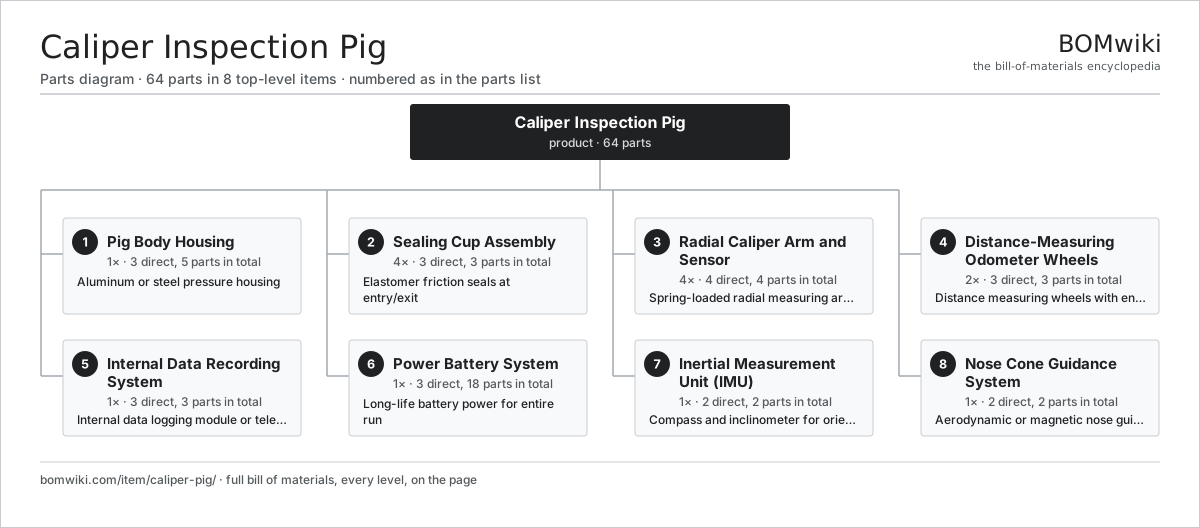
| # | Part | Qty | What it does |
|---|---|---|---|
| 1 | Pig Body Housing 3 parts | 1× | Aluminum or steel pressure housing |
| 2 | Sealing Cup Assembly 3 parts | 4× | Elastomer friction seals at entry/exit |
| 3 | Radial Caliper Arm and Sensor 4 parts | 4× | Spring-loaded radial measuring arms with sensors |
| 4 | Distance-Measuring Odometer Wheels 3 parts | 2× | Distance measuring wheels with encoder |
| 5 | Internal Data Recording System 3 parts | 1× | Internal data logging module or telemetry |
| 6 | Power Battery System 3 parts | 1× | Long-life battery power for entire run |
| 7 | Inertial Measurement Unit (IMU) 2 parts | 1× | Compass and inclinometer for orientation |
| 8 | Nose Cone Guidance System 2 parts | 1× | Aerodynamic or magnetic nose guiding bore navigation |
3D model
No 3D model yet. Have a CAD file of this? Add a 3D model. STL renders right on this page; STEP, FreeCAD, and OpenSCAD sources are welcome too (openly licensed, like all 3D models on BOMwiki).
Build & assembly graph
expand / collapse · shared sub-assemblies converge · links to related products · est. labourTap an assembly to expand/collapse · tap a part to open it · use “Open page” for any node · drag to pan, scroll to zoom.
Bill of materials for Caliper Inspection Pig
8 top-level lines · 31 rows shown · 64 parts total · indented to 3 levels| # | Item / sub-assembly | Part no. | Qty/assy | Ext. qty | Parts | Type |
|---|---|---|---|---|---|---|
| 1 | Pig Body Housing 3 parts | caliper-pig-body-shell | 1× | 1 | 5 | assembly |
| 1.1 | Main Pressure Cylinder | caliper-pig-body-cylinder | 1× | 1 | · | part |
| 1.2 | End Plate Covers | caliper-pig-body-end-caps | 2× | 2 | · | part |
| 1.3 | Internal Support Brackets | caliper-pig-body-internal-brackets | 2× | 2 | · | part |
| 2 | Sealing Cup Assembly 3 parts | caliper-pig-sealing-cups | 4× | 4 | 3 | assembly |
| 2.1 | Sealing Cup | caliper-pig-cup-elastomer-ring | 1× | 4 | · | part |
| 2.2 | Cup Spring Washer | caliper-pig-cup-spring-washer | 1× | 4 | · | part |
| 2.3 | Cup Retainer Ring | caliper-pig-cup-retainer-ring | 1× | 4 | · | part |
| 3 | Radial Caliper Arm and Sensor 4 parts | caliper-pig-caliper-sensor-arm | 4× | 4 | 4 | assembly |
| 3.1 | Arm Lever | caliper-pig-arm-structure | 1× | 4 | · | part |
| 3.2 | Arm Spring | caliper-pig-arm-spring | 1× | 4 | · | part |
| 3.3 | Contact Probe Tip | caliper-pig-arm-contact-button | 1× | 4 | · | part |
| 3.4 | Displacement Transducer | caliper-pig-arm-sensor | 1× | 4 | · | part |
| 4 | Distance-Measuring Odometer Wheels 3 parts | caliper-pig-odometer-wheel | 2× | 2 | 3 | assembly |
| 4.1 | Odometer Wheel | caliper-pig-wheel-element | 1× | 2 | · | part |
| 4.2 | Wheel Mounting Shaft | caliper-pig-wheel-shaft | 1× | 2 | · | part |
| 4.3 | Rotary Distance Encoder | caliper-pig-wheel-encoder | 1× | 2 | · | part |
| 5 | Internal Data Recording System 3 parts | caliper-pig-data-recorder | 1× | 1 | 3 | assembly |
| 5.1 | Data Acquisition Board | caliper-pig-data-board-electronics | 1× | 1 | · | part |
| 5.2 | Data Storage Memory | caliper-pig-data-memory-card | 1× | 1 | · | part |
| 5.3 | Real-Time Clock | caliper-pig-data-timestamp-clock | 1× | 1 | · | part |
| 6 | Power Battery System 3 parts | caliper-pig-battery-pack | 1× | 1 | 18 | assembly |
| 6.1 | Battery Cell Stack | caliper-pig-battery-cells | 16× | 16 | · | part |
| 6.2 | Battery Pack Container | caliper-pig-battery-pack-housing | 1× | 1 | · | part |
| 6.3 | Battery Connector | caliper-pig-battery-connector | 1× | 1 | · | part |
| 7 | Inertial Measurement Unit (IMU) 2 parts | caliper-pig-navigation-gyro | 1× | 1 | 2 | assembly |
| 7.1 | IMU Sensor Chip | caliper-pig-imu-sensor-module | 1× | 1 | · | part |
| 7.2 | IMU Data Bus | caliper-pig-imu-data-interface | 1× | 1 | · | part |
| 8 | Nose Cone Guidance System 2 parts | caliper-pig-protective-nose-cone | 1× | 1 | 2 | assembly |
| 8.1 | Nose Cone Shell | caliper-pig-nose-cone-structure | 1× | 1 | · | part |
| 8.2 | Magnetic Guidance System (Optional) | caliper-pig-nose-cone-magnet-optional | 1× | 1 | · | part |
Something wrong in this list? Report a problem with this BOM.
Sourcing: possible vendors
Browse the supplier directory → Prices, MOQ, and lead times are algorithmic estimates, not quotes, and not claims about these companies. Company mappings are curated by keyword; est. price band $10k–$50M. How estimates work| Vendor | HQ | Specialty | MOQ | Lead time |
|---|---|---|---|---|
|
🇺🇸SLB
slb.com ↗
|
Houston, US | Oilfield services & equipment | made to order | 24–48 wks |
| halliburton.com ↗ | Houston, US | Oilfield services | made to order | 24–48 wks |
| bakerhughes.com ↗ | Houston, US | Energy technology | made to order | 24–48 wks |
|
🇺🇸NOV
nov.com ↗
|
Houston, US | Drilling equipment | made to order | 24–48 wks |
| technipfmc.com ↗ | London, GB | Subsea & surface systems | made to order | 24–48 wks |
1,458-word article