Camera Obscura
ProductOverview
A camera obscura is an optical device, either a darkened chamber or room, that projects a real, inverted image of external scenes onto an internal viewing surface. The name is Latin for "dark chamber." The fundamental principle is geometric: light passing through a small aperture (a Lens Turret Assembly or simple pinhole in the Shutter and Diaphragm) forms an inverted image on a distant surface.
The Chamber Body is a lightproof enclosure with thick walls, small entrance door, and internal light baffles. A Lens Turret Assembly at one side houses interchangeable lenses or pinholes. Light from the external environment passes through the lens, is possibly redirected by the Mirror System, and strikes the Viewing Table, where the observer views the projected image.
The camera obscura was an essential tool for artists, architects, and scientists from the Renaissance onward. Before photography, artists used it for accurate perspective drawing. Early photographers used modified camera obscuras as the basis for their cameras. The device remains valuable for understanding optics and for artistic installations.
How it works
Light from an external scene enters the Chamber Body only through the Lens Turret Assembly, a small opening in the darkened wall. The Primary Imaging Lens (a converging lens with a focal length of 50–100 mm) gathers this light and focuses it at a point inside the chamber.
Geometric optics governs the image formation. If the lens has focal length f, and an object is at distance u from the lens, the image forms at distance v, where:
1/f = 1/u + 1/v
For an object far away (u → ∞), v → f (image at focal plane). For an object closer, v increases. The Focus Adjustment Mechanism adjusts the distance from the lens to the Viewing Table, bringing the projected image into sharp focus for the viewer's eye.
The magnification of the image is v/u. If an object (e.g., a building 100 feet away) has height h, its image height on the viewing surface is h × (v/u). For example, a 50-foot tree at 1000 feet distance projects an image height of 50 × (v/1000) inches on the viewing surface.
The image is inverted: light rays from the top of the object pass through the lens and converge at the bottom of the image, and vice versa. This inversion is unintuitive but fundamental to single-aperture imaging.
Lens vs. Pinhole
Most camera obscuras use a Primary Imaging Lens because a lens gathers more light and allows sharper focus over a range of distances. However, the Turret Housing often includes a Pinhole Aperture, a fine metal sheet with a tiny hole (0.5–2 mm diameter).
A pinhole projects by diffraction: all light rays passing through the small hole are essentially parallel, creating a sharp image regardless of object distance (within limits). However, the pinhole transmits much less light; a pinhole camera obscura image is dim and requires bright daylight or a white viewing surface. The pinhole's advantage is perfect sharpness across the entire field without focusing adjustment.
Viewing Surface and Tracing
The Viewing Table is typically a translucent or semi-transparent surface:
- Frosted glass (3–4 mm thick borosilicate or optical glass): Allows light to transmit through the surface while diffusing it for even viewing.
- Oiled paper: Thin paper rubbed with oil becomes semi-transparent and transmits light evenly.
- Semi-transparent acrylic or polyester sheet: Durable alternative to glass.
An observer in the darkened chamber views the projected image on the surface. By placing tracing paper or canvas on the surface, artists can draw or paint along the projected image, capturing its proportions with accuracy. This technique was used by Renaissance artists including Leonardo da Vinci, who documented the device in his notebooks.
Mirror Deflection
Some camera obscuras use a Mirror System to redirect the light path. A Primary Deflecting Mirror at 45 degrees might deflect light downward from a side aperture onto a horizontal viewing surface, improving ergonomics. The mirror is adjustable (Mirror Adjustment Mount) to precisely align the light path.
Focus Adjustment
The Focus Adjustment Mechanism allows the observer to move either the lens or the viewing surface (or both) along the optical axis, adjusting the image position for sharp focus. A Focus Drive Screw (lead screw or rack-and-pinion) driven by a Focus Adjustment Knob (hand-crank or threaded knob) provides smooth, continuous adjustment. A Focus Distance Scale marked in distance units helps repeatability.
Aperture Control
The Shutter and Diaphragm includes an Iris Diaphragm (similar to a camera iris) adjustable from f/2.8 (large aperture, bright image, shallow depth of field) to f/16 (small aperture, dim image, deep depth of field). A Shutter Blade allows the operator to block light entirely when not in use.
Chamber Design
Portable models (24×24×36 inches) are wooden boxes with a removable viewing screen and a door for operator access. The interior is blackened to absorb stray light. Light baffles (Light Baffle System) around the aperture prevent light leakage.
Room-sized models are darkened rooms with one wall housing the lens turret and a large translucent screen as the opposite wall. The observer stands in the darkened room, viewing a real-time projection of the outside world. Large room camera obscuras were popular in the 18th and 19th centuries as public curiosities.
Both types require good sealing (felt or rubber gaskets at doors and apertures) to maintain darkness.
Ventilation and Operator Comfort
Extended observation in a darkened chamber can be uncomfortable. Ventilation System openings with light-blocking baffles allow air circulation without admitting external light. Some designs include benches or stools for seated viewing.
Optical Aberrations
Simple single-lens designs introduce optical aberrations at large apertures (f/2.8):
- Spherical aberration: Rays at the lens edges focus at different points, creating blur.
- Chromatic aberration: Red, green, and blue wavelengths focus at slightly different distances, causing color fringing.
- Distortion: Straight lines near the edge curve.
- Vignetting: Image brightness decreases toward edges.
These aberrations are minimized by using smaller apertures (f/8 to f/16) and quality ground lenses. Multi-element corrected lenses (expensive) further reduce aberrations.
Historical Development and Use
The camera obscura principle was known to ancient Greeks (Euclid, Aristotle) but largely forgotten until the Islamic scholar Alhazen documented it in the 11th century. The Renaissance saw renewed interest; Leonardo da Vinci described the device and its optical properties. By the 16th century, camera obscuras were established tools in the workshops of Baroque painters for creating accurate perspective drawings and compositions.
The camera obscura remained in use through the 18th and 19th centuries. With the invention of photographic film in the 1820s–1830s, camera obscuras were modified by replacing the viewing screen with photographic plates, creating the first cameras. The term "camera" is derived from "camera obscura."
Modern Use and Artistic Applications
Contemporary uses include:
- Art and architecture education: Teaching perspective and optical principles.
- Artistic installations: Large-scale room installations inviting contemplation of landscape and light.
- Photography workshops: Understanding the optical foundation of cameras.
- Science demonstrations: Popular museum exhibits demonstrating geometric optics.
Some artists intentionally use camera obscura images (inverted, low-resolution, dynamic) as aesthetic choices, embracing the device's limitations for creative effect.
Camera Obscura parts and their functions
6 top-level parts · 27 parts in total · full bill of materials below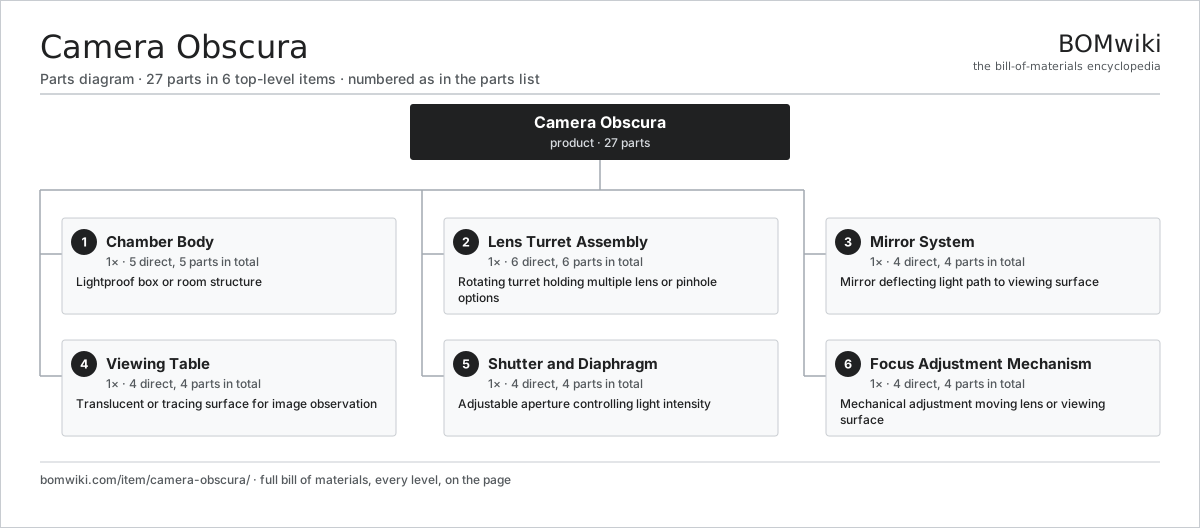
| # | Part | Qty | What it does |
|---|---|---|---|
| 1 | Chamber Body 5 parts | 1× | Lightproof box or room structure |
| 2 | Lens Turret Assembly 6 parts | 1× | Rotating turret holding multiple lens or pinhole options |
| 3 | Mirror System 4 parts | 1× | Mirror deflecting light path to viewing surface |
| 4 | Viewing Table 4 parts | 1× | Translucent or tracing surface for image observation |
| 5 | Shutter and Diaphragm 4 parts | 1× | Adjustable aperture controlling light intensity |
| 6 | Focus Adjustment Mechanism 4 parts | 1× | Mechanical adjustment moving lens or viewing surface |
3D model
No 3D model yet. Have a CAD file of this? Add a 3D model. STL renders right on this page; STEP, FreeCAD, and OpenSCAD sources are welcome too (openly licensed, like all 3D models on BOMwiki).
Build & assembly graph
expand / collapse · shared sub-assemblies converge · links to related products · est. labourTap an assembly to expand/collapse · tap a part to open it · use “Open page” for any node · drag to pan, scroll to zoom.
Bill of materials for Camera Obscura
6 top-level lines · 33 rows shown · 27 parts total · indented to 3 levels| # | Item / sub-assembly | Part no. | Qty/assy | Ext. qty | Parts | Type |
|---|---|---|---|---|---|---|
| 1 | Chamber Body 5 parts | camera-obscura-chamber-body | 1× | 1 | 5 | assembly |
| 1.1 | Chamber Walls | camera-obscura-walls | 1× | 1 | · | part |
| 1.2 | Entrance Door | camera-obscura-entrance-door | 1× | 1 | · | part |
| 1.3 | Light Baffle System | camera-obscura-light-baffles | 1× | 1 | · | part |
| 1.4 | Ventilation System | camera-obscura-ventilation | 1× | 1 | · | part |
| 1.5 | Fastener Set | fastener-set | 1× | 1 | · | part |
| 2 | Lens Turret Assembly 6 parts | camera-obscura-lens-turret | 1× | 1 | 6 | assembly |
| 2.1 | Turret Housing | camera-obscura-turret-housing | 1× | 1 | · | part |
| 2.2 | Primary Imaging Lens | camera-obscura-lens-primary | 1× | 1 | · | part |
| 2.3 | Secondary Imaging Lens | camera-obscura-lens-secondary | 1× | 1 | · | part |
| 2.4 | Pinhole Aperture | camera-obscura-pinhole-aperture | 1× | 1 | · | part |
| 2.5 | Turret Bearing | camera-obscura-turret-bearing | 1× | 1 | · | part |
| 2.6 | Fastener Set | fastener-set | 1× | 1 | · | part |
| 3 | Mirror System 4 parts | camera-obscura-mirror-system | 1× | 1 | 4 | assembly |
| 3.1 | Primary Deflecting Mirror | camera-obscura-mirror-primary | 1× | 1 | · | part |
| 3.2 | Secondary Deflecting Mirror | camera-obscura-mirror-secondary | 1× | 1 | · | part |
| 3.3 | Mirror Adjustment Mount | camera-obscura-mirror-mount | 1× | 1 | · | part |
| 3.4 | Fastener Set | fastener-set | 1× | 1 | · | part |
| 4 | Viewing Table 4 parts | camera-obscura-viewing-table | 1× | 1 | 4 | assembly |
| 4.1 | Viewing Surface | camera-obscura-table-surface | 1× | 1 | · | part |
| 4.2 | Table Frame | camera-obscura-table-frame | 1× | 1 | · | part |
| 4.3 | Table Adjustment Screws | camera-obscura-table-adjusting-screws | 1× | 1 | · | part |
| 4.4 | Fastener Set | fastener-set | 1× | 1 | · | part |
| 5 | Shutter and Diaphragm 4 parts | camera-obscura-shutter-diaphragm | 1× | 1 | 4 | assembly |
| 5.1 | Iris Diaphragm | camera-obscura-iris-diaphragm | 1× | 1 | · | part |
| 5.2 | Shutter Blade | camera-obscura-shutter-blade | 1× | 1 | · | part |
| 5.3 | Shutter Control Lever | camera-obscura-shutter-lever | 1× | 1 | · | part |
| 5.4 | Fastener Set | fastener-set | 1× | 1 | · | part |
| 6 | Focus Adjustment Mechanism 4 parts | camera-obscura-focus-mechanism | 1× | 1 | 4 | assembly |
| 6.1 | Focus Drive Screw | camera-obscura-focus-screw | 1× | 1 | · | part |
| 6.2 | Focus Adjustment Knob | camera-obscura-focus-knob | 1× | 1 | · | part |
| 6.3 | Focus Distance Scale | camera-obscura-focus-scale | 1× | 1 | · | part |
| 6.4 | Fastener Set | fastener-set | 1× | 1 | · | part |
Something wrong in this list? Report a problem with this BOM.
Sourcing: possible vendors
Browse the supplier directory → Prices, MOQ, and lead times are algorithmic estimates, not quotes, and not claims about these companies. Company mappings are curated by keyword; est. price band $100–$8k. How estimates work| Vendor | HQ | Specialty | MOQ | Lead time |
|---|---|---|---|---|
|
🇯🇵Canon
canon.com ↗
|
Tokyo, JP | Imaging & optics | 500 units | 10–16 wks |
|
🇯🇵Nikon
nikon.com ↗
|
Tokyo, JP | Imaging & optics | 500 units | 10–16 wks |
|
🇩🇪ZEISS
zeiss.com ↗
|
Oberkochen, DE | Optics & optoelectronics | 500 units | 10–16 wks |
| leica-camera.com ↗ | Wetzlar, DE | Cameras & optics | 500 units | 10–16 wks |
| flir.com ↗ | Wilsonville, US | Thermal imaging | 500 units | 10–16 wks |
1,234-word article