Can Filler-Seamer
ProductOverview
Can filler-seamers (monoblock units) are specialized machines for beer and carbonated beverage canning, integrating filling and lid application into a single synchronized work head. Unlike rotary carousels, monoblock designs position the can stationary in the work zone, with filler and seamer heads approaching from above or sides. The machine fills the can under counter-pressure (5–10 bar), preventing CO2 loss from carbonated beverages, and immediately applies a pre-formed aluminum lid with a precision seamed edge.
Monoblock architectures are common in craft breweries and specialized beverage producers where production rates are 200–600 cans/minute per head. Multiple identical monoblock units can be arranged in a line for higher throughput.
How it works
Can Positioning and Lift
Cans are positioned on an infeed conveyor and lifted vertically into the filler-seamer work zone by pneumatic lift cylinders. The can remains stationary during fill and seaming, held in place by guides or a vacuum chuck. Once seaming is complete, a stripper ring or air-jet ejects the can downward onto the discharge conveyor.
Counter-Pressure Filling
The filler head descends, making contact with the can rim. A proportional metering valve controls product flow from a positive-displacement pump at 5–10 bar. Counter-pressure inside the can (applied via headspace pressurization or maintained through fill valve design) prevents CO2 from escaping during fill. Fill volume is controlled by solenoid dwell time (typically 1–3 seconds) and sensed via a level probe or volumetric time-fill algorithm. Accuracy of ±5 mL is achievable.
Pre-Formed Lid Dispensing
A lid magazine (vibratory hopper or gravity chute) dispenses pre-formed aluminum lids (DIN 65170 standard) into a pressure ring centered on the can body. The pressure ring is solenoid-controlled or spring-driven, holding the lid in place during seaming.
Seaming Operation
The seaming head descends and rotates at 200–400 rpm. Two precision dies, first-operation (1-op) and second-operation (2-op), form the 3-piece seam: the body-curl hooks over the lid cover-hook, and the 2-op die compresses the seam to specification (thickness 0.40–0.45 mm per DIN 65172). Seaming typically requires 2–4 spindle rotations (0.3–0.8 seconds total). Precision encoder feedback on the spindle ensures repeatable seam quality and synchronized timing with fill completion.
Undercover Gas Injection
Nitrogen or CO2 is injected directly under the seaming dies during the seaming operation. This gas displaces oxygen in the void between the lid and product surface, reducing headspace oxidation and extending shelf-life. Gas flow is controlled by a needle valve (5–20 L/min) and solenoid on-off gate.
Synchronized Drive System
A main servo motor (3–5.5 kW) with a bevel or helical gearbox synchronizes the filling head, seaming spindle, and can lift/reject motions. An encoder on the main drive provides feedback to the PLC, ensuring all timed events (fill start, fill stop, seaming start, seaming stop, gas injection, lid release) occur in precise phase relationship with can position.
Typical Applications
Beer Canning
355 mL or 473 mL cans at 5–8 bar counter-pressure. CO2 undercover gas at 10–15 L/min to prevent staling. Seaming quality critical for carbonation retention. Typical line speed 300–400 cans/minute.
Energy Drinks or Juices
200–500 mL cans, typically not carbonated, so counter-pressure is optional. Fill accuracy ±3–5 mL critical for consumer satisfaction. Speeds 400–600 cans/minute achievable.
RTD (Ready-to-Drink) Cocktails
High alcohol content (15–20%) requires tight fill control for consistent ABV. Seaming is standard; nitrogen gas injection extends shelf-life by 12–18 months.
Seaming Quality Control
Seam samples are periodically removed and cut open, inspected for proper body-curl hook depth, lid cover-hook formation, and seam thickness. Cross-section measurements (metallography) confirm compliance with DIN 65172:
- Body-curl depth: 1.5–2.5 mm
- Cover-hook lap: 1.0–1.5 mm
- Seam thickness: 0.40–0.50 mm
Out-of-spec seams indicate worn seaming dies (replace every 100,000–500,000 cans) or incorrect pressure-ring force or spindle speed.
Fill Volume and Dwell Time Adjustments
Fill dwell time (solenoid open duration) is the primary control for fill volume. Standard fill range is 330–375 mL for 355 mL cans (target filling at ~95% capacity, leaving headspace for carbonation pressure). Fine adjustments (±5 mL) are made via PLC recipe parameters without mechanical changeover.
Changeover for Different Can Sizes
Changing from 355 mL to 500 mL cans requires:
- Replacement of seaming dies (matched pair for new can rim diameter)
- Adjustment of pressure-ring gap and height guides
- Reprogram PLC fill volume dwell time and seaming rotations
Typical changeover time: 30–45 minutes. Many producers stock multiple sets of seaming dies to reduce changeover time.
Lid Handling and Magazine
Lid magazines must be kept clean and dry to prevent jamming. Humidity causes lids to stick together; periodic agitation prevents clumping. Disposable plastic liners in the magazine catch dust and are replaced after each production run.
Pressure Regulation and Safety
Counter-pressure fill systems operate at 5–10 bar, well within standard pneumatic/hydraulic safe limits. Pressure relief valves protect pump and fill system from overpressure. Regular pressure gauge checks (weekly) confirm proper regulation. Inert gas (nitrogen) is preferred over compressed air due to lower explosion risk if vapors are present.
Maintenance Schedule
Seaming dies: inspection every 50,000 cans, replacement every 100,000–500,000 cans depending on can material hardness. Pressure ring seals: replacement annually. Product pump: bearing and seal inspection every 250,000 cans. Encoder calibration: annually (or per metrology SOP).
Single vs. Dual-Head Monoblock
Single-head monoblock: 200–400 cans/minute, simpler, lower footprint. Dual-head (in-line or rotating carousel): 400–600+ cans/minute, higher throughput but larger footprint and more complex synchronization.
Can Filler-Seamer parts and their functions
8 top-level parts · 28 parts in total · full bill of materials below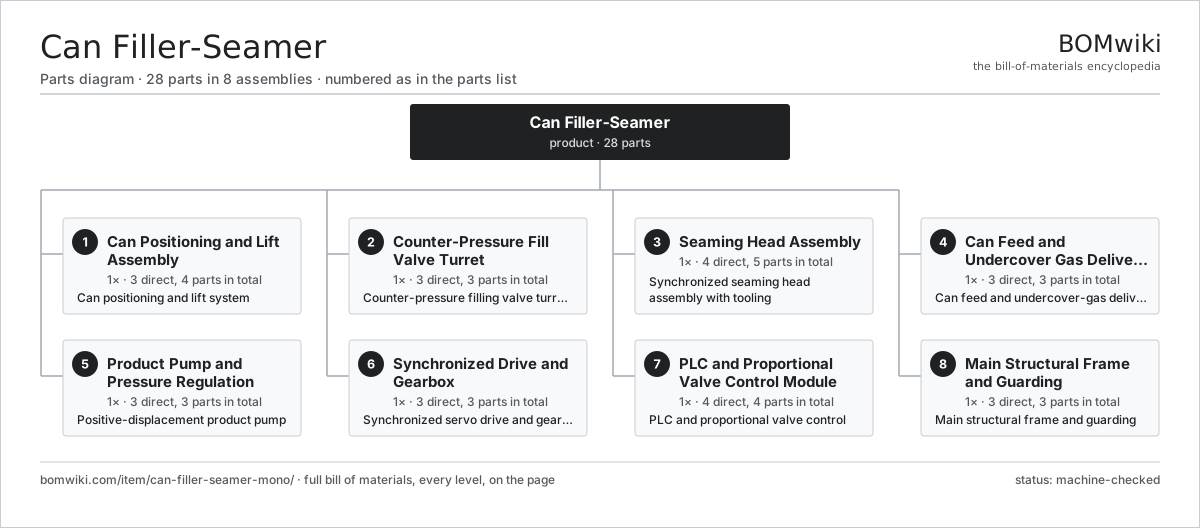
| # | Part | Qty | What it does |
|---|---|---|---|
| 1 | Can Positioning and Lift Assembly 3 parts | 1× | Can positioning and lift system |
| 2 | Counter-Pressure Fill Valve Turret 3 parts | 1× | Counter-pressure filling valve turret |
| 3 | Seaming Head Assembly 4 parts | 1× | Synchronized seaming head assembly with tooling |
| 4 | Can Feed and Undercover Gas Delivery 3 parts | 1× | Can feed and undercover-gas delivery |
| 5 | Product Pump and Pressure Regulation 3 parts | 1× | Positive-displacement product pump |
| 6 | Synchronized Drive and Gearbox 3 parts | 1× | Synchronized servo drive and gearbox |
| 7 | PLC and Proportional Valve Control Module 4 parts | 1× | PLC and proportional valve control |
| 8 | Main Structural Frame and Guarding 3 parts | 1× | Main structural frame and guarding |
3D model
No 3D model yet. Have a CAD file of this? Add a 3D model — STL renders right on this page; STEP, FreeCAD, and OpenSCAD sources are welcome too (openly licensed, like all 3D models on BOMwiki).
Build & assembly graph
expand / collapse · shared sub-assemblies converge · links to related products · est. labourTap an assembly to expand/collapse · tap a part to open it · use “Open page” for any node · drag to pan, scroll to zoom.
Bill of materials for Can Filler-Seamer
8 top-level lines · 34 rows shown · 28 parts total · indented to 3 levels| # | Item / sub-assembly | Part no. | Qty/assy | Ext. qty | Parts | Type |
|---|---|---|---|---|---|---|
| 1 | Can Positioning and Lift Assembly 3 parts | can-filler-seamer-mono-can-infeed | 1× | 1 | 4 | assembly |
| 1.1 | Pneumatic Lift Cylinder | can-filler-seamer-mono-lift-cylinders | 2× | 2 | · | part |
| 1.2 | Lift Servo Motor (optional) | can-filler-seamer-mono-lift-motor | 1× | 1 | · | part |
| 1.3 | Can Stripper Ring Ejector | can-filler-seamer-mono-stripper | 1× | 1 | · | part |
| 2 | Counter-Pressure Fill Valve Turret 3 parts | can-filler-seamer-mono-fill-head | 1× | 1 | 3 | assembly |
| 2.1 | Counter-Pressure Fill Spout | can-filler-seamer-mono-fill-nozzle | 1× | 1 | · | part |
| 2.2 | Fill Metering Valve | can-filler-seamer-mono-fill-valve | 1× | 1 | · | part |
| 2.3 | Pressure Accumulator Sphere | can-filler-seamer-mono-pressure-sphere | 1× | 1 | · | part |
| 3 | Seaming Head Assembly 4 parts | can-filler-seamer-mono-seam-head | 1× | 1 | 5 | assembly |
| 3.1 | Seaming Spindle Servo Motor | can-filler-seamer-mono-seam-motor | 1× | 1 | · | part |
| 3.2 | Seaming Die Chuck | can-filler-seamer-mono-chuck | 1× | 1 | · | part |
| 3.3 | Seaming Die Pair (First and Second Operation) | can-filler-seamer-mono-seaming-tool | 2× | 2 | · | part |
| 3.4 | Lid Pressure Ring | can-filler-seamer-mono-pressure-ring | 1× | 1 | · | part |
| 4 | Can Feed and Undercover Gas Delivery 3 parts | can-filler-seamer-mono-feed-system | 1× | 1 | 3 | assembly |
| 4.1 | Lid Hopper and Feeder | can-filler-seamer-mono-lid-magazine | 1× | 1 | · | part |
| 4.2 | Inert Gas Supply Regulator | can-filler-seamer-mono-gas-supply | 1× | 1 | · | part |
| 4.3 | Undercover Gas Needle Valve | can-filler-seamer-mono-gas-needle | 1× | 1 | · | part |
| 5 | Product Pump and Pressure Regulation 3 parts | can-filler-seamer-mono-pump | 1× | 1 | 3 | assembly |
| 5.1 | Pump Drive Motor | can-filler-seamer-mono-pump-motor | 1× | 1 | · | part |
| 5.2 | Pump Rotor Assembly | can-filler-seamer-mono-pump-shaft | 1× | 1 | · | part |
| 5.3 | Pressure Relief Valve | can-filler-seamer-mono-pressure-relief | 1× | 1 | · | part |
| 6 | Synchronized Drive and Gearbox 3 parts | can-filler-seamer-mono-drive | 1× | 1 | 3 | assembly |
| 6.1 | Main Drive Servo Motor | can-filler-seamer-mono-main-motor | 1× | 1 | · | part |
| 6.2 | Synchronizing Gearbox | can-filler-seamer-mono-gearbox | 1× | 1 | · | part |
| 6.3 | Encoder | encoder | 1× | 1 | · | part |
| 7 | PLC and Proportional Valve Control Module 4 parts | can-filler-seamer-mono-servo-amp | 1× | 1 | 4 | assembly |
| 7.1 | Filler-Seamer Control PLC | can-filler-seamer-mono-plc | 1× | 1 | · | part |
| 7.2 | Fill Proportional Amplifier | can-filler-seamer-mono-fill-amp | 1× | 1 | · | part |
| 7.3 | Seaming Pressure Proportional Amplifier | can-filler-seamer-mono-pressure-amp | 1× | 1 | · | part |
| 7.4 | Touch Digitizer | touch-digitizer | 1× | 1 | · | part |
| 8 | Main Structural Frame and Guarding 3 parts | can-filler-seamer-mono-frame | 1× | 1 | 3 | assembly |
| 8.1 | Structural Steel Frame | can-filler-seamer-mono-frame-struct | 1× | 1 | · | part |
| 8.2 | Electrical Control Enclosure | can-filler-seamer-mono-enclosure | 1× | 1 | · | part |
| 8.3 | Safety Guard Assembly | can-filler-seamer-mono-guard | 1× | 1 | · | part |
Related products
same domain, ranked by shared parts Crowner/Capper
38 parts · shares 2 with this page
Crowner/Capper
38 parts · shares 2 with this page
 Drum Drying Machine
634 parts · shares 2 with this page
Drum Drying Machine
634 parts · shares 2 with this page
 Fluid Bed Dryer
550 parts · shares 2 with this page
Fruit Grading Line
3,765 parts · shares 2 with this page
Fluid Bed Dryer
550 parts · shares 2 with this page
Fruit Grading Line
3,765 parts · shares 2 with this page
 Grain Color Sorter
3,056 parts · shares 2 with this page
Grain Color Sorter
3,056 parts · shares 2 with this page
Sourcing: possible vendors
Prices, MOQ, and lead times are algorithmic estimates, not quotes, and not claims about these companies. Company mappings are curated by keyword; est. price band $1k–$500k. How estimates work| Vendor | HQ | Specialty | MOQ | Lead time |
|---|---|---|---|---|
| gea.com ↗ | Düsseldorf, DE | Process technology | 20 units | 12–20 wks |
| buhlergroup.com ↗ | Uzwil, CH | Food & materials processing | 20 units | 12–20 wks |
| tetrapak.com ↗ | Pully, CH | Food packaging & processing | 20 units | 12–20 wks |
| jbtc.com ↗ | Chicago, US | Food processing equipment | 20 units | 12–20 wks |
| alfalaval.com ↗ | Lund, SE | Heat transfer & separation | 20 units | 12–20 wks |
972-word article