Candy Cane Machine
ProductOverview
A candy cane machine is a specialized high-speed automatic confectionery apparatus that produces iconic candy canes, striped rope candy bent into a hook shape. The machine combines dual rope extrusion (red and white simultaneously), a twister head that intertwines the ropes into a helical stripe, a crook-forming station that bends the warm rope into the characteristic J-hook shape, and a cooling conveyor that hardens the finished canes. Output ranges from 300–600 canes per hour depending on crook bend precision and cooling time. The machine is essential for seasonal candy cane production and is also used for novelty bent candies in other colors and shapes.
Candy canes are one of the few confections where the striping is mechanically created during production rather than applied afterward. The twisted rope creates the visual appeal and is a key part of the product's premium positioning.
Dual rope extrusion
The candy cane machine uniquely features two parallel extrusion barrels: one for red candy and one for white candy. Each barrel (25 mm ID, 200 mm length) is independently heated via 3-zone band heaters maintaining 65–80 °C. A single-flight screw in each barrel rotates at exactly 60 rpm, driven by synchronized servo motors with 1:30 gear reduction. This synchronized speed is critical: if red rope extrudes faster than white (or vice versa), the twister head would struggle, creating uneven stripes or jams.
Both ropes exit simultaneously through precision dies (8–12 mm orifice diameter) into a common receiving zone. The two ropes (red and white, each ~10 mm diameter) then immediately enter the twister head.
Rope twisting and stripe formation
The rope twister is a counter-rotating dual-screw mechanism (16 mm diameter, opposite-hand helical flights, 10 mm pitch, 120 rpm rotation). As red and white ropes fall simultaneously into the top of the twister block, the two counter-rotating screws intertwine them into a single striped rope. The screw pitch and rotation speed determine stripe frequency: at 120 rpm and 10 mm pitch, a new complete helical wrap completes every 2–3 mm of rope length, creating a tight, even stripe pattern.
The screw center spacing (adjusted via micrometer, ±1 mm range) controls stripe tightness. Closer spacing (1.5 mm) creates tight, uniform stripes; wider spacing (2.5 mm) creates looser, bolder stripes. Most manufacturers prefer tight stripes (~2 mm spacing) for premium appearance.
The resulting twisted rope emerges from the bottom of the twister block at continuous speed and immediately drops toward the crook-forming station.
Crook formation
Once the twisted striped rope reaches the crook bender, a heated plunger descends (triggered by a proximity sensor detecting rope arrival). The plunger presses the warm rope (still ~60 °C) into a stainless steel forming die that has a 120° hook radius (typical candy cane bend angle). The servo motor controlling the plunger provides gentle, consistent pressure; if pressure is too low, the bend is shallow; if too high, the rope deforms or flattens. Dwell time in the die is typically 1–2 seconds, allowing the rope to cool slightly and set the curve before the plunger retracts.
The bend angle is not adjustable without die changes; different angles (90° for novelty canes, 135° for specialty shapes) require swapping die blocks (15–30 minute changeover).
Once the plunger retracts, the bent candy cane continues moving and drops onto the cooling conveyor.
Cooling and hardening
The cooling conveyor is a stainless steel mesh belt (500 mm wide, 4 meters long) running at 0.2–0.5 m/min. Beneath the belt is a chilled water block (5–10 °C from an external chiller or ice bath) that cools the belt and indirectly cools candy canes via conduction. Optional forced air circulation (0.5 kW blower, 2 m³/min) further accelerates cooling. The candy canes gradually cool from 60 °C at the conveyor inlet to ~20 °C at the outlet (3–5 minutes of belt travel time).
Once hardened, the straight sections of each candy cane are intact, and the crook end has set into a permanent bend. The canes then proceed to the cutting station.
Cutting and length control
At the end of the cooling conveyor, a hot-wire or rotary blade cutter severs the continuous candy cane rope into individual finished canes. A mechanical length stop (adjustable 0–150 mm) controls the distance the rope advances before cutting. Standard candy canes are 120–150 mm (4.7–5.9 inches) long; adjusting the stop to 120 mm and triggering the cutter every 2–3 seconds produces canes of uniform length. The hot-wire method (200 W nichrome, ~0.5 mm diameter) melts a clean cut in <100 ms; the rotary blade method (stainless steel, 1 mm thick) shears cleanly and is preferred for faster cycles.
Synchronization and control
All moving components, dual extrusion screws, twister, crook plunger, cutting trigger, and conveyor, must operate in tight synchronization via the PLC system. Any drift in rope feed speed relative to twister speed causes stripe irregularity. Similarly, crook formation timing must align with twisted rope arrival, and cutting must occur at precise length intervals.
The multi-axis servo drive orchestrates all motion. The PLC receives encoder feedback from each servo, constantly adjusting speed to maintain perfect phase alignment. If extrusion speed increases by 5%, the PLC automatically increases twister speed by 5% to keep pace. An emergency stop button halts all servos immediately if a jam is detected.
Recipe parameters stored on the HMI include:
- Extrusion temperature (red barrel, white barrel, independent setpoints)
- Extrusion/twist speed (rpm, scaled to rope output)
- Crook press depth and dwell time
- Conveyor speed (m/min)
- Cane length (mm)
- Cutting cycle interval (seconds)
Production metrics and changeover
A mid-range candy cane machine at full speed produces 300–600 canes per hour, depending on cane length and cooling time. A 120 mm cane at 400 canes/hour represents one cane every 9 seconds. Running a single 8-hour shift yields 2,400–4,800 canes per day. Major confectioneries running multiple machines and extended hours (16–24 hours daily during seasonal peaks) can produce 50,000–100,000 canes per day.
Changeover to a different stripe pattern or cane length takes minutes: the operator adjusts the mechanical stop for length and the twister screw spacing for stripe tightness via micrometer. Changing candy colors (from red/white to green/white, or chocolate/white) requires dumping and reloading both barrels with new compound (15–30 minutes, including barrel cleaning).
Heat maintenance and energy
Both extrusion barrels consume continuous heating power (0.5 kW × 3 zones × 2 barrels = 3 kW nominal during warm-up, <1 kW during steady-state once temperature is reached). The crook-forming plunger heater runs intermittently (~0.5 kW when active, 1–2 seconds per cycle). Cooling conveyors and air circulation require 0.25 kW + 0.5 kW respectively. Total installed power is 5–6 kW electric plus 1–3 kW chiller (if used).
Flavor and color variation
Standard candy canes are peppermint-flavored with red and white colors. Variations include:
- Cinnamon canes: Red rope flavored with cinnamon oil, white rope plain sugar.
- Chocolate canes: Brown rope (cocoa + color), white rope (vanilla).
- Fruit flavors: Orange (orange + white), strawberry (red + white).
- Sugar-free: Using sorbitol or xylitol instead of glucose/sucrose.
Each flavor variation requires only a barrel reload; no hardware change is needed. The machine is fully neutral to flavor and color.
Maintenance and wear
The feed screws in both barrels see continuous contact with hot candy and are inspected every 500 hours. Screw replacement (if worn or stuck) costs ~€800 per screw. The twister screws (counter-rotating, high speed at 120 rpm) are subject to candy buildup and are cleaned weekly; replacement every 1,000 hours costs ~€1,200 per set.
The crook-forming die is stainless steel and virtually indestructible; it is only replaced if a different bend angle is desired (custom die cost ~€5,000–8,000).
All servo motors, encoders, and gearboxes are sealed cartridge units rated 10+ years with minimal maintenance (annual bearing inspection only).
Integration in candy production
Candy cane machines are typically standalone, specialty equipment dedicated to seasonal production. A complete candy cane line includes: candy cane machine → inspection/defect removal → wrapping → case pack. Some plants add secondary operations: dipping the crook end in melted chocolate, rolling in sprinkles, or applying a gift box immediately. These are usually manual operations or simple secondary machines.
The candy cane machine is one of the few confectionery systems that creates its own unique product identity (the twisted stripe) entirely within the machine, most other candies rely on multiple stages or post-production decoration.
Candy Cane Machine parts and their functions
8 top-level parts · 258 parts in total · full bill of materials below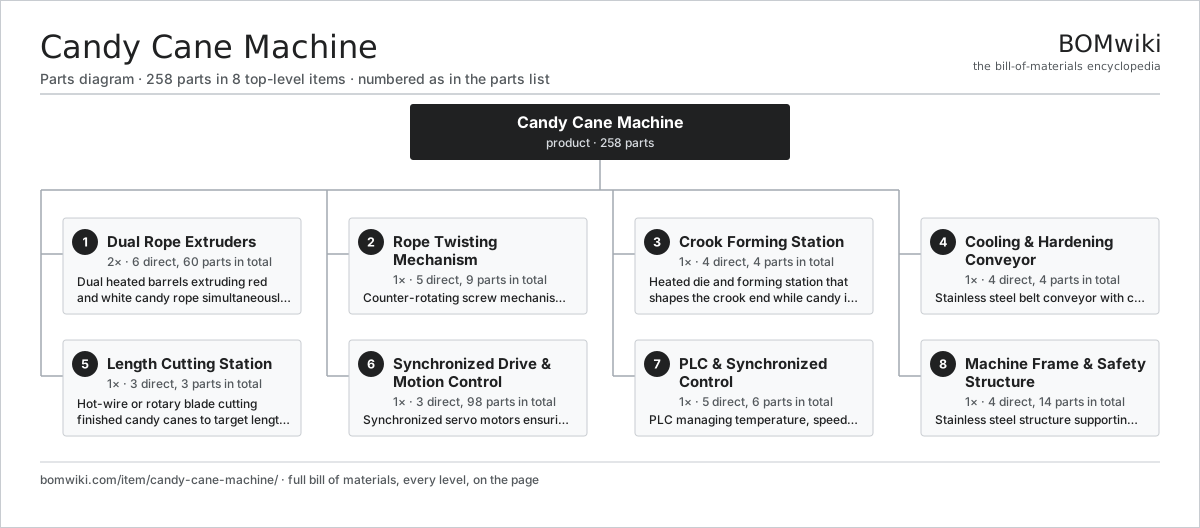
| # | Part | Qty | What it does |
|---|---|---|---|
| 1 | Dual Rope Extruders 6 parts | 2× | Dual heated barrels extruding red and white candy rope simultaneously at matched speeds |
| 2 | Rope Twisting Mechanism 5 parts | 1× | Counter-rotating screw mechanism intertwining red and white ropes into helical stripe pattern |
| 3 | Crook Forming Station 4 parts | 1× | Heated die and forming station that shapes the crook end while candy is warm |
| 4 | Cooling & Hardening Conveyor 4 parts | 1× | Stainless steel belt conveyor with chilled water or air circulation for final set |
| 5 | Length Cutting Station 3 parts | 1× | Hot-wire or rotary blade cutting finished candy canes to target length (120–150 mm) |
| 6 | Synchronized Drive & Motion Control 3 parts | 1× | Synchronized servo motors ensuring matched rope extrusion speed and twist rate |
| 7 | PLC & Synchronized Control 5 parts | 1× | PLC managing temperature, speed, cutting length, and production rate |
| 8 | Machine Frame & Safety Structure 4 parts | 1× | Stainless steel structure supporting all subsystems with safety guarding |
3D model
No 3D model yet. Have a CAD file of this? Add a 3D model. STL renders right on this page; STEP, FreeCAD, and OpenSCAD sources are welcome too (openly licensed, like all 3D models on BOMwiki).
Build & assembly graph
expand / collapse · shared sub-assemblies converge · links to related products · est. labourTap an assembly to expand/collapse · tap a part to open it · use “Open page” for any node · drag to pan, scroll to zoom.
Bill of materials for Candy Cane Machine
8 top-level lines · 50 rows shown · 258 parts total · indented to 3 levels| # | Item / sub-assembly | Part no. | Qty/assy | Ext. qty | Parts | Type |
|---|---|---|---|---|---|---|
| 1 | Dual Rope Extruders 6 parts | candy-cane-machine-rope-extrusion | 2× | 2 | 60 | assembly |
| 1.1 | Red Rope Barrel | candy-cane-machine-barrel-red | 1× | 2 | · | part |
| 1.2 | White Rope Barrel | candy-cane-machine-barrel-white | 1× | 2 | · | part |
| 1.3 | Extrusion Die | candy-cane-machine-extrusion-die | 2× | 4 | · | part |
| 1.4 | Feed Screw | candy-cane-machine-feed-screw | 2× | 4 | · | part |
| 1.5 | Servo Motor 4 parts | servo-motor | 2× | 4 | 24 | assembly |
| 1.5.1 | Stator Assembly 3 parts + deeper › | stator-assembly | 1× | 4 | 3 | assembly |
| 1.5.2 | Rotor Assembly 4 parts + deeper › | rotor-assembly | 1× | 4 | 19 | assembly |
| 1.5.3 | Encoder | encoder | 1× | 4 | · | part |
| 1.5.4 | Motor Housing | motor-housing | 1× | 4 | · | part |
| 1.6 | Heating Element | heating-element | 6× | 12 | · | part |
| 2 | Rope Twisting Mechanism 5 parts | candy-cane-machine-twister-head | 1× | 1 | 9 | assembly |
| 2.1 | Twister Screw | candy-cane-machine-twister-screw | 2× | 2 | · | part |
| 2.2 | Twister Drive Motor | candy-cane-machine-twister-motor | 1× | 1 | · | part |
| 2.3 | Twister Block | candy-cane-machine-twister-housing | 1× | 1 | · | part |
| 2.4 | Ball Bearing | ball-bearing | 4× | 4 | · | part |
| 2.5 | Screw Spacing Adjuster | candy-cane-machine-twist-depth-adjust | 1× | 1 | · | part |
| 3 | Crook Forming Station 4 parts | candy-cane-machine-crook-bender | 1× | 1 | 4 | assembly |
| 3.1 | Crook Die Block | candy-cane-machine-crook-die | 1× | 1 | · | part |
| 3.2 | Crook Forming Plunger | candy-cane-machine-crook-plunger | 1× | 1 | · | part |
| 3.3 | Crook Former Motor | candy-cane-machine-crook-servo | 1× | 1 | · | part |
| 3.4 | Rope Position Sensor | candy-cane-machine-crook-sensor | 1× | 1 | · | part |
| 4 | Cooling & Hardening Conveyor 4 parts | candy-cane-machine-cooling-conveyor | 1× | 1 | 4 | assembly |
| 4.1 | Cooling Belt | candy-cane-machine-conveyor-belt | 1× | 1 | · | part |
| 4.2 | Cooling Block | candy-cane-machine-cooling-jacket | 1× | 1 | · | part |
| 4.3 | Conveyor Drive | candy-cane-machine-conveyor-motor | 1× | 1 | · | part |
| 4.4 | Cooling Air Blower | candy-cane-machine-air-circulation | 1× | 1 | · | part |
| 5 | Length Cutting Station 3 parts | candy-cane-machine-cutting-station | 1× | 1 | 3 | assembly |
| 5.1 | Cutting Wire or Blade | candy-cane-machine-cut-wire | 1× | 1 | · | part |
| 5.2 | Length Stop | candy-cane-machine-cut-guide | 1× | 1 | · | part |
| 5.3 | Cut Trigger Solenoid | candy-cane-machine-cut-solenoid | 1× | 1 | · | part |
| 6 | Synchronized Drive & Motion Control 3 parts | candy-cane-machine-drive-system | 1× | 1 | 98 | assembly |
| 6.1 | Servo Motor 4 parts | servo-motor | 4× | 4 | 24 | assembly |
| 6.1.1 | Stator Assembly 3 parts + deeper › | stator-assembly | 1× | 4 | 3 | assembly |
| 6.1.2 | Rotor Assembly 4 parts + deeper › | rotor-assembly | 1× | 4 | 19 | assembly |
| 6.1.3 | Encoder | encoder | 1× | 4 | · | part |
| 6.1.4 | Motor Housing | motor-housing | 1× | 4 | · | part |
| 6.2 | Multi-Axis Servo Drive | candy-cane-machine-multi-axis-drive | 1× | 1 | · | part |
| 6.3 | Power Supply | power-supply | 1× | 1 | · | part |
| 7 | PLC & Synchronized Control 5 parts | candy-cane-machine-control-unit | 1× | 1 | 6 | assembly |
| 7.1 | Microcontroller | mcu | 1× | 1 | · | part |
| 7.2 | Multi-Axis Servo Drive | candy-cane-machine-multi-axis-drive | 1× | 1 | · | part |
| 7.3 | Power Supply | power-supply | 1× | 1 | · | part |
| 7.4 | LCD Panel | lcd-panel | 1× | 1 | · | part |
| 7.5 | Connector | connector | 2× | 2 | · | part |
| 8 | Machine Frame & Safety Structure 4 parts | candy-cane-machine-frame | 1× | 1 | 14 | assembly |
| 8.1 | Sheet Metal Panel | sheet-panel | 4× | 4 | · | part |
| 8.2 | Fastener Set | fastener-set | 4× | 4 | · | part |
| 8.3 | Heavy Isolator Feet | candy-cane-machine-feet | 4× | 4 | · | part |
| 8.4 | Wire Bundle | wire-bundle | 2× | 2 | · | part |
Something wrong in this list? Report a problem with this BOM.
Related products
same domain, ranked by shared parts Membrane Filtration Skid
482 parts · shares 18 with this page
Membrane Filtration Skid
482 parts · shares 18 with this page
Sourcing: possible vendors
Browse the supplier directory → Prices, MOQ, and lead times are algorithmic estimates, not quotes, and not claims about these companies. Company mappings are curated by keyword; est. price band $1k–$500k. How estimates work| Vendor | HQ | Specialty | MOQ | Lead time |
|---|---|---|---|---|
| gea.com ↗ | Düsseldorf, DE | Process technology | 20 units | 12–20 wks |
| buhlergroup.com ↗ | Uzwil, CH | Food & materials processing | 20 units | 12–20 wks |
| tetrapak.com ↗ | Pully, CH | Food packaging & processing | 20 units | 12–20 wks |
| jbtc.com ↗ | Chicago, US | Food processing equipment | 20 units | 12–20 wks |
| alfalaval.com ↗ | Lund, SE | Heat transfer & separation | 20 units | 12–20 wks |
1,570-word article