Capping Machine
ProductAlso known as: Bottle Capping Machine
Overview
A capping machine closes filled containers with screw caps at production speed, doing three jobs in one pass: sort caps from a bulk hopper into a known orientation, place one cap on each container, and tighten it to a controlled torque. Torque is the whole game, too loose and the product leaks or fails its induction seal, too tight and consumers cannot open it, cap skirts crack, or threads strip. Inline spindle cappers handle 40–200 containers per minute; rotary chuck machines used in beverage plants reach over 1,000.
How it works
Loose caps go into the Bulk Cap Hopper and ride the Cap Elevator up to the Orienting Disc. The spinning disc throws caps to its rim, where profile rails exploit the cap's asymmetry, open side is lighter and hollow, to pass only correctly oriented caps; the rest fall down the Return Chute and try again. A Blower Motor air assist flips borderline caps, and the Hopper Level Sensor cycles the elevator to keep the disc charged without flooding it.
Oriented caps queue single-file between the Chute Rails down to the pick-off point. On an inline capper there is no placement mechanism as such: the Pick-off Tongue holds the lowest cap tilted nose-down in the bottle path, and the moving container simply drives under it, threading the cap onto its own neck. The Cap Escapement releases one cap per bottle and the Low-Cap Sensor halts the line before the queue empties, since a bottle passing an empty chute leaves uncapped product heading for the case packer.
Tightening happens under the Capping Head Assembly. Each Head Spindle carries a Capping Chuck that grips the cap skirt and a Magnetic Torque Clutch in the drive path. The magnetic hysteresis clutch transmits torque through a magnetic field rather than contact friction, so it slips at precisely the set value, adjustable from 0.5 to 5 N·m by rotating the magnet array, with no wear drift, the reason it has displaced friction clutches on most machines. The Head Compliance Spring presses the head down so threads stay engaged while the cap runs down, and a Servo Motor per spindle lets modern machines profile the speed: fast run-down, slow final tightening, with servo current as a second torque check.
None of this works if the bottle spins with the cap. The Gripper Belts, opposed urethane belts running at conveyor speed, clamp the container body through the capping zone, reacting the full application torque. Round bottles on rotary machines are held in Starwheel pockets against a backing guide instead, with a Timing Screw upstream converting randomly spaced bottles into head-pitch spacing. The Bottle Conveyor, belts and heads all derive their speed from the Main Drive through its Gearbox Housing and Encoder feedback, so bottle and head velocities match through the engagement zone.
Inspection and quality
Every container then passes the Cap Inspection Station station. The laser Cap Height Sensor measures cap-top height to ±0.2 mm: a high reading means a cocked cap or cross-thread, a missing echo means no cap at all. An CMOS Image Sensor checks skew and cap colour against the recipe. Failures are pushed off by the Reject Pusher, with a Hall Sensor confirming the reject actually left the line, an unverified reject is a quality escape. Application torque itself is audited offline: removal torque measured minutes after capping settles to roughly half the applied value as the liner relaxes, and packagers sample it hourly.
Formats and changeover
Change parts make one machine serve many SKUs: chucks sized to cap diameter, chute rails, timing screw and guide rails per bottle, head height set on the Height Adjustment Column. A disciplined changeover takes 15–30 minutes. Child-resistant caps need a push-down-and-turn action, which the compliant head spring provides naturally; pump and trigger caps run on the same machines with deeper chucks and torque raised to seat the dip tube. The PLC Controller stores all of it as recipes, and Guard Interlock switches on the guard doors stop the spindles whenever an operator reaches in.
Capping Machine parts and their functions
8 top-level parts · 172 parts in total · full bill of materials below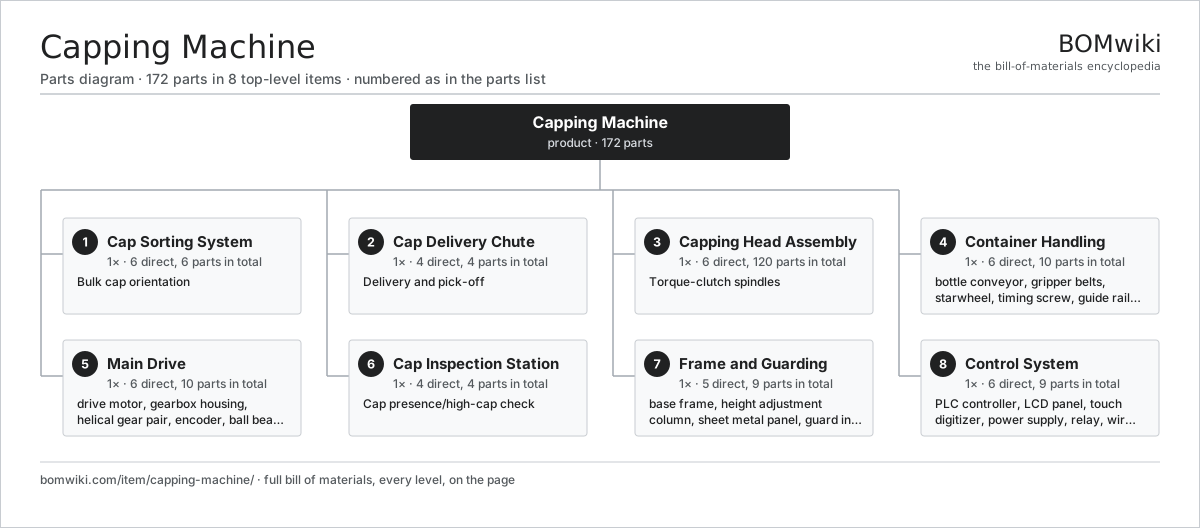
| # | Part | Qty | What it does |
|---|---|---|---|
| 1 | Cap Sorting System 6 parts | 1× | Bulk cap orientation |
| 2 | Cap Delivery Chute 4 parts | 1× | Delivery and pick-off |
| 3 | Capping Head Assembly 6 parts | 1× | Torque-clutch spindles |
| 4 | Container Handling 6 parts | 1× | Conveyor, gripper belts and starwheels that hold bottles against capping torque. |
| 5 | Main Drive 6 parts | 1× | Geared drive synchronizing conveyor, belts and head carriage. |
| 6 | Cap Inspection Station 4 parts | 1× | Cap presence/high-cap check |
| 7 | Frame and Guarding 5 parts | 1× | Stainless frame with height adjustment and interlocked guard doors. |
| 8 | Control System 6 parts | 1× | PLC with servo torque control, recipes and reject tracking. |
3D model
No 3D model yet. Have a CAD file of this? Add a 3D model. STL renders right on this page; STEP, FreeCAD, and OpenSCAD sources are welcome too (openly licensed, like all 3D models on BOMwiki).
Build & assembly graph
expand / collapse · shared sub-assemblies converge · links to related products · est. labourTap an assembly to expand/collapse · tap a part to open it · use “Open page” for any node · drag to pan, scroll to zoom.
Bill of materials for Capping Machine
8 top-level lines · 55 rows shown · 172 parts total · indented to 3 levels| # | Item / sub-assembly | Part no. | Qty/assy | Ext. qty | Parts | Type |
|---|---|---|---|---|---|---|
| 1 | Cap Sorting System 6 parts | capping-machine-cap-sorter | 1× | 1 | 6 | assembly |
| 1.1 | Bulk Cap Hopper | capping-machine-cap-hopper | 1× | 1 | · | part |
| 1.2 | Cap Elevator | capping-machine-cap-elevator | 1× | 1 | · | part |
| 1.3 | Orienting Disc | capping-machine-orienting-disc | 1× | 1 | · | part |
| 1.4 | Return Chute | capping-machine-return-chute | 1× | 1 | · | part |
| 1.5 | Blower Motor | blower-motor | 1× | 1 | · | part |
| 1.6 | Hopper Level Sensor | capping-machine-level-sensor | 1× | 1 | · | part |
| 2 | Cap Delivery Chute 4 parts | capping-machine-cap-chute | 1× | 1 | 4 | assembly |
| 2.1 | Chute Rails | capping-machine-chute-rails | 1× | 1 | · | part |
| 2.2 | Cap Escapement | capping-machine-escapement | 1× | 1 | · | part |
| 2.3 | Pick-off Tongue | capping-machine-pickoff-cam | 1× | 1 | · | part |
| 2.4 | Low-Cap Sensor | capping-machine-low-cap-sensor | 1× | 1 | · | part |
| 3 | Capping Head Assembly 6 parts | capping-machine-capping-heads | 1× | 1 | 120 | assembly |
| 3.1 | Capping Chuck | capping-machine-chuck | 4× | 4 | · | part |
| 3.2 | Magnetic Torque Clutch | capping-machine-torque-clutch | 4× | 4 | · | part |
| 3.3 | Head Spindle | capping-machine-head-spindle | 4× | 4 | · | part |
| 3.4 | Head Compliance Spring | capping-machine-head-spring | 4× | 4 | · | part |
| 3.5 | Servo Motor 4 parts | servo-motor | 4× | 4 | 24 | assembly |
| 3.5.1 | Stator Assembly 3 parts + deeper › | stator-assembly | 1× | 4 | 3 | assembly |
| 3.5.2 | Rotor Assembly 4 parts + deeper › | rotor-assembly | 1× | 4 | 19 | assembly |
| 3.5.3 | Encoder | encoder | 1× | 4 | · | part |
| 3.5.4 | Motor Housing | motor-housing | 1× | 4 | · | part |
| 3.6 | Ball Bearing | ball-bearing | 8× | 8 | · | part |
| 4 | Container Handling 6 parts | capping-machine-container-handling | 1× | 1 | 10 | assembly |
| 4.1 | Bottle Conveyor | capping-machine-conveyor | 1× | 1 | · | part |
| 4.2 | Gripper Belts | capping-machine-gripper-belts | 2× | 2 | · | part |
| 4.3 | Starwheel | capping-machine-starwheel | 2× | 2 | · | part |
| 4.4 | Timing Screw | capping-machine-timing-screw | 1× | 1 | · | part |
| 4.5 | Guide Rails | capping-machine-guide-rails | 2× | 2 | · | part |
| 4.6 | Drive Belt | drive-belt | 2× | 2 | · | part |
| 5 | Main Drive 6 parts | capping-machine-main-drive | 1× | 1 | 10 | assembly |
| 5.1 | Drive Motor | capping-machine-drive-motor | 1× | 1 | · | part |
| 5.2 | Gearbox Housing | gearbox-housing | 1× | 1 | · | part |
| 5.3 | Helical Gear Pair | gear-pair | 2× | 2 | · | part |
| 5.4 | Encoder | encoder | 1× | 1 | · | part |
| 5.5 | Ball Bearing | ball-bearing | 4× | 4 | · | part |
| 5.6 | Fastener Set | fastener-set | 1× | 1 | · | part |
| 6 | Cap Inspection Station 4 parts | capping-machine-inspection | 1× | 1 | 4 | assembly |
| 6.1 | Cap Height Sensor | capping-machine-height-sensor | 1× | 1 | · | part |
| 6.2 | CMOS Image Sensor | image-sensor | 1× | 1 | · | part |
| 6.3 | Reject Pusher | capping-machine-reject-pusher | 1× | 1 | · | part |
| 6.4 | Hall Sensor | hall-sensor | 1× | 1 | · | part |
| 7 | Frame and Guarding 5 parts | capping-machine-frame | 1× | 1 | 9 | assembly |
| 7.1 | Base Frame | capping-machine-base-frame | 1× | 1 | · | part |
| 7.2 | Height Adjustment Column | capping-machine-height-column | 1× | 1 | · | part |
| 7.3 | Sheet Metal Panel | sheet-panel | 4× | 4 | · | part |
| 7.4 | Guard Interlock | capping-machine-interlock | 2× | 2 | · | part |
| 7.5 | Fastener Set | fastener-set | 1× | 1 | · | part |
| 8 | Control System 6 parts | capping-machine-controls | 1× | 1 | 9 | assembly |
| 8.1 | PLC Controller | capping-machine-plc | 1× | 1 | · | part |
| 8.2 | LCD Panel | lcd-panel | 1× | 1 | · | part |
| 8.3 | Touch Digitizer | touch-digitizer | 1× | 1 | · | part |
| 8.4 | Power Supply | power-supply | 1× | 1 | · | part |
| 8.5 | Relay | relay | 4× | 4 | · | part |
| 8.6 | Wire Bundle | wire-bundle | 1× | 1 | · | part |
Something wrong in this list? Report a problem with this BOM.
Related products
same domain, ranked by shared parts Hot Foil Stamping Machine
69 parts · shares 3 with this page
Hot Foil Stamping Machine
69 parts · shares 3 with this page
 Induction Cap Sealer
44 parts · shares 2 with this page
Induction Cap Sealer
44 parts · shares 2 with this page
 Blister Packaging Machine
256 parts · shares 6 with this page
Thermoform-Fill-Seal Machine
364 parts · shares 6 with this page
Blister Packaging Machine
256 parts · shares 6 with this page
Thermoform-Fill-Seal Machine
364 parts · shares 6 with this page
 Tube Filling Machine
134 parts · shares 6 with this page
Tube Filling Machine
134 parts · shares 6 with this page
Sourcing: possible vendors
Browse the supplier directory → Prices, MOQ, and lead times are algorithmic estimates, not quotes, and not claims about these companies. Company mappings are curated by keyword; est. price band $10k–$3M. How estimates work| Vendor | HQ | Specialty | MOQ | Lead time |
|---|---|---|---|---|
| heidelberg.com ↗ | Heidelberg, DE | Printing presses | 10 units | 12–22 wks |
|
🇨🇭Bobst
bobst.com ↗
|
Lausanne, CH | Packaging machinery | 10 units | 12–22 wks |
| koenig-bauer.com ↗ | Würzburg, DE | Printing presses | 10 units | 12–22 wks |
| wuh-group.com ↗ | Lengerich, DE | Flexible packaging machines | 10 units | 12–22 wks |
| markandy.com ↗ | Chesterfield, US | Label presses | 10 units | 12–22 wks |
723-word article