Car Elevator
ProductOverview
A car elevator, also known as an automotive lift or multi-car lift, is a fixed vertical transportation system designed to raise and lower one to three automobiles between different building levels or parking decks. Unlike the free-standing hydraulic lifts found in auto-repair shops, car elevators are integrated into building infrastructure, anchored to the structure via guide rails, suspended by steel ropes, and driven by electric motors and geared transmissions. They are common in high-rise parking facilities, hotels, luxury residences, and industrial facilities where compact vertical parking is required.
The system operates on one of two principles: traction drive (friction-based rope engagement) or hydraulic pump drive (pressure-actuated cylinders). Traction systems, using grooved sheaves and multiple wire ropes, are more common in urban installations due to higher efficiency and smoother operation. Hydraulic systems, using pump-driven cylinders, are preferred in rugged or outdoor environments and offer simpler maintenance. Both methods employ counterweights to reduce motor load, safety rails to prevent tilting, and multiple interlocks to prevent operation when doors or safety gates are open.
A typical car elevator can lift 2–3 vehicles (totaling 3000–6000 kg) vertically at speeds of 0.5–1.0 m/s, making a full cycle (load, ascend, unload, descend) in 20–40 seconds per floor. With modern soft-starters and proportional control, electrical demand is modest: most systems draw 5–15 kW during acceleration and only 1–2 kW during steady descent.
How it Works
A driver maneuvers a vehicle onto the platform cabin, typically 4–6 m long and 2–3 m wide, and stops. An attendant or the driver presses a call button. A control relay verifies that the safety latches on both the entrance gate and the landing gate are engaged, if not, the motor cannot start. Once verified, the soft-starter energizes the AC motor, which drives the gear reducer at approximately 100–150 rpm (stepped down from 1500 rpm motor speed).
The gear reducer output shaft couples directly to the traction sheave, a grooved pulley typically 300–400 mm in diameter. The sheave grips multiple steel wire ropes (typically 2–4 ropes, each 8–12 mm diameter) through friction in the grooves. As the sheave rotates, the ropes are pulled upward, lifting the cabin and its vehicle load. Simultaneously, counterweights (800–2000 kg) descend on parallel ropes, balancing the load and reducing the net work the motor must perform.
The cabin rises along vertical guide rails, maintained in perfect vertical alignment by multiple roller guide blocks bolted to the cabin frame. These guides run on the rail with 5–10 mm clearance, preventing swinging or tilting. The motor maintains constant speed via the gear reducer's fixed ratio; there is no variable transmission in a traction elevator.
When the cabin reaches the target floor, a top or bottom limit switch, triggered by a mechanical cam on the cabin or cable, cuts power to the soft-starter. The motor coasts to a stop through friction. The cabin door hydraulic actuators open automatically, driven by the auxiliary hydraulic pump which is engaged during descent phases. The vehicle drives out; the cycle then reverses.
If at any point a door or safety gate is opened by personnel, the mechanical interlock latch releases, opening a safety relay contact and de-energizing the motor. The cabin cannot move. This is a hard mechanical interlock, not dependent on electrical signals.
Traction vs. Hydraulic Operation
In a traction system (the dominant design for car elevators):
- The sheave grips the ropes through friction. Rope tension is balanced on both sides of the sheave via the counterweight and the cabin load.
- Motor power is proportional to the load: lifting 3000 kg requires more motor torque than lifting 500 kg, but the sheave speed remains constant.
- Efficiency is high: the counterweight mechanically offsets load, reducing net motor work.
- Smooth operation: the sheave and rope system naturally distributes loads and tolerates minor rope wear without jerking.
In a hydraulic system:
- An electric motor (or diesel engine, in standby systems) drives a hydraulic pump.
- Large-bore cylinders mounted on the cabin frame lift it via hydraulic pressure (typically 210 bar for car elevators, 280 bar for cargo).
- The pump is typically fixed-displacement; speed control is via proportional directional control valves (similar to ship lift architecture but at much smaller scale).
- Efficiency is lower than traction (hydraulic fluid absorbs energy as heat), but the system is simpler, more compact, and easier to maintain.
Most modern car elevators for buildings are traction-driven due to superior efficiency and the ability to achieve fine speed control via soft-starters.
Safety and Interlock Systems
Car elevators are subject to strict safety regulations (EN 81-3 in Europe, ASME A17.1 in North America). Key safety features include:
Mechanical Door Interlocks: The safety latch is a spring-loaded hook engaged when the landing gate is closed. If the gate swings open, the latch disengages mechanically, cutting power to a safety relay and preventing motor restart.
Overspeed Governor: A centrifugal governor is mounted on the rope system. If the cabin descends faster than a preset threshold (e.g., 1.5× rated speed), the governor triggers a mechanical emergency rope clamp that grips the rope, halting descent. This is a passive, mechanical system requiring no electrical input.
Buffers and Dampers: At the bottom of the shaft, the cabin frame contacts heavy compression spring buffers and hydraulic buffer cylinders. These absorb the kinetic energy of an overtravel impact, limiting deceleration to safe levels (typically 2–4 g).
Redundant Limit Switches: Independent mechanical limit switches at the top and bottom of the shaft are wired in series with the safety relay circuit. If either is triggered, the motor cannot run.
Load Monitoring: Modern systems include rope tension monitors and pressure transducers in the hydraulic system (if applicable). Abnormal tension or pressure cuts power to prevent operation with a fouled or misaligned rope.
Environmental and Performance Considerations
Car elevators operating in climate-controlled buildings (most modern installations) experience minimal corrosion. However, units exposed to salt spray (coastal facilities) or aggressive industrial atmospheres require stainless-steel sheaves, galvanized ropes, and aluminum or stainless cladding.
The noise signature of a traction car elevator is dominated by the motor and gear reducer; a complete machine room installation produces 75–85 dB at the pithouse. Addition of elastomeric motor mounts and acoustic shrouding reduces this to 70–75 dB, acceptable for most building codes.
Electrical loads are modest: a fully loaded 15 kW motor draws that peak power only during upward acceleration; steady-state descent with a counterweight consumes 1–2 kW as the motor restarts periodically to overcome friction and load creep. Modern soft-starters limit inrush current, reducing demand on the building electrical system and extending motor life.
Related Systems
For larger vehicles or heavier loads, industrial goods lifts are used. For inclined terrain, inclined elevators replace the vertical rail guide system. For extreme heights (tall buildings), passenger elevators are scaled up with multiple ropes and higher motor power but retain the same traction-sheave principle.
Car Elevator parts and their functions
8 top-level parts · 279 parts in total · full bill of materials below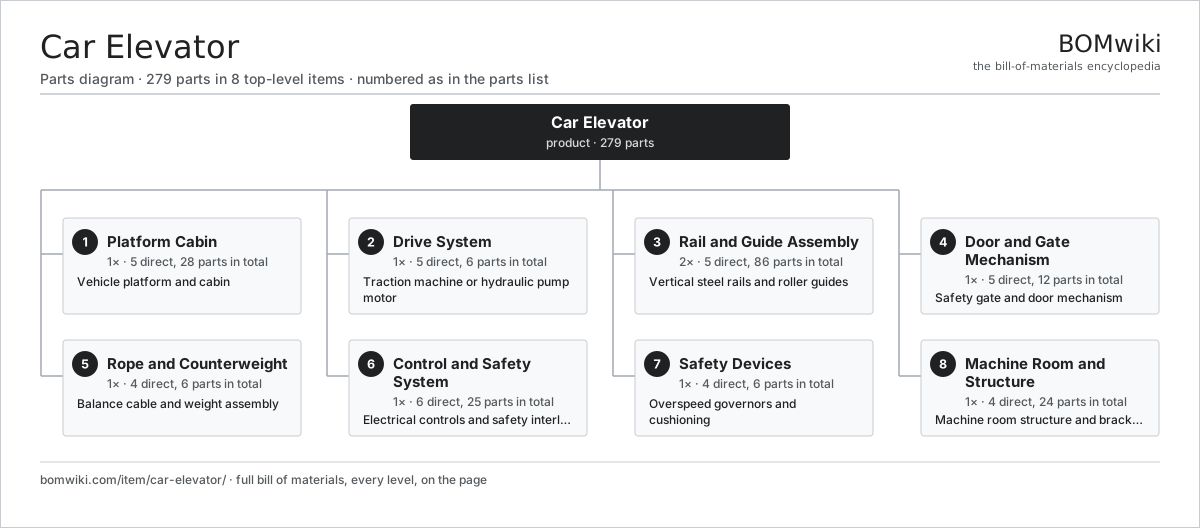
| # | Part | Qty | What it does |
|---|---|---|---|
| 1 | Platform Cabin 5 parts | 1× | Vehicle platform and cabin |
| 2 | Drive System 5 parts | 1× | Traction machine or hydraulic pump motor |
| 3 | Rail and Guide Assembly 5 parts | 2× | Vertical steel rails and roller guides |
| 4 | Door and Gate Mechanism 5 parts | 1× | Safety gate and door mechanism |
| 5 | Rope and Counterweight 4 parts | 1× | Balance cable and weight assembly |
| 6 | Control and Safety System 6 parts | 1× | Electrical controls and safety interlocks |
| 7 | Safety Devices 4 parts | 1× | Overspeed governors and cushioning |
| 8 | Machine Room and Structure 4 parts | 1× | Machine room structure and brackets |
3D model
No 3D model yet. Have a CAD file of this? Add a 3D model. STL renders right on this page; STEP, FreeCAD, and OpenSCAD sources are welcome too (openly licensed, like all 3D models on BOMwiki).
Build & assembly graph
expand / collapse · shared sub-assemblies converge · links to related products · est. labourTap an assembly to expand/collapse · tap a part to open it · use “Open page” for any node · drag to pan, scroll to zoom.
Bill of materials for Car Elevator
8 top-level lines · 46 rows shown · 279 parts total · indented to 3 levels| # | Item / sub-assembly | Part no. | Qty/assy | Ext. qty | Parts | Type |
|---|---|---|---|---|---|---|
| 1 | Platform Cabin 5 parts | car-elevator-platform-cab | 1× | 1 | 28 | assembly |
| 1.1 | Platform Steel Frame | car-elevator-platform-frame | 1× | 1 | · | part |
| 1.2 | Cabin Enclosure | car-elevator-cabin-walls | 1× | 1 | · | part |
| 1.3 | Drive Ramp | car-elevator-ramp-plate | 2× | 2 | · | part |
| 1.4 | Cable Termination Lug | car-elevator-cable-lugs | 8× | 8 | · | part |
| 1.5 | Fastener Set | fastener-set | 16× | 16 | · | part |
| 2 | Drive System 5 parts | car-elevator-drive-system | 1× | 1 | 6 | assembly |
| 2.1 | Traction Motor | car-elevator-traction-motor | 1× | 1 | · | part |
| 2.2 | Gear Reducer | car-elevator-gear-reducer | 1× | 1 | · | part |
| 2.3 | Traction Sheave | car-elevator-sheave-set | 2× | 2 | · | part |
| 2.4 | Hydraulic Pump | car-elevator-hydraulic-pump | 1× | 1 | · | part |
| 2.5 | Flexible Coupling | car-elevator-coupling | 1× | 1 | · | part |
| 3 | Rail and Guide Assembly 5 parts | car-elevator-rail-guide | 2× | 2 | 86 | assembly |
| 3.1 | Vertical Rail | car-elevator-rail-section | 2× | 4 | · | part |
| 3.2 | Roller Guide Unit | car-elevator-roller-guide | 8× | 16 | · | part |
| 3.3 | Guide Bracket | car-elevator-guide-bracket | 12× | 24 | · | part |
| 3.4 | Ball Bearing | ball-bearing | 16× | 32 | · | part |
| 3.5 | Fastener Set | fastener-set | 48× | 96 | · | part |
| 4 | Door and Gate Mechanism 5 parts | car-elevator-door-system | 1× | 1 | 12 | assembly |
| 4.1 | Gate Frame | car-elevator-gate-frame | 2× | 2 | · | part |
| 4.2 | Gate Panel | car-elevator-gate-panel | 2× | 2 | · | part |
| 4.3 | Door Actuator | car-elevator-gate-actuator | 2× | 2 | · | part |
| 4.4 | Safety Interlock Latch | car-elevator-safety-latch | 4× | 4 | · | part |
| 4.5 | O-Ring Set | oring-set | 2× | 2 | · | part |
| 5 | Rope and Counterweight 4 parts | car-elevator-rope-counterweight | 1× | 1 | 6 | assembly |
| 5.1 | Steel Wire Rope | car-elevator-roping | 2× | 2 | · | part |
| 5.2 | Counterweight Block | car-elevator-counterweight-set | 1× | 1 | · | part |
| 5.3 | Counterweight Frame | car-elevator-weight-frame | 1× | 1 | · | part |
| 5.4 | Counterweight Pulley | car-elevator-rope-guide | 2× | 2 | · | part |
| 6 | Control and Safety System 6 parts | car-elevator-control-box | 1× | 1 | 25 | assembly |
| 6.1 | Control Enclosure | car-elevator-electrical-enclosure | 1× | 1 | · | part |
| 6.2 | Electronic Soft-Starter | car-elevator-soft-starter | 1× | 1 | · | part |
| 6.3 | Limit Switch | car-elevator-limit-switch | 4× | 4 | · | part |
| 6.4 | Relay | relay | 6× | 6 | · | part |
| 6.5 | Connector | connector | 12× | 12 | · | part |
| 6.6 | Pressure Sensor | pressure-sensor | 1× | 1 | · | part |
| 7 | Safety Devices 4 parts | car-elevator-bumpers-safeties | 1× | 1 | 6 | assembly |
| 7.1 | Overspeed Governor | car-elevator-governor | 1× | 1 | · | part |
| 7.2 | Compression Spring Buffer | car-elevator-buffer-spring | 2× | 2 | · | part |
| 7.3 | Hydraulic Buffer | car-elevator-buffer-piston | 2× | 2 | · | part |
| 7.4 | Emergency Rope Clamp | car-elevator-rope-clamp | 1× | 1 | · | part |
| 8 | Machine Room and Structure 4 parts | car-elevator-pithouse | 1× | 1 | 24 | assembly |
| 8.1 | Machine Room Frame | car-elevator-machine-frame | 1× | 1 | · | part |
| 8.2 | Noise Shroud | car-elevator-noise-shroud | 1× | 1 | · | part |
| 8.3 | Fastener Set | fastener-set | 20× | 20 | · | part |
| 8.4 | Sheet Metal Panel | sheet-panel | 2× | 2 | · | part |
Something wrong in this list? Report a problem with this BOM.
Related products
same domain, ranked by shared parts Canal Ship Lift
169 parts · shares 3 with this page
Canal Ship Lift
169 parts · shares 3 with this page
 Industrial Goods Lift
358 parts · shares 3 with this page
Pneumatic Vacuum Elevator
122 parts · shares 2 with this page
Two-Post Car Parking Lift
108 parts · shares 2 with this page
Industrial Goods Lift
358 parts · shares 3 with this page
Pneumatic Vacuum Elevator
122 parts · shares 2 with this page
Two-Post Car Parking Lift
108 parts · shares 2 with this page
 Wheelchair Platform Lift
89 parts · shares 2 with this page
Residential Stair Lift
143 parts · shares 1 with this page
Wheelchair Platform Lift
89 parts · shares 2 with this page
Residential Stair Lift
143 parts · shares 1 with this page
Sourcing: possible vendors
Browse the supplier directory → Prices, MOQ, and lead times are algorithmic estimates, not quotes, and not claims about these companies. Company mappings are curated by keyword; est. price band $10k–$200k. How estimates work| Vendor | HQ | Specialty | MOQ | Lead time |
|---|---|---|---|---|
|
🇺🇸Otis
otis.com ↗
|
Farmington, US | Elevators & escalators | 20 units | 14–24 wks |
| schindler.com ↗ | Ebikon, CH | Elevators & escalators | 20 units | 14–24 wks |
|
🇫🇮KONE
kone.com ↗
|
Espoo, FI | Elevators & escalators | 20 units | 14–24 wks |
| tkelevator.com ↗ | Düsseldorf, DE | Elevators | 20 units | 14–24 wks |
| mitsubishielectric.com ↗ | Tokyo, JP | Elevators & electronics | 20 units | 14–24 wks |
1,290-word article