Carbon Arrow
ProductOverview
A carbon arrow is the projectile in modern archery, consisting of a hollow carbon fiber shaft, tapered aluminum point insert, nock receiver, and adhesively-bonded fletching. Carbon fiber dominates archery because it balances lightweight construction (5–8 grains per inch vs. 10–12 for aluminum) with superior straightness tolerance, impact resilience, and cost efficiency ($8–15 per shaft in bulk).
The Carbon Fiber Shaft is a critical engineering component: too light (low grain-per-inch), and the arrow lacks energy to penetrate; too stiff, and the bow's energy cannot flex it sufficiently, wasting power; too flexible (underspined), and the arrow droops and misses the target. Matching arrow spine to bow draw weight and draw length is a fundamental accuracy requirement called "arrow tuning."
Shaft Engineering
The Carbon Fiber Shaft is manufactured by wrapping continuous carbon fiber strands (0.5–2 micron diameter fibers bundled into yarn) around a mandrel, impregnating with epoxy resin, and heat-curing. The resulting hollow tube has:
Material properties:
- Carbon fiber modulus: 220–230 GPa (elastic stiffness), much higher than aluminum (~70 GPa).
- Density: 1.6 g/cm³ (carbon composite) vs. 2.7 g/cm³ (aluminum 7075), explaining weight advantage.
- Tensile strength: 3,500–4,000 MPa (carbon) vs. 570 MPa (6061 aluminum).
- Impact resistance: Carbon is brittle; a sharp sideways impact can cause internal cracking without visible external damage. Aluminum bends; carbon fractures.
Spine rating: Spine is the shaft's bending stiffness, quantified as deflection under a 2-pound load suspended 28 inches from support points:
- Spine 500 = 0.500 inch deflection (stiff)
- Spine 400 = 0.400 inch deflection
- Spine 340 = 0.340 inch deflection (flexible)
Correct spine is determined by the AMO (Archery Manufacturers Organization) formula:
- Spine = (Draw Weight × Draw Length) / 11 (for recurve bows)
- Spine = (Draw Weight × Draw Length) / 12 (for compound bows, due to mechanical advantage)
Example: A 50 lb recurve bow at 28″ draw requires spine (50 × 28) / 11 ≈ 127 → spine 125 or 150 arrow.
If the arrow is overspined (too stiff):
- Arrow doesn't flex sufficiently at release; energy is wasted bending the bow limbs rather than accelerating the arrow.
- Arrow shoots to the right (weak side) because the bow cannot drive it straight.
If the arrow is underspined (too flexible):
- Arrow oscillates too much, drooping and losing energy.
- Arrow shoots to the left (strong side) due to excessive flexing.
Spining within ±5 is acceptable for casual shooting; ±1–2 is preferred for competition.
Nock & String Interface
The Nock Receiver receiver is a reinforced terminal that accepts the plastic Nock Receiver part (not defined in our scope; shared leaf). The nock's T-shaped or U-shaped groove fits onto the bowstring, and the string's nocking point (typically a crimp 0.5–1 inch above perpendicular) seats the arrow at consistent height.
Nocking point precision:
- If nock height is too high, arrow point drops at release (arrow climbs higher initially, falling further downrange).
- If nock height is too low, arrow oscillates vertically.
- Optimal height is typically ±0.125 inch of perfect perpendicular (center nocking).
The Nock-End Reinforcement Wrap is a thin fiberglass or Mylar tape reinforcing the shaft just above the nock bushing, preventing crack initiation under repeated nocking stress. Without the wrap, vibration from string tension causes micro-cracking at the nock–shaft junction, eventually leading to shaft failure.
Point Insert & Broadhead Attachment
The Point-Weight Insert is a tapered aluminum or steel bushing glued (with epoxy) into the shaft's hollow forward end. The insert provides:
- Threaded bore (typically M6 metric or 5/32 inch) accepting broadhead or field point screws.
- Taper match: The insert's external taper seats flush within the shaft's internal diameter, distributing impact load gradually.
- Weight class separation: Different inserts are used for different point weights (75, 100, 125, 150 grain), ensuring the finished arrow achieves correct total mass.
Point attachment:
- A broadhead or field point (75–150 grains) screws into the insert.
- Torque is critical: too loose, the point can separate mid-flight; too tight, the insert threads strip.
- Typical torque: 5–8 inch-pounds (gently snug, not wrenched tight).
Broadhead types:
- Fixed-blade: Single-piece steel or aluminum design; durable, accurate, slower (5–10 ft/s slower than field points).
- Mechanical: Blades fold closed during flight, deploying on impact; fast, complex, risk of deployment failure.
- Blunt (field point): Rounded or slightly flattened tip for target practice; does not damage foam or inflatable targets.
For hunting, broadhead selection is critical: a 2-inch cutting diameter mechanical broadhead at 300 ft/s penetrates 12–16 inches into medium game; a blunt field point at the same speed inflicts trauma but does not penetrate.
Fletching & Stabilization
The Fletching Assembly consists of three vanes or feathers glued to the shaft near the nock end, providing rotational and lateral stability. Fletching creates drag, which is aerodynamically inefficient but mechanically essential: without fletching, an arrow follows a parabolic arc and cannot be aimed.
Vane design:
- Height: 0.5–1.0 inch (13–25 mm) typical.
- Length: 2–3.5 inches (5–9 cm) measured along shaft axis.
- Material: Plastic (polyethylene or polypropylene, durable and consistent) or natural turkey feather (slightly faster due to less mass, more fragile).
Spin & helical offset:
- Traditional fletching is glued straight (parallel to shaft axis), providing no spin.
- Helical fletching is angled (3–5 degree offset) around the shaft's circumference, inducing clockwise or counterclockwise spin.
- Spinning arrow is more stable in crosswind and provides gyroscopic stability (like a rifle bullet).
Fletching placement:
- Three-fletch symmetry is standard (120° separation), distributing drag evenly.
- Offset vane placement (cock vane pointing perpendicular to arrow rest) prevents collision with bowstring at release.
Fletching damage (torn or loose vanes) requires replacement. A vane can be re-glued with epoxy, or the entire fletching set can be stripped and re-fletch using a Fletching Jig (not shown in this product's scope but a related product).
Weight & Kinetic Energy
Arrow mass affects bow performance. A heavier arrow absorbs more energy from the bow but travels slower:
Physics: Kinetic energy = 0.5 × m × v². If a bow stores 60 joules:
- Light arrow (300 grains = 19 g): v² = 2 × 60 / 0.019 = 6,316 m²/s² → v = 79 m/s = 259 ft/s.
- Heavy arrow (600 grains = 39 g): v² = 2 × 60 / 0.039 = 3,077 m²/s² → v = 55 m/s = 181 ft/s.
Both carry 60 joules, but the light arrow is faster (less energy retained as kinetic energy lost to drag and wind drift). For hunting, heavier arrows are often preferred for penetration (momentum = m × v, favoring heavier projectiles); for 3D sport or target, lighter arrows are preferred for speed and flatter trajectory.
Kinetic energy retention:
- At 20 yards, a 300-grain arrow at 259 ft/s retains ~95% of energy (57 joules), sufficient for game.
- At 60 yards, energy retention drops to ~70% (42 joules), marginal for ethical hunting.
Assembly & Quality Control
Carbon arrows are batch-manufactured for straightness and consistency:
Production process:
- Shaft wrapping and curing.
- Cut to length (±0.0625 inch tolerance).
- Ream nock receiver (enlarge and smooth the end bore).
- Insert gluing (apply epoxy, press in insert, set under load for curing).
- Fletching jig setup (index arrow in jig, glue three vanes at 120° intervals, clamp until dry ~4 hours).
- Wrap application (apply thin reinforcement tape near nock).
- Inspection (straightness check, visual damage, random weight sampling).
Straightness tolerance: ±0.003 inches per 100 inches (±0.076 mm per 2.54 m) is typical for quality arrows. Bent shafts are culled and recycled.
Maintenance & Replacement
In-field care:
- Inspect shaft for cracks after each use (hold under light, rotate; hairline cracks are visible).
- Check nock for wear (grooves deepen with repeated nocking, eventually requiring replacement).
- Clean shaft with damp cloth (remove dirt and moisture).
- Store in quiver or arrow tube (prevents humidity infiltration).
Lifespan:
- Carbon arrows can shoot 100–500 times before spine damage, nock wear, or impact damage requires replacement.
- Hunting arrows are often retired after a single kill to avoid structural compromise.
- Target arrows are more durable and reused extensively until damage.
Cost analysis:
- Bulk purchase (12-pack): $8–15 per arrow finished.
- Premium hunting arrows: $15–25 per arrow.
- Arrow rebuild (nock + fletching replacement): $3–5 per arrow.
- Broadhead investment: $20–50 per unit (reusable).
Comparison: Carbon vs. Aluminum vs. Wood
| Characteristic | Carbon | Aluminum | Wood |
|---|---|---|---|
| Weight (gpp) | 5–8 | 10–12 | 8–10 |
| Straightness | ±0.003″ | ±0.003″ | ±0.010″ |
| Cost | $8–15 | $10–18 | $20–40 |
| Durability | Brittle (breaks, not bends) | Bends, dents (repairable) | Bends, splinters (fragile) |
| Lifespan | 200–500 shots | 300–1000 shots | 50–200 shots |
| Market Share | ~85% | ~10% | ~5% |
Carbon fiber dominates modern archery due to superior cost-to-performance ratio. Aluminum remains common in institutional settings (schools, clubs) due to durability and easier repairs. Wood arrows appeal to traditional and historical reenactment archers.
Safety & Field Use
Arrows are dangerous projectiles. Safe handling practices:
- Always nock an arrow before drawing (prevents dry fire).
- Point downrange only (never at people or behind a bystander).
- Inspect arrows before shooting (damaged shafts can fail spectacularly, fragmenting and sending pieces at high velocity).
- Retrieve arrows only with permission (other archers may be shooting).
- Never shoot at hard ground or rocks (can cause arrow to ricochet unpredictably).
A carbon arrow traveling at 250 ft/s has kinetic energy of ~60 joules, comparable to a center-fire rifle shot at typical hunting distances. Proper safety protocols and responsible shooting discipline are non-negotiable.
Carbon Arrow parts and their functions
6 top-level parts · 20 parts in total · full bill of materials below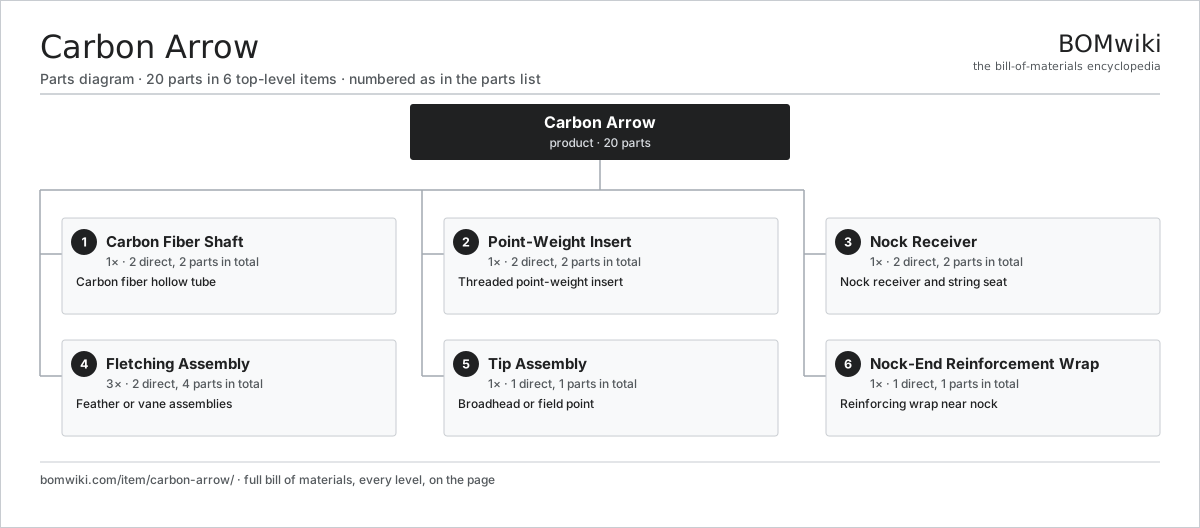
| # | Part | Qty | What it does |
|---|---|---|---|
| 1 | Carbon Fiber Shaft 2 parts | 1× | Carbon fiber hollow tube |
| 2 | Point-Weight Insert 2 parts | 1× | Threaded point-weight insert |
| 3 | Nock Receiver 2 parts | 1× | Nock receiver and string seat |
| 4 | Fletching Assembly 2 parts | 3× | Feather or vane assemblies |
| 5 | Tip Assembly 1 parts | 1× | Broadhead or field point |
| 6 | Nock-End Reinforcement Wrap 1 parts | 1× | Reinforcing wrap near nock |
3D model
No 3D model yet. Have a CAD file of this? Add a 3D model. STL renders right on this page; STEP, FreeCAD, and OpenSCAD sources are welcome too (openly licensed, like all 3D models on BOMwiki).
Build & assembly graph
expand / collapse · shared sub-assemblies converge · links to related products · est. labourTap an assembly to expand/collapse · tap a part to open it · use “Open page” for any node · drag to pan, scroll to zoom.
Bill of materials for Carbon Arrow
6 top-level lines · 16 rows shown · 20 parts total · indented to 3 levels| # | Item / sub-assembly | Part no. | Qty/assy | Ext. qty | Parts | Type |
|---|---|---|---|---|---|---|
| 1 | Carbon Fiber Shaft 2 parts | carbon-arrow-shaft | 1× | 1 | 2 | assembly |
| 1.1 | Tube Assembly | carbon-arrow-tube | 1× | 1 | · | part |
| 1.2 | Spine Specification | carbon-arrow-spine-rating | 1× | 1 | · | part |
| 2 | Point-Weight Insert 2 parts | carbon-arrow-insert | 1× | 1 | 2 | assembly |
| 2.1 | Insert Body | carbon-arrow-insert-body | 1× | 1 | · | part |
| 2.2 | Internal Thread | carbon-arrow-insert-thread | 1× | 1 | · | part |
| 3 | Nock Receiver 2 parts | carbon-arrow-nock | 1× | 1 | 2 | assembly |
| 3.1 | Nock Bushing | carbon-arrow-nock-bushing | 1× | 1 | · | part |
| 3.2 | Nock Slot | carbon-arrow-nock-groove | 1× | 1 | · | part |
| 4 | Fletching Assembly 2 parts | carbon-arrow-fletching | 3× | 3 | 4 | assembly |
| 4.1 | Vane or Feather | carbon-arrow-vane | 3× | 9 | · | part |
| 4.2 | Fletching Adhesive | carbon-arrow-fletching-glue | 1× | 3 | · | part |
| 5 | Tip Assembly 1 parts | carbon-arrow-point | 1× | 1 | 1 | assembly |
| 5.1 | Point Head | carbon-arrow-point-head | 1× | 1 | · | part |
| 6 | Nock-End Reinforcement Wrap 1 parts | carbon-arrow-wrap | 1× | 1 | 1 | assembly |
| 6.1 | Wrap Tape | carbon-arrow-wrap-tape | 1× | 1 | · | part |
Something wrong in this list? Report a problem with this BOM.
Sourcing: possible vendors
Browse the supplier directory → Prices, MOQ, and lead times are algorithmic estimates, not quotes, and not claims about these companies. Company mappings are curated by keyword; est. price band $20–$2k. How estimates work| Vendor | HQ | Specialty | MOQ | Lead time |
|---|---|---|---|---|
|
🇺🇸Coleman
coleman.com ↗
|
Chicago, US | Camping gear | 1,000 units | 6–10 wks |
| thenorthface.com ↗ | Denver, US | Outdoor apparel & gear | 1,000 units | 6–10 wks |
|
🇺🇸YETI
yeti.com ↗
|
Austin, US | Coolers & drinkware | 1,000 units | 6–10 wks |
| decathlon.com ↗ | Villeneuve-d'Ascq, FR | Sporting goods | 1,000 units | 6–10 wks |
|
🇺🇸Garmin
garmin.com ↗
|
Olathe, US | GPS & wearables | 1,000 units | 6–10 wks |
1,588-word article