Cargo X-Ray Scanner
ProductOverview
Cargo X-ray scanners are large-scale inspection systems deployed at seaports, land borders, and logistics hubs to screen shipping containers and trucks for weapons, explosives, drugs, and contraband. They use industrial X-ray sources (typically 160 kilovolt pulsed) to penetrate steel container walls and generate high-resolution radiographic images of interior contents. Unlike smaller parcel scanners, cargo systems must image through thick steel (up to 5 mm walls) and dense stacks of cargo, requiring high photon energy and large detector arrays.
A typical seaport with 1000 container movements per day operates 2–4 large cargo scanners running in parallel, each capable of screening ~300 containers/day. A single undetected weapons smuggling event (cost: detention, prosecution, insurance claims) can exceed the entire annual operating budget of a scanner system, justifying substantial investment in penetrating-inspection technology.
X-Ray Physics & Penetration
Linear Accelerator Principles
The linear accelerator source generates X-rays via bremsstrahlung: high-energy electrons (accelerated to 160 keV) strike a tungsten target and lose kinetic energy, emitting X-ray photons. A pulsed beam (not continuous) reduces radiation hazard and allows synchronization with the conveyor system and detector readout timing.
Key specifications:
- Tube voltage (kVp): 160 kV is a compromise, high enough to penetrate steel with reasonable exposure time, but low enough to avoid excessive shielding costs. Higher-energy systems (240 kV or 320 kV linacs) exist for ultra-thick cargo but are restricted (dual-use export control) in many countries.
- Beam current: 150 mA peak current during pulse ensures sufficient photon flux; longer pulses (>10 ms) cause dose accumulation.
- Pulse width: Typically 100–500 microseconds, triggered once per conveyor position increment.
Penetration Through Steel & Cargo
Attenuation of X-rays through matter follows the Beer-Lambert law:
I = I₀ × e^(-µx)
where:
- I₀ = incident photon intensity
- µ = mass attenuation coefficient (material dependent)
- x = thickness
For 160 keV X-rays through mild steel:
- 1 mm steel: ~30% transmission
- 5 mm steel: ~0.2% transmission (requires >500× intensity gain to maintain image contrast)
A typical shipping container has 2 mm corrugated steel walls at top/bottom and 5 mm sides. To image through 5 mm walls, the detector array must have sufficient sensitivity to distinguish a small weapon (e.g., 20 mm steel barrel) embedded in dense cargo (e.g., steel bearings, metal machinery parts) against the background scatter.
Scatter radiation (photons deflected by Compton scattering) represents 80–90% of the signal at the detector in high-density cargo. This scatter degrades image contrast. Mitigation uses:
- Collimation: Narrow the primary beam and add anti-scatter collimators at the detector to block sideways-scattered photons.
- Energy discrimination: Modern detectors suppress low-energy scatter (Compton photons) through pulse-height discrimination or spectral imaging.
Detection & Image Analysis
Radiographic Image Formation
As cargo moves on the conveyor belt, the conveyor triggers the X-ray source once per position increment (e.g., every 50 mm). Each pulse exposes the entire detector array (2048 pixels wide) for a thin "slice" of the cargo. The acquisition computer collects all slices and stitches them into a complete 2D radiographic image.
Image qualities that reveal contraband:
- Abrupt density changes: A firearm (iron/steel) surrounded by clothing or foam appears as a sharp high-density blob against low-density background.
- Geometry: Weapons have characteristic shapes (long cylinders with trigger guard protrusions, grooved barrels).
- Layering: Deliberate shielding (lead plates wrapped around contraband) appears as dense layers sandwiching lighter material.
Threat Detection AI
Modern cargo scanners employ deep learning (convolutional neural networks trained on >100,000 annotated images) to classify objects automatically. The threat detection engine identifies:
- Firearms: Revolvers, pistols, rifles by characteristic receiver geometry and barrel tapering.
- Explosives: PETN, RDX, C-4, TNT by density and crystalline structure appearance.
- Drugs (dense packaging): Compressed cocaine, heroin bundles by uniform high-density rectangular profiles.
- Nuclear material: Depleted uranium, reactor fuel by attenuation patterns (uranium is extremely dense; 5 cm blocks nearly all X-rays).
Sensitivity: Modern AI achieves ~98% true positive rate on weapons, <2% false positive rate on innocent cargo (e.g., metal engine blocks) after training on facility-specific contraband samples.
Challenges:
- Shielding: A thin lead shield (1–2 mm) around a firearm drops image contrast by ~80%, potentially evading detection. Countermeasure: use spectral X-ray analysis (tuning beam energy) to identify lead edges.
- Mimicry: Legitimate metal machinery (engine blocks, pump housings) have shapes similar to firearms. Operator training and multi-angle imaging reduce false rejections.
Facility Integration & Logistics
Pit & Scanning Chamber
Most cargo scanners are installed in a below-grade pit or dedicated scanning hall:
- Dimensions: 30 m long × 4 m wide × 4 m tall typical.
- Shielding: Primary chamber (6 mm lead) attenuates X-rays to <0.1% leakage. Secondary barrier (3 mm lead) separates scanning area from control room, ensuring dose rate <5 µSv/hour at operator position.
- Ventilation: HEPA-filtered air handling (negative pressure in primary chamber) prevents dust contamination of electronics.
Conveyor Synchronization
The speed encoder mounted on the conveyor belt provides real-time cargo position. The acquisition computer triggers X-ray pulses at fixed intervals (e.g., 50 mm cargo advance) and assigns each detector frame a position tag. Reconstructed images maintain spatial coherence even if conveyor speed varies (within bounds).
Emergency stop: An fail-safe brake on the motor locks the conveyor within <1 m if the E-stop button is pressed, ensuring no personnel enter the primary chamber while X-rays are active.
Operational Workflow
Pre-Scan Setup
- Manifest verification: Shipping documents are entered into the database; expected cargo types inform threat detection thresholds.
- Cargo loading: Container is positioned on conveyor; driver departs scanning area.
- Weight check: Load cell confirms cargo <5000 kg (safety limit for X-ray dose accumulation).
- Personnel evacuation: Interlocks prevent scan if motion is detected inside primary chamber.
Scanning
- Operator initiates scan: Presses button; conveyor begins slow advance (0.5 m/s).
- X-ray pulses fire at fixed intervals (every 50 mm cargo travel).
- Detector array captures each slice; data streams to acquisition computer at ~10 Gbps.
- Real-time threat detection: GPU-accelerated CNN model analyzes each reconstructed image slice; flags suspicious regions with confidence scores.
- Scan completes when cargo exits chamber; typical scan time 5–15 seconds per 20-foot container.
Post-Scan Review
- AI alerts: High-confidence threats (>95% AI confidence) are automatically flagged; low-confidence anomalies (60–80%) are queued for operator review.
- Operator inspection: Security officer views flagged regions in high-resolution zoom, cross-references with manifest expectations.
- Clearance decision:
- Clear: Release container for onward movement.
- Secondary inspection: Route to physical inspection bay (staff searches container).
- Hold: Notify law enforcement if credible threat suspected.
Typical workflow per container: 2–5 minutes including setup and decision time.
Radiation Safety & Regulatory Compliance
ALARA Principle
ALARA (As Low As Reasonably Achievable) guides scanner operations:
- Pulse duration: Minimized to deliver required dose in shortest time.
- Pulse frequency: Lowered to reduce unnecessary irradiation if conveyor pauses.
- Shielding: Primary chamber (6 mm lead) + secondary barrier (3 mm lead) ensure external dose rates comply with occupational limits.
Dose Limits (ICRP & NCRP Standards)
- Occupational exposure limit: 20 mSv/year (scanner operators).
- Public exposure limit: <1 mSv/year (general public, persons outside facility perimeter).
- Shipping manifest limit: <0.1 mGy per container (prevents cargo becoming radioactive residue after scanning).
Dose monitoring:
- Thermoluminescent dosimeters (TLDs): Personnel wear badges; exchanged monthly and analyzed for dose accumulation.
- Area radiation monitors: Fixed detectors at exit doors and control room measure ambient dose rate continuously.
- Scan-specific dose logging: System records exposure time and power level for each scan; total operator annual dose is tracked and compared against limits.
Regulatory Approvals
Cargo scanners require certification from:
- IAEA (International Atomic Energy Agency): Authorization for non-destructive testing equipment.
- National radiation protection authority: Facility licensing; shielding verification via Monte Carlo dose modeling.
- Labor department: Occupational safety certification for operator exposure management.
- Customs authority: Operational standards for border/port security integration.
Maintenance & Calibration
Preventive Maintenance (Monthly)
- Check X-ray tube filament heater current (should be stable within ±2%).
- Verify detector pixel response uniformity (bad pixels indicate age or physical damage).
- Calibrate energy level (measure kVp with non-invasive high-voltage probe).
- Run test scan of reference phantom (metal step-wedge); compare image contrast to baseline.
Annual Service
- Replace X-ray tube (~$30,000; service life 2–3 years, 500,000–1M pulse cycles).
- Inspect shielding integrity (lead barrier cracks); use fluoroscopy to verify attenuation.
- Recalibrate detector gain matrix (detector sensitivity may drift >5% over a year).
- Update threat detection AI with new patterns observed in facility operation.
Component Lifespan
| Component | Service Life | Cost |
|---|---|---|
| X-ray tube | 2–3 years | $30,000 |
| Detector array | 5–7 years | $150,000 |
| HV transformer | 8–10 years | $50,000 |
| Conveyor belt | 3–5 years | $20,000 |
| GPU processing module | 4–6 years | $15,000 |
Standards & Certifications
- IAEA STR-347: Safety standards for radiation protection in cargo and baggage inspection X-ray systems.
- ISO 9001: Quality management system (equipment manufacturers).
- ANSI N42.20: American National Standard for diagnostic radiological equipment.
- EU Directive 2013/59/EURATOM: Basic safety standards for radiation protection.
Performance & Throughput
- Scan time: 5–15 seconds per 20-ft container.
- Maximum throughput (with review): 300–400 containers/day per scanner.
- Detection sensitivity: 98%+ for weapons >10 mm in dimension.
- False positive rate: <2% (after operator review filtering).
- Mean time between failures: 10,000–15,000 operating hours.
Economics
A complete cargo X-ray scanner system (X-ray source, detector, gantry, shielding, control room, installation) costs $1.5–3M. Operating costs run $200,000–400,000/year (power, maintenance, staffing). Assuming 10-year system life, total cost of ownership is $3.5–7M. For high-traffic ports (>10,000 containers/month), the cost per container scanned is <$50, making it economically justified for threat detection and regulatory compliance.
Cargo X-Ray Scanner parts and their functions
8 top-level parts · 38 parts in total · full bill of materials below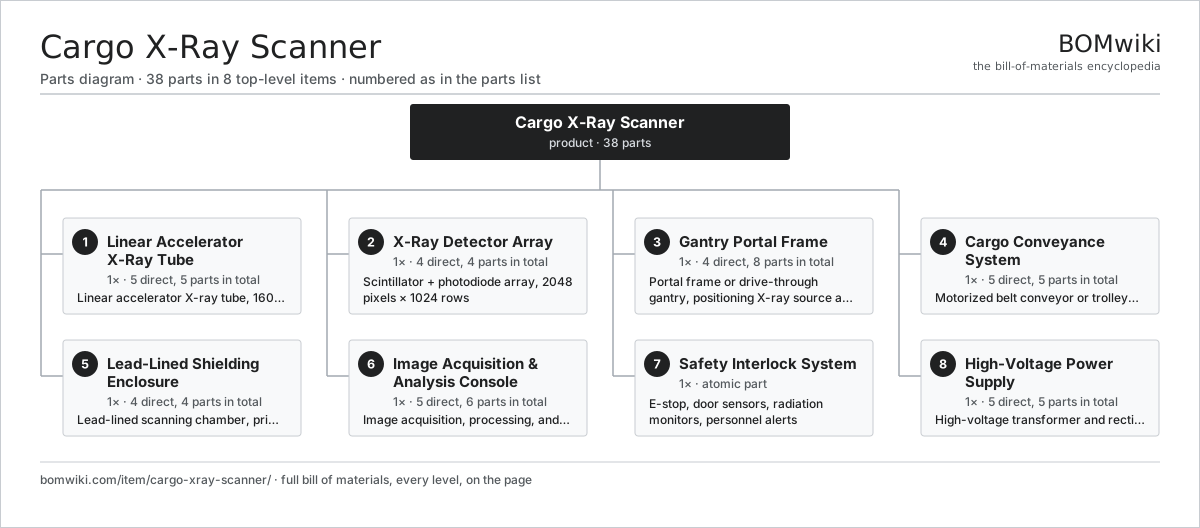
| # | Part | Qty | What it does |
|---|---|---|---|
| 1 | Linear Accelerator X-Ray Tube 5 parts | 1× | Linear accelerator X-ray tube, 160 kVp, pulsed 150 mA |
| 2 | X-Ray Detector Array 4 parts | 1× | Scintillator + photodiode array, 2048 pixels × 1024 rows |
| 3 | Gantry Portal Frame 4 parts | 1× | Portal frame or drive-through gantry, positioning X-ray source and detector |
| 4 | Cargo Conveyance System 5 parts | 1× | Motorized belt conveyor or trolley, moves cargo through scan zone |
| 5 | Lead-Lined Shielding Enclosure 4 parts | 1× | Lead-lined scanning chamber, primary and secondary barriers |
| 6 | Image Acquisition & Analysis Console 5 parts | 1× | Image acquisition, processing, and threat detection workstation |
| 7 | Safety Interlock System | 1× | E-stop, door sensors, radiation monitors, personnel alerts |
| 8 | High-Voltage Power Supply 5 parts | 1× | High-voltage transformer and rectifier for X-ray tube |
3D model
No 3D model yet. Have a CAD file of this? Add a 3D model. STL renders right on this page; STEP, FreeCAD, and OpenSCAD sources are welcome too (openly licensed, like all 3D models on BOMwiki).
Build & assembly graph
expand / collapse · shared sub-assemblies converge · links to related products · est. labourTap an assembly to expand/collapse · tap a part to open it · use “Open page” for any node · drag to pan, scroll to zoom.
Bill of materials for Cargo X-Ray Scanner
8 top-level lines · 40 rows shown · 38 parts total · indented to 3 levels| # | Item / sub-assembly | Part no. | Qty/assy | Ext. qty | Parts | Type |
|---|---|---|---|---|---|---|
| 1 | Linear Accelerator X-Ray Tube 5 parts | cargo-xray-scanner-linac-source | 1× | 1 | 5 | assembly |
| 1.1 | X-Ray Tube | cargo-xray-scanner-x-ray-tube-head | 1× | 1 | · | part |
| 1.2 | Tube Cooling Unit | cargo-xray-scanner-cooling-fan | 1× | 1 | · | part |
| 1.3 | X-Ray Collimator | cargo-xray-scanner-collimator-cone | 1× | 1 | · | part |
| 1.4 | Beryllium Exit Window | cargo-xray-scanner-x-ray-window | 1× | 1 | · | part |
| 1.5 | Aluminum/Copper Filter | cargo-xray-scanner-beam-filter | 1× | 1 | · | part |
| 2 | X-Ray Detector Array 4 parts | cargo-xray-scanner-detector-array | 1× | 1 | 4 | assembly |
| 2.1 | Scintillator Crystal Array | cargo-xray-scanner-scintillator-crystal | 1× | 1 | · | part |
| 2.2 | CMOS Photodiode Array | cargo-xray-scanner-photodiode-amplifier | 1× | 1 | · | part |
| 2.3 | Detector Protective Window | cargo-xray-scanner-detector-window | 1× | 1 | · | part |
| 2.4 | Anti-Scatter Collimator | cargo-xray-scanner-collimator-grid | 1× | 1 | · | part |
| 3 | Gantry Portal Frame 4 parts | cargo-xray-scanner-gantry-portal | 1× | 1 | 8 | assembly |
| 3.1 | Structural Frame Beam | cargo-xray-scanner-gantry-beam | 2× | 2 | · | part |
| 3.2 | Source Positioning Actuator | cargo-xray-scanner-source-mount-actuator | 1× | 1 | · | part |
| 3.3 | Detector Mount Assembly | cargo-xray-scanner-detector-mount | 1× | 1 | · | part |
| 3.4 | Vibration Isolator | cargo-xray-scanner-vibration-damper | 4× | 4 | · | part |
| 4 | Cargo Conveyance System 5 parts | cargo-xray-scanner-conveyance-system | 1× | 1 | 5 | assembly |
| 4.1 | Conveyor Belt Assembly | cargo-xray-scanner-conveyor-belt | 1× | 1 | · | part |
| 4.2 | Drive Motor | cargo-xray-scanner-belt-motor | 1× | 1 | · | part |
| 4.3 | Position Encoder | cargo-xray-scanner-speed-encoder | 1× | 1 | · | part |
| 4.4 | Fail-Safe Brake | cargo-xray-scanner-emergency-stop-brake | 1× | 1 | · | part |
| 4.5 | Weight Limit Loadcell | cargo-xray-scanner-load-cell | 1× | 1 | · | part |
| 5 | Lead-Lined Shielding Enclosure 4 parts | cargo-xray-scanner-shielding-enclosure | 1× | 1 | 4 | assembly |
| 5.1 | Primary Lead Barrier | cargo-xray-scanner-primary-lead-barrier | 1× | 1 | · | part |
| 5.2 | Secondary Lead Barrier | cargo-xray-scanner-secondary-lead-wall | 1× | 1 | · | part |
| 5.3 | Leaded Glass Viewport | cargo-xray-scanner-leaded-glass-window | 1× | 1 | · | part |
| 5.4 | Safety Interlock System | cargo-xray-scanner-safety-interlocks | 1× | 1 | · | part |
| 6 | Image Acquisition & Analysis Console 5 parts | cargo-xray-scanner-control-console | 1× | 1 | 6 | assembly |
| 6.1 | Image Acquisition PC | cargo-xray-scanner-acquisition-computer | 1× | 1 | · | part |
| 6.2 | GPU Processing Module | cargo-xray-scanner-image-processing-gpu | 1× | 1 | · | part |
| 6.3 | 4K Medical Monitor | cargo-xray-scanner-monitor-array | 2× | 2 | · | part |
| 6.4 | RAID-6 Storage Array | cargo-xray-scanner-storage-server | 1× | 1 | · | part |
| 6.5 | Threat Detection AI Software | cargo-xray-scanner-threat-detection-software | 1× | 1 | · | part |
| 7 | Safety Interlock System | cargo-xray-scanner-safety-interlocks | 1× | 1 | · | part |
| 8 | High-Voltage Power Supply 5 parts | cargo-xray-scanner-power-supply-unit | 1× | 1 | 5 | assembly |
| 8.1 | High-Voltage Transformer | cargo-xray-scanner-hv-transformer | 1× | 1 | · | part |
| 8.2 | Vacuum Rectifier Tube | cargo-xray-scanner-hv-rectifier-tube | 1× | 1 | · | part |
| 8.3 | HV Smoothing Capacitor | cargo-xray-scanner-hv-capacitor-bank | 1× | 1 | · | part |
| 8.4 | Output Choke Inductor | cargo-xray-scanner-hv-choke-coil | 1× | 1 | · | part |
| 8.5 | Filament Transformer | cargo-xray-scanner-tube-filament-supply | 1× | 1 | · | part |
Something wrong in this list? Report a problem with this BOM.
Sourcing: possible vendors
Browse the supplier directory → Prices, MOQ, and lead times are algorithmic estimates, not quotes, and not claims about these companies. Company mappings are curated by keyword; est. price band $200–$100M. How estimates work| Vendor | HQ | Specialty | MOQ | Lead time |
|---|---|---|---|---|
| smithsdetection.com ↗ | London, GB | Security screening | made to order | 24–52 wks |
|
🇺🇸Leidos
leidos.com ↗
|
Reston, US | Security & screening | made to order | 24–52 wks |
|
🇺🇸Rapiscan
rapiscansystems.com ↗
|
Torrance, US | X-ray screening | made to order | 24–52 wks |
|
🇫🇷Thales
thalesgroup.com ↗
|
Paris, FR | Defense electronics | made to order | 24–52 wks |
| baesystems.com ↗ | London, GB | Defense | made to order | 24–52 wks |
1,687-word article