Carpet Blower/Dryer Stack
ProductOverview
The carpet blower dryer is a portable centrifugal fan designed to rapidly dry wet carpet after cleaning, water damage, or flooding. The machine consists of a Blower Housing Assembly centrifugal fan generating 2000–3500 CFM (cubic feet per minute), mounted on a Base Frame Assembly multi-angle stand that allows discharge air direction from horizontal (floor sweep) to vertical (ceiling lift). The modular design enables stacking 2–3 units via Stack Coupling Assembly quick-connect couplings, increasing total CFM output proportionally for large-area drying.
The primary application is post-cleaning drying: after carpet shampooing or hot-water extraction (which leaves carpet 40–60% water-saturated), blower dryers reduce drying time from 12–24 hours to 4–8 hours by forced-air circulation. Secondary applications include water damage mitigation (burst pipes, flood), where rapid moisture removal prevents mold growth and structural damage.
A single blower dryer can dry approximately 500–1000 square feet of carpet in 4–8 hours, depending on pile height, water saturation level, and ambient humidity. Multiple units work in series or parallel to cover larger areas more quickly: two units in parallel (side by side) can dry 1000–2000 square feet; three units in series (stacked, combined output) can dry 2000–3000 square feet simultaneously.
Centrifugal fan design and air movement
The Blower Housing Assembly is a centrifugal fan (also called a "squirrel cage" fan), not an axial propeller fan. The Impeller Wheel (10–12 inches diameter) features multiple forward-curved blades that spin at 1750–1800 RPM, accelerating air radially outward toward a Volute Casting spiral housing. The volute collects the high-velocity air and directs it into the discharge outlet, converting kinetic energy into pressure.
Centrifugal design delivers superior pressure (static head) compared to axial fans; this enables the Outlet Nozzle Assembly to focus air into a concentrated high-velocity jet. The jet penetrates carpet pile, reaching the carpet backing and subfloor where moisture is typically trapped. Axial fans (like typical box fans) deliver higher volume but lower pressure, creating diffuse air flow that is less effective at deep moisture extraction.
The discharge air velocity at the nozzle exit is approximately 30–50 mph, sufficient to cause carpet fiber movement and to create air circulation in enclosed spaces (rooms, trailers).
Air direction and drying strategy
The Base Frame Assembly multi-angle stand allows 0–90 degree tilt, enabling three primary drying strategies:
Horizontal (0 degrees): Blower pushes air parallel to floor across the carpet surface. This configuration creates air circulation across the floor, encouraging moisture evaporation. Effective for large open areas and light drying (post-cleaning).
45-degree angle (intermediate): Combines floor sweep with upward air lift, suitable for medium moisture loads and variable room geometry.
Vertical (90 degrees): Blower pushes air straight upward, creating ceiling-directed circulation. Effective for high-moisture loads where carpet is soaked; upward air lift draws moisture from carpet pile and subfloor, directing it toward room air where evaporation can occur.
Most professional drying protocols use a combination: 4–6 hours of horizontal positioning to move surface moisture, followed by 2–4 hours of 45-degree or vertical positioning to accelerate deep moisture extraction.
Moisture extraction physics
Carpet drying occurs through two mechanisms: (1) direct evaporation, air circulating past wet carpet absorbs moisture through normal diffusion, and (2) forced extraction, moving air physically displaces water trapped in carpet fibers and pile.
The blower dryer enables both mechanisms. The Impeller Wheel high-velocity air stream displaces water from carpet pile (forced extraction) and simultaneously carries away vapor (evaporation). The effectiveness depends on air velocity, dwell time, humidity, and temperature.
Water removal rate depends on air conditions:
- Low humidity (< 40%): Air has capacity to absorb moisture; drying is rapid (4–6 hours for light-to-medium saturation).
- High humidity (> 70%): Air becomes saturated quickly; drying plateaus as the driving potential decreases. In high-humidity climates, drying time can extend to 12–24 hours even with blower dryers.
Temperature significantly affects evaporation rate; warmer air (70–85°F) dries much faster than cool air (55–65°F). Many professional dryers combine blower dryers with dehumidifiers and space heaters to accelerate drying in cool or humid climates.
Modular stacking and capacity scaling
Single blower dryer units are rated 2000–3500 CFM. For large areas or high-moisture situations, multiple units are connected via Stack Coupling Assembly quick-connect couplings. Stacked units can be arranged:
In series: Units connected sequentially, with the first blower's outlet feeding the second blower's inlet. Series stacking increases pressure (depth of air penetration) but maintains similar CFM (air passes through each impeller sequentially). Pressure stacking is used to overcome resistance (obstacles, long air delivery hoses) but doesn't increase drying speed significantly.
In parallel: Multiple blowers positioned side-by-side, each with independent discharge. Parallel arrangement maintains pressure but doubles CFM output. Parallel stacking is the standard for large-area drying.
In practice, a cleaning company might use 2–3 parallel blower dryers on a 3000-square-foot flooding scenario to simultaneously dry multiple room zones.
Inlet filtration and motor protection
The Inlet Filter Assembly foam or pleated paper filter prevents lint, carpet fibers, and dust from entering the Impeller Wheel, which would reduce CFM output and cause bearing wear. The filter requires replacement or cleaning every 50–100 operating hours; clogged filters can reduce CFM by 20–40%.
Most professional dryer operators maintain spare filter elements on site and swap filters between jobs. Dirty filters reduce drying efficiency and place additional load on the Blower Motor, shortening motor life.
The Thermal Overload protects the motor from sustained overheating. If the motor inlet is blocked (clogged filter, objects covering intake), motor temperature rises rapidly. The thermal cutout trips at ~140°C, shutting down power. This is a critical safety feature preventing motor winding insulation failure and fire hazard.
Positioning and safety
The Base Frame Assembly is lightweight (25–35 lbs per unit) and mobile via Wheel Assembly swivel casters. However, the base can become unstable if positioned on uneven carpet or if stacked units create a tall assembly. Professional operators:
- Level the base using shims or by adjusting caster height.
- Secure stacked units with quick-clamps or cable ties to prevent tipping.
- Position blowers away from electrical outlets and high-traffic areas to avoid cord tripping hazards.
- Direct discharge away from people and equipment.
The blower outlet velocity (30–50 mph) can create hazards if directed at people or fragile items. Proper positioning and job-site awareness are essential safety practices.
Applications and drying protocols
Post-extraction drying: Hot-water carpet cleaning systems (truck mounts or portable extractors) leave carpet 40–60% saturated. Blower dryers reduce drying time from 24 hours to 4–8 hours, enabling same-day move-in after cleaning.
Water damage mitigation: Burst pipes, overflows, or floods saturate carpet to 80%+ water content. Rapid drying (within 24–48 hours) prevents mold growth. Professional water-damage contractors deploy multiple blowers immediately after water removal, often combining with dehumidifiers.
Flood drying: Large-scale flooding (building-wide) requires significant blower capacity. A 10,000-square-foot commercial space might require 6–10 blower dryers operating continuously for 48–72 hours.
Professional drying protocols include:
- Hour 0–2: Deploy blowers in horizontal orientation, maximum CFM output.
- Hour 2–6: Reposition blowers to 45-degree angle, targeting high-moisture zones.
- Hour 6–12: Switch to vertical orientation, accelerate deep moisture extraction. Deploy dehumidifiers if humidity is elevated.
- Hour 12+: Monitor moisture levels (hygrometer readings). Reduce blower count as moisture decreases. Stop when carpet pad and subfloor reach acceptable moisture levels (typically 40–50% relative humidity).
Noise and ventilation considerations
Blower dryers generate 85–92 dB noise, comparable to a lawnmower. Extended operation (8+ hours) requires hearing protection. In residential situations, continuous blower operation is disruptive; many residential contractors schedule drying to run overnight or during unoccupied periods.
Blower dryers exhaust air to the room; they do not remove air from the space. In enclosed rooms, exhaust air becomes stagnant. Effective drying requires:
- Opening windows to allow outside air circulation.
- Positioning blowers to create cross-flow (inlet air from one direction, exhaust from opposite).
- Using dehumidifiers to remove moisture-saturated air.
Poor ventilation can cause humidity to peak and plateau, reducing drying effectiveness. Proper air exchange ensures fresh, dry air continuously replaces moisture-saturated air.
Maintenance and durability
The Blower Motor endures 2000–4000 operating hours (typical life). Replacement cost is $150–$300 per unit. Motor bearing wear becomes apparent as noise increases or vibration increases.
The Impeller Wheel is durable and rarely requires replacement unless physically damaged. Bearing replacement (within the Volute Casting) costs $50–$100.
The Inlet Filter Assembly is a consumable, replaced 4–8 times per year in high-use rental shops. Cost is $5–$15 per filter.
The Power Cord Assembly is subject to abuse (stepping on, dragging across sharp edges, water exposure). Insulation damage requires immediate cord replacement for safety. Replacement cords cost $30–$60.
The Base Frame Assembly and Wheel Assembly are robust. Caster wheels can wear (becoming loose or wobbly) after 500–1000 operating hours. Wheel replacement costs $10–$30 per wheel.
Rental market
Carpet blower dryers are widely available for rent at equipment rental shops and home improvement centers, typically $15–$30/day per unit. Rental market availability makes blower dryers accessible for homeowners and small contractors who don't justify the $200–$400 capital cost of purchase. Professional water-damage and carpet-cleaning contractors own multiple blowers for immediate deployment to customer sites.
Carpet Blower/Dryer Stack parts and their functions
8 top-level parts · 69 parts in total · full bill of materials below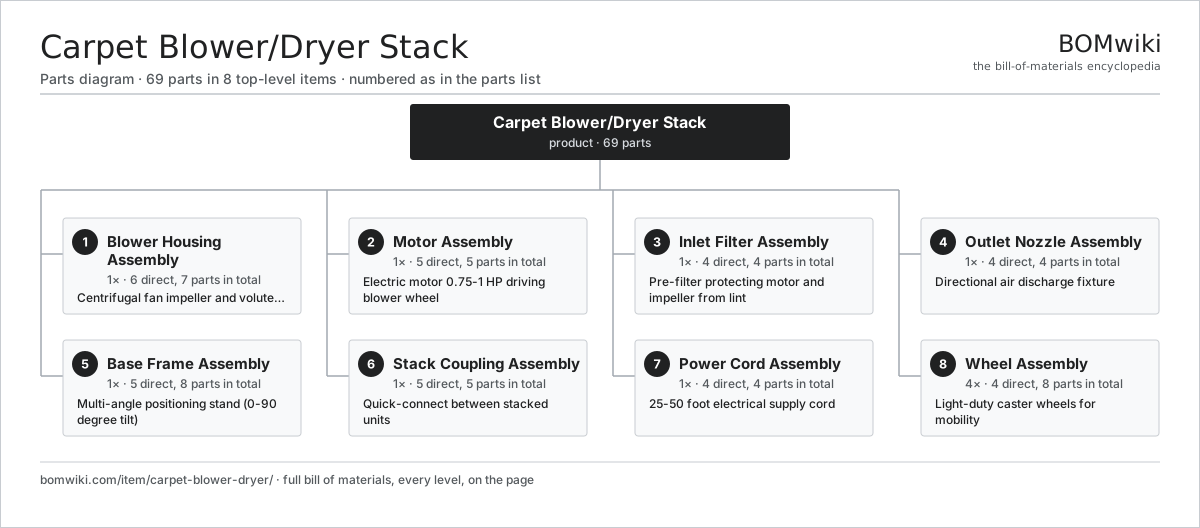
| # | Part | Qty | What it does |
|---|---|---|---|
| 1 | Blower Housing Assembly 6 parts | 1× | Centrifugal fan impeller and volute (stackable unit) |
| 2 | Motor Assembly 5 parts | 1× | Electric motor 0.75-1 HP driving blower wheel |
| 3 | Inlet Filter Assembly 4 parts | 1× | Pre-filter protecting motor and impeller from lint |
| 4 | Outlet Nozzle Assembly 4 parts | 1× | Directional air discharge fixture |
| 5 | Base Frame Assembly 5 parts | 1× | Multi-angle positioning stand (0-90 degree tilt) |
| 6 | Stack Coupling Assembly 5 parts | 1× | Quick-connect between stacked units |
| 7 | Power Cord Assembly 4 parts | 1× | 25-50 foot electrical supply cord |
| 8 | Wheel Assembly 4 parts | 4× | Light-duty caster wheels for mobility |
3D model
No 3D model yet. Have a CAD file of this? Add a 3D model. STL renders right on this page; STEP, FreeCAD, and OpenSCAD sources are welcome too (openly licensed, like all 3D models on BOMwiki).
Build & assembly graph
expand / collapse · shared sub-assemblies converge · links to related products · est. labourTap an assembly to expand/collapse · tap a part to open it · use “Open page” for any node · drag to pan, scroll to zoom.
Bill of materials for Carpet Blower/Dryer Stack
8 top-level lines · 45 rows shown · 69 parts total · indented to 3 levels| # | Item / sub-assembly | Part no. | Qty/assy | Ext. qty | Parts | Type |
|---|---|---|---|---|---|---|
| 1 | Blower Housing Assembly 6 parts | carpet-blower-dryer-blower-housing | 1× | 1 | 7 | assembly |
| 1.1 | Volute Casting | carpet-blower-dryer-volute-casting | 1× | 1 | · | part |
| 1.2 | Impeller Wheel | carpet-blower-dryer-impeller-wheel | 1× | 1 | · | part |
| 1.3 | Motor Mount Plate | carpet-blower-dryer-motor-mount-plate | 1× | 1 | · | part |
| 1.4 | Stack Collar | carpet-blower-dryer-stack-collar | 1× | 1 | · | part |
| 1.5 | Bearing Block | carpet-blower-dryer-bearing-block | 2× | 2 | · | part |
| 1.6 | Fastener Set | fastener-set | 1× | 1 | · | part |
| 2 | Motor Assembly 5 parts | carpet-blower-dryer-motor | 1× | 1 | 5 | assembly |
| 2.1 | Blower Motor | blower-motor | 1× | 1 | · | part |
| 2.2 | Motor Shaft | carpet-blower-dryer-motor-shaft | 1× | 1 | · | part |
| 2.3 | Thermal Overload | carpet-blower-dryer-thermal-overload | 1× | 1 | · | part |
| 2.4 | Motor Power Plug | carpet-blower-dryer-motor-power-plug | 1× | 1 | · | part |
| 2.5 | Fastener Set | fastener-set | 1× | 1 | · | part |
| 3 | Inlet Filter Assembly 4 parts | carpet-blower-dryer-inlet-filter | 1× | 1 | 4 | assembly |
| 3.1 | Filter Element | carpet-blower-dryer-filter-element | 1× | 1 | · | part |
| 3.2 | Filter Frame | carpet-blower-dryer-filter-frame | 1× | 1 | · | part |
| 3.3 | Filter Door | carpet-blower-dryer-filter-door | 1× | 1 | · | part |
| 3.4 | Fastener Set | fastener-set | 1× | 1 | · | part |
| 4 | Outlet Nozzle Assembly 4 parts | carpet-blower-dryer-outlet-nozzle | 1× | 1 | 4 | assembly |
| 4.1 | Nozzle Cone | carpet-blower-dryer-nozzle-cone | 1× | 1 | · | part |
| 4.2 | Deflector Flap | carpet-blower-dryer-deflector-flap | 1× | 1 | · | part |
| 4.3 | Outlet Hose Coupling | carpet-blower-dryer-outlet-hose-coupling | 1× | 1 | · | part |
| 4.4 | Fastener Set | fastener-set | 1× | 1 | · | part |
| 5 | Base Frame Assembly 5 parts | carpet-blower-dryer-base-frame | 1× | 1 | 8 | assembly |
| 5.1 | Frame Base Plate | carpet-blower-dryer-frame-base-plate | 1× | 1 | · | part |
| 5.2 | Angle Adjuster | carpet-blower-dryer-angle-adjuster | 1× | 1 | · | part |
| 5.3 | Locking Pin | carpet-blower-dryer-locking-pin | 1× | 1 | · | part |
| 5.4 | Anti-Slip Feet | carpet-blower-dryer-anti-slip-feet | 4× | 4 | · | part |
| 5.5 | Fastener Set | fastener-set | 1× | 1 | · | part |
| 6 | Stack Coupling Assembly 5 parts | carpet-blower-dryer-stack-coupling | 1× | 1 | 5 | assembly |
| 6.1 | Coupling Male | carpet-blower-dryer-coupling-male | 1× | 1 | · | part |
| 6.2 | Coupling Female | carpet-blower-dryer-coupling-female | 1× | 1 | · | part |
| 6.3 | Coupling Clamp | carpet-blower-dryer-coupling-clamp | 1× | 1 | · | part |
| 6.4 | Coupling Gasket | carpet-blower-dryer-coupling-gasket | 1× | 1 | · | part |
| 6.5 | Fastener Set | fastener-set | 1× | 1 | · | part |
| 7 | Power Cord Assembly 4 parts | carpet-blower-dryer-power-cord | 1× | 1 | 4 | assembly |
| 7.1 | Cord Wire | carpet-blower-dryer-cord-wire | 1× | 1 | · | part |
| 7.2 | Plug Connector | carpet-blower-dryer-plug-connector | 1× | 1 | · | part |
| 7.3 | Strain Relief | carpet-blower-dryer-strain-relief | 1× | 1 | · | part |
| 7.4 | Cord Reel Optional | carpet-blower-dryer-cord-reel-optional | 1× | 1 | · | part |
| 8 | Wheel Assembly 4 parts | carpet-blower-dryer-wheels | 4× | 4 | 8 | assembly |
| 8.1 | Caster Swivel | carpet-blower-dryer-caster-swivel | 4× | 16 | · | part |
| 8.2 | Wheel Axle | carpet-blower-dryer-wheel-axle | 1× | 4 | · | part |
| 8.3 | Brake Lever | carpet-blower-dryer-brake-lever | 2× | 8 | · | part |
| 8.4 | Fastener Set | fastener-set | 1× | 4 | · | part |
Something wrong in this list? Report a problem with this BOM.
Related products
same domain, ranked by shared parts Artificial Turf Groomer
63 parts · shares 1 with this page
Artificial Turf Groomer
63 parts · shares 1 with this page
 Concrete Floor Grinder
69 parts · shares 1 with this page
Concrete Floor Grinder
69 parts · shares 1 with this page
 Concrete Polisher
57 parts · shares 1 with this page
Escalator Step Cleaner
124 parts · shares 1 with this page
Concrete Polisher
57 parts · shares 1 with this page
Escalator Step Cleaner
124 parts · shares 1 with this page
 Floor Shot Blaster
72 parts · shares 1 with this page
Marble Crystallization Machine
48 parts · shares 1 with this page
Floor Shot Blaster
72 parts · shares 1 with this page
Marble Crystallization Machine
48 parts · shares 1 with this page
Sourcing: possible vendors
Browse the supplier directory → Prices, MOQ, and lead times are algorithmic estimates, not quotes, and not claims about these companies. Company mappings are curated by keyword; est. price band $50–$1.5k. How estimates work| Vendor | HQ | Specialty | MOQ | Lead time |
|---|---|---|---|---|
| sharkninja.com ↗ | Needham, US | Floorcare & kitchen | 1,000 units | 8–12 wks |
|
🇬🇧Dyson
dyson.com ↗
|
Malmesbury, GB | Vacuums & hair care | 1,000 units | 8–12 wks |
|
🇺🇸Bissell
bissell.com ↗
|
Grand Rapids, US | Floorcare | 1,000 units | 8–12 wks |
|
🇺🇸iRobot
irobot.com ↗
|
Bedford, US | Robot vacuums | 1,000 units | 8–12 wks |
|
🇩🇪Kärcher
karcher.com ↗
|
Winnenden, DE | Cleaning equipment | 1,000 units | 8–12 wks |
1,643-word article