Cassette Tissue Processor
ProductOverview
A cassette tissue processor (also called an automated tissue processor) performs the tedious and hazardous task of preparing tissue for histological sectioning. The instrument automatically moves specimens through a programmed sequence of chemical baths, typically fixative (10% neutral buffered formalin), dehydrating alcohols (70%, 80%, 95%, 100%), organic clearing agents (xylene, a xylene substitute, or isoparaffin), and paraffin infiltration, with precise timing and optional vacuum/pressure application. A typical overnight 12–16 hour cycle takes tissue from fresh or freshly fixed state to paraffin-infiltrated blocks ready for embedding.
The Retort Chamber Assembly carousel rotates through Reagent Station Module containing 12–20 bottles of reagent, dwell time at each station can be programmed (typically 45 minutes to 4 hours depending on tissue size and protocol). The Control Unit Assembly PLC manages station dwell times, and the Vacuum System Assembly and optional Pressure System Assembly enhance infiltration. The Temperature Control Assembly maintains paraffin stations at 55–65 °C for proper consistency.
How it works
Tissue specimens are placed in plastic cassettes (small perforated baskets with sample ID imprinted), which are loaded into the Carousel Drum positions. The operator selects a pre-programmed protocol on the Touchscreen (or via Control Panel) and presses start.
The PLC Module activates the Carousel Motor, rotating the carousel to position 1 (typically a fixative station). The carousel pauses for the programmed dwell time (commonly 2–4 hours for formalin fixation of fresh tissue). At fixation, the Vacuum System Assembly may apply brief vacuum pulses to remove air from tissue interstices and improve fixative penetration.
After the fixation dwell, the Carousel Motor advances to the next station (typically 70% ethanol), where the cassette soaks for a programmed time (45 minutes to 1 hour). Alcohol gradually replaces water in the tissue. The carousel sequentially advances through 80%, 95%, and 100% ethanol, with longer dwell times at higher concentrations. Between stations, vacuum pulses may be applied to enhance solvent exchange.
After complete ethanol dehydration, the carousel enters the clearing phase: xylene or a xylene alternative (e.g., limonene, mineral oil) displaces alcohol. These organic solvents render tissue transparent and miscible with molten paraffin. One or two clearing stations (each 45 minutes to 1 hour) ensure complete clearance.
Finally, the carousel enters the paraffin infiltration stations, typically 2–4 stations of molten paraffin at 55–65 °C (maintained by Bottle Heater). Dwell times are 1–4 hours per station. Vacuum is often applied during paraffin infiltration, removing air bubbles trapped in the tissue. In some protocols, gentle pressure (50–100 kPa) is applied during the final paraffin station to force paraffin into deeper recesses of the tissue, ensuring complete infiltration without trapped air pockets.
Once the full cycle completes, the carousel automatically halts. The operator removes the cassettes (now filled with hardened or warm paraffin) and transfers them to an Histology Embedding Center for block formation and mounting. The Data Logger records the entire run: timestamp, dwell times at each station, temperature trends, vacuum/pressure cycles applied, and any alarms (low reagent, temperature deviation).
Reagent management
The Reagent Station Module consist of Reagent Bottles in a carousel holder. Reagents degrade with use (fixative oxidizes and accumulates proteins, alcohols absorb water, xylene becomes colored). To extend reagent life and improve tissue quality, the Circulation Pump pump (on premium models) slowly recirculates each reagent through a small cartridge filter during the day, removing suspended particulates.
Alternatively, high-throughput labs use the "dip method": each reagent bottle dips into a larger container of fresh reagent between runs, or reagents are manually replaced every 50–100 cassette runs. The Level Sensor alerts the operator when a bottle is depleted.
Protocol programming
A typical 16-hour overnight protocol might be:
- 10% neutral buffered formalin: 3 hours (fixation)
- 70% ethanol: 1 hour
- 80% ethanol: 1 hour
- 95% ethanol: 1 hour
- 100% ethanol: 2 hours (×2 stations for complete dehydration)
- Xylene: 2 hours (×2 stations for complete clearing)
- Paraffin (55 °C): 3 hours (×2 stations for complete infiltration, with vacuum pulses)
Total: ~18 hours (allowing for carousel movement time between stations).
The PLC Module Program Memory stores 10–20 such protocols, allowing quick selection based on tissue type (small biopsy, large surgical specimen, bone, fatty tissue) and laboratory SOP.
Vacuum and pressure options
Vacuum during infiltration removes air bubbles trapped in tissue, improving section quality and reducing "chattering" during microtomy. Applied at 0.5–1 mbar (absolute), vacuum is effective but can be harsh on delicate tissues (causing mechanical artifact). Premium models allow selective vacuum on specific stations (e.g., only the final paraffin station).
Pressure (50–100 kPa gauge) applied during the final paraffin station pushes paraffin deeper into tissue without the aggressive bubble removal of vacuum. Some labs use a hybrid: vacuum on the first paraffin station (to remove residual clearing agent and air), then pressure on the second (to finalize infiltration).
Safety and reliability
The Safety Lid locking solenoid prevents operator exposure to hazardous solvent and paraffin vapors during operation. The Control Panel emergency stop halts carousel motion and closes all solenoid valves. Low-reagent alarms via the Level Sensor prevent the carousel from entering an empty station.
The Data Logger records every run, documenting temperature and timing, useful for QC audits and troubleshooting if tissue quality is poor.
Tissue artifacts and protocol optimization
Incomplete infiltration (air bubbles in tissue): extend paraffin dwell time or increase vacuum/pressure. Tissue hardness or over-dehydration: reduce final ethanol dwell time or lower paraffin temperature slightly. Tissue shrinkage: reduce fixation time or use milder fixatives (e.g., ethanol rather than formalin).
Premium labs periodically validate protocols by processing control samples (reference tissue) and examining paraffin sections for air voids and infiltration uniformity.
Cassette Tissue Processor parts and their functions
9 top-level parts · 35 parts in total · full bill of materials below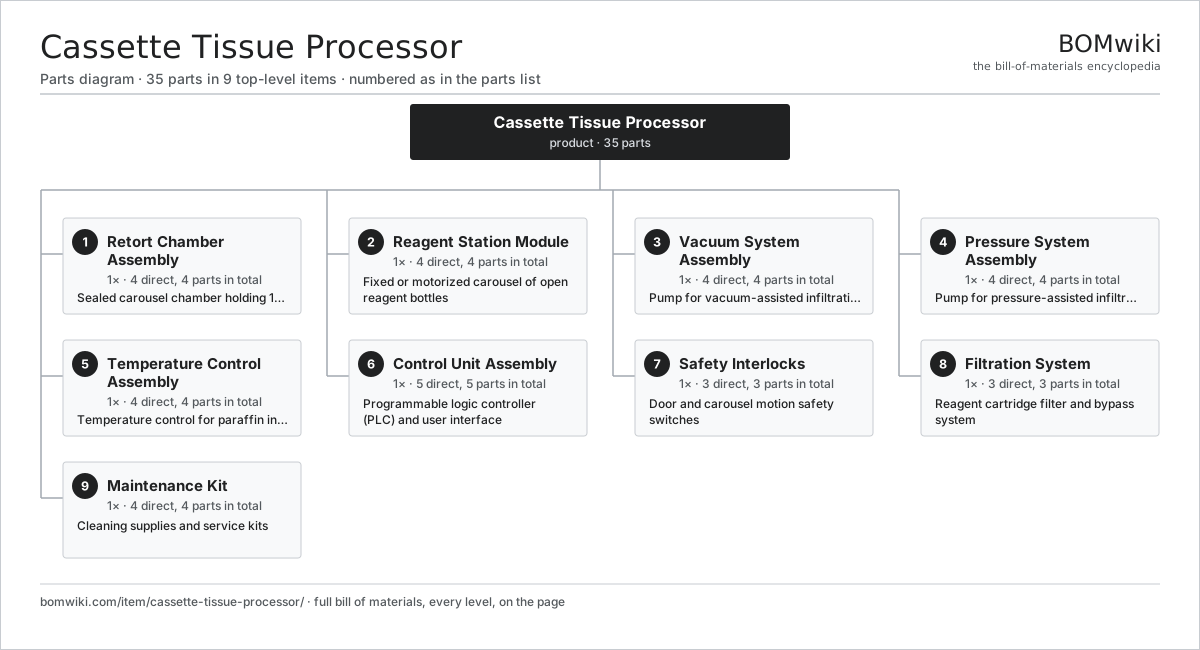
| # | Part | Qty | What it does |
|---|---|---|---|
| 1 | Retort Chamber Assembly 4 parts | 1× | Sealed carousel chamber holding 12–80 reagent stations |
| 2 | Reagent Station Module 4 parts | 1× | Fixed or motorized carousel of open reagent bottles |
| 3 | Vacuum System Assembly 4 parts | 1× | Pump for vacuum-assisted infiltration |
| 4 | Pressure System Assembly 4 parts | 1× | Pump for pressure-assisted infiltration |
| 5 | Temperature Control Assembly 4 parts | 1× | Temperature control for paraffin infiltration |
| 6 | Control Unit Assembly 5 parts | 1× | Programmable logic controller (PLC) and user interface |
| 7 | Safety Interlocks 3 parts | 1× | Door and carousel motion safety switches |
| 8 | Filtration System 3 parts | 1× | Reagent cartridge filter and bypass system |
| 9 | Maintenance Kit 4 parts | 1× | Cleaning supplies and service kits |
3D model
No 3D model yet. Have a CAD file of this? Add a 3D model. STL renders right on this page; STEP, FreeCAD, and OpenSCAD sources are welcome too (openly licensed, like all 3D models on BOMwiki).
Build & assembly graph
expand / collapse · shared sub-assemblies converge · links to related products · est. labourTap an assembly to expand/collapse · tap a part to open it · use “Open page” for any node · drag to pan, scroll to zoom.
Bill of materials for Cassette Tissue Processor
9 top-level lines · 44 rows shown · 35 parts total · indented to 3 levels| # | Item / sub-assembly | Part no. | Qty/assy | Ext. qty | Parts | Type |
|---|---|---|---|---|---|---|
| 1 | Retort Chamber Assembly 4 parts | cassette-tissue-processor-retort-chamber | 1× | 1 | 4 | assembly |
| 1.1 | Carousel Drum | cassette-tissue-processor-carousel-drum | 1× | 1 | · | part |
| 1.2 | Carousel Motor | cassette-tissue-processor-carousel-motor | 1× | 1 | · | part |
| 1.3 | Seal Assembly | cassette-tissue-processor-seal-assembly | 1× | 1 | · | part |
| 1.4 | Safety Lid | cassette-tissue-processor-safety-lid | 1× | 1 | · | part |
| 2 | Reagent Station Module 4 parts | cassette-tissue-processor-reagent-stations | 1× | 1 | 4 | assembly |
| 2.1 | Reagent Bottle | cassette-tissue-processor-reagent-bottle | 1× | 1 | · | part |
| 2.2 | Bottle Heater | cassette-tissue-processor-bottle-heater | 1× | 1 | · | part |
| 2.3 | Circulation Pump | cassette-tissue-processor-reagent-circulation | 1× | 1 | · | part |
| 2.4 | Level Sensor | cassette-tissue-processor-reagent-level-sensor | 1× | 1 | · | part |
| 3 | Vacuum System Assembly 4 parts | cassette-tissue-processor-vacuum-system | 1× | 1 | 4 | assembly |
| 3.1 | Vacuum Pump | cassette-tissue-processor-vacuum-pump | 1× | 1 | · | part |
| 3.2 | Vacuum Manifold | cassette-tissue-processor-vacuum-manifold | 1× | 1 | · | part |
| 3.3 | Vacuum Gauge | cassette-tissue-processor-vacuum-gauge | 1× | 1 | · | part |
| 3.4 | Vacuum Trap | cassette-tissue-processor-vacuum-trap | 1× | 1 | · | part |
| 4 | Pressure System Assembly 4 parts | cassette-tissue-processor-pressure-system | 1× | 1 | 4 | assembly |
| 4.1 | Pressure Pump | cassette-tissue-processor-pressure-pump | 1× | 1 | · | part |
| 4.2 | Pressure Regulator | cassette-tissue-processor-pressure-regulator | 1× | 1 | · | part |
| 4.3 | Pressure Manifold | cassette-tissue-processor-pressure-manifold | 1× | 1 | · | part |
| 4.4 | Pressure Gauge | cassette-tissue-processor-pressure-gauge | 1× | 1 | · | part |
| 5 | Temperature Control Assembly 4 parts | cassette-tissue-processor-heating-cooling | 1× | 1 | 4 | assembly |
| 5.1 | Immersion Heater | cassette-tissue-processor-immersion-heater | 1× | 1 | · | part |
| 5.2 | Jacket Heater | cassette-tissue-processor-jacket-heater | 1× | 1 | · | part |
| 5.3 | Temperature Controller | cassette-tissue-processor-temperature-controller | 1× | 1 | · | part |
| 5.4 | Thermostat | cassette-tissue-processor-thermostat | 1× | 1 | · | part |
| 6 | Control Unit Assembly 5 parts | cassette-tissue-processor-control-unit | 1× | 1 | 5 | assembly |
| 6.1 | PLC Module | cassette-tissue-processor-plc-module | 1× | 1 | · | part |
| 6.2 | Program Memory | cassette-tissue-processor-program-memory | 1× | 1 | · | part |
| 6.3 | Touchscreen | cassette-tissue-processor-touchscreen | 1× | 1 | · | part |
| 6.4 | Control Panel | cassette-tissue-processor-pushbutton-panel | 1× | 1 | · | part |
| 6.5 | Data Logger | cassette-tissue-processor-data-logger | 1× | 1 | · | part |
| 7 | Safety Interlocks 3 parts | cassette-tissue-processor-safety-interlocks | 1× | 1 | 3 | assembly |
| 7.1 | Door Interlock | cassette-tissue-processor-door-interlock-switch | 1× | 1 | · | part |
| 7.2 | Carousel Brake | cassette-tissue-processor-carousel-motion-brake | 1× | 1 | · | part |
| 7.3 | E-Stop Relay | cassette-tissue-processor-emergency-stop-relay | 1× | 1 | · | part |
| 8 | Filtration System 3 parts | cassette-tissue-processor-filtration-exchange | 1× | 1 | 3 | assembly |
| 8.1 | Filter Cartridge | cassette-tissue-processor-reagent-filter-cartridge | 1× | 1 | · | part |
| 8.2 | Bypass Valve | cassette-tissue-processor-filter-bypass-valve | 1× | 1 | · | part |
| 8.3 | Filter Housing | cassette-tissue-processor-filter-housing | 1× | 1 | · | part |
| 9 | Maintenance Kit 4 parts | cassette-tissue-processor-routine-maintenance | 1× | 1 | 4 | assembly |
| 9.1 | Gasket Kit | cassette-tissue-processor-gasket-seal-kit | 1× | 1 | · | part |
| 9.2 | Pump Oil Kit | cassette-tissue-processor-pump-oil-change-kit | 1× | 1 | · | part |
| 9.3 | Carousel Lube | cassette-tissue-processor-carousel-bearing-lube | 1× | 1 | · | part |
| 9.4 | Carryover Cleaner | cassette-tissue-processor-reagent-carryover-cleaner | 1× | 1 | · | part |
Something wrong in this list? Report a problem with this BOM.
Sourcing: possible vendors
Browse the supplier directory → Prices, MOQ, and lead times are algorithmic estimates, not quotes, and not claims about these companies. Company mappings are curated by keyword; est. price band $1k–$500k. How estimates work| Vendor | HQ | Specialty | MOQ | Lead time |
|---|---|---|---|---|
| thermofisher.com ↗ | Waltham, US | Lab instruments | 100 units | 10–18 wks |
|
🇺🇸Agilent
agilent.com ↗
|
Santa Clara, US | Analytical instruments | 100 units | 10–18 wks |
|
🇺🇸Bruker
bruker.com ↗
|
Billerica, US | Scientific instruments | 100 units | 10–18 wks |
|
🇯🇵Shimadzu
shimadzu.com ↗
|
Kyoto, JP | Analytical instruments | 100 units | 10–18 wks |
|
🇺🇸Waters
waters.com ↗
|
Milford, US | Chromatography & MS | 100 units | 10–18 wks |
1,015-word article