Catch Basin Cleaner
ProductOverview
Catch basin cleaners are vacuum-equipped trucks removing accumulated sediment, leaves, trash, and standing water from storm drain catch basins along highways and urban streets. These machines are essential for maintaining stormwater systems: clogged basins cause surface flooding during heavy rain, reduce drainage efficiency, and accumulate pollutants (motor oil, heavy metals, hydrocarbons) that contaminate receiving waters. Cities, counties, and state DOTs operate fleets of catch basin cleaners on rotating schedules (typically 1–3 year intervals per basin) to preserve infrastructure and water quality.
The system combines a Articulated Vacuum Boom articulated boom reaching 15–20 feet, a Vacuum Blower System high-volume blower (2,500–5,000 CFM), and a Debris Collection Tank settling tank recovering solids and water separately. The truck's Hydraulic Dump Hoist System hydraulic hoist raises the debris tank, allowing gravity discharge of accumulated sediment to a disposal truck or on-site stockpile.
Suction system design
The Articulated Vacuum Boom boom arm extends 15–20 feet horizontally; at its tip, the catch-basin-cleaner-vacuum-nozzle 6–8 inch diameter collection nozzle lowers into the catch basin opening (typically 2 feet diameter, 4–6 feet deep). The Vacuum Nozzle rigid PVC nozzle has an adjustable rubber skirt conforming to the basin's rim, creating a seal that directs suction into the basin and minimizes external air infiltration (which reduces effective suction).
The Vacuum Blower System blower motor draws 3,000–4,000 CFM at 20 inches water column, creating negative pressure (~7.5 PSI below atmospheric) in the collection hose. This pressure differential pulls sediment and water into the Vacuum Hose 4 inch diameter hose (50–100 feet long) and transports material to the truck. A Hose Swivel Coupler vacuum hose swivel coupling at the boom prevents hose tangling as the boom articulates.
Settling and separation
Recovered material (sediment, gravel, leaves, sticks, trash, standing water) enters the Debris Collection Tank at a tangential inlet creating a swirl vortex. Heavy solids (sand, gravel, pebbles) settle quickly to the tank bottom; lighter material (leaves, leaves, trash, foam) floats. Water drains through an internal Settling Weir Baffle baffle separating the settled zone from the clean outlet zone.
The Overflow Port 3 inch NPT port at the top allows clear water to exit during recovery; this outlet is connected to a hose for controlled discharge to the street gutter, storm drain inlet, or onto a disposal site. As the tank fills (usually 2–4 basins worth of material), the operator reverses direction slightly, closing the outlet, allowing solids to consolidate further.
Over 24–48 hours (depending on sediment clay content), gravity settling isolates distinct layers: top layer (clear or slightly turbid water), middle layer (silt and clay suspension), bottom layer (sand, gravel, debris). When solids reach sediment depth limit (~24–30 inches), the truck operator drives to a disposal site (typically a municipal landfill, compost facility, or pavement aggregate recycle plant).
Dump and discharge
At the disposal site, the Hydraulic Dump Hoist System hydraulic hoist cylinders raise the debris tank 45°, pivoting it on the Hoist Frame frame hinges. A Safety Chain Latch safety chain prevents uncontrolled freefall. Gravity discharges settled solids (sediment and trash) into a waiting disposal truck or dumpster; remaining water drains via the outlet hose. The catch-basin-cleaner-drain-valve bottom drain ball valve is manually operated to accelerate water discharge if needed.
Disposal of recovered sediment depends on regulatory classification:
Clean sediment (sand, gravel, little trash): can be stockpiled for aggregate reuse, dust control on unpaved roads, or landfill disposal.
Contaminated sediment (visible petroleum residue, heavy metal staining, trash): requires disposal at licensed hazardous waste facilities or certified solid waste landfills.
Most roadside catch basin sediment falls into the clean category (mineral soil, leaves, pine needles, light trash), making disposal straightforward and inexpensive (~$10–30 per tank load at municipal landfills).
Typical operational workflow
A crew of two (truck operator + ground crew) positions the truck near a catch basin. The operator uses the Boom Arm boom controls to extend and lower the catch-basin-cleaner-vacuum-nozzle nozzle into the basin opening, engaging the rubber skirt on the rim. The Vacuum Blower System blower is engaged; suction begins, pulling sediment and water into the hose. The operator maintains suction for 2–5 minutes (depending on sediment depth), then retracts the boom.
The ground crew moves to the next basin while the truck operator drives forward. In a typical urban street (basins spaced 300–500 feet apart), a crew cleans 50–150 basins per 8-hour shift, depending on spacing, sediment load, and disposal distance. Highways with basins spaced 1,000 feet apart and lighter sediment can achieve 100–200 basins/day.
Maintenance of stormwater systems
Catch basin cleaning is part of total maximum daily load (TMDL) compliance strategies in states subject to Clean Water Act requirements. Clogged basins contribute to:
- Overflow during heavy rainfall, causing street flooding and vehicle hydroplaning
- Sediment backlogging, reducing drainage capacity
- Accumulation of pollutants (motor oil, tire wear, industrial fallout, de-icing salt), which wash into receiving waters during storm events
A 3-year cleaning cycle typically removes 80–90% of accumulated sediment, reducing pollutant export. High-traffic areas (highway interchanges, parking lots) require 1–2 year cycles; residential streets 2–4 year cycles.
Safety and environmental considerations
The Vacuum Blower System blower motor operates at high speed (3,000+ RPM) and generates 75–80 dB noise; long-term exposure requires hearing protection. Dust generation from desiccated sediment (especially in arid climates) can create respiratory hazards; enclosed nozzle skirts and boom covers help contain dust. Hydrogen sulfide (H₂S) gas can accumulate in stagnant basins; operators must ventilate basins before suction to prevent H₂S inhalation.
The catch-basin-cleaner-drain-valve discharge water may contain suspended sediment and pollutants; discharge must occur at appropriate outlets (storm drains, not sanitary sewers, which can overwhelm treatment plants). Proper disposal site compliance with local environmental regulations is essential to prevent secondary pollution at landfills or compost facilities.
Specialized applications
Modified catch basin cleaners serve confined-space drainage:
Pipe cleaning: Hose extended into drainage pipes (4–12 inch diameter) removes sediment blockages.
Subsurface inlet cleaning: Cleaning of inlet boxes (catch basins with underdrains, particularly in cold climates with de-icing salt accumulation).
Parking lot drainage: Cleaning of parking lot inlet sumps and separated sediment sumps.
These specialized applications require pressure-rated inlet manifolds and extended hose kits, adding $5,000–15,000 to base unit cost.
Catch Basin Cleaner parts and their functions
7 top-level parts · 32 parts in total · full bill of materials below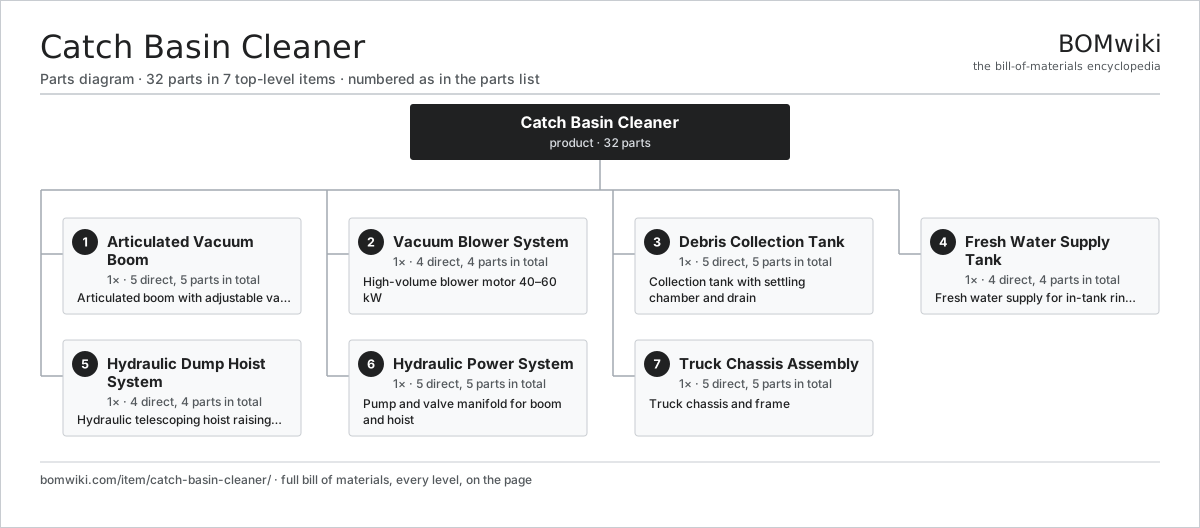
| # | Part | Qty | What it does |
|---|---|---|---|
| 1 | Articulated Vacuum Boom 5 parts | 1× | Articulated boom with adjustable vacuum nozzle |
| 2 | Vacuum Blower System 4 parts | 1× | High-volume blower motor 40–60 kW |
| 3 | Debris Collection Tank 5 parts | 1× | Collection tank with settling chamber and drain |
| 4 | Fresh Water Supply Tank 4 parts | 1× | Fresh water supply for in-tank rinsing |
| 5 | Hydraulic Dump Hoist System 4 parts | 1× | Hydraulic telescoping hoist raising debris tank |
| 6 | Hydraulic Power System 5 parts | 1× | Pump and valve manifold for boom and hoist |
| 7 | Truck Chassis Assembly 5 parts | 1× | Truck chassis and frame |
3D model
No 3D model yet. Have a CAD file of this? Add a 3D model. STL renders right on this page; STEP, FreeCAD, and OpenSCAD sources are welcome too (openly licensed, like all 3D models on BOMwiki).
Build & assembly graph
expand / collapse · shared sub-assemblies converge · links to related products · est. labourTap an assembly to expand/collapse · tap a part to open it · use “Open page” for any node · drag to pan, scroll to zoom.
Bill of materials for Catch Basin Cleaner
7 top-level lines · 39 rows shown · 32 parts total · indented to 3 levels| # | Item / sub-assembly | Part no. | Qty/assy | Ext. qty | Parts | Type |
|---|---|---|---|---|---|---|
| 1 | Articulated Vacuum Boom 5 parts | catch-basin-cleaner-vacuum-boom | 1× | 1 | 5 | assembly |
| 1.1 | Boom Arm | catch-basin-cleaner-boom-arm | 1× | 1 | · | part |
| 1.2 | Vacuum Hose | catch-basin-cleaner-vacuum-hose | 1× | 1 | · | part |
| 1.3 | Vacuum Nozzle | catch-basin-cleaner-nozzle-head | 1× | 1 | · | part |
| 1.4 | Handheld Vacuum Control | catch-basin-cleaner-valve-handle | 1× | 1 | · | part |
| 1.5 | Hose Swivel Coupler | catch-basin-cleaner-swivel-coupler | 1× | 1 | · | part |
| 2 | Vacuum Blower System 4 parts | catch-basin-cleaner-vacuum-motor | 1× | 1 | 4 | assembly |
| 2.1 | Centrifugal Blower Wheel | catch-basin-cleaner-blower-wheel | 1× | 1 | · | part |
| 2.2 | Motor Mount Assembly | catch-basin-cleaner-motor-base | 1× | 1 | · | part |
| 2.3 | Drive Pulley | catch-basin-cleaner-drive-pulley | 1× | 1 | · | part |
| 2.4 | Motor Bearings | catch-basin-cleaner-motor-bearing | 1× | 1 | · | part |
| 3 | Debris Collection Tank 5 parts | catch-basin-cleaner-debris-tank | 1× | 1 | 5 | assembly |
| 3.1 | Tank Body | catch-basin-cleaner-tank-body | 1× | 1 | · | part |
| 3.2 | Settling Weir Baffle | catch-basin-cleaner-settling-weir | 1× | 1 | · | part |
| 3.3 | Drain Assembly | catch-basin-cleaner-drain-system | 1× | 1 | · | part |
| 3.4 | Overflow Port | catch-basin-cleaner-overflow-outlet | 1× | 1 | · | part |
| 3.5 | Swirl Inlet Chamber | catch-basin-cleaner-clean-inlet | 1× | 1 | · | part |
| 4 | Fresh Water Supply Tank 4 parts | catch-basin-cleaner-water-tank | 1× | 1 | 4 | assembly |
| 4.1 | Water Tank Shell | catch-basin-cleaner-water-body | 1× | 1 | · | part |
| 4.2 | Rinse Water Pump | catch-basin-cleaner-water-pump | 1× | 1 | · | part |
| 4.3 | Water Supply Filter | catch-basin-cleaner-water-filter | 1× | 1 | · | part |
| 4.4 | Rinse Water Hose | catch-basin-cleaner-rinse-line | 1× | 1 | · | part |
| 5 | Hydraulic Dump Hoist System 4 parts | catch-basin-cleaner-dump-hoist | 1× | 1 | 4 | assembly |
| 5.1 | Hoist Cylinder | catch-basin-cleaner-hoist-cylinder | 1× | 1 | · | part |
| 5.2 | Hoist Frame | catch-basin-cleaner-hoist-frame | 1× | 1 | · | part |
| 5.3 | Hinge Pin Assembly | catch-basin-cleaner-hoist-pins | 1× | 1 | · | part |
| 5.4 | Safety Chain Latch | catch-basin-cleaner-chain-latch | 1× | 1 | · | part |
| 6 | Hydraulic Power System 5 parts | catch-basin-cleaner-hydraulic-system | 1× | 1 | 5 | assembly |
| 6.1 | Main Hydraulic Pump | catch-basin-cleaner-hydraulic-pump | 1× | 1 | · | part |
| 6.2 | Control Manifold | catch-basin-cleaner-hydraulic-manifold | 1× | 1 | · | part |
| 6.3 | Hydraulic Cooler | catch-basin-cleaner-hydraulic-cooler | 1× | 1 | · | part |
| 6.4 | Hydraulic Reservoir | catch-basin-cleaner-reservoir-assy | 1× | 1 | · | part |
| 6.5 | Pressure Indicator | catch-basin-cleaner-pressure-gauge | 1× | 1 | · | part |
| 7 | Truck Chassis Assembly 5 parts | catch-basin-cleaner-chassis | 1× | 1 | 5 | assembly |
| 7.1 | Main Diesel Engine | catch-basin-cleaner-engine | 1× | 1 | · | part |
| 7.2 | Power Transmission | catch-basin-cleaner-transmission | 1× | 1 | · | part |
| 7.3 | Rear Axle Assembly | catch-basin-cleaner-axles | 1× | 1 | · | part |
| 7.4 | Chassis Frame | catch-basin-cleaner-frame | 1× | 1 | · | part |
| 7.5 | Operator Cabin | catch-basin-cleaner-cabin | 1× | 1 | · | part |
Something wrong in this list? Report a problem with this BOM.
Sourcing: possible vendors
Browse the supplier directory → Prices, MOQ, and lead times are algorithmic estimates, not quotes, and not claims about these companies. Company mappings are curated by keyword; est. price band $15k–$2M. How estimates work| Vendor | HQ | Specialty | MOQ | Lead time |
|---|---|---|---|---|
| caterpillar.com ↗ | Irving, US | Construction & mining equipment | made to order | 16–28 wks |
|
🇯🇵Komatsu
komatsu.com ↗
|
Tokyo, JP | Construction & mining equipment | made to order | 16–28 wks |
|
🇸🇪Volvo CE
volvoce.com ↗
|
Gothenburg, SE | Construction equipment | made to order | 16–28 wks |
|
🇨🇭Liebherr
liebherr.com ↗
|
Bulle, CH | Cranes & heavy equipment | made to order | 16–28 wks |
|
🇨🇳XCMG
xcmg.com ↗
|
Xuzhou, CN | Construction machinery | made to order | 16–28 wks |
1,113-word article