Automated Cell Counter
ProductOverview
An automated cell counter is a laboratory instrument for rapid, reproducible enumeration and classification of cells in suspension. Traditional methods (manual hemocytometer, Coulter counter) are slow, operator-dependent, and labor-intensive. Modern automated counters use brightfield or fluorescence microscopy with image processing to detect cell boundaries, count them, measure size, and classify morphology, all in seconds.
Automated cell counters are essential in clinical hematology (white blood cell, platelet counts), virology (TCID50 assays, viral titration), and research (cell proliferation assays, fermentation monitoring). The Processor Unit performs real-time image analysis, identifying and segmenting individual cells from background noise.
How it works
A sample (typically whole blood or cell suspension) is introduced via Sample Inlet into the Fluidics Stage. The Peristaltic Pump draws sample at a controlled rate (1–10 µL/min) into the Flow Cell, a shallow chamber (15–50 µm thick) placed on the Slide Stage.
The LED Illumination illuminates the flow cell with brightfield (white) or fluorescence light (450 nm, 633 nm LEDs). The Lens Assembly (40x or 20x objective) images the sample onto a CMOS Image Sensor (CMOS, 1–2 megapixels, capturing 10–30 frames per second). The Dichroic Filter separates excitation and emission wavelengths (for fluorescence modes).
The Processor Unit receives raw images and executes image segmentation:
- Contrast enhancement: Histogram equalization highlights cells.
- Thresholding: Pixels brighter than a threshold become "cell" candidates.
- Morphological filtering: Connected-component analysis clusters adjacent pixels.
- Feature extraction: Size, circularity, fluorescence intensity measured per object.
- Classification: Rules separate true cells from debris, determine viability (fluorescence pattern), and sort by size (WBC subpopulations: lymphocytes ~7 µm, monocytes ~15 µm, granulocytes ~10 µm).
A sampling protocol may collect 50–100 image frames across the flow cell, analyzing ~10,000 cells per sample, with statistical binning by size class. Results (total count, subpopulations, mean size) display on the Display Interface.
Brightfield vs. Fluorescence
Brightfield: Cell bodies absorb and scatter light, appearing dark against a bright background. This is sensitive but suffers from halos (diffracted light around edges) and is sensitive to stain quality. Brightfield counts total cells, unable to distinguish viable from dead cells without vital stains.
Fluorescence: Cells pre-stained with acridine orange (AO) fluoresce green (live cells) or propidium iodide (PI) fluoresces red (dead cells, permeable membrane). Fluorescence is more specific; only stained cells appear. Two-color detection allows simultaneous live/dead discrimination.
Dilution and Counting Strategy
Most cell suspensions are too concentrated for counting (>10,000 cells/µL causes cell overlap, reducing accuracy). The Dilution Channel automatically dilutes samples 1:10, 1:100, or 1:500 in phosphate-buffered saline (PBS) or diluent. The instrument selects dilution to keep target count in optimal range (100–5000 cells per frame).
A Peristaltic Pump driven by stepper motors provides precise volumetric mixing, independent of pressure or viscosity variations.
Autofocus and Image Quality
The Z-Axis Stepper (Z-axis) adjusts Lens Assembly focus via a Slide Holder. Real-time contrast analysis (Laplacian or edge variance) detects focus quality; the autofocus loop iteratively adjusts Z until maximum contrast is reached. This is critical; a 1–2 µm focus shift blurs cell boundaries and reduces counting accuracy.
Flow Cell Design
The Flow Cell is shallow (15–50 µm) to create a monolayer of cells. If too shallow, cells compress and distort; if too thick, cells overlap (multiple layers). Most flow cells are disposable polystyrene or glass, reducing cross-contamination risk between samples. Some instruments use reusable chambers with periodic cleaning.
Data Management and QC
The Memory Storage archives raw images and results. Each test generates metadata (timestamp, operator, sample ID via Input Device barcode scanner) linked to count data. Quality control flags (e.g., "coincidence detected, cell overlap," "debris high," "focus poor") alert operators to suspicious results.
The Network Interface (Ethernet) integrates with lab information systems (LIS), enabling direct result transfer without manual transcription, reducing error and improving traceability.
Reagent Cartridges
Some automated counters (e.g., hematology analyzers) use specialized Reagent Cartridge containing Buffer Reservoir (lysis buffer) and Stain Bottle (vital stains). The peristaltic pump automatically dispenses calculated volumes into the sample; aliquots of lysed blood then flow to multiple modules (WBC, RBC, platelet channels). Single-use cartridges eliminate cross-contamination but add cost.
Viability Assessment
Live cells maintain membrane integrity; acridine orange (AO) penetrates all cells, fluorescing green. Propidium iodide (PI) enters only damaged/dead cells (red). A viable count is AO+ PI−; dead count is AO+ PI+. Percentage viability = viable / total × 100%. This is critical in cell therapy, vaccine production, and primary cell handling.
Size Classification
Cells are binned by diameter or area:
- Lymphocytes: 7–10 µm
- Monocytes: 12–20 µm
- Granulocytes: 8–12 µm
- Platelets: 2–4 µm
- RBCs: 6–8 µm
The Processor Unit computes size histograms and flags abnormalities (e.g., immature blast cells, platelet clumps) for operator review.
Microbial Cell Counting
In fermentation and microbiology, automated counters measure bacterial or yeast cell density. Total cell count (including dead cells) is measured in brightfield. Viable count (metabolically active cells) uses fluorescent vital stains (e.g., calcein AM, propidium iodide). Growth kinetics (exponential, stationary, death phase) are assessed from optical density (OD) trends, but cell count provides actual viable cell concentration independent of cell size or morphological changes.
Accuracy and Calibration
Counting accuracy is ±5–10% vs. manual hemocytometer (gold standard) or ±3–5% between automated instruments. Accuracy degrades with:
- Sample quality: Clots, air bubbles, evaporation alter concentration.
- Stain variability: Old reagents or improper staining reduce fluorescence intensity.
- Focus drift: Over long sample sequences, focus creep introduces systematic error.
Annual calibration using certified control slides (known cell concentration, embedded in polymer matrix) verifies accuracy and drift.
Throughput and Batching
A typical automated counter processes 1–5 samples per minute in single-sample mode. Some instruments support 96-well plate loaders, enabling overnight batch processing of 10–20 plates (1000+ samples) with robotic sampling.
Cost-Benefit
Manual hemocytometer: ~5 minutes per sample, operator fatigue, ±10–15% variation between operators. Automated counter: ~30 seconds per sample, high precision, <5% variation, full audit trail, but higher instrument capital cost ($30k–$100k+).
Breakeven is achieved at 50–100 samples/week in a busy laboratory.
Applications
- Clinical hematology: Complete blood count (CBC), WBC differential
- Quality assurance: Bacterial culture monitoring, cell viability in production
- Research: Cell proliferation assays, flow cytometry preparation (cell dilution verification)
- Microbiology: Antimicrobial efficacy testing, fermentation optimization
- Vaccine manufacturing: Final product potency confirmation (cell titer for live attenuated vaccines)
Integration with Flow Cytometry
Flow cytometers also count cells but add detailed immunophenotyping (antibody-based classification). Automated counters are faster and simpler for total count; flow cytometry is required for specific subpopulation analysis (e.g., CD4+ T cells).
Automated Cell Counter parts and their functions
8 top-level parts · 54 parts in total · full bill of materials below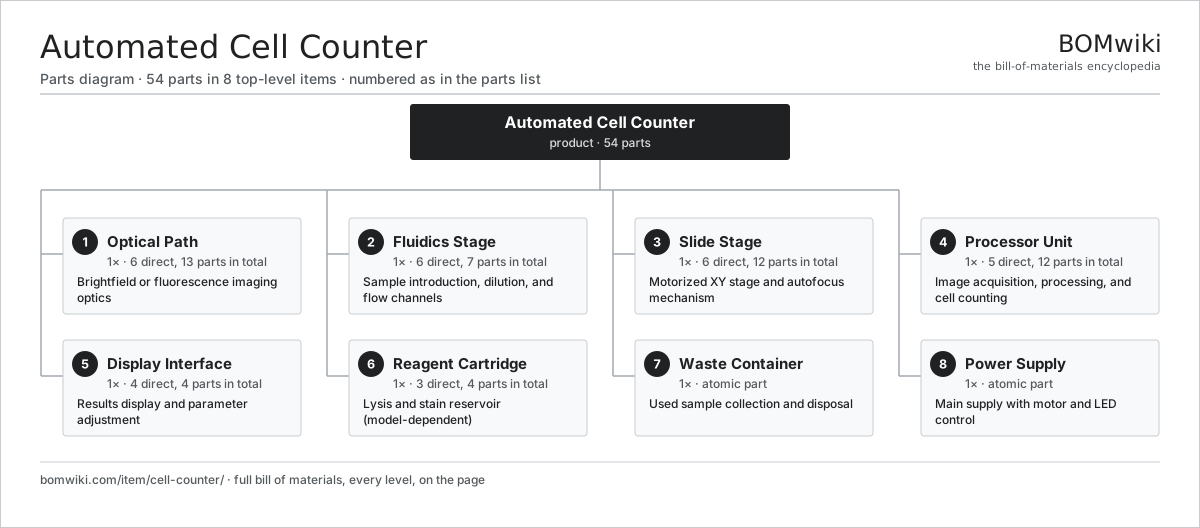
| # | Part | Qty | What it does |
|---|---|---|---|
| 1 | Optical Path 6 parts | 1× | Brightfield or fluorescence imaging optics |
| 2 | Fluidics Stage 6 parts | 1× | Sample introduction, dilution, and flow channels |
| 3 | Slide Stage 6 parts | 1× | Motorized XY stage and autofocus mechanism |
| 4 | Processor Unit 5 parts | 1× | Image acquisition, processing, and cell counting |
| 5 | Display Interface 4 parts | 1× | Results display and parameter adjustment |
| 6 | Reagent Cartridge 3 parts | 1× | Lysis and stain reservoir (model-dependent) |
| 7 | Waste Container | 1× | Used sample collection and disposal |
| 8 | Power Supply | 1× | Main supply with motor and LED control |
3D model
No 3D model yet. Have a CAD file of this? Add a 3D model. STL renders right on this page; STEP, FreeCAD, and OpenSCAD sources are welcome too (openly licensed, like all 3D models on BOMwiki).
Build & assembly graph
expand / collapse · shared sub-assemblies converge · links to related products · est. labourTap an assembly to expand/collapse · tap a part to open it · use “Open page” for any node · drag to pan, scroll to zoom.
Bill of materials for Automated Cell Counter
8 top-level lines · 38 rows shown · 54 parts total · indented to 3 levels| # | Item / sub-assembly | Part no. | Qty/assy | Ext. qty | Parts | Type |
|---|---|---|---|---|---|---|
| 1 | Optical Path 6 parts | cell-counter-optical-path | 1× | 1 | 13 | assembly |
| 1.1 | Lens Assembly | camera-lens | 2× | 2 | · | part |
| 1.2 | LED Illumination | cell-counter-led-source | 1× | 1 | · | part |
| 1.3 | Dichroic Filter | cell-counter-dichroic-filter | 2× | 2 | · | part |
| 1.4 | Eyepiece | cell-counter-eyepiece | 1× | 1 | · | part |
| 1.5 | CMOS Image Sensor | image-sensor | 1× | 1 | · | part |
| 1.6 | SMD Passive (R/C/L) | smd-passives | 6× | 6 | · | part |
| 2 | Fluidics Stage 6 parts | cell-counter-fluidics-stage | 1× | 1 | 7 | assembly |
| 2.1 | Sample Inlet | cell-counter-sample-inlet | 1× | 1 | · | part |
| 2.2 | Peristaltic Pump | cell-counter-peristaltic-pump | 1× | 1 | · | part |
| 2.3 | Flow Cell | cell-counter-flow-cell | 1× | 1 | · | part |
| 2.4 | Dilution Channel | cell-counter-dilution-channel | 1× | 1 | · | part |
| 2.5 | Waste Outlet | cell-counter-waste-outlet | 1× | 1 | · | part |
| 2.6 | Check Valve | cell-counter-check-valve | 2× | 2 | · | part |
| 3 | Slide Stage 6 parts | cell-counter-slide-stage | 1× | 1 | 12 | assembly |
| 3.1 | X-Axis Stepper | cell-counter-stepper-motor-x | 1× | 1 | · | part |
| 3.2 | Y-Axis Stepper | cell-counter-stepper-motor-y | 1× | 1 | · | part |
| 3.3 | Z-Axis Stepper | cell-counter-stepper-motor-z | 1× | 1 | · | part |
| 3.4 | Motor Driver | cell-counter-motor-driver | 3× | 3 | · | part |
| 3.5 | Slide Holder | cell-counter-slide-holder | 1× | 1 | · | part |
| 3.6 | SMD Passive (R/C/L) | smd-passives | 5× | 5 | · | part |
| 4 | Processor Unit 5 parts | cell-counter-processor-unit | 1× | 1 | 12 | assembly |
| 4.1 | Main Processor | cell-counter-main-processor | 1× | 1 | · | part |
| 4.2 | Image Processor | cell-counter-image-processor | 1× | 1 | · | part |
| 4.3 | Memory Storage | cell-counter-memory-storage | 1× | 1 | · | part |
| 4.4 | Network Interface | cell-counter-network-interface | 1× | 1 | · | part |
| 4.5 | SMD Passive (R/C/L) | smd-passives | 8× | 8 | · | part |
| 5 | Display Interface 4 parts | cell-counter-display-interface | 1× | 1 | 4 | assembly |
| 5.1 | LCD Panel | lcd-panel | 1× | 1 | · | part |
| 5.2 | Input Device | cell-counter-keyboard | 1× | 1 | · | part |
| 5.3 | Thermal Printer | cell-counter-printer | 1× | 1 | · | part |
| 5.4 | Power Supply | power-supply | 1× | 1 | · | part |
| 6 | Reagent Cartridge 3 parts | cell-counter-reagent-cartridge | 1× | 1 | 4 | assembly |
| 6.1 | Buffer Reservoir | cell-counter-buffer-reservoir | 1× | 1 | · | part |
| 6.2 | Stain Bottle | cell-counter-stain-bottle | 2× | 2 | · | part |
| 6.3 | Cartridge Seal | cell-counter-cartridge-seal | 1× | 1 | · | part |
| 7 | Waste Container | cell-counter-waste-container | 1× | 1 | · | part |
| 8 | Power Supply | power-supply | 1× | 1 | · | part |
Something wrong in this list? Report a problem with this BOM.
Related products
same domain, ranked by shared parts Confocal Microscope
745 parts · shares 4 with this page
Confocal Microscope
745 parts · shares 4 with this page
 Laser Particle Size Analyzer
607 parts · shares 4 with this page
Laser Particle Size Analyzer
607 parts · shares 4 with this page
 Scanning Electron Microscope
1,000 parts · shares 4 with this page
Digital/Bar-Code Level
28 parts · shares 3 with this page
Scanning Electron Microscope
1,000 parts · shares 4 with this page
Digital/Bar-Code Level
28 parts · shares 3 with this page
 Microscope
60 parts · shares 3 with this page
Microscope
60 parts · shares 3 with this page
Sourcing: possible vendors
Browse the supplier directory → Prices, MOQ, and lead times are algorithmic estimates, not quotes, and not claims about these companies. Company mappings are curated by keyword; est. price band $1k–$500k. How estimates work| Vendor | HQ | Specialty | MOQ | Lead time |
|---|---|---|---|---|
| thermofisher.com ↗ | Waltham, US | Lab instruments | 100 units | 10–18 wks |
|
🇺🇸Agilent
agilent.com ↗
|
Santa Clara, US | Analytical instruments | 100 units | 10–18 wks |
|
🇺🇸Bruker
bruker.com ↗
|
Billerica, US | Scientific instruments | 100 units | 10–18 wks |
|
🇯🇵Shimadzu
shimadzu.com ↗
|
Kyoto, JP | Analytical instruments | 100 units | 10–18 wks |
|
🇺🇸Waters
waters.com ↗
|
Milford, US | Chromatography & MS | 100 units | 10–18 wks |
1,148-word article