Cell on Wheels (COW)
ProductOverview
A Cell on Wheels (COW) is a self-contained cellular base station mounted on a commercial flatbed or cargo trailer, engineered for rapid deployment in emergency situations, disaster recovery, temporary event coverage, or to supplement fixed infrastructure during peak demand. A COW can be driven to a site within 24–48 hours and be broadcasting within 4–8 hours of arrival, making it invaluable when fixed sites are damaged or capacity is exhausted.
The core of a COW is a Trailer Base base: a 32–40 ft commercial chassis with dual axles rated for 10,000+ lb payload. Atop the trailer sits an insulated Equipment Shelter housing baseband processors, power distribution, and backhaul equipment. A Mast Assembly telescopes from 8 ft stowed height to 50–60 ft operational height, supporting three sector antennas, a microwave dish, and a GNSS antenna.
Power is supplied by a Power System consisting of a 30–50 kW diesel genset and a 48V battery bank. The genset typically runs 10–12 hours per day, with the battery providing UPS functionality and backup during genset maintenance or fuel shortage. Diesel fuel in a 500–1000 gallon tank under the trailer provides 3–5 days of continuous operation.
The shelter is a standard 20 ft ISO container or a custom-built insulated box, 8 ft × 8.5 ft in cross-section, with a rooftop air conditioning unit maintaining equipment at 65–75°F. Inside, 42U racks hold baseband processors, power supplies, backhaul equipment, and distribution cabinets. A locked access door and weatherproof seals protect equipment from theft and weather exposure.
The Antenna Array typically consists of three 65° sector antennas optimized for mobile bands (700/800/900/1800/1900 MHz), plus omnidirectional and microwave antennas. RF feeders are routed down the mast and into the shelter via Cable Distribution. Low-noise amplifiers are mounted near the mast top to suppress path losses and noise figure.
Connectivity to the operator's network is typically via a microwave backhaul dish (23 or 28 GHz), or increasingly via licensed spectrum microwave or fiber where available. Grounding and lightning protection are critical: the entire mast is bonded to the trailer chassis, which is earthed via multiple ground rods.
How It Works
The trailer is towed to a site with adequate cellular line-of-sight, parked on level ground, and parking brakes are set. Electrical connections are made: a diesel generator is connected via shore power or the onboard genset is started to supply the shelter HVAC and baseband.
The Mast Assembly is then extended via motor control. As the Mast Sections telescope upward, the Mast Guide Rails rails prevent binding. The Mast Latch Pin pin releases, allowing full extension. Simultaneously, the antennas and their feeders rise, presenting RF coverage to nearby mobile devices.
Inside the shelter, baseband processors boot and synchronize with the operator's core network via the Microwave Dish or backhaul link. The LNA Module units amplify receive signals from the Sector Antenna sets before passing them to the baseband. Transmit signals flow in the opposite direction: from the baseband, through RF feeders, and out the antennas.
The Diesel Generator runs continuously or on demand, depending on site power availability and design. The Battery Bank is kept charged by the Charger & Controller and serves as a buffer if the generator stops or load spikes occur.
A technician monitors the site via remote management tools and performs antenna tilt/azimuth adjustments or baseband configuration changes from inside the shelter or remotely. When the deployment is finished, the mast is retracted, the shelter is sealed, and the trailer is ready to be towed away.
Deployment Scenarios
COWs are most commonly deployed in the following scenarios:
Disaster Recovery: Natural disasters (earthquakes, floods, hurricanes) can render fixed towers inoperable for weeks. Operators deploy COWs to restore coverage in days, providing critical emergency communications for first responders and the public.
Temporary Events: Large outdoor events (music festivals, sporting events, conventions) concentrate traffic on a few cell sites. COWs deployed nearby provide temporary capacity, reducing congestion and improving service quality.
Network Augmentation: During network maintenance or forced outages at a major site, a COW can be deployed within hours to maintain service continuity, avoiding customer dissatisfaction and SLA violations.
Rural or Remote Coverage: In areas where fixed infrastructure build-out is economically infeasible, COWs can provide periodic service, such as during harvest season in agricultural regions.
The rapid deployment and operational flexibility of a COW comes at a cost: the diesel genset is noisy, consumes fuel, and has environmental impact; the temporary nature means no effort is made to minimize visual impact; and the backhaul link (microwave) may be congested on shared spectrum. For long-term solutions, fixed towers are preferred.
Cell on Wheels (COW) parts and their functions
6 top-level parts · 34 parts in total · full bill of materials below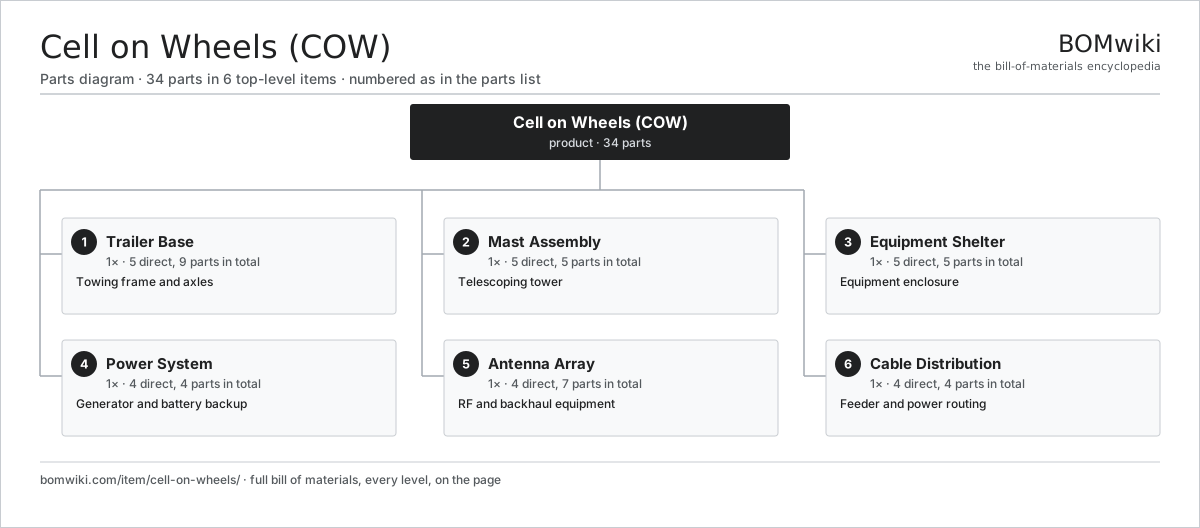
| # | Part | Qty | What it does |
|---|---|---|---|
| 1 | Trailer Base 5 parts | 1× | Towing frame and axles |
| 2 | Mast Assembly 5 parts | 1× | Telescoping tower |
| 3 | Equipment Shelter 5 parts | 1× | Equipment enclosure |
| 4 | Power System 4 parts | 1× | Generator and battery backup |
| 5 | Antenna Array 4 parts | 1× | RF and backhaul equipment |
| 6 | Cable Distribution 4 parts | 1× | Feeder and power routing |
3D model
No 3D model yet. Have a CAD file of this? Add a 3D model. STL renders right on this page; STEP, FreeCAD, and OpenSCAD sources are welcome too (openly licensed, like all 3D models on BOMwiki).
Build & assembly graph
expand / collapse · shared sub-assemblies converge · links to related products · est. labourTap an assembly to expand/collapse · tap a part to open it · use “Open page” for any node · drag to pan, scroll to zoom.
Bill of materials for Cell on Wheels (COW)
6 top-level lines · 33 rows shown · 34 parts total · indented to 3 levels| # | Item / sub-assembly | Part no. | Qty/assy | Ext. qty | Parts | Type |
|---|---|---|---|---|---|---|
| 1 | Trailer Base 5 parts | cell-on-wheels-trailer | 1× | 1 | 9 | assembly |
| 1.1 | Trailer Frame | cell-on-wheels-frame | 1× | 1 | · | part |
| 1.2 | Axles & Suspension | cell-on-wheels-axles | 2× | 2 | · | part |
| 1.3 | Tires | cell-on-wheels-tires | 4× | 4 | · | part |
| 1.4 | Coupler | cell-on-wheels-coupler | 1× | 1 | · | part |
| 1.5 | Hitch Pin | cell-on-wheels-hitch-pin | 1× | 1 | · | part |
| 2 | Mast Assembly 5 parts | cell-on-wheels-mast-assembly | 1× | 1 | 5 | assembly |
| 2.1 | Mast Sections | cell-on-wheels-mast-sections | 1× | 1 | · | part |
| 2.2 | Drive Motor | cell-on-wheels-drive-motor | 1× | 1 | · | part |
| 2.3 | Mast Guide Rails | cell-on-wheels-mast-guide | 1× | 1 | · | part |
| 2.4 | Mast Latch Pin | cell-on-wheels-mast-latch | 1× | 1 | · | part |
| 2.5 | Base Mount | cell-on-wheels-base-mount | 1× | 1 | · | part |
| 3 | Equipment Shelter 5 parts | cell-on-wheels-shelter | 1× | 1 | 5 | assembly |
| 3.1 | Shelter Body | cell-on-wheels-shelter-body | 1× | 1 | · | part |
| 3.2 | HVAC Unit | cell-on-wheels-hvac-unit | 1× | 1 | · | part |
| 3.3 | Power Distribution | cell-on-wheels-power-distribution | 1× | 1 | · | part |
| 3.4 | Rack System | cell-on-wheels-rack-system | 1× | 1 | · | part |
| 3.5 | Door Assembly | cell-on-wheels-door-assembly | 1× | 1 | · | part |
| 4 | Power System 4 parts | cell-on-wheels-power-system | 1× | 1 | 4 | assembly |
| 4.1 | Diesel Generator | cell-on-wheels-diesel-generator | 1× | 1 | · | part |
| 4.2 | Fuel Tank | cell-on-wheels-fuel-tank | 1× | 1 | · | part |
| 4.3 | Battery Bank | cell-on-wheels-battery-bank | 1× | 1 | · | part |
| 4.4 | Charger & Controller | cell-on-wheels-charger-controller | 1× | 1 | · | part |
| 5 | Antenna Array 4 parts | cell-on-wheels-antenna-array | 1× | 1 | 7 | assembly |
| 5.1 | Sector Antenna | cell-on-wheels-sector-antenna | 3× | 3 | · | part |
| 5.2 | Omnidirectional Antenna | cell-on-wheels-omnidirectional | 1× | 1 | · | part |
| 5.3 | Microwave Dish | cell-on-wheels-microwave-dish | 1× | 1 | · | part |
| 5.4 | LNA Module | cell-on-wheels-lna-module | 2× | 2 | · | part |
| 6 | Cable Distribution 4 parts | cell-on-wheels-cable-distribution | 1× | 1 | 4 | assembly |
| 6.1 | RF Feeder Cable | cell-on-wheels-rf-feeder | 1× | 1 | · | part |
| 6.2 | Power Harness | cell-on-wheels-power-harness | 1× | 1 | · | part |
| 6.3 | Grounding Straps | cell-on-wheels-grounding-straps | 1× | 1 | · | part |
| 6.4 | Cable Routing | cell-on-wheels-cable-routing | 1× | 1 | · | part |
Something wrong in this list? Report a problem with this BOM.
Sourcing: possible vendors
Browse the supplier directory → Prices, MOQ, and lead times are algorithmic estimates, not quotes, and not claims about these companies. Company mappings are curated by keyword; est. price band $30–$50k. How estimates work| Vendor | HQ | Specialty | MOQ | Lead time |
|---|---|---|---|---|
|
🇺🇸Cisco
cisco.com ↗
|
San Jose, US | Networking | 500 units | 8–14 wks |
|
🇺🇸Juniper
juniper.net ↗
|
Sunnyvale, US | Networking | 500 units | 8–14 wks |
| arista.com ↗ | Santa Clara, US | Networking | 500 units | 8–14 wks |
|
🇫🇮Nokia
nokia.com ↗
|
Espoo, FI | Telecom equipment | 500 units | 8–14 wks |
|
🇨🇳Huawei
huawei.com ↗
|
Shenzhen, CN | Networking & telecom | 500 units | 8–14 wks |
831-word article