Cellular Signal Repeater
ProductOverview
A cellular signal repeater (or booster) solves the weak-signal problem in buildings, vehicles, or remote sites by receiving cellular coverage from a nearby tower (via a high-gain donor antenna), amplifying it, and rebroadcasting indoors to fill dead zones. The system is bidirectional: it boosts both downlink (tower to phone) and uplink (phone to tower) simultaneously using frequency-division duplexing (separate TX/RX bands) and automatic feedback control to prevent oscillation.
The repeater is transparent to phones and networks. A phone in a dead zone using a repeater perceives normal service, it doesn't know the signal is rebroadcast. The repeater is purely passive from the phone's perspective (passive access), making it simple to deploy and operator-friendly.
How it works: duplex architecture
The key challenge is preventing the amplifier from oscillating. If the TX amplifier outputs on the same frequency the RX amplifier is listening to, positive feedback loops occur, and the device either oscillates (screeching noise) or hard-limits to protect itself. The solution is a TX/RX duplexer.
The duplexer is a set of precision band-pass filters exploiting the fact that uplink and downlink occupy different frequency bands. For example, in the 800 MHz band, downlink (tower to phone) uses 869–894 MHz, while uplink (phone to tower) uses 824–849 MHz. The duplexer has two filter branches: the downlink path (which the TX amp drives) is tuned to 869–894, and the uplink path (which the RX amp listens to) is tuned to 824–849. The two bands are far enough apart (25 MHz gap) that a modest RF filter provides 30–40 dB of isolation, preventing oscillation.
RX and TX chains
The rooftop donor antenna is a high-gain element (10–15 dBi) pointed at the nearest cell tower. It feeds into the RX amplifier, which contains a low-noise amplifier (LNA) providing 18–25 dB gain. This boosts the weak received signal (often −100 dBm or weaker) to a level the duplexer and TX amp can handle.
The signal passes through the downlink filter, which rejects uplink frequencies. It then enters the TX amplifier stage, which provides another 30–40 dB gain, bringing the signal to +20 dBm (100 mW) or higher. This boosted signal feeds the service antenna, which radiates omnidirectionally indoors.
A phone in the building now receives this strong signal and connects to the tower through the repeater. When the phone transmits uplink (e.g., during a call), the weak uplink signal is radiated by the service antenna and captured by the donor antenna at the same rooftop location. This weak signal feeds back into the duplexer's uplink path, passes through the RX amp (which now acts as an uplink booster), and exits the TX filter toward a separate uplink power amplifier. The uplink amp then transmits this signal back to the tower at a higher power level (+20–30 dBm), ensuring the tower receives it clearly.
Isolation and feedback control
Despite the duplexer's filtering, a small amount of TX power can couple back into the RX path (through the antenna, cabling, or filter leakage). The feedback suppression system monitors RF power in both paths. If TX power couples into RX, the system detects this as rising RX power with no corresponding received signal, indicating feedback. The automatic gain control (AGC) then reduces the gain of the TX amplifier stage, lowering the feedback. The phase shifter can also apply a 180° phase shift to the feedback, causing destructive interference and canceling it out. This combination of AGC, limiting, and phase cancellation keeps the repeater stable even if the donor and service antennas are close together.
A key specification is isolation: how much the donor antenna sees its own rebroadcast. With 65+ dB isolation, oscillation is nearly impossible; the repeater self-prevents runaway amplification.
Coverage footprint and planning
A repeater's coverage depends on the TX power, antenna gain, and building materials. A 30 dBm repeater with omnidirectional service antenna covers a radius of roughly 100–300 meters indoors (depending on wall penetration loss). Outdoors in line-of-sight, coverage can extend 2 km.
In large buildings (e.g., a warehouse), multiple repeaters may be needed. Each repeater uses the same donor tower, so they all see similar downlink signal. Service coverage areas should not overlap too much, or two repeaters amplifying the same signal will cause signal discontinuities as a phone moves between zones. Network planning tools help predict coverage and placement.
Bidirectional traffic dynamics
A call over a repeater has asymmetric audio delay. The downlink path (tower → repeater → phone) has some processing latency (a few milliseconds for filtering and amplification), and the uplink path (phone → repeater → tower) has similar latency. Both add up to roughly 10–20 ms round-trip, barely noticeable in voice calls but potentially problematic for delay-sensitive applications.
Interference and spectral management
Repeaters must be used carefully in dense cellular areas. A poorly isolated repeater in a small room can interfere with other nearby repeaters or the macro network. Regulations (FCC in the US, ISED in Canada, etc.) limit repeater gain and TX power, requiring proper installation (outdoor donor antenna, sufficient isolation, power limits). Enterprise and consumer-grade repeaters differ: enterprise devices offer more control and monitoring; consumer devices are plug-and-play but less flexible.
Cellular Signal Repeater parts and their functions
8 top-level parts · 214 parts in total · full bill of materials below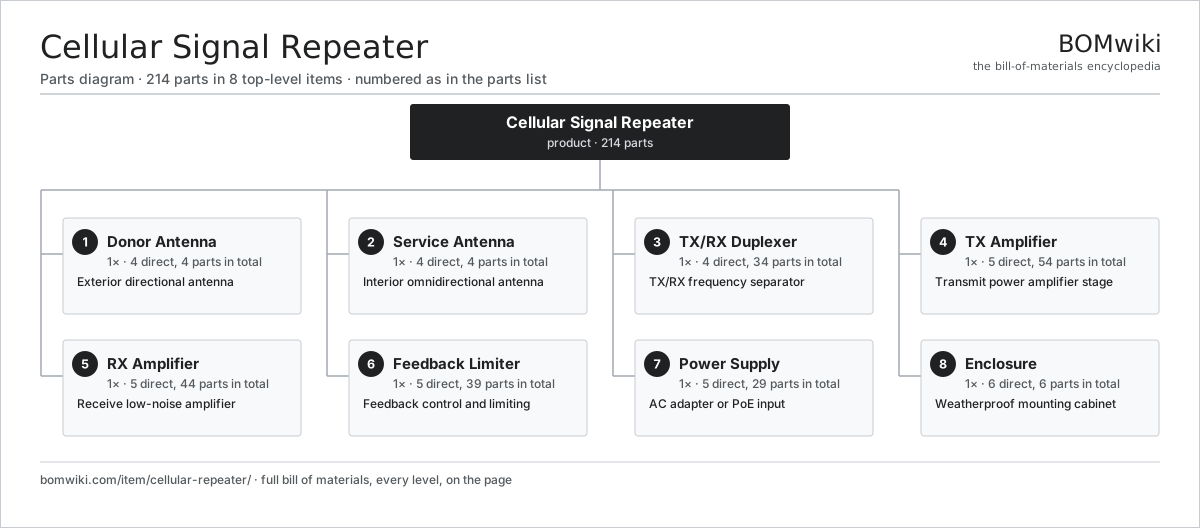
| # | Part | Qty | What it does |
|---|---|---|---|
| 1 | Donor Antenna 4 parts | 1× | Exterior directional antenna |
| 2 | Service Antenna 4 parts | 1× | Interior omnidirectional antenna |
| 3 | TX/RX Duplexer 4 parts | 1× | TX/RX frequency separator |
| 4 | TX Amplifier 5 parts | 1× | Transmit power amplifier stage |
| 5 | RX Amplifier 5 parts | 1× | Receive low-noise amplifier |
| 6 | Feedback Limiter 5 parts | 1× | Feedback control and limiting |
| 7 | Power Supply 5 parts | 1× | AC adapter or PoE input |
| 8 | Enclosure 6 parts | 1× | Weatherproof mounting cabinet |
3D model
No 3D model yet. Have a CAD file of this? Add a 3D model. STL renders right on this page; STEP, FreeCAD, and OpenSCAD sources are welcome too (openly licensed, like all 3D models on BOMwiki).
Build & assembly graph
expand / collapse · shared sub-assemblies converge · links to related products · est. labourTap an assembly to expand/collapse · tap a part to open it · use “Open page” for any node · drag to pan, scroll to zoom.
Bill of materials for Cellular Signal Repeater
8 top-level lines · 46 rows shown · 214 parts total · indented to 3 levels| # | Item / sub-assembly | Part no. | Qty/assy | Ext. qty | Parts | Type |
|---|---|---|---|---|---|---|
| 1 | Donor Antenna 4 parts | cellular-repeater-donor-antenna | 1× | 1 | 4 | assembly |
| 1.1 | Directional Element | cellular-repeater-donor-element | 1× | 1 | · | part |
| 1.2 | Donor Mount | cellular-repeater-donor-mount | 1× | 1 | · | part |
| 1.3 | Donor Feedline | cellular-repeater-donor-cable | 1× | 1 | · | part |
| 1.4 | Antenna Jack | cellular-repeater-antenna-connector | 1× | 1 | · | part |
| 2 | Service Antenna 4 parts | cellular-repeater-service-antenna | 1× | 1 | 4 | assembly |
| 2.1 | Service Radiator | cellular-repeater-service-element | 1× | 1 | · | part |
| 2.2 | Service Mount | cellular-repeater-service-mount | 1× | 1 | · | part |
| 2.3 | Service Feedline | cellular-repeater-service-cable | 1× | 1 | · | part |
| 2.4 | Antenna Jack | cellular-repeater-antenna-connector | 1× | 1 | · | part |
| 3 | TX/RX Duplexer 4 parts | cellular-repeater-duplexer | 1× | 1 | 34 | assembly |
| 3.1 | Cavity Filter | cellular-repeater-duplexer-cavity | 1× | 1 | · | part |
| 3.2 | Circulator | cellular-repeater-circulator | 2× | 2 | · | part |
| 3.3 | Isolator | cellular-repeater-isolator | 1× | 1 | · | part |
| 3.4 | SMD Passive (R/C/L) | smd-passives | 30× | 30 | · | part |
| 4 | TX Amplifier 5 parts | cellular-repeater-amplifier-tx | 1× | 1 | 54 | assembly |
| 4.1 | TX Driver | cellular-repeater-tx-driver | 1× | 1 | · | part |
| 4.2 | TX Power Amp | cellular-repeater-tx-power | 1× | 1 | · | part |
| 4.3 | TX Bias Module | cellular-repeater-tx-bias | 1× | 1 | · | part |
| 4.4 | TX Heatsink | cellular-repeater-tx-cooling | 1× | 1 | · | part |
| 4.5 | SMD Passive (R/C/L) | smd-passives | 50× | 50 | · | part |
| 5 | RX Amplifier 5 parts | cellular-repeater-amplifier-rx | 1× | 1 | 44 | assembly |
| 5.1 | RX LNA | cellular-repeater-rx-lna | 1× | 1 | · | part |
| 5.2 | RX Filter | cellular-repeater-rx-filter | 1× | 1 | · | part |
| 5.3 | RX Bias | cellular-repeater-rx-bias | 1× | 1 | · | part |
| 5.4 | RX Thermal | cellular-repeater-rx-cooling | 1× | 1 | · | part |
| 5.5 | SMD Passive (R/C/L) | smd-passives | 40× | 40 | · | part |
| 6 | Feedback Limiter 5 parts | cellular-repeater-limiter | 1× | 1 | 39 | assembly |
| 6.1 | Power Detector | cellular-repeater-power-detector | 1× | 1 | · | part |
| 6.2 | AGC Control | cellular-repeater-agc-control | 1× | 1 | · | part |
| 6.3 | Phase Shifter | cellular-repeater-phase-shifter | 1× | 1 | · | part |
| 6.4 | Control MCU | cellular-repeater-control-mcu | 1× | 1 | · | part |
| 6.5 | SMD Passive (R/C/L) | smd-passives | 35× | 35 | · | part |
| 7 | Power Supply 5 parts | cellular-repeater-power-supply | 1× | 1 | 29 | assembly |
| 7.1 | Power Input | cellular-repeater-psu-input | 1× | 1 | · | part |
| 7.2 | Power Converter | cellular-repeater-psu-transformer | 1× | 1 | · | part |
| 7.3 | Regulators | cellular-repeater-psu-regulation | 1× | 1 | · | part |
| 7.4 | Filter Bank | cellular-repeater-psu-filtering | 1× | 1 | · | part |
| 7.5 | SMD Passive (R/C/L) | smd-passives | 25× | 25 | · | part |
| 8 | Enclosure 6 parts | cellular-repeater-enclosure | 1× | 1 | 6 | assembly |
| 8.1 | Enclosure Box | cellular-repeater-enclosure-box | 1× | 1 | · | part |
| 8.2 | Access Door | cellular-repeater-enclosure-door | 1× | 1 | · | part |
| 8.3 | Thermal Fin | cellular-repeater-enclosure-heatsink | 1× | 1 | · | part |
| 8.4 | Drain Port | cellular-repeater-enclosure-drains | 1× | 1 | · | part |
| 8.5 | Mount Bracket | cellular-repeater-enclosure-mount | 1× | 1 | · | part |
| 8.6 | Fastener Set | fastener-set | 1× | 1 | · | part |
Something wrong in this list? Report a problem with this BOM.
Sourcing: possible vendors
Browse the supplier directory → Prices, MOQ, and lead times are algorithmic estimates, not quotes, and not claims about these companies. Company mappings are curated by keyword; est. price band $30–$50k. How estimates work| Vendor | HQ | Specialty | MOQ | Lead time |
|---|---|---|---|---|
|
🇺🇸Cisco
cisco.com ↗
|
San Jose, US | Networking | 500 units | 8–14 wks |
|
🇺🇸Juniper
juniper.net ↗
|
Sunnyvale, US | Networking | 500 units | 8–14 wks |
| arista.com ↗ | Santa Clara, US | Networking | 500 units | 8–14 wks |
|
🇫🇮Nokia
nokia.com ↗
|
Espoo, FI | Telecom equipment | 500 units | 8–14 wks |
|
🇨🇳Huawei
huawei.com ↗
|
Shenzhen, CN | Networking & telecom | 500 units | 8–14 wks |
954-word article