Emergency Lighting Central Battery System
ProductOverview
A central battery emergency lighting system is the backbone of building code compliance in commercial, healthcare, and industrial facilities. When mains power fails, whether from grid outage, equipment failure, or natural disaster, the system automatically switches all emergency lighting circuits to backup battery power within 100 milliseconds, providing illuminated exit paths and safe evacuation routes.
Unlike traditional unit equipment (individual battery packs in each fixture), a central battery system pools all battery capacity in a single, strategically located cabinet, serving 50–500+ emergency lights across the entire building via a dedicated low-voltage or AC wiring circuit. This architecture offers cost savings, centralized maintenance, and the ability to easily expand capacity as the building grows.
The system comprises seven key subsystems: the battery bank, charger, inverter, system controller, distribution panel, monitoring interface, and cabinet enclosure.
Design scenario: Building power loss
When mains power is present (normal operation):
The multi-stage charger trickles current into the battery bank, maintaining it at full state of charge.
All building lighting (including emergency exit lights) is powered directly from the 120/240 VAC mains via the distribution panel.
The system controller continuously monitors the mains voltage via an opto-isolated AC sensor. A green status LED on the monitoring display indicates normal operation.
When mains power fails (e.g., transformer explosion or utility outage):
The mains sensor detects the loss within 10–20 ms (one half-cycle of 60 Hz AC).
The MCU immediately commands the DC-to-AC inverter to activate, stepping the 24–48 VDC battery voltage up to 120/240 VAC.
Simultaneously, the transfer relay switches all emergency lighting loads from the now-dead mains to the inverter output. This switchover is complete within 100 ms (mandated by NFPA 110 Code).
The alarm sounder activates, alerting building occupants and staff to the power loss.
All emergency exit lights, exit corridor lighting, stairwell lights, and other designated emergency circuits remain illuminated for up to 90 minutes, allowing safe evacuation.
As battery voltage decays (typically 40–50% per hour under full load), the controller monitors battery voltage and current sensors and can dim non-critical emergency lights (via PWM modulation of certain circuits) to extend battery life if the outage is lengthy. Safety-critical lights (exits, stairs) remain full brightness.
When mains power is restored:
The charger resumes its three-stage charging sequence, restoring the battery to full state of charge within 12–24 hours.
The transfer relay switches loads back to mains power.
The alarm sounder stops, and the green status LED returns, signaling that the system is ready for the next emergency.
Battery technologies: Lead-acid vs. lithium
Lead-acid batteries (traditional, cost-effective):
- Individual modules: 12 V, 7–100 Ah per module
- Arranged in series (e.g., 4 modules = 48 V nominal)
- Cost: ~$100–150 per kWh stored
- Lifespan: 5–7 years (depends on depth-of-discharge cycles)
- Advantages: Proven reliability, easy to replace individual failed modules, lower initial cost
- Disadvantages: Heavy (40–50 kg per 100 Ah module), self-discharge (~5% per month), temperature-sensitive (capacity drops 50% at 0 °C)
Lithium (LiFePO4) batteries (modern, high-density):
- Individual cells: 3.2 V nominal, assembled into packs
- Higher energy density: 150–200 Wh/kg (vs. 50 Wh/kg for lead-acid)
- Cost: ~$300–500 per kWh stored (declining)
- Lifespan: 10–15 years (2000–5000 cycles)
- Advantages: Compact, lightweight, superior low-temperature performance, longer calendar life
- Disadvantages: Higher upfront cost, requires specialized BMS (battery management system), less field-serviceable
Modern buildings increasingly specify lithium for retrofit emergency lighting systems in space-constrained mechanical rooms, while new construction often uses lead-acid for simplicity and cost unless battery density is a constraint.
Charger design and battery longevity
The charger module implements three-stage charging to extend lead-acid battery lifespan:
Stage 1: Bulk charge (0–80% SOC)
- Constant current (e.g., 10 A) charging at maximum allowable voltage (27.6 V for 24 V nominal bank)
- Charge current limited by charger output capability and battery acceptance rate
- Duration: 4–6 hours for typical 200–400 Ah battery bank
Stage 2: Absorption phase (80–95% SOC)
- Constant voltage (27.6 V) with tapering current as battery approaches full charge
- Duration: 2–4 hours as current slowly drops from 10 A to ~1 A
- Critical phase: allows slow settling of internal battery chemistry, preventing gassing and promoting even charge distribution among cells
Stage 3: Float/maintenance charge (95–100% SOC)
- Constant voltage (24.3 V, slightly lower than absorption) with minimal current (0.5–1 A)
- Compensates for self-discharge and minor load leakage
- Duration: Indefinite (normal operation)
- Keep battery at full charge without overcharging, extending cycle life from 3–5 years (constant overcharge) to 7–10 years
The charger IC (e.g., bq24770) automatically transitions between stages, eliminating user error and maximizing battery longevity.
Lithium systems use a different profile: constant-current-constant-voltage (CCCV) charging to 3.65 V per cell (12.0 V per 4-cell module), with faster absorption due to better internal thermal management. A dedicated lithium BMS monitors individual cell voltages, balancing charge across all cells and protecting against over-voltage or under-voltage conditions.
Inverter design and output quality
The DC-to-AC inverter is the critical bridge from battery to emergency loads. A poorly designed inverter produces high total harmonic distortion (THD), which can damage electronic ballasts in LED or fluorescent fixtures, causing premature failure or non-illumination.
Inverter topology:
- High-power MOSFET bridge switches the 24–48 VDC bus at ~20 kHz (PWM frequency)
- Output transformer steps the high-frequency PWM signal up to line voltage (120/240 VAC)
- LC output filter removes high-frequency switching noise, leaving only the 60 Hz fundamental and low harmonics
The resulting output is a quasi-sinusoidal waveform with <5% THD, acceptable for all standard emergency lighting loads (incandescent, fluorescent ballasts, LED drivers).
Inrush current is a critical design parameter: when the inverter switches on, 50+ amp-hour lamps starting simultaneously can draw 10× normal current for the first 1–2 ms (magnetizing inrush in transformer ballasts). The inverter's DC bus capacitor must supply this current spike without sagging >20% voltage, or the lights will flicker or fail to start. The battery's internal resistance and the filter capacitors are sized to handle this transient.
Monitoring, testing, and compliance
Building codes (NFPA 101 Life Safety Code, IFC) mandate that emergency lighting systems:
Self-test monthly: The system controller can be programmed to automatically transfer to inverter power for 30 seconds each month, verifying that the battery will function when needed.
Load test annually: A technician commands the system to run the inverter under full load for a predetermined duration (typically 30 minutes at 50% load, or until battery reaches 90% discharge). This validates that the battery bank has sufficient capacity for the required 90-minute backup duration.
Display system status locally: The LCD display shows battery voltage, estimated capacity remaining, number of recent switchovers, and last self-test result.
Report to building management systems: Via BACnet or Modbus TCP, the system integrates with the building's fire alarm, security, and HVAC networks, allowing centralized monitoring of all emergency systems.
Failure modes trigger alarms:
- Battery low voltage: Indicates depleted or failing battery module
- Charger fault: Loss of mains power to charger, or charger inability to charge battery
- Inverter fault: Short-circuit in inverter or control circuit
- Mains loss: Automatically triggers inverter switchover and alarm
- Module imbalance: One battery module voltage significantly lower than others, indicating internal cell failure
Installation and integration
A central battery system is installed in a dedicated, climate-controlled location (mechanical room, electrical closet) with:
- Mains power feed: 120 or 240 VAC, 20–60 A circuit (depending on charger size)
- Emergency load feed: Typically a dedicated, separately run low-voltage (24 VDC) or AC emergency circuit from the distribution panel to all emergency lights
- Network interface: Cat-5 Ethernet to building BMS or fire alarm system
- Access: Sufficient space for annual battery replacement (lead-acid packs ~40 kg each; lithium packs lighter but denser)
Wiring simplicity is a major advantage of central battery: all emergency lights are wired to a single distribution panel circuit, rather than each light needing its own unit battery pack and wiring.
Sizing and capacity planning
Sizing requires:
- Load inventory: List all emergency lights that must operate on battery (exit signs, corridor lights, stairwell lights, etc.), sum their power consumption
- Duration requirement: Typically 90 minutes per code; in some critical facilities (hospitals, data centers), 3–8 hours
- Voltage drop budget: 24 or 48 VDC (depending on system design); higher voltage reduces wire gauge and I²R losses over long runs
Example:
- 100 emergency lights × 15 W per light = 1.5 kW load
- 90-minute runtime: 1.5 kW × 1.5 hours = 2.25 kWh
- Add 20% margin for aging and inefficiency: 2.7 kWh required
- At 48 VDC: 2700 Wh ÷ 48 V = 56 Ah minimum battery capacity
- Specify: 48 V bank (4 × 12 V, 100 Ah modules in series) = 4.8 kWh nominal, or 3 × 48 V 100 Ah LiFePO4 packs
Regulatory and standards
- NFPA 101 (Life Safety Code): Mandates emergency lighting and egress systems; calls for 90-minute battery backup minimum
- NFPA 110 (Emergency and Standby Power Systems): Defines system performance, switchover time (<100 ms), monitoring, and testing requirements
- IEC 62040 (Uninterruptible Power Supplies): Technical standards for inverters, chargers, and system reliability
- UL 924 (Emergency Lighting and Power Equipment): Product safety standard for battery packs, inverters, and central battery units
- Local Building Codes: IFC, IBC, or regional codes may impose additional requirements (e.g., California requires addressable emergency lighting in high-rises)
Certification and documentation are essential: a UL 924-listed central battery system includes maintenance manuals, capacity worksheets, and annual inspection checklists that facilities managers rely on for code compliance.
Long-term economics and total cost of ownership
Initial cost:
- Lead-acid system: $3–8 per watt-hour stored (~$15–40 kWh for a 200-kW building)
- Lithium system: $5–15 per watt-hour (~$25–75 kWh)
Lifecycle cost (10 years):
- Lead-acid: 2 battery replacements ($8–15 kWh per replacement) + annual maintenance ($500–1000/year) + electricity for charger (~$100–200/year)
- Lithium: 1 or 0 replacements + minimal maintenance ($200–500/year) + electricity ($100–200/year)
The higher upfront cost of lithium is offset by reduced replacement and maintenance burden, especially in large buildings where battery packs are heavy and labor-intensive to replace. Many facility managers now specify lithium for all new construction and major retrofits.
Emergency Lighting Central Battery System parts and their functions
7 top-level parts · 27 parts in total · full bill of materials below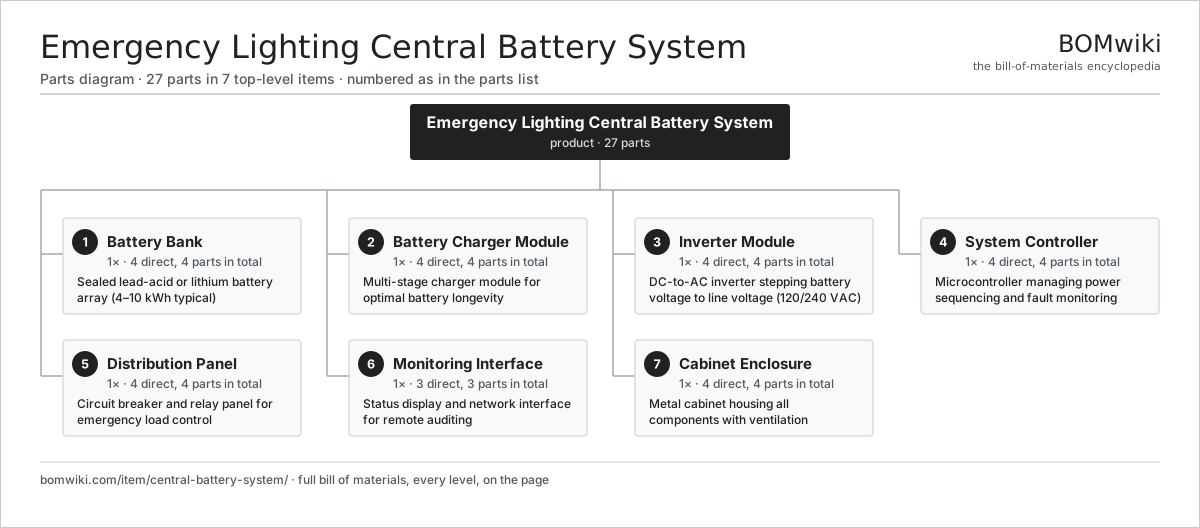
| # | Part | Qty | What it does |
|---|---|---|---|
| 1 | Battery Bank 4 parts | 1× | Sealed lead-acid or lithium battery array (4–10 kWh typical) |
| 2 | Battery Charger Module 4 parts | 1× | Multi-stage charger module for optimal battery longevity |
| 3 | Inverter Module 4 parts | 1× | DC-to-AC inverter stepping battery voltage to line voltage (120/240 VAC) |
| 4 | System Controller 4 parts | 1× | Microcontroller managing power sequencing and fault monitoring |
| 5 | Distribution Panel 4 parts | 1× | Circuit breaker and relay panel for emergency load control |
| 6 | Monitoring Interface 3 parts | 1× | Status display and network interface for remote auditing |
| 7 | Cabinet Enclosure 4 parts | 1× | Metal cabinet housing all components with ventilation |
3D model
No 3D model yet. Have a CAD file of this? Add a 3D model. STL renders right on this page; STEP, FreeCAD, and OpenSCAD sources are welcome too (openly licensed, like all 3D models on BOMwiki).
Build & assembly graph
expand / collapse · shared sub-assemblies converge · links to related products · est. labourTap an assembly to expand/collapse · tap a part to open it · use “Open page” for any node · drag to pan, scroll to zoom.
Bill of materials for Emergency Lighting Central Battery System
7 top-level lines · 34 rows shown · 27 parts total · indented to 3 levels| # | Item / sub-assembly | Part no. | Qty/assy | Ext. qty | Parts | Type |
|---|---|---|---|---|---|---|
| 1 | Battery Bank 4 parts | central-battery-system-battery-bank | 1× | 1 | 4 | assembly |
| 1.1 | Battery Module | central-battery-system-battery-module | 1× | 1 | · | part |
| 1.2 | Parallel Harness | central-battery-system-parallel-harness | 1× | 1 | · | part |
| 1.3 | Isolation Breaker | central-battery-system-isolation-breaker | 1× | 1 | · | part |
| 1.4 | Battery Monitoring | central-battery-system-battery-monitoring | 1× | 1 | · | part |
| 2 | Battery Charger Module 4 parts | central-battery-system-charger | 1× | 1 | 4 | assembly |
| 2.1 | Charger PCB | central-battery-system-charger-pcb | 1× | 1 | · | part |
| 2.2 | Charger Transformer | central-battery-system-charger-transformer | 1× | 1 | · | part |
| 2.3 | Charge Control IC | central-battery-system-charge-control-ic | 1× | 1 | · | part |
| 2.4 | Charger Filter | central-battery-system-charger-filter | 1× | 1 | · | part |
| 3 | Inverter Module 4 parts | central-battery-system-inverter | 1× | 1 | 4 | assembly |
| 3.1 | Inverter PCB | central-battery-system-inverter-pcb | 1× | 1 | · | part |
| 3.2 | Inverter Transformer | central-battery-system-inverter-transformer | 1× | 1 | · | part |
| 3.3 | Inverter Filter | central-battery-system-inverter-filter | 1× | 1 | · | part |
| 3.4 | Inverter MOSFET | central-battery-system-inverter-mosfet | 1× | 1 | · | part |
| 4 | System Controller 4 parts | central-battery-system-controller | 1× | 1 | 4 | assembly |
| 4.1 | System MCU | central-battery-system-mcu | 1× | 1 | · | part |
| 4.2 | Mains Monitor | central-battery-system-mains-monitor | 1× | 1 | · | part |
| 4.3 | Relay Driver | central-battery-system-relay-driver | 1× | 1 | · | part |
| 4.4 | Communication Module | central-battery-system-communication-module | 1× | 1 | · | part |
| 5 | Distribution Panel 4 parts | central-battery-system-distribution-panel | 1× | 1 | 4 | assembly |
| 5.1 | Main Breaker | central-battery-system-main-breaker | 1× | 1 | · | part |
| 5.2 | Load Breakers | central-battery-system-load-breakers | 1× | 1 | · | part |
| 5.3 | Changeover Relay | central-battery-system-changeover-relay | 1× | 1 | · | part |
| 5.4 | Bus Bars | central-battery-system-bus-bars | 1× | 1 | · | part |
| 6 | Monitoring Interface 3 parts | central-battery-system-monitoring-interface | 1× | 1 | 3 | assembly |
| 6.1 | Status Display | central-battery-system-status-display | 1× | 1 | · | part |
| 6.2 | Ethernet Port | central-battery-system-ethernet-port | 1× | 1 | · | part |
| 6.3 | Alarm Sounder | central-battery-system-alarm-sounder | 1× | 1 | · | part |
| 7 | Cabinet Enclosure 4 parts | central-battery-system-enclosure | 1× | 1 | 4 | assembly |
| 7.1 | Cabinet Frame | central-battery-system-cabinet-frame | 1× | 1 | · | part |
| 7.2 | Cooling Fan | central-battery-system-cooling-fan | 1× | 1 | · | part |
| 7.3 | Cable Tray | central-battery-system-cable-tray | 1× | 1 | · | part |
| 7.4 | Door Latch | central-battery-system-door-latch | 1× | 1 | · | part |
Something wrong in this list? Report a problem with this BOM.
Sourcing: possible vendors
Browse the supplier directory → Prices, MOQ, and lead times are algorithmic estimates, not quotes, and not claims about these companies. Company mappings are curated by keyword; est. price band $3–$2k. How estimates work| Vendor | HQ | Specialty | MOQ | Lead time |
|---|---|---|---|---|
|
🇳🇱Signify
signify.com ↗
|
Eindhoven, NL | Lighting (Philips Hue) | 2,000 units | 6–10 wks |
| acuitybrands.com ↗ | Atlanta, US | Lighting & controls | 2,000 units | 6–10 wks |
|
🇦🇹Zumtobel
zumtobelgroup.com ↗
|
Dornbirn, AT | Lighting | 2,000 units | 6–10 wks |
| creelighting.com ↗ | Racine, US | LED lighting | 2,000 units | 6–10 wks |
|
🇮🇳Havells
havells.com ↗
|
Noida, IN | Electrical & lighting | 2,000 units | 6–10 wks |
1,937-word article