Sugar Centrifugal
ProductAlso known as: Batch Sugar Centrifugal
Overview
The sugar centrifugal is the key separation machine after Vacuum Pan cooking, using high-speed rotation to centrifugally separate sugar crystals from mother liquor (residual syrup). A perforated basket spins at 1800 rpm, generating 65g centrifugal force, which throws sugar crystals outward against the basket wall while liquid syrup passes through perforations. Subsequent pulsed wash cycles with hot water remove adhering syrup, improving purity and crystal color. Modern centrifuges separate 300–400 kg sugar per 5–6 minute cycle, processing 3–4 tonnes per hour in continuous operation.
How it Works
Hot sugar mass (crystals + mother liquor) from Vacuum Pan flows into the rotating centrifugal-sugar-machine-basket-rotor. As the basket spins at 1800 rpm, centrifugal force accelerates crystals radially outward at ~65g, pressing them against the perforated wall. Liquid syrup, with lower density and smaller inertial force, drains through 2 mm perforations into the outer casing and overflows back to re-melt.
Once crystals are deposited (30–40 seconds), the Wash Pump begins pulsing wash water (hot water at 70–80 °C or low-purity molasses solution) onto the crystal bed. The wash percolates downward, dissolving residual syrup clinging to crystals. Syrup drains through perforations while crystals remain on the basket wall due to centrifugal force.
After 2–3 wash pulses (10–15 seconds each), the plough blade retracts inward and the Discharge System phase begins. The plough follows the basket contour as it rotates, mechanically scraping crystals off the wall into a Discharge Conveyor that conveys them to the product hopper.
The entire cycle, fill, spin, wash, discharge, takes 5–6 minutes. Continuous operation requires 4–5 centrifuges running staggered cycles to maintain steady product flow.
Design Features
The perforated basket is precision-engineered: hole diameter, pitch, and open area are optimized to drain syrup quickly while supporting the crystal bed. Too-small holes clog; too-large holes lose fines.
Direct motor drive (no gearbox) ensures smooth torque and low maintenance. Soft-start controllers gradually ramp motor current to avoid mechanical shock.
Vibration isolation is essential: rotating imbalance at 1800 rpm generates significant dynamic loads. Elastomer mounts reduce vibration amplitude by 80%, protecting foundations and neighboring equipment.
The wash pulse strategy is critical: continuous wash floods the basket and dilutes syrup but doesn't drain effectively. Pulsed wash (on 3s, off 8s) allows gravity drainage between pulses, removing more syrup per unit water consumed.
Plough blade geometry (15° angle, hardened steel) must match basket contour and rotate smoothly without jamming. Pneumatic or mechanical plough actuation raises and lowers the blade precisely.
Operational Modes
A Massecuite: High-purity mother liquor; wash is hot water; produces white sugar.
B Massecuite: Lower-purity syrup; wash is recycle syrup; produces lower-grade sugar or raw product.
C Massecuite: Exhausted syrup; minimal crystallization; product is molasses, not sugar.
Centrifuge scheduling is critical: A massecuite requires longer spin and more wash; C massecuite can be discarded as molasses after a quick spin.
Common Issues
Unbalance: Uneven crystal distribution or bearing wear causes violent vibration. Motor overload protection trips.
Plough jamming: Wet sugar can pack against plough blade, preventing smooth discharge. Manual intervention required.
Syrup carryover: Inadequate wash leaves syrup on crystals; moisture content becomes too high, affecting product quality.
Bearing damage: Continuous operation at high G-force stresses bearings; regular lubrication and bearing replacement (every 2–3 years) is required.
Integration
Vacuum Pan → Sugar Centrifugal → drying (if required) → Molecular Sieve Dehydrator (for special grades) or bagging → shipping.
Mother liquor from discharge → re-melt tank → Vacuum Pan for next batch, or → Molasses Desugarization for recovery of remaining sugar.
The centrifuge is the bottleneck in most sugar plants; capacity planning and reliability maintenance are critical to throughput.
Sugar Centrifugal parts and their functions
6 top-level parts · 21 parts in total · full bill of materials below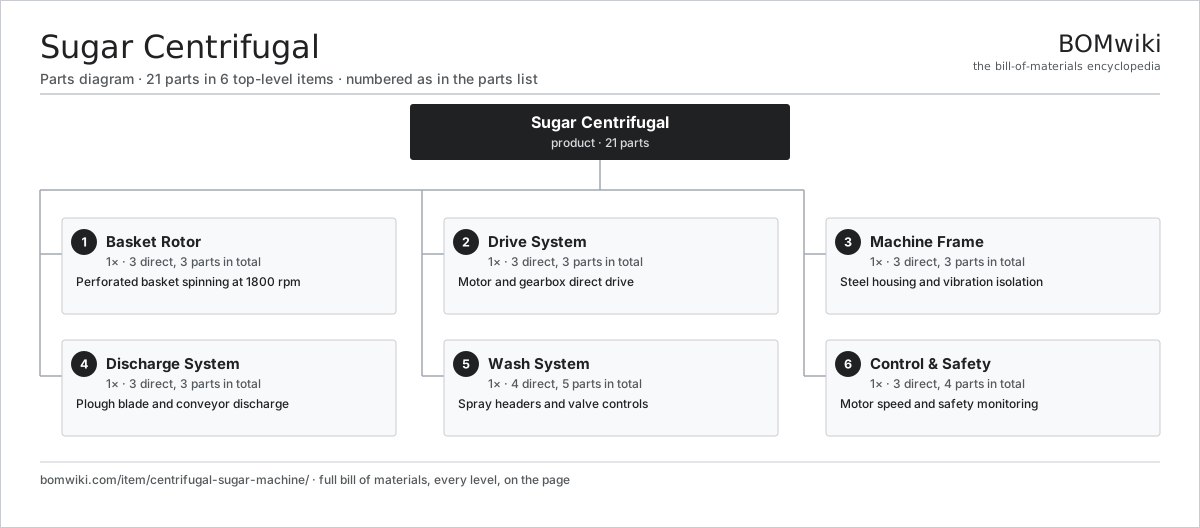
| # | Part | Qty | What it does |
|---|---|---|---|
| 1 | Basket Rotor 3 parts | 1× | Perforated basket spinning at 1800 rpm |
| 2 | Drive System 3 parts | 1× | Motor and gearbox direct drive |
| 3 | Machine Frame 3 parts | 1× | Steel housing and vibration isolation |
| 4 | Discharge System 3 parts | 1× | Plough blade and conveyor discharge |
| 5 | Wash System 4 parts | 1× | Spray headers and valve controls |
| 6 | Control & Safety 3 parts | 1× | Motor speed and safety monitoring |
3D model
No 3D model yet. Have a CAD file of this? Add a 3D model. STL renders right on this page; STEP, FreeCAD, and OpenSCAD sources are welcome too (openly licensed, like all 3D models on BOMwiki).
Build & assembly graph
expand / collapse · shared sub-assemblies converge · links to related products · est. labourTap an assembly to expand/collapse · tap a part to open it · use “Open page” for any node · drag to pan, scroll to zoom.
Bill of materials for Sugar Centrifugal
6 top-level lines · 25 rows shown · 21 parts total · indented to 3 levels| # | Item / sub-assembly | Part no. | Qty/assy | Ext. qty | Parts | Type |
|---|---|---|---|---|---|---|
| 1 | Basket Rotor 3 parts | centrifugal-sugar-machine-rotor | 1× | 1 | 3 | assembly |
| 1.1 | Basket Shell | centrifugal-sugar-machine-basket-shell | 1× | 1 | · | part |
| 1.2 | Basket Bottom | centrifugal-sugar-machine-basket-bottom | 1× | 1 | · | part |
| 1.3 | Basket Seal Ring | centrifugal-sugar-machine-basket-seal | 1× | 1 | · | part |
| 2 | Drive System 3 parts | centrifugal-sugar-machine-drive | 1× | 1 | 3 | assembly |
| 2.1 | Drive Motor | centrifugal-sugar-machine-motor | 1× | 1 | · | part |
| 2.2 | Spindle Shaft | centrifugal-sugar-machine-spindle | 1× | 1 | · | part |
| 2.3 | Bearing Block | centrifugal-sugar-machine-bearing-block | 1× | 1 | · | part |
| 3 | Machine Frame 3 parts | centrifugal-sugar-machine-frame | 1× | 1 | 3 | assembly |
| 3.1 | Machine Casing | centrifugal-sugar-machine-casing | 1× | 1 | · | part |
| 3.2 | Isolation Mounts | centrifugal-sugar-machine-isolation | 1× | 1 | · | part |
| 3.3 | Safety Guard | centrifugal-sugar-machine-guard | 1× | 1 | · | part |
| 4 | Discharge System 3 parts | centrifugal-sugar-machine-discharge | 1× | 1 | 3 | assembly |
| 4.1 | Plough Blade | centrifugal-sugar-machine-plough-blade | 1× | 1 | · | part |
| 4.2 | Plough Actuator | centrifugal-sugar-machine-plough-actuator | 1× | 1 | · | part |
| 4.3 | Discharge Conveyor | centrifugal-sugar-machine-discharge-conveyor | 1× | 1 | · | part |
| 5 | Wash System 4 parts | centrifugal-sugar-machine-wash-system | 1× | 1 | 5 | assembly |
| 5.1 | Wash Pump | centrifugal-sugar-machine-wash-pump | 1× | 1 | · | part |
| 5.2 | Spray Headers | centrifugal-sugar-machine-spray-headers | 2× | 2 | · | part |
| 5.3 | Wash Valve | centrifugal-sugar-machine-wash-valve | 1× | 1 | · | part |
| 5.4 | Wash Strainer | centrifugal-sugar-machine-wash-strainer | 1× | 1 | · | part |
| 6 | Control & Safety 3 parts | centrifugal-sugar-machine-controls | 1× | 1 | 4 | assembly |
| 6.1 | Drive Controller | centrifugal-sugar-machine-vfd | 1× | 1 | · | part |
| 6.2 | Vibration Monitor | centrifugal-sugar-machine-vibration-sensor | 1× | 1 | · | part |
| 6.3 | Safety Switches | centrifugal-sugar-machine-limit-switch | 2× | 2 | · | part |
Something wrong in this list? Report a problem with this BOM.
Sourcing: possible vendors
Browse the supplier directory → Prices, MOQ, and lead times are algorithmic estimates, not quotes, and not claims about these companies. Company mappings are curated by keyword; est. price band $1k–$500k. How estimates work| Vendor | HQ | Specialty | MOQ | Lead time |
|---|---|---|---|---|
| gea.com ↗ | Düsseldorf, DE | Process technology | 20 units | 12–20 wks |
| buhlergroup.com ↗ | Uzwil, CH | Food & materials processing | 20 units | 12–20 wks |
| tetrapak.com ↗ | Pully, CH | Food packaging & processing | 20 units | 12–20 wks |
| jbtc.com ↗ | Chicago, US | Food processing equipment | 20 units | 12–20 wks |
| alfalaval.com ↗ | Lund, SE | Heat transfer & separation | 20 units | 12–20 wks |
649-word article