Ski Chairlift
ProductOverview
A ski chairlift is a continuous mechanical lift system transporting skiers and snowboarders upslope using a circulating steel wire rope and individually detachable chairs. Modern high-speed detachable lifts move chairs at 0.5–2.5 m/s, automatically disengaging grip at stations to allow safe boarding and alighting. A single chairlift can move 600–1000 passengers per hour, making it the standard lift for ski resort vertical transport.
The core mechanics are simple: a Drive Bullwheel Assembly (large grooved pulley driven by a 30–50 kW Drive Motor) propels a Haul Rope System (32–40 mm steel wire rope) in a continuous loop. Chairlift Chairs with detachable Rope Grip mechanisms hang from this rope, spaced 12–15 m apart. When a chair reaches a station, a computer-controlled Detach Mechanism releases the grip, and the chair slows to ~0.3 m/s for safe transfer. At the opposite end, the grip re-engages and the chair accelerates back to line speed.
Haul rope and mechanical foundation
The Haul Rope System is the structural heart of the system. A single Haul Rope (32–40 mm diameter 8×19S or 6×36WS steel wire rope, 1960 or 2160 MPa tensile grade) loops continuously from the Drive Bullwheel Assembly at the base station to a Bullwheel return pulley at the top station, supported along the slope by intermediate Support Tower System spaced 30–80 m apart. The rope is typically 500–2000 m long on a typical ski mountain route.
The rope ends are connected via factory or field Rope Splice, rated for 100% of rope breaking strength. Rope Clip (Crosby U-bolts or equivalent) are spaced along the splice as per DNV or API standards. Annual Rope Inspection, visual, ultrasonic, or eddy-current non-destructive testing, detects hidden corrosion, fatigue cracks, or wire breakage, ensuring early retirement before catastrophic failure.
Chairs and grip mechanism
Each Chairlift Chairs consists of an aluminum or steel Chair Seat (accommodating 2–4 skiers), a Backrest (either padded or simple), and a hinged Safety Bar that lowers to waist height. The chair is suspended from a Chair Hanger (a ball-joint swivel mount) connected to the Rope Grip, spring-loaded steel jaws or friction pads that clamp the haul rope during transit.
The critical innovation is the Detach Mechanism, a cam or lever system actuated by fixed machinery at the stations. As a chair approaches the station, a mechanical actuator pushes or rotates a lever, slowly releasing the grip jaws until the rope slides free. The chair then rolls on separate wheels over a transfer table and around a bend, decelerating to ~0.3 m/s for skiers to easily step off. At the other end, the grip re-engages and the chair accelerates smoothly back to full line speed (no jerking). This continuous-loading, detachable design allows safe transfer even during heavy crowding.
Drive terminal and motor system
The Drive Terminal Station at the base is where the Drive Bullwheel Assembly assembly lives. A Drive Motor (30–50 kW AC induction three-phase) couples through an Elastic Coupling (jaw or disc coupling with elastomer damping) to a Drive Gearbox (helical inline reducer, 10:1–15:1 ratio). The gearbox output shaft drives the Bullwheel (a large grooved cast-iron or ductile-iron pulley, 1500–2000 mm pitch diameter), gripping the haul rope via friction across 2–3 grooves.
The Terminal Frame is a welded-steel base structure mounted on Terminal Support (reinforced concrete pier with anchor bolts). The Bullwheel Bearing (large cylindrical roller bearing, 150–200 mm bore) supports the 2–3 tonne shaft and rotating mass. Vibration isolators decouple the motor/gearbox from the structure, reducing operational noise and protecting the concrete foundation.
Tension and return station
At the upper end (or lower end, depending on slope routing), the Return Tension Station houses a Return Frame and a return Bullwheel supporting the rope. Critically, a Tension Counterweight (1–2 tonnes of cast iron on a sliding carriage) maintains constant rope tension via gravity. The counterweight sits on vertical guide rails and is connected to the return bullwheel frame via a Tension Cable (steel wire rope). As the rope stretches slightly from use or temperature change, the counterweight carriage slides down, maintaining tension. This automatic tensioning system keeps the rope taut and prevents slack that could cause chair derailment.
Tower system and alignment
The Support Tower System are intermediate load-bearing structures spaced 30–80 m apart along the mountain slope. Each tower consists of a Tower Foundation (concrete pad) anchored to bedrock or fill, four Tower Leg (welded tubular steel, 250–350 mm diameter), and Cross Bracing (diagonal and horizontal members) providing lateral stiffness. At the top of each tower sits an Idler Sheave (non-driven pulley, 600–800 mm diameter) with Idler Bearing (roller bearing) supporting the Haul Rope System. These pulleys guide the rope over the mountain terrain, reducing rope sag and ensuring smooth chair travel.
Motor control and safety systems
The Drive Motor and Safety Controls subsystem manages motor power and enforces safety interlocks. A Motor Starter (three-phase contactor or soft-start unit) supplies power to the Drive Motor, with a Speed Controller (potentiometer or VFD) allowing an operator to throttle the lift between idle (0 m/s) and maximum speed (1.5–2.5 m/s).
A hardwired Emergency Stop button (no electronics) cuts motor power immediately. A Holding Brake (spring-applied electromagnet brake, ~200 kN·m holding torque) engages on power loss, preventing rope drift. A Slip Guard (optical or magnetic sensor) compares rope speed (via wheel speed) to motor speed; if the rope slips on the bullwheel (indicating rope wear or overload), an alarm triggers, cueing the operator to stop and inspect.
Operational and safety context
Ski lifts operate at rated capacity for 8–16 hours daily during peak season, with annual maintenance shut-downs for rope inspection, bearing lubrication, and grip mechanism service. The detachable grip mechanism is the key innovation that makes modern high-speed lifts (1.5–2.5 m/s) safe; skiers can board and exit at manageable speeds without jumping on/off a moving chair.
Rope lifespan is typically 8–15 years depending on use intensity, with annual inspection required. The continuous loop design means if a single chairlift-chair becomes damaged, it is simply removed by locking the rope and unbolting the hanger; the lift continues operating with one fewer chair.
Ski Chairlift parts and their functions
8 top-level parts · 188 parts in total · full bill of materials below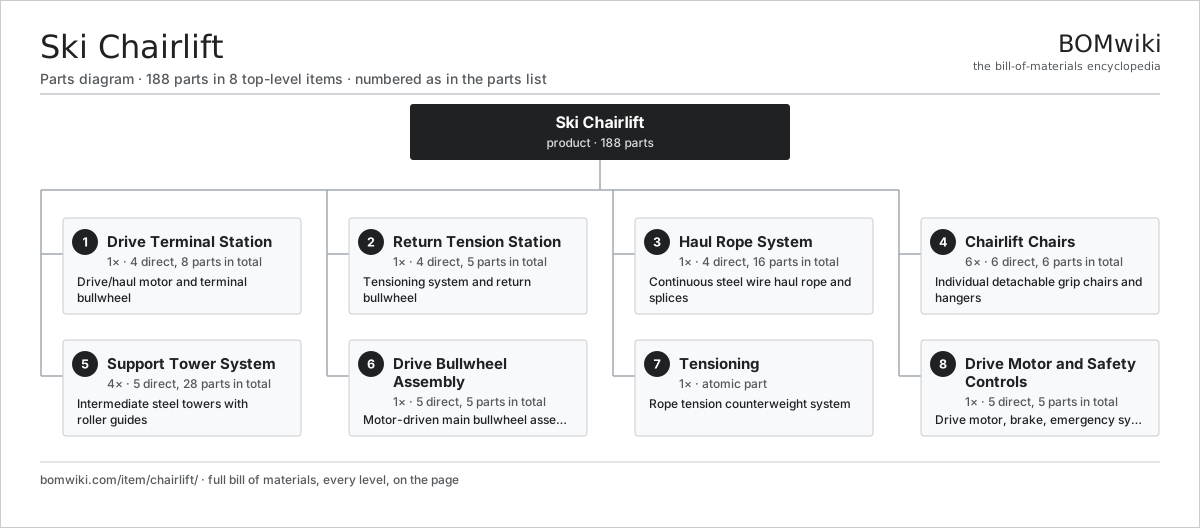
| # | Part | Qty | What it does |
|---|---|---|---|
| 1 | Drive Terminal Station 4 parts | 1× | Drive/haul motor and terminal bullwheel |
| 2 | Return Tension Station 4 parts | 1× | Tensioning system and return bullwheel |
| 3 | Haul Rope System 4 parts | 1× | Continuous steel wire haul rope and splices |
| 4 | Chairlift Chairs 6 parts | 6× | Individual detachable grip chairs and hangers |
| 5 | Support Tower System 5 parts | 4× | Intermediate steel towers with roller guides |
| 6 | Drive Bullwheel Assembly 5 parts | 1× | Motor-driven main bullwheel assembly |
| 7 | Tensioning | 1× | Rope tension counterweight system |
| 8 | Drive Motor and Safety Controls 5 parts | 1× | Drive motor, brake, emergency systems |
3D model
No 3D model yet. Have a CAD file of this? Add a 3D model. STL renders right on this page; STEP, FreeCAD, and OpenSCAD sources are welcome too (openly licensed, like all 3D models on BOMwiki).
Build & assembly graph
expand / collapse · shared sub-assemblies converge · links to related products · est. labourTap an assembly to expand/collapse · tap a part to open it · use “Open page” for any node · drag to pan, scroll to zoom.
Bill of materials for Ski Chairlift
8 top-level lines · 41 rows shown · 188 parts total · indented to 3 levels| # | Item / sub-assembly | Part no. | Qty/assy | Ext. qty | Parts | Type |
|---|---|---|---|---|---|---|
| 1 | Drive Terminal Station 4 parts | chairlift-terminal-station | 1× | 1 | 8 | assembly |
| 1.1 | Terminal Frame | chairlift-terminal-frame | 1× | 1 | · | part |
| 1.2 | Motor Mount | chairlift-motor-mount | 1× | 1 | · | part |
| 1.3 | Bullwheel Bearing | chairlift-bullwheel-bearing | 4× | 4 | · | part |
| 1.4 | Terminal Support | chairlift-terminal-support | 2× | 2 | · | part |
| 2 | Return Tension Station 4 parts | chairlift-return-station | 1× | 1 | 5 | assembly |
| 2.1 | Return Frame | chairlift-return-frame | 1× | 1 | · | part |
| 2.2 | Tension Counterweight | chairlift-tension-counterweight | 1× | 1 | · | part |
| 2.3 | Tension Cable | chairlift-tension-cable | 1× | 1 | · | part |
| 2.4 | Return Bearing | chairlift-return-bearing | 2× | 2 | · | part |
| 3 | Haul Rope System 4 parts | chairlift-haul-rope | 1× | 1 | 16 | assembly |
| 3.1 | Haul Rope | chairlift-rope-main | 1× | 1 | · | part |
| 3.2 | Rope Splice | chairlift-rope-splice | 2× | 2 | · | part |
| 3.3 | Rope Clip | chairlift-rope-clips | 12× | 12 | · | part |
| 3.4 | Rope Inspection | chairlift-rope-inspection | 1× | 1 | · | part |
| 4 | Chairlift Chairs 6 parts | chairlift-chairs | 6× | 6 | 6 | assembly |
| 4.1 | Chair Seat | chairlift-chair-seat | 1× | 6 | · | part |
| 4.2 | Backrest | chairlift-chair-backrest | 1× | 6 | · | part |
| 4.3 | Safety Bar | chairlift-safety-bar | 1× | 6 | · | part |
| 4.4 | Rope Grip | chairlift-chair-grip | 1× | 6 | · | part |
| 4.5 | Detach Mechanism | chairlift-detach-mechanism | 1× | 6 | · | part |
| 4.6 | Chair Hanger | chairlift-chair-hanger | 1× | 6 | · | part |
| 5 | Support Tower System 5 parts | chairlift-support-towers | 4× | 4 | 28 | assembly |
| 5.1 | Tower Foundation | chairlift-tower-base | 4× | 16 | · | part |
| 5.2 | Tower Leg | chairlift-tower-legs | 8× | 32 | · | part |
| 5.3 | Cross Bracing | chairlift-tower-cross-brace | 4× | 16 | · | part |
| 5.4 | Idler Sheave | chairlift-idler-sheave | 4× | 16 | · | part |
| 5.5 | Idler Bearing | chairlift-idler-bearing | 8× | 32 | · | part |
| 6 | Drive Bullwheel Assembly 5 parts | chairlift-drive-sheave | 1× | 1 | 5 | assembly |
| 6.1 | Bullwheel | chairlift-bullwheel | 1× | 1 | · | part |
| 6.2 | Sheave Bore | chairlift-sheave-bore | 1× | 1 | · | part |
| 6.3 | Drive Motor | chairlift-drive-motor | 1× | 1 | · | part |
| 6.4 | Drive Gearbox | chairlift-drive-gearbox | 1× | 1 | · | part |
| 6.5 | Elastic Coupling | chairlift-elastic-coupling | 1× | 1 | · | part |
| 7 | Tensioning | chairlift-tensioning | 1× | 1 | · | part |
| 8 | Drive Motor and Safety Controls 5 parts | chairlift-controls | 1× | 1 | 5 | assembly |
| 8.1 | Motor Starter | chairlift-motor-starter | 1× | 1 | · | part |
| 8.2 | Holding Brake | chairlift-holding-brake | 1× | 1 | · | part |
| 8.3 | Slip Guard | chairlift-rope-slip-guard | 1× | 1 | · | part |
| 8.4 | Emergency Stop | chairlift-emergency-stop | 1× | 1 | · | part |
| 8.5 | Speed Controller | chairlift-speed-controller | 1× | 1 | · | part |
Something wrong in this list? Report a problem with this BOM.
Sourcing: possible vendors
Browse the supplier directory → Prices, MOQ, and lead times are algorithmic estimates, not quotes, and not claims about these companies. Company mappings are curated by keyword; est. price band $10k–$200k. How estimates work| Vendor | HQ | Specialty | MOQ | Lead time |
|---|---|---|---|---|
|
🇺🇸Otis
otis.com ↗
|
Farmington, US | Elevators & escalators | 20 units | 14–24 wks |
| schindler.com ↗ | Ebikon, CH | Elevators & escalators | 20 units | 14–24 wks |
|
🇫🇮KONE
kone.com ↗
|
Espoo, FI | Elevators & escalators | 20 units | 14–24 wks |
| tkelevator.com ↗ | Düsseldorf, DE | Elevators | 20 units | 14–24 wks |
| mitsubishielectric.com ↗ | Tokyo, JP | Elevators & electronics | 20 units | 14–24 wks |
1,107-word article