Char Broiler
ProductOverview
A charbroiler is a standalone cooking station that applies intense radiant heat from below the food, using gas burners and either lava rock or ceramic radiant plates. The iconic result is a distinctive crosshatch of char marks and a caramelized, crusty exterior, the hallmark of high-end steakhouse and burger cookery.
Unlike a conventional flat-top griddle that conducts heat through a metal surface, a charbroiler generates radiant heat that rises from lava rock or radiant elements positioned beneath the cooking grates. Lava rock, a porous volcanic stone, absorbs and re-radiates heat efficiently, and its irregular surface traps rendered fat and creates flavorful smoke. Steel radiant plates offer a cleaner, more consistent heat source with easier maintenance. Either way, the gap between the burners and the grates is just 2–3 inches, so the food experiences intense, localized heat that sears the exterior while the interior cooks at a slower rate.
The cooking surface is a heavy cast-iron or stainless-steel grate, typically 24–36 inches wide and 20–24 inches deep. The grate is removable for cleaning and features widely spaced bars (0.5 to 0.75 inches apart) that allow rendered fat to fall through to the grease tray below. Most charbroilers have 2–4 independent burner zones, each with its own control valve, so a cook can maintain different temperatures in different areas of the cooking surface, hot on one end for searing, medium on the other for finishing.
A Grease Management system beneath the cooking surface collects rendered fat in a removable tray, with an outlet valve for safe disposal. The sloped floor and drain design prevent grease from pooling and smoking excessively during service.
How it works
When a valve is opened, gas flows to the Main Burner, where it mixes with air drawn in through the Air Shutter. The fuel-air mix ignites at a small Pilot Burner or via an electronic spark ignitor. The flame contacts the Lava Rock Bed or Radiant Plates, which absorb the heat and begin to glow.
Lava rock, once hot, provides superb thermal mass and a large radiating surface. The porous structure traps rendered fat, which vaporizes and produces smoke, a desirable byproduct that contributes to the charred flavor. The rock must be replaced every 6–12 months as it accumulates carbon ash and becomes less efficient. Radiant plates, by contrast, are solid metal that re-radiate efficiently and are easier to clean; they lack the smoky character of lava rock but are preferred in high-volume or cleanliness-critical operations.
Food placed on the Cooking Grates sits 2–3 inches above the radiating surface. The intense heat (400–700 °F at the grate surface) immediately begins to sear the exterior. The bars of the grate itself conduct some heat into the food, and as the meat or protein rests there for 30 seconds to a minute, the contact points char, creating the distinctive crosshatch pattern. The cook rotates or flips the item once or twice during the cooking time to achieve even browning and desired doneness.
A char-broiler-thermostat and manual Control Valve regulate the temperature by adjusting burner output. Experienced grill cooks develop a feel for the radiant temperature by hand proximity and food response. The Air Shutter on each burner controls the primary air mixture, affecting flame color and heat output. Blue flame indicates complete combustion; yellow or orange flame suggests fuel-rich conditions and more smoke.
As fat drips through the grate bars, it collects in the Grease Tray. A Splatter Baffle above the tray protects the burners and lava rock from excessive grease accumulation. The tray is emptied daily or as needed via the Grease Drain valve, and the interior is wiped clean to prevent flare-ups.
Charbroilers are essential in kitchens specializing in grilled proteins, steaks, burgers, chops, and whole fish. The speed, precision, and visual drama of the char make them a signature tool for high-end steakhouses and grill rooms.
Char Broiler parts and their functions
6 top-level parts · 29 parts in total · full bill of materials below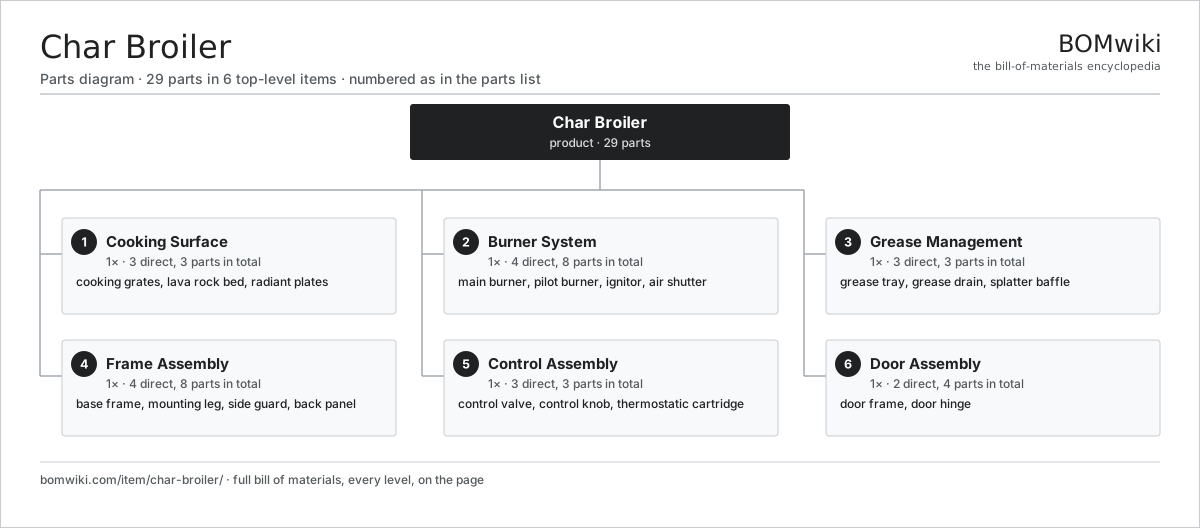
| # | Part | Qty | What it does |
|---|---|---|---|
| 1 | Cooking Surface 3 parts | 1× | Grid of steel grates with radiant burners or lava rocks underneath that create charring heat. |
| 2 | Burner System 4 parts | 1× | Multiple gas burners or electric heating elements that produce the high radiant heat needed for charring. |
| 3 | Grease Management 3 parts | 1× | System that collects and channels grease away from the food and burners for safe disposal. |
| 4 | Frame Assembly 4 parts | 1× | Steel structural frame that supports the cooking surface and houses the burner system. |
| 5 | Control Assembly 3 parts | 1× | Thermostatic valve and front-mounted knobs that regulate burner output and cooking temperature. |
| 6 | Door Assembly 2 parts | 1× | Hinged access doors that allow visibility and access to the cooking surface. |
3D model
No 3D model yet. Have a CAD file of this? Add a 3D model. STL renders right on this page; STEP, FreeCAD, and OpenSCAD sources are welcome too (openly licensed, like all 3D models on BOMwiki).
Build & assembly graph
expand / collapse · shared sub-assemblies converge · links to related products · est. labourTap an assembly to expand/collapse · tap a part to open it · use “Open page” for any node · drag to pan, scroll to zoom.
Bill of materials for Char Broiler
6 top-level lines · 25 rows shown · 29 parts total · indented to 3 levels| # | Item / sub-assembly | Part no. | Qty/assy | Ext. qty | Parts | Type |
|---|---|---|---|---|---|---|
| 1 | Cooking Surface 3 parts | char-broiler-cooking-surface | 1× | 1 | 3 | assembly |
| 1.1 | Cooking Grates | char-broiler-cooking-grates | 1× | 1 | · | part |
| 1.2 | Lava Rock Bed | char-broiler-lava-rock-bed | 1× | 1 | · | part |
| 1.3 | Radiant Plates | char-broiler-radiant-plates | 1× | 1 | · | part |
| 2 | Burner System 4 parts | char-broiler-burner-system | 1× | 1 | 8 | assembly |
| 2.1 | Main Burner | char-broiler-main-burner | 3× | 3 | · | part |
| 2.2 | Pilot Burner | char-broiler-pilot-burner | 1× | 1 | · | part |
| 2.3 | Ignitor | char-broiler-ignitor | 1× | 1 | · | part |
| 2.4 | Air Shutter | char-broiler-air-shutter | 3× | 3 | · | part |
| 3 | Grease Management 3 parts | char-broiler-grease-management | 1× | 1 | 3 | assembly |
| 3.1 | Grease Tray | char-broiler-grease-tray | 1× | 1 | · | part |
| 3.2 | Grease Drain | char-broiler-grease-drain | 1× | 1 | · | part |
| 3.3 | Splatter Baffle | char-broiler-splatter-baffle | 1× | 1 | · | part |
| 4 | Frame Assembly 4 parts | char-broiler-frame | 1× | 1 | 8 | assembly |
| 4.1 | Base Frame | char-broiler-base-frame | 1× | 1 | · | part |
| 4.2 | Mounting Leg | char-broiler-mounting-legs | 4× | 4 | · | part |
| 4.3 | Side Guard | char-broiler-side-guards | 2× | 2 | · | part |
| 4.4 | Back Panel | char-broiler-back-panel | 1× | 1 | · | part |
| 5 | Control Assembly 3 parts | char-broiler-controls | 1× | 1 | 3 | assembly |
| 5.1 | Control Valve | char-broiler-control-valve | 1× | 1 | · | part |
| 5.2 | Control Knob | char-broiler-control-knob | 1× | 1 | · | part |
| 5.3 | Thermostatic Cartridge | char-broiler-thermostatic-cartridge | 1× | 1 | · | part |
| 6 | Door Assembly 2 parts | char-broiler-doors | 1× | 1 | 4 | assembly |
| 6.1 | Door Frame | char-broiler-door-frame | 2× | 2 | · | part |
| 6.2 | Door Hinge | char-broiler-door-hinge | 2× | 2 | · | part |
Something wrong in this list? Report a problem with this BOM.
Sourcing: possible vendors
Browse the supplier directory → Prices, MOQ, and lead times are algorithmic estimates, not quotes, and not claims about these companies. Company mappings are curated by keyword; est. price band $1k–$500k. How estimates work| Vendor | HQ | Specialty | MOQ | Lead time |
|---|---|---|---|---|
| gea.com ↗ | Düsseldorf, DE | Process technology | 20 units | 12–20 wks |
| buhlergroup.com ↗ | Uzwil, CH | Food & materials processing | 20 units | 12–20 wks |
| tetrapak.com ↗ | Pully, CH | Food packaging & processing | 20 units | 12–20 wks |
| jbtc.com ↗ | Chicago, US | Food processing equipment | 20 units | 12–20 wks |
| alfalaval.com ↗ | Lund, SE | Heat transfer & separation | 20 units | 12–20 wks |
688-word article