Checkout Lane Conveyor
ProductOverview
The checkout lane conveyor is a powered belt system transporting grocery items from the cash register toward the bagging station, eliminating the need for cashiers to manually arrange products. The conveyor advances items at a controlled speed (0.3–0.5 m/s), allowing bagging staff to work ergonomically at standing height while sorting and placing items into bags. Photo-eye sensors detect product accumulation and halt the belt automatically, preventing jamming or pile-up at the far end.
The system is a reliable workhorse found in nearly every supermarket worldwide, with designs standardized to 36-inch counter height for ergonomic compatibility. Most modern conveyors use a synthetic rubber belt on cast iron rollers driven by a fractional-horsepower AC motor through a gear reducer. Stainless steel bed surfaces and drainage slots accommodate the wet, produce-soaked environment of a busy checkout.
How it Works
A customer places a shopping cart filled with groceries at the register. The cashier begins scanning items one by one, placing each onto the moving Checkout Lane Conveyor. As the item lands on the belt, friction between the rubber belt surface and the product causes the item to advance toward the far end of the conveyor where bagging staff stands.
The Belt Drive Assembly is the power source. A 0.5 HP single-phase AC motor receives 120VAC from a wall outlet, controlled via a soft-starter that limits inrush current. The motor shaft connects to a Gearbox (10:1 reduction) via a flexible coupling. The gearbox output shaft is fitted with a Drive Pulley (100 mm diameter). This pulley is in contact with a looped Drive Belt (synthetic rubber, 200 mm wide, 3 mm thick) that runs over a series of support rollers.
The belt system consists of a driven pulley (the drive pulley), a return pulley on the far end, and four or five intermediate support rollers. All rollers ride on sealed Ball Bearing hubs. The Tension Adjuster Screw (a screw-drive mechanism) adjusts the return pulley position, controlling belt tension. Proper tension ensures positive grip between belt and product without excessive bearing load.
The Structural Frame is a welded steel structure holding all rollers and motors. Two main rails (2" × 3" rectangular tube) run the length of the conveyor, with cross-braces bolted at regular intervals for rigidity. The frame is mounted to the checkout counter at fixed height (typically 36 inches), which positions the belt slightly above the counter surface for hand-off from the cashier.
The Conveyor Bed & Surface is a critical hygiene surface. A 304 stainless steel plate (2.5 m × 0.4 m × 3 mm thick) is bolted to the frame top, creating a smooth running surface. A series of 8 mm slots run parallel along the length, allowing water, ice melt, and produce juice to drain downward into a collection trough below. These slots prevent standing liquid that could harbor bacteria or mold.
A Product Divider Bar (a stainless steel bar, 40 mm tall) is kept at hand by the cashier. As the previous customer's items are cleared and the next customer's items arrive, the cashier or bagging staff push the divider bar onto the belt, separating the two transactions. The divider rides on the belt surface, moving with the items, until staff remove it after bagging is complete.
As items accumulate toward the bagging end of the belt, a Photo-Eye Sensor & Logic (photo-eye) detects product presence. When items approach the photo-eye beam, the sensor sends a signal to a logic relay in the Control & Electrical Panel. The relay de-energizes the soft-starter, which ramps the motor to zero speed over 2–3 seconds. The belt stops smoothly, preventing items from piling into the bagging area. When the bagging staff have cleared the backed-up items, a footswitch or manual button re-energizes the drive, and the conveyor resumes normal speed.
Key Subsystems
The Belt Drive Assembly is the mechanical heart. The 0.5 HP motor is sized to overcome belt friction and the shearing resistance of items sliding along the stainless steel bed. A soft-starter (rather than a direct contactor) reduces mechanical shock when the belt starts, extending belt and motor bearing life. The Gearbox (10:1 reduction) reduces motor speed from 1,800 rpm to approximately 180 rpm at the output shaft, multiplying torque and allowing belt speed of 0.3–0.5 m/s, slow enough for safe hand-off, fast enough to clear items in 5–10 seconds.
The Belt & Roller Assembly is the wear component. Synthetic rubber belts last 3–5 years under heavy use (8+ hours/day), degrading from UV exposure, heat, and mechanical fatigue. When a belt shows signs of cracking or slipping (items moving slower than normal), replacement is straightforward: unbolt the return pulley, slide the old belt off, thread the new belt over all rollers, and re-tension. The Drive Belt is a standard industrial product, available from any conveyor supplier.
Rollers (Drive Roller, Return Roller, and Support Roller) require seasonal inspection. Bearing grease dries out and accumulates lint, increasing friction. Every 12–18 months, maintenance staff remove each roller, clean the bearing thoroughly with a degreaser, repack with food-grade grease, and reinstall. If a bearing is seized and will not spin, the roller is replaced as an assembly.
The Photo-Eye Sensor & Logic is simple but critical. A photo-eye (infrared LED emitter and phototransistor receiver) is mounted above the far end of the belt, aimed downward at a shallow angle. When an item passes beneath the beam, the receiver output goes low, triggering the logic relay. This relay de-energizes the soft-starter, halting the belt. Most conveyors include a manual reset button allowing staff to override the auto-stop if items are stuck or the sensor is fouled by produce debris.
The Conveyor Bed & Surface stainless steel surface resists rust and corrosion from the constant wet environment. However, soap and mineral deposits build up over weeks. Weekly cleaning with a soft brush and mild detergent, followed by rinsing and air-drying, keeps the surface hygienic and maintains product friction. The drainage slots are hosed clean weekly to prevent blockage.
Installation & Maintenance
Checkout conveyors are typically installed at the time of store construction, though retrofit kits allow existing counters to be retrofitted. Installation involves bolting the frame assembly to the counter top, running a 120VAC dedicated circuit from the breaker panel, and connecting the sensor and soft-starter wiring to terminal blocks. Most installations are completed in a single day.
Weekly maintenance includes visual inspection of the belt for tears or fraying, testing the photo-eye by placing an object in the beam to confirm the belt stops, and rinsing the bed and drainage slots. Monthly maintenance involves checking belt tension (belt should deflect approximately 10 mm midspan with light hand pressure) and lubricating the adjustment mechanism.
The motor soft-starter and photo-eye relay are solid-state electronics with a 10–15 year lifespan. If the belt stops responding to the sensor or the motor fails to start, diagnosis begins with checking that the breaker is not tripped and the 120VAC supply is present. Voltage checks at the soft-starter inputs confirm signal integrity. If the relay is faulty, replacement is a 15-minute job of swapping the module and re-connecting three wires.
Related Products
Checkout conveyors work in tandem with Checkout Bagging Carousel systems in modern grocery stores, creating an efficient workflow: items move along the conveyor, bagging staff place them in bags, and the bags are placed on the carousel for customer retrieval. The Shopping Cart and Checkout Lane Conveyor are the core physical infrastructure of the checkout experience.
Specialized conveyor variants include curved sections (allowing L-shaped counter layouts), speed-controlled zones (faster movement upstream, slower at the bagging end), and integrated scales for price-by-weight produce. Some high-end systems interface with point-of-sale software, automatically stopping the belt when the cashier completes scanning and resuming when the next customer begins.
Checkout Lane Conveyor parts and their functions
7 top-level parts · 63 parts in total · full bill of materials below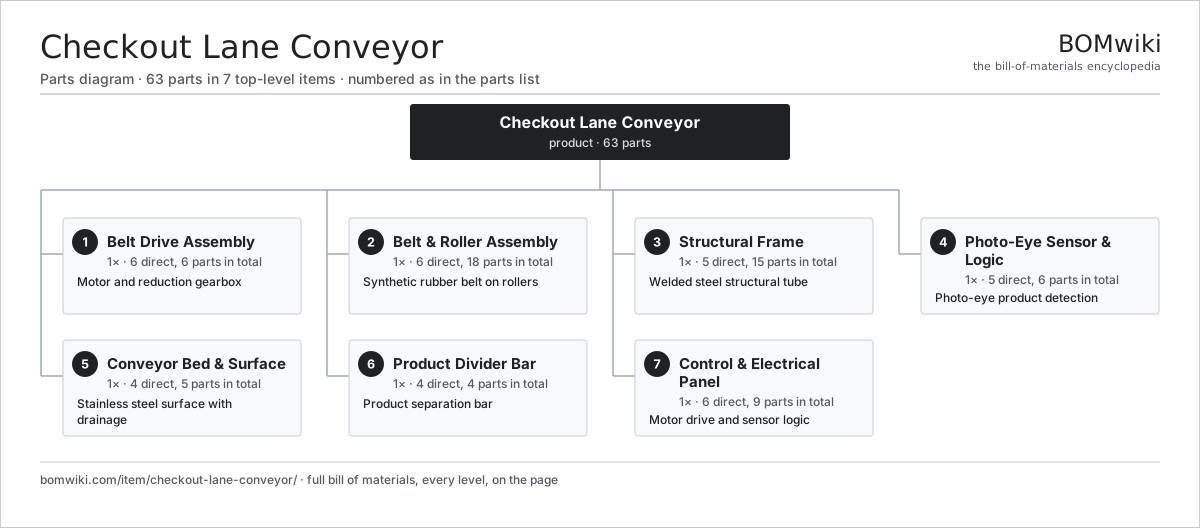
| # | Part | Qty | What it does |
|---|---|---|---|
| 1 | Belt Drive Assembly 6 parts | 1× | Motor and reduction gearbox |
| 2 | Belt & Roller Assembly 6 parts | 1× | Synthetic rubber belt on rollers |
| 3 | Structural Frame 5 parts | 1× | Welded steel structural tube |
| 4 | Photo-Eye Sensor & Logic 5 parts | 1× | Photo-eye product detection |
| 5 | Conveyor Bed & Surface 4 parts | 1× | Stainless steel surface with drainage |
| 6 | Product Divider Bar 4 parts | 1× | Product separation bar |
| 7 | Control & Electrical Panel 6 parts | 1× | Motor drive and sensor logic |
3D model
No 3D model yet. Have a CAD file of this? Add a 3D model. STL renders right on this page; STEP, FreeCAD, and OpenSCAD sources are welcome too (openly licensed, like all 3D models on BOMwiki).
Build & assembly graph
expand / collapse · shared sub-assemblies converge · links to related products · est. labourTap an assembly to expand/collapse · tap a part to open it · use “Open page” for any node · drag to pan, scroll to zoom.
Bill of materials for Checkout Lane Conveyor
7 top-level lines · 43 rows shown · 63 parts total · indented to 3 levels| # | Item / sub-assembly | Part no. | Qty/assy | Ext. qty | Parts | Type |
|---|---|---|---|---|---|---|
| 1 | Belt Drive Assembly 6 parts | checkout-lane-conveyor-belt-drive | 1× | 1 | 6 | assembly |
| 1.1 | AC Motor | checkout-lane-conveyor-motor | 1× | 1 | · | part |
| 1.2 | Gearbox | checkout-lane-conveyor-gearbox | 1× | 1 | · | part |
| 1.3 | Motor Coupling | checkout-lane-conveyor-motor-coupling | 1× | 1 | · | part |
| 1.4 | Drive Pulley | checkout-lane-conveyor-drive-pulley | 1× | 1 | · | part |
| 1.5 | Motor Mount Bracket | checkout-lane-conveyor-motor-mount-plate | 1× | 1 | · | part |
| 1.6 | Fastener Set | fastener-set | 1× | 1 | · | part |
| 2 | Belt & Roller Assembly 6 parts | checkout-lane-conveyor-belt-assembly | 1× | 1 | 18 | assembly |
| 2.1 | Drive Belt | checkout-lane-conveyor-drive-belt | 1× | 1 | · | part |
| 2.2 | Drive Roller | checkout-lane-conveyor-drive-roller | 1× | 1 | · | part |
| 2.3 | Return Roller | checkout-lane-conveyor-return-roller | 1× | 1 | · | part |
| 2.4 | Support Roller | checkout-lane-conveyor-support-roller | 4× | 4 | · | part |
| 2.5 | Ball Bearing | ball-bearing | 10× | 10 | · | part |
| 2.6 | Tension Adjuster Screw | checkout-lane-conveyor-belt-tension-adjuster | 1× | 1 | · | part |
| 3 | Structural Frame 5 parts | checkout-lane-conveyor-frame | 1× | 1 | 15 | assembly |
| 3.1 | Main Structural Rail | checkout-lane-conveyor-main-rail | 2× | 2 | · | part |
| 3.2 | Cross Brace | checkout-lane-conveyor-cross-brace | 4× | 4 | · | part |
| 3.3 | Bearing Pedestal | checkout-lane-conveyor-bearing-block | 6× | 6 | · | part |
| 3.4 | End Cover Panel | checkout-lane-conveyor-end-panel | 2× | 2 | · | part |
| 3.5 | Fastener Set | fastener-set | 1× | 1 | · | part |
| 4 | Photo-Eye Sensor & Logic 5 parts | checkout-lane-conveyor-sensor-system | 1× | 1 | 6 | assembly |
| 4.1 | Photoelectric Sensor | checkout-lane-conveyor-photoelectric-switch | 1× | 1 | · | part |
| 4.2 | Sensor Mounting Bracket | checkout-lane-conveyor-sensor-bracket | 1× | 1 | · | part |
| 4.3 | Sensor Cable | checkout-lane-conveyor-sensor-cable | 1× | 1 | · | part |
| 4.4 | Sensor Logic Relay | checkout-lane-conveyor-logic-relay | 1× | 1 | · | part |
| 4.5 | Connector | connector | 2× | 2 | · | part |
| 5 | Conveyor Bed & Surface 4 parts | checkout-lane-conveyor-bed | 1× | 1 | 5 | assembly |
| 5.1 | Stainless Steel Bed | checkout-lane-conveyor-stainless-bed-plate | 1× | 1 | · | part |
| 5.2 | Drainage Slot | checkout-lane-conveyor-drainage-slot | 1× | 1 | · | part |
| 5.3 | Bed Support Rail | checkout-lane-conveyor-bed-support-rail | 2× | 2 | · | part |
| 5.4 | Fastener Set | fastener-set | 1× | 1 | · | part |
| 6 | Product Divider Bar 4 parts | checkout-lane-conveyor-divider-rail | 1× | 1 | 4 | assembly |
| 6.1 | Divider Blade | checkout-lane-conveyor-divider-blade | 1× | 1 | · | part |
| 6.2 | Divider Handle | checkout-lane-conveyor-divider-handle | 1× | 1 | · | part |
| 6.3 | Divider Foot | checkout-lane-conveyor-divider-foot | 1× | 1 | · | part |
| 6.4 | Fastener Set | fastener-set | 1× | 1 | · | part |
| 7 | Control & Electrical Panel 6 parts | checkout-lane-conveyor-control-panel | 1× | 1 | 9 | assembly |
| 7.1 | Panel Enclosure | checkout-lane-conveyor-panel-enclosure | 1× | 1 | · | part |
| 7.2 | Soft-Start Drive | checkout-lane-conveyor-soft-starter | 1× | 1 | · | part |
| 7.3 | Circuit Breaker | checkout-lane-conveyor-circuit-breaker | 1× | 1 | · | part |
| 7.4 | Relay | relay | 2× | 2 | · | part |
| 7.5 | Connector | connector | 3× | 3 | · | part |
| 7.6 | Power Supply | power-supply | 1× | 1 | · | part |
Something wrong in this list? Report a problem with this BOM.
Related products
same domain, ranked by shared parts Cash Deposit Machine
64 parts · shares 2 with this page
Coin Counting Kiosk
63 parts · shares 2 with this page
Drive-Through Teller Unit
178 parts · shares 2 with this page
Cash Deposit Machine
64 parts · shares 2 with this page
Coin Counting Kiosk
63 parts · shares 2 with this page
Drive-Through Teller Unit
178 parts · shares 2 with this page
 Electric Typewriter
47 parts · shares 2 with this page
Electric Typewriter
47 parts · shares 2 with this page
 Night Depository
101 parts · shares 2 with this page
Night Depository
101 parts · shares 2 with this page
Sourcing: possible vendors
Browse the supplier directory → Prices, MOQ, and lead times are algorithmic estimates, not quotes, and not claims about these companies. Company mappings are curated by keyword; est. price band $50–$15k. How estimates work| Vendor | HQ | Specialty | MOQ | Lead time |
|---|---|---|---|---|
|
🇯🇵Canon
canon.com ↗
|
Tokyo, JP | Imaging & optics | 500 units | 8–12 wks |
|
🇯🇵Ricoh
ricoh.com ↗
|
Tokyo, JP | Office imaging | 500 units | 8–12 wks |
|
🇺🇸Xerox
xerox.com ↗
|
Norwalk, US | Printers & copiers | 500 units | 8–12 wks |
|
🇯🇵Epson
epson.com ↗
|
Suwa, JP | Printers & projectors | 500 units | 8–12 wks |
|
🇯🇵Brother
brother.com ↗
|
Nagoya, JP | Printers & sewing | 500 units | 8–12 wks |
1,384-word article