Chimney Draft Fan
ProductOverview
A chimney draft fan, also called a fireplace fan or induced-draft fan, is an electric fan mounted on the roof that mechanically boosts the natural draft of a chimney. Chimneys rely on buoyancy, the tendency of hot air to rise, to create a pressure difference that draws combustion air into a fireplace or heating appliance and exhausts flue gases upward. However, natural draft varies dramatically with outdoor conditions: cold weather increases the temperature difference and strengthens draft, while warm outdoor air (spring/fall) or wind coming down the chimney can weaken or reverse draft.
A chimney fan provides consistent, controllable draft regardless of weather. It is a retrofit solution for fireplaces or heating systems experiencing backdrafting, smoking, or poor performance. Unlike a furnace blower or boiler draft fan (which are active combustion control devices), a chimney fan is passive in the combustion sense, it simply evacuates flue gases after they have left the heating appliance, but it offers powerful control over draft dynamics.
The Fan Wheel Assembly is typically an axial-blade fan (propeller-style) or a centrifugal impeller, selected for low-pressure operation (typically 0.1–0.3 inches of water column resistance). It is coupled to a Draft Fan Motor (usually 1/4 to 1 HP AC induction or EC motor) via a Motor Coupling that includes a clutch to prevent stall damage if the fan blade becomes jammed with debris.
Speed control varies: a simple manual rheostat allows the operator to dial fan speed from 0–100%; a thermostat-activated controller starts the fan automatically when flue gas temperature rises above a setpoint (e.g., 50°C, indicating active fire); or an electronically commutated (EC) motor can be modulated proportionally based on feedback.
How it works
Thermostat activation mode (most common): A Temperature Element is mounted in a stainless-steel Sensor Mounting Thimble inserted 3–6 inches into the flue above the heating appliance. As combustion begins and flue gases warm, the bimetallic coil in the sensor expands. When temperature reaches the setpoint (typically 60–80°C), the Thermostat Switch Contact closes, completing an electrical circuit to the motor.
The Draft Fan Motor starts and accelerates to rated speed (typically 900–1200 RPM). The chimney-fan-motor-gearbox reduces speed, and the resulting torque rotates the Fan Wheel Assembly (usually 200–500 RPM final). This slow rotation is essential, high-speed fans create excessive noise and mechanical wear, while slow speeds maximize efficiency and durability.
The Fan Wheel Assembly draws flue gases from the Vent Collar on the Roof Mount Base Assembly and exhausts them sideways into the atmosphere. The low-pressure suction created upstream of the fan pulls additional gases from the chimney and flue pipe, effectively creating an artificial draft. This draft is independent of buoyancy, so even on a warm day with minimal natural draft, the fan maintains steady flow.
Operating pressure: The fan typically operates at 0.1–0.3 inches of water column gauge (25–75 Pa). This is much lower than furnace blowers (1–2 inches W.C.) because flue gases are less dense than air and fan power requirements are modest. Excessive draft (trying to run too fast) can cause the fireplace to pull excessive air, smoking the room if dampers are not balanced.
Manual speed control: If equipped with a Manual Rheostat on an interior switch, the operator can manually increase fan speed during heavy wood-stove burning (thick smoke) or reduce speed to conserve electricity on mild days. A timer controller can be added for scheduled operation.
Shutdown and backdraft prevention: When combustion ends and flue temperature drops below the Thermostat Switch Contact setpoint, the switch opens and the motor de-energizes. The fan blade coasts to a stop over ~10–30 seconds. A one-way damper or chimney-fan-damper can be installed in the flue to prevent outside air from being drawn backward through the fan into the home when it is off. Many installations include a simple ball-check valve or spring-loaded damper for this purpose.
Installation and ductwork
The Roof Mount Base Assembly must be positioned directly above the flue opening, with the Vent Collar threaded or flanged onto the chimney pipe. Proper Roof Flashing is critical, a poorly sealed flashing can allow rain and snow melt to leak into the attic. Flashing should be stepped (overlapped shingles) or sealed with urethane caulk and fastened with stainless-steel fasteners (rust-proof).
The Vibration Isolation Mount rubber pads decouple the motor and fan from the roof structure, preventing vibration from transmitting through the roof and into the home. Isolation also protects the roof membrane from sustained vibration, which can crack sealants.
Electrical wiring from the interior switch to the motor must be rated for outdoor use (UV-resistant jacket) and run through conduit or inside the attic as appropriate. A 120 V supply is sufficient for most units; larger fans (1+ HP) may require a dedicated 20 A circuit.
Noise and vibration
Chimney fans are inherently noisier than furnace fans because they operate in the open (no muffling duct) and because flue dynamics can create whistling or roaring. Typical sound levels are 65–75 dB at rated speed, comparable to a medium-speed bathroom exhaust fan. Slow-speed EC motors are quieter (~55–60 dB) than fixed-speed AC induction motors. Acoustic ductwork (lined with foam) can be added, but cost and installation complexity are substantial.
Vibration isolation is critical, without proper isolators, the roof structure can transmit fan vibration into the home, creating annoying buzzing or rattling noises. Installation quality is paramount.
Maintenance and safety
Annual service includes:
- Cleaning the Fan Wheel Assembly blade and motor exterior of soot, bird droppings, and debris.
- Lubricating motor bearings if grease ports are provided (though modern sealed-bearing motors require no lubrication).
- Checking the Thermostat Temperature Sensor thermostat element for corrosion; if corroded, replace the sensor.
- Verifying the Motor Coupling is tight and the fan blade spins freely without wobble.
- Inspecting the Roof Flashing for cracks, loose fasteners, or daylight leaks.
Safety considerations:
- Never operate a chimney fan without an active fire or heat source, as it can reverse the natural draft of adjacent appliances and cause backdrafting.
- Some jurisdictions prohibit chimney fans for certain heating types (e.g., natural-draft gas furnaces without power dampers) due to interaction effects.
- A failed fan blade jammed with debris cannot start; the chimney-fan-clutch will slip, but the fan will not achieve speed. The motor will overheat if prolonged startup is attempted, so automatic overload protection is essential.
Capacity matching: The fan capacity (CFM) must be matched to the appliance. An oversized fan pulls excessive air through the fireplace or stove, causing smoking. An undersized fan fails to clear flue gases quickly and creates excessive back-pressure. Professional installation typically includes draft measurement and fan sizing.
Advantages and limitations
Advantages:
- Retrofit to existing fireplaces and chimneys without modification.
- Automatic thermostat control eliminates manual operation.
- Boosts draft during marginal conditions (warm weather, short chimney).
- Can improve primary heating performance if draft was previously weak.
Limitations:
- Adds electrical consumption (~200–500 W continuously while operating).
- Noise can be intrusive if installed near sleeping areas.
- Requires annual maintenance (sensor cleaning, flashing inspection).
- Does not replace a damaged or deteriorated chimney; both must be functional.
- Incompatible with some heating systems; professional verification is necessary.
Chimney fans are most cost-effective for existing fireplaces or wood stoves where draft problems cannot be solved by chimney repair alone, or where homeowners want reliable draft control regardless of weather.
Chimney Draft Fan parts and their functions
7 top-level parts · 27 parts in total · full bill of materials below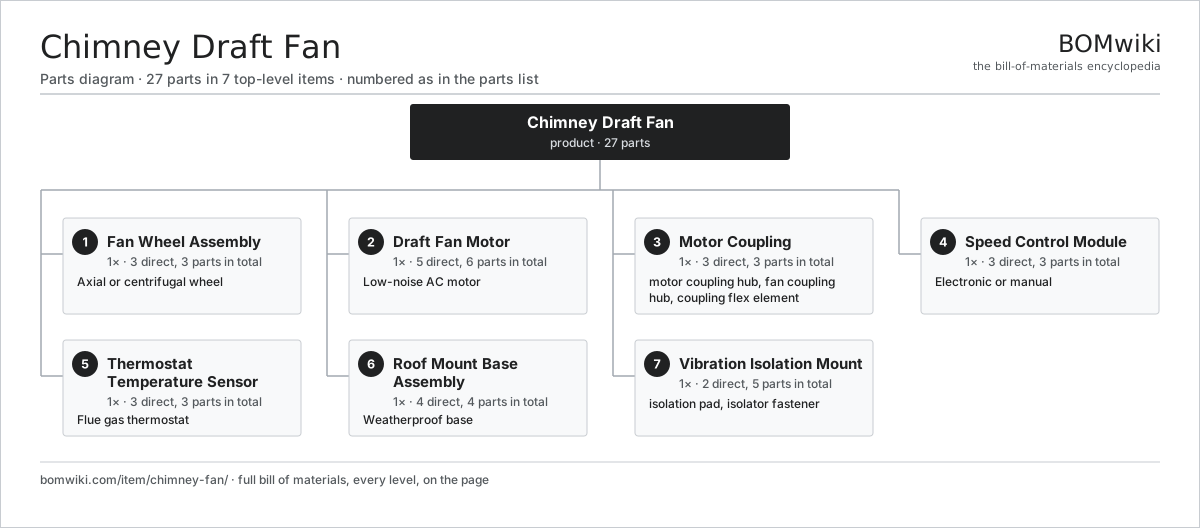
| # | Part | Qty | What it does |
|---|---|---|---|
| 1 | Fan Wheel Assembly 3 parts | 1× | Axial or centrifugal wheel |
| 2 | Draft Fan Motor 5 parts | 1× | Low-noise AC motor |
| 3 | Motor Coupling 3 parts | 1× | Flexible shaft coupler connecting motor shaft to fan wheel shaft, absorbing vibration. |
| 4 | Speed Control Module 3 parts | 1× | Electronic or manual |
| 5 | Thermostat Temperature Sensor 3 parts | 1× | Flue gas thermostat |
| 6 | Roof Mount Base Assembly 4 parts | 1× | Weatherproof base |
| 7 | Vibration Isolation Mount 2 parts | 1× | Rubber-in-shear or elastomer mount cushioning motor vibration from roof structure. |
3D model
No 3D model yet. Have a CAD file of this? Add a 3D model. STL renders right on this page; STEP, FreeCAD, and OpenSCAD sources are welcome too (openly licensed, like all 3D models on BOMwiki).
Build & assembly graph
expand / collapse · shared sub-assemblies converge · links to related products · est. labourTap an assembly to expand/collapse · tap a part to open it · use “Open page” for any node · drag to pan, scroll to zoom.
Bill of materials for Chimney Draft Fan
7 top-level lines · 30 rows shown · 27 parts total · indented to 3 levels| # | Item / sub-assembly | Part no. | Qty/assy | Ext. qty | Parts | Type |
|---|---|---|---|---|---|---|
| 1 | Fan Wheel Assembly 3 parts | chimney-fan-fan-unit | 1× | 1 | 3 | assembly |
| 1.1 | Fan Blade Set | chimney-fan-wheel-blade | 1× | 1 | · | part |
| 1.2 | Fan Hub | chimney-fan-wheel-hub | 1× | 1 | · | part |
| 1.3 | Fan Shaft | chimney-fan-wheel-shaft | 1× | 1 | · | part |
| 2 | Draft Fan Motor 5 parts | chimney-fan-motor | 1× | 1 | 6 | assembly |
| 2.1 | Motor Frame | chimney-fan-motor-frame | 1× | 1 | · | part |
| 2.2 | Motor Stator | chimney-fan-motor-stator | 1× | 1 | · | part |
| 2.3 | Motor Rotor | chimney-fan-motor-rotor | 1× | 1 | · | part |
| 2.4 | Motor Bearing | chimney-fan-motor-bearing | 2× | 2 | · | part |
| 2.5 | Run Capacitor | chimney-fan-motor-capacitor | 1× | 1 | · | part |
| 3 | Motor Coupling 3 parts | chimney-fan-motor-coupling | 1× | 1 | 3 | assembly |
| 3.1 | Motor Coupling Hub | chimney-fan-coupling-hub-motor | 1× | 1 | · | part |
| 3.2 | Fan Coupling Hub | chimney-fan-coupling-hub-fan | 1× | 1 | · | part |
| 3.3 | Coupling Flex Element | chimney-fan-coupling-insert | 1× | 1 | · | part |
| 4 | Speed Control Module 3 parts | chimney-fan-speed-controller | 1× | 1 | 3 | assembly |
| 4.1 | Electronic Control Board | chimney-fan-controller-pcb | 1× | 1 | · | part |
| 4.2 | Manual Rheostat | chimney-fan-controller-rheostat | 1× | 1 | · | part |
| 4.3 | Control Switch | chimney-fan-controller-switch | 1× | 1 | · | part |
| 5 | Thermostat Temperature Sensor 3 parts | chimney-fan-temperature-sensor | 1× | 1 | 3 | assembly |
| 5.1 | Temperature Element | chimney-fan-thermostat-element | 1× | 1 | · | part |
| 5.2 | Thermostat Switch Contact | chimney-fan-thermostat-switch | 1× | 1 | · | part |
| 5.3 | Sensor Mounting Thimble | chimney-fan-thermostat-mounting-sleeve | 1× | 1 | · | part |
| 6 | Roof Mount Base Assembly 4 parts | chimney-fan-roof-mount | 1× | 1 | 4 | assembly |
| 6.1 | Mount Base Plate | chimney-fan-base-plate | 1× | 1 | · | part |
| 6.2 | Roof Flashing | chimney-fan-roof-flashing | 1× | 1 | · | part |
| 6.3 | Mounting Fastener Set | chimney-fan-mounting-bolts | 1× | 1 | · | part |
| 6.4 | Vent Collar | chimney-fan-vent-collar | 1× | 1 | · | part |
| 7 | Vibration Isolation Mount 2 parts | chimney-fan-vibration-isolator | 1× | 1 | 5 | assembly |
| 7.1 | Isolation Pad | chimney-fan-isolator-block | 1× | 1 | · | part |
| 7.2 | Isolator Fastener | chimney-fan-isolator-fastener | 4× | 4 | · | part |
Something wrong in this list? Report a problem with this BOM.
Sourcing: possible vendors
Browse the supplier directory → Prices, MOQ, and lead times are algorithmic estimates, not quotes, and not claims about these companies. Company mappings are curated by keyword; est. price band $100–$20k. How estimates work| Vendor | HQ | Specialty | MOQ | Lead time |
|---|---|---|---|---|
|
🇺🇸Carrier
carrier.com ↗
|
Palm Beach Gardens, US | HVAC | 500 units | 8–14 wks |
| tranetechnologies.com ↗ | Davidson, US | HVAC | 500 units | 8–14 wks |
|
🇯🇵Daikin
daikin.com ↗
|
Osaka, JP | HVAC | 500 units | 8–14 wks |
|
🇺🇸Lennox
lennox.com ↗
|
Richardson, US | HVAC | 500 units | 8–14 wks |
| johnsoncontrols.com ↗ | Milwaukee, US | Building systems | 500 units | 8–14 wks |
1,288-word article