Churro Machine
ProductOverview
The churro machine is a continuous extrusion system that pumps heated, pressurized dough through a star-shaped die, forming strands that are immediately cut to length and dropped into hot oil. The machine is common in food carts, theme parks, and Latin American bakeries worldwide.
The process begins with a large heated dough hopper holding 8–15 liters of churro batter. The dough is a simple flour, water, and salt mixture with a thick, paste-like consistency (similar to choux dough). The hopper is maintained at 170–190°F to keep the dough warm and fluid; cold dough is too viscous to pump.
A positive-displacement pump draws dough from the hopper and forces it through a star-shaped extrusion die. The pump operates at 30–80 psi, enough pressure to force viscous dough through the die but not so much as to risk equipment failure. The star die is the heart of the machine, its cross-sectional profile determines the churro's ridged shape (typically 6–12 points).
As dough exits the die, a heated blade or wire cuts the strand at operator-selected length (typically 6–10 inches). The cut strand falls directly into a deep-fryer filled with vegetable oil heated to 350–375°F. Frying takes 60–90 seconds per side, puffing the dough and forming a golden crust. Finished churros are removed with a slotted spoon, drained, and rolled in cinnamon sugar or coated with chocolate sauce.
How It Works
An operator fills the hopper with prepared dough. The hopper is heated to 170–190°F by an immersion heater element and thermostat. A slow-rotating paddle stirrer (5–10 rpm) keeps dough from settling and ensures uniform temperature distribution.
The operator opens the hopper outlet valve and primes the pump by running it in reverse briefly to fill the pump chamber with dough. Once primed, the pump direction is reversed to forward, and dough begins flowing toward the die.
The operator adjusts the motor speed dial on the control panel to the desired extrusion rate. The pump motor accelerates to the set speed, typically producing 20–100 strands per minute depending on demand. Higher speed produces thinner or shorter strands; lower speed produces thicker or longer strands (within the mechanical limits of the die).
As the dough stream flows from the die, the operator presses a foot pedal or timer button. This actuates the cutting mechanism, a solenoid-driven heated blade or heated wire that slices through the dough in a fraction of a second. The blade is heated to 160–180°F to prevent dough from sticking and to ensure a clean cut.
The freshly cut strand falls into the guide tube and drops directly into the fryer oil. The operator immediately begins the next extrusion cycle. Experienced operators produce churros in rapid succession, achieving 30–60 finished units per minute.
Dough Preparation
Churro dough is straightforward: flour, water, and salt mixed to a thick paste. Some recipes add small amounts of baking powder or cornstarch. The dough must be warm (70–80°F) when mixed to aid hydration. Cold water is added in stages until the dough reaches the target consistency, thick enough to hold its shape but pumpable at 50–80 psi.
The dough is poured into the hopper and allowed to warm to 170–190°F. At this temperature, the flour grains absorb additional moisture and the starch begins to gelatinize slightly, lowering viscosity. This warm state is ideal for pumping. Fresh dough can remain in the hopper for 2–4 hours before oil oxidation or fermentation spoils it.
Maintenance
The pump chamber accumulates dough residue and must be cleaned daily. The pump is disassembled, and the cylinder and piston are rinsed in hot water. Baked-on flour is scrubbed away with a soft brush. The check valve is inspected and cleaned if debris restricts flow.
The die and die insert are soaked in hot water to dissolve remaining dough. The star insert can be removed (if the die design allows) and scrubbed clean. A clogged die produces misshapen strands or stops flow entirely.
The cutter blade or wire is wiped with a hot, damp cloth after each shift. Dough residue hardens on a cold blade, requiring soaking and scrubbing. The blade or wire must remain centered and straight; bent or misaligned cutters produce uneven cuts.
The hopper is emptied at shift end and rinsed. Leftover dough is discarded; it will not refrigerate well and may ferment. The hopper interior is dried to prevent rust on steel surfaces.
The belt drive, if used, is checked for tension monthly. A loose belt slips and reduces extrusion rate. The hopper stirrer bearing is lubricated every 100 operating hours to prevent friction wear.
The immersion heater eventually scales (in hard-water areas) or burns out. It is replaceable and typically lasts 12–24 months. The thermostat can drift and may require recalibration annually.
Troubleshooting
If the dough extrudes as a thin ribbon instead of a star shape, the die insert is clogged or off-center. Remove and clean the die. If extrusion stops entirely, the check valve may be stuck open. Reverse the pump briefly to dislodge debris.
If the cutter produces uneven cuts, the blade may be dull or off-angle. Inspect and replace or sharpen. If dough splurts from the pump instead of forming a steady stream, the hopper may be running low, or the dough may have cooled and thickened. Refill or reheat.
Churro machines are robust but sensitive to dough consistency. Too-thick dough stalls the pump and can damage the motor. Too-thin dough extrudes poorly and fries into a limp, greasy product. Proper dough preparation is critical for trouble-free operation.
Standards and Safety
Commercial churro machines comply with NSF/ANSI 4 (sanitation) and UL 197 (electrical safety). All dough-contact surfaces must be food-grade stainless steel or aluminum. The pump cylinder and die are the wear surfaces and should be stainless or hardened steel.
The primary motor is a three-phase industrial type and requires proper electrical installation by a licensed electrician. A dead-man control switch ensures the pump stops if the operator releases the pedal. An emergency stop button on the control panel provides manual override.
The heated cutter blade presents burn risk. Operators should never reach into the fryer or place fingers in the guide tube while the machine is running. Safety interlocks prevent motor start if an access panel is open.
Churro Machine parts and their functions
8 top-level parts · 32 parts in total · full bill of materials below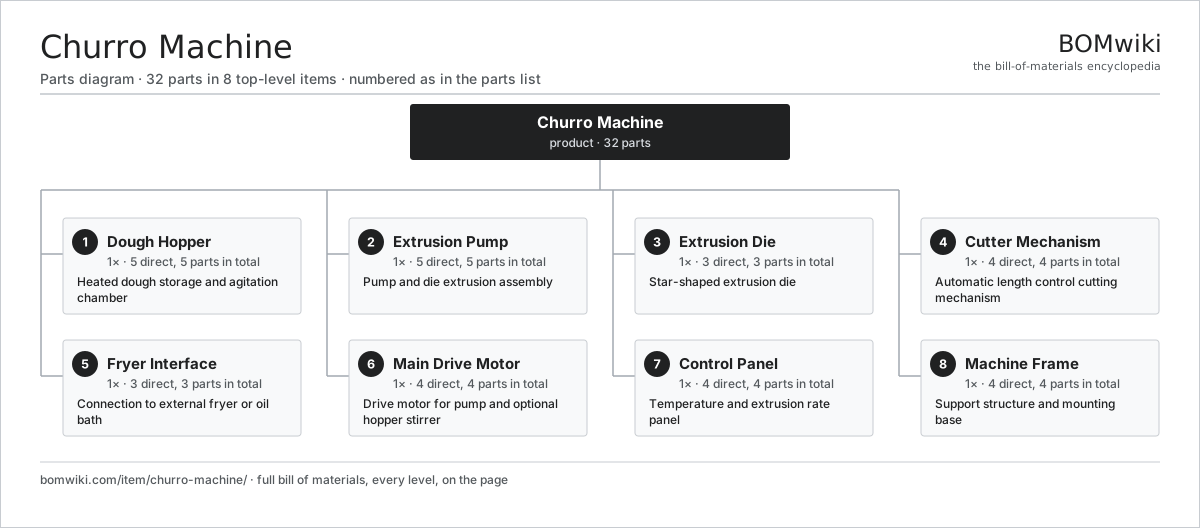
| # | Part | Qty | What it does |
|---|---|---|---|
| 1 | Dough Hopper 5 parts | 1× | Heated dough storage and agitation chamber |
| 2 | Extrusion Pump 5 parts | 1× | Pump and die extrusion assembly |
| 3 | Extrusion Die 3 parts | 1× | Star-shaped extrusion die |
| 4 | Cutter Mechanism 4 parts | 1× | Automatic length control cutting mechanism |
| 5 | Fryer Interface 3 parts | 1× | Connection to external fryer or oil bath |
| 6 | Main Drive Motor 4 parts | 1× | Drive motor for pump and optional hopper stirrer |
| 7 | Control Panel 4 parts | 1× | Temperature and extrusion rate panel |
| 8 | Machine Frame 4 parts | 1× | Support structure and mounting base |
3D model
No 3D model yet. Have a CAD file of this? Add a 3D model. STL renders right on this page; STEP, FreeCAD, and OpenSCAD sources are welcome too (openly licensed, like all 3D models on BOMwiki).
Build & assembly graph
expand / collapse · shared sub-assemblies converge · links to related products · est. labourTap an assembly to expand/collapse · tap a part to open it · use “Open page” for any node · drag to pan, scroll to zoom.
Bill of materials for Churro Machine
8 top-level lines · 40 rows shown · 32 parts total · indented to 3 levels| # | Item / sub-assembly | Part no. | Qty/assy | Ext. qty | Parts | Type |
|---|---|---|---|---|---|---|
| 1 | Dough Hopper 5 parts | churro-machine-hopper | 1× | 1 | 5 | assembly |
| 1.1 | Hopper Tank | churro-machine-hopper-tank | 1× | 1 | · | part |
| 1.2 | Hopper Heater | churro-machine-hopper-heater | 1× | 1 | · | part |
| 1.3 | Hopper Thermostat | churro-machine-hopper-thermostat | 1× | 1 | · | part |
| 1.4 | Hopper Stirrer | churro-machine-hopper-stirrer | 1× | 1 | · | part |
| 1.5 | Hopper Outlet | churro-machine-hopper-outlet | 1× | 1 | · | part |
| 2 | Extrusion Pump 5 parts | churro-machine-extrusion | 1× | 1 | 5 | assembly |
| 2.1 | Pump Cylinder | churro-machine-pump-cylinder | 1× | 1 | · | part |
| 2.2 | Pump Piston | churro-machine-pump-piston | 1× | 1 | · | part |
| 2.3 | Check Valve | churro-machine-pump-valve | 1× | 1 | · | part |
| 2.4 | Pump Motor | churro-machine-pump-motor | 1× | 1 | · | part |
| 2.5 | Pressure Gauge | churro-machine-pump-pressure-gauge | 1× | 1 | · | part |
| 3 | Extrusion Die 3 parts | churro-machine-die | 1× | 1 | 3 | assembly |
| 3.1 | Die Body | churro-machine-die-body | 1× | 1 | · | part |
| 3.2 | Die Insert | churro-machine-die-insert | 1× | 1 | · | part |
| 3.3 | Die Seal | churro-machine-die-seal | 1× | 1 | · | part |
| 4 | Cutter Mechanism 4 parts | churro-machine-cutter | 1× | 1 | 4 | assembly |
| 4.1 | Cutter Blade | churro-machine-cutter-blade | 1× | 1 | · | part |
| 4.2 | Blade Actuator | churro-machine-cutter-actuator | 1× | 1 | · | part |
| 4.3 | Cutter Heater | churro-machine-cutter-heater | 1× | 1 | · | part |
| 4.4 | Cutter Timer | churro-machine-cutter-timing | 1× | 1 | · | part |
| 5 | Fryer Interface 3 parts | churro-machine-fryer-interface | 1× | 1 | 3 | assembly |
| 5.1 | Fryer Guide | churro-machine-fryer-guide | 1× | 1 | · | part |
| 5.2 | Fryer Connector | churro-machine-fryer-connector | 1× | 1 | · | part |
| 5.3 | Drip Tray | churro-machine-fryer-drip-tray | 1× | 1 | · | part |
| 6 | Main Drive Motor 4 parts | churro-machine-motor | 1× | 1 | 4 | assembly |
| 6.1 | Primary Motor | churro-machine-motor-primary | 1× | 1 | · | part |
| 6.2 | Stirrer Motor | churro-machine-motor-stirrer | 1× | 1 | · | part |
| 6.3 | Drive Transmission | churro-machine-motor-transmission | 1× | 1 | · | part |
| 6.4 | Speed Controller | churro-machine-motor-speed-control | 1× | 1 | · | part |
| 7 | Control Panel 4 parts | churro-machine-controls | 1× | 1 | 4 | assembly |
| 7.1 | Control Faceplate | churro-machine-controls-panel | 1× | 1 | · | part |
| 7.2 | Temp Display | churro-machine-controls-temp-display | 1× | 1 | · | part |
| 7.3 | Speed Knob | churro-machine-controls-speed-dial | 1× | 1 | · | part |
| 7.4 | Control Switches | churro-machine-controls-start-switch | 1× | 1 | · | part |
| 8 | Machine Frame 4 parts | churro-machine-frame | 1× | 1 | 4 | assembly |
| 8.1 | Frame Base | churro-machine-frame-base | 1× | 1 | · | part |
| 8.2 | Frame Uprights | churro-machine-frame-uprights | 1× | 1 | · | part |
| 8.3 | Frame Bracing | churro-machine-frame-crossmembers | 1× | 1 | · | part |
| 8.4 | Frame Drip Pan | churro-machine-frame-drip-pan | 1× | 1 | · | part |
Something wrong in this list? Report a problem with this BOM.
Sourcing: possible vendors
Browse the supplier directory → Prices, MOQ, and lead times are algorithmic estimates, not quotes, and not claims about these companies. Company mappings are curated by keyword; est. price band $1k–$500k. How estimates work| Vendor | HQ | Specialty | MOQ | Lead time |
|---|---|---|---|---|
| gea.com ↗ | Düsseldorf, DE | Process technology | 20 units | 12–20 wks |
| buhlergroup.com ↗ | Uzwil, CH | Food & materials processing | 20 units | 12–20 wks |
| tetrapak.com ↗ | Pully, CH | Food packaging & processing | 20 units | 12–20 wks |
| jbtc.com ↗ | Chicago, US | Food processing equipment | 20 units | 12–20 wks |
| alfalaval.com ↗ | Lund, SE | Heat transfer & separation | 20 units | 12–20 wks |
1,223-word article