8mm Cine Projector
ProductOverview
An 8mm cine projector is a light-based device that advances photographic film frame-by-frame through a light gate, projects each frame onto a screen, and optionally plays back synchronized audio from an optical or magnetic sound track. The projector was the primary home movie viewing tool from the 1950s through the 1990s, allowing families to project 8mm film reels onto walls or screens.
The Lamp Assembly produces intense light (400–750 W). Light passes through the film registered in the Registration Gate and is magnified by the Projection Lens Assembly, projecting a 10- to 20-foot image at typical viewing distances. The Film Transport Mechanism advances film intermittently, one frame at a time, via a mechanical Film Claw. The Shutter System blocks light during frame advances, preventing motion blur. The Takeup Reel and Motor Assembly continuously winds exposed film onto a reel for rewinding after projection.
Optional Sound Head (Optional) can play back audio recorded on optical or magnetic tracks, synchronizing sound with the projected image.
How it works
The Main Drive Motor, a 1/4 horsepower AC motor, drives all mechanical systems via a gearbox or chain drive. The Film Transport Mechanism mechanism is the mechanical heart of the projector.
Intermittent Motion: The Film Claw is a reciprocating lever with a pin that engages the perforations (sprocket holes) on both edges of the 8mm film. As the main shaft rotates:
- The claw engages a perforation and pulls the film downward by exactly one frame height (0.105 inches for Standard 8mm, 0.196 inches for Super 8).
- The film pauses momentarily in the Registration Gate, where a precise aperture (0.37 × 0.28 inches) holds the frame flat and centered.
- The Shutter System, a rotating disk with two or three blades, blocks light during the advance, preventing smearing.
- When the film pauses, the shutter opens, illuminating the frame.
This cycle repeats 18 times per second (silent speed) or 24 times per second (sound speed), creating the illusion of continuous motion.
The Feed Roller loosely guides film from the supply reel, while the Takeup Roller and Takeup Reel Motor continuously pull exposed film toward the takeup reel, maintaining steady film tension.
Illumination: The Projection Lamp, a bright tungsten or halogen bulb at the focal point of the Lamp Reflector, produces intense white light (~3200 K color temperature). The cine-film-projector-heat-shield protects the film from radiant heat. The Lamp Cooling Fan forces air through the lamp housing, maintaining safe operating temperatures.
Light Path: Light from the lamp travels through the Light Path Tube (a blackened metal or plastic tube preventing stray light) and strikes the film at the registration gate. Light is transmitted through the film (the exposed and developed photographic emulsion); the film's image is projected by the Projection Lens Assembly.
Projection Lens: The Primary Projection Lens (typically 75–150 mm focal length) focuses the transmitted light onto a distant screen. A Corrector Lens corrects aberrations. The Iris Diaphragm adjusts brightness. The Focus Mechanism (a helical focusing screw) moves the lens along the optical axis for sharp focus at different screen distances.
Film Format and Frame Dimension
Standard 8mm film is 0.315 inches (8 mm) wide with perforations on both edges. The image aperture is 4.2 × 5.5 mm. Super 8, introduced in 1965, uses the same film width but enlarged sprocket holes and a larger image aperture (5.3 × 3.81 mm), allowing approximately 50% more image area and better light transmission.
Frame height in Super 8 is 0.196 inches; a standard 400-foot reel contains approximately 3,600 frames, lasting 150 seconds (2.5 minutes) at 24 fps.
Sound Playback
Early 8mm film was silent; sound capability was added via magnetic stripe recordings. Modern projectors may read optical sound tracks (light-sensitive pickup reading a photographic pattern) or magnetic sound (pickup head reading a thin magnetic stripe on the film edge).
The Sound Head (Optional) is positioned after the registration gate, slightly downstream of the image. The sound pickup (optical cell or magnetic head) is offset by a fixed distance from the image gate; the projector drive mechanism automatically compensates, ensuring audio is synchronized with the corresponding image.
An Audio Amplifier Module (typically 1–3 watts) powers the Speaker, providing audible playback. Better projectors allow external speaker connection for higher fidelity.
Mechanical Design
The projector chassis (Body Casting) is typically cast aluminum or welded steel, providing rigidity and thermal mass for cooling. The main shaft, driven by the motor, carries multiple cams and gears:
- A claw cam operating the intermittent motion.
- A shutter drive gear synchronized to blank light during advances.
- A takeup drive pulling film through the system.
Bearings are typically brass or steel; no precision ball bearings are needed because the speeds are low (24 fps = ~4–5 shaft RPM).
The Lens Mount Bracket is adjustable, allowing the lens to be tilted horizontally and vertically to correct keystoning (image distortion caused by angled projection).
Optical Performance
A well-adjusted projector produces a clear, bright image with good color fidelity (assuming the film stock itself is good). The projection lens is designed for the specific film format; 8mm lenses are relatively simple (2–4 elements) because the magnification is high (~50–100×), reducing the need for advanced aberration correction.
The brightness of the projected image depends on:
- Lamp power (400 W produces dimmer images than 750 W).
- Lens aperture (lower f-numbers admit more light).
- Screen reflectivity (white screens reflect ~80%, silver screens up to 95%).
A 750 W lamp projecting through a standard 50-inch screen in a dark room produces a bright, viewable image.
Advantages and Limitations
Advantages:
- Simple, mechanical design requiring no electronics (except motor and optional amplifier).
- Excellent color and contrast (film stocks have high gamma and saturation).
- Durable, projectors from the 1960s–1980s still work reliably.
- Unique aesthetic; film grain and color shifts are appreciated by modern audiences.
Limitations:
- Lamp replacement is required every 40–100 hours of operation.
- Film is fragile and susceptible to damage, fading, and vinegar syndrome (acidic degradation).
- Projectors are bulky, heavy, and generate significant heat.
- No standardization of audio formats or film speeds across manufacturers.
Historical Context
The 8mm film format was introduced by Kodak in 1932 as an affordable alternative to 16mm professional film. It became the standard home movie format in the 1950s–1970s, with millions of projectors sold worldwide. The arrival of VCRs in the 1980s and digital video in the 2000s displaced film projectors, but 8mm films remain culturally significant archive media.
8mm Cine Projector parts and their functions
7 top-level parts · 37 parts in total · full bill of materials below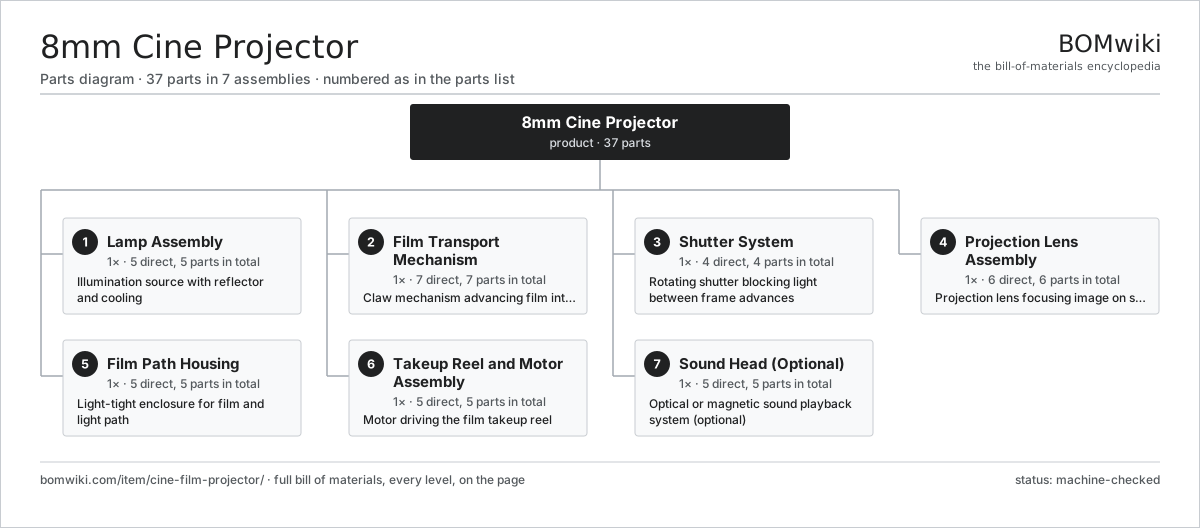
| # | Part | Qty | What it does |
|---|---|---|---|
| 1 | Lamp Assembly 5 parts | 1× | Illumination source with reflector and cooling |
| 2 | Film Transport Mechanism 7 parts | 1× | Claw mechanism advancing film intermittently |
| 3 | Shutter System 4 parts | 1× | Rotating shutter blocking light between frame advances |
| 4 | Projection Lens Assembly 6 parts | 1× | Projection lens focusing image on screen |
| 5 | Film Path Housing 5 parts | 1× | Light-tight enclosure for film and light path |
| 6 | Takeup Reel and Motor Assembly 5 parts | 1× | Motor driving the film takeup reel |
| 7 | Sound Head (Optional) 5 parts | 1× | Optical or magnetic sound playback system (optional) |
3D model
No 3D model yet. Have a CAD file of this? Add a 3D model — STL renders right on this page; STEP, FreeCAD, and OpenSCAD sources are welcome too (openly licensed, like all 3D models on BOMwiki).
Build & assembly graph
expand / collapse · shared sub-assemblies converge · links to related products · est. labourTap an assembly to expand/collapse · tap a part to open it · use “Open page” for any node · drag to pan, scroll to zoom.
Bill of materials for 8mm Cine Projector
7 top-level lines · 44 rows shown · 37 parts total · indented to 3 levels| # | Item / sub-assembly | Part no. | Qty/assy | Ext. qty | Parts | Type |
|---|---|---|---|---|---|---|
| 1 | Lamp Assembly 5 parts | cine-film-projector-lamp-assembly | 1× | 1 | 5 | assembly |
| 1.1 | Projection Lamp | cine-film-projector-lamp | 1× | 1 | · | part |
| 1.2 | Lamp Reflector | cine-film-projector-lamp-reflector | 1× | 1 | · | part |
| 1.3 | Lamp Heat Shield | cine-film-projector-lamp-heat-shield | 1× | 1 | · | part |
| 1.4 | Lamp Cooling Fan | cine-film-projector-lamp-cooling-fan | 1× | 1 | · | part |
| 1.5 | Fastener Set | fastener-set | 1× | 1 | · | part |
| 2 | Film Transport Mechanism 7 parts | cine-film-projector-film-transport | 1× | 1 | 7 | assembly |
| 2.1 | Film Claw | cine-film-projector-claw-mechanism | 1× | 1 | · | part |
| 2.2 | Feed Roller | cine-film-projector-feed-roller | 1× | 1 | · | part |
| 2.3 | Registration Gate | cine-film-projector-registration-gate | 1× | 1 | · | part |
| 2.4 | Takeup Roller | cine-film-projector-takeup-roller | 1× | 1 | · | part |
| 2.5 | Main Drive Motor | cine-film-projector-drive-motor | 1× | 1 | · | part |
| 2.6 | Film Guide Rollers | cine-film-projector-film-guides | 1× | 1 | · | part |
| 2.7 | Fastener Set | fastener-set | 1× | 1 | · | part |
| 3 | Shutter System 4 parts | cine-film-projector-shutter-system | 1× | 1 | 4 | assembly |
| 3.1 | Shutter Blade | cine-film-projector-shutter-blade | 1× | 1 | · | part |
| 3.2 | Shutter Disk | cine-film-projector-shutter-disk | 1× | 1 | · | part |
| 3.3 | Shutter Drive Gear | cine-film-projector-shutter-drive-gear | 1× | 1 | · | part |
| 3.4 | Fastener Set | fastener-set | 1× | 1 | · | part |
| 4 | Projection Lens Assembly 6 parts | cine-film-projector-lens-assembly | 1× | 1 | 6 | assembly |
| 4.1 | Primary Projection Lens | cine-film-projector-lens-primary | 1× | 1 | · | part |
| 4.2 | Corrector Lens | cine-film-projector-lens-secondary | 1× | 1 | · | part |
| 4.3 | Lens Barrel | cine-film-projector-lens-barrel | 1× | 1 | · | part |
| 4.4 | Iris Diaphragm | cine-film-projector-lens-iris-diaphragm | 1× | 1 | · | part |
| 4.5 | Focus Mechanism | cine-film-projector-focus-mechanism | 1× | 1 | · | part |
| 4.6 | Lens Mount Bracket | cine-film-projector-lens-mount-bracket | 1× | 1 | · | part |
| 5 | Film Path Housing 5 parts | cine-film-projector-film-path-housing | 1× | 1 | 5 | assembly |
| 5.1 | Body Casting | cine-film-projector-body-casting | 1× | 1 | · | part |
| 5.2 | Light Path Tube | cine-film-projector-light-path-tube | 1× | 1 | · | part |
| 5.3 | Access Panel | cine-film-projector-access-panel | 1× | 1 | · | part |
| 5.4 | Ventilation Louver | cine-film-projector-ventilation-louver | 1× | 1 | · | part |
| 5.5 | Fastener Set | fastener-set | 1× | 1 | · | part |
| 6 | Takeup Reel and Motor Assembly 5 parts | cine-film-projector-takeup-reel-motor | 1× | 1 | 5 | assembly |
| 6.1 | Takeup Reel Motor | cine-film-projector-takeup-motor | 1× | 1 | · | part |
| 6.2 | Takeup Reel Arbor | cine-film-projector-takeup-reel-arbor | 1× | 1 | · | part |
| 6.3 | Reel Adapter | cine-film-projector-takeup-reel-adapter | 1× | 1 | · | part |
| 6.4 | Film Tension Brake | cine-film-projector-film-brake | 1× | 1 | · | part |
| 6.5 | Fastener Set | fastener-set | 1× | 1 | · | part |
| 7 | Sound Head (Optional) 5 parts | cine-film-projector-sound-head-optional | 1× | 1 | 5 | assembly |
| 7.1 | Optical Sound Pickup Cell | cine-film-projector-optical-sound-pickup | 1× | 1 | · | part |
| 7.2 | Magnetic Sound Head | cine-film-projector-magnetic-pickup-head | 1× | 1 | · | part |
| 7.3 | Audio Amplifier Module | cine-film-projector-audio-amplifier | 1× | 1 | · | part |
| 7.4 | Speaker | speaker | 1× | 1 | · | part |
| 7.5 | Fastener Set | fastener-set | 1× | 1 | · | part |
Related products
same domain, ranked by shared parts

Sourcing: possible vendors
Prices, MOQ, and lead times are algorithmic estimates, not quotes, and not claims about these companies. Company mappings are curated by keyword; est. price band $100–$8k. How estimates work| Vendor | HQ | Specialty | MOQ | Lead time |
|---|---|---|---|---|
|
🇯🇵Canon
canon.com ↗
|
Tokyo, JP | Imaging & optics | 500 units | 10–16 wks |
|
🇯🇵Nikon
nikon.com ↗
|
Tokyo, JP | Imaging & optics | 500 units | 10–16 wks |
|
🇩🇪ZEISS
zeiss.com ↗
|
Oberkochen, DE | Optics & optoelectronics | 500 units | 10–16 wks |
| leica-camera.com ↗ | Wetzlar, DE | Cameras & optics | 500 units | 10–16 wks |
| flir.com ↗ | Wilsonville, US | Thermal imaging | 500 units | 10–16 wks |
1,170-word article