Cleanroom Luminaire
ProductOverview
Cleanroom luminaires are specialized LED fixtures designed for ISO class 5–7 controlled environments where airborne particulate contamination must be minimized, pharmaceutical manufacturing, microelectronics, biotech, and food processing cleanrooms. Unlike standard ceiling lights, cleanroom fixtures employ hermetic sealing, low-outgassing materials, and smooth surfaces that prevent particle shedding and harbor within crevices.
The sealed LED panel is mounted flush to the drop-ceiling grid, with multi-layer gaskets sealing the perimeter interface, preventing particulate air from leaking around the fixture. The stainless steel frame is electro-polished (not chromium-plated) to eliminate corrosion products that could be released as particles. All potted components use medical-grade silicone with <1 ppm volatile organic compound (VOC) outgassing, ensuring that the fixture does not emit molecular contaminants into the cleanroom air.
The teardrop diffuser provides high color rendering (>95 CRI) critical for product inspection, where color mismatch (e.g., contaminated pharmaceutical coating) must be detectable.
Cleanroom classification and particle control
Cleanrooms are classified by ISO 14644-1 according to the maximum number of airborne particles >0.5 µm per cubic foot of air:
- ISO Class 5: <100,000 particles/ft³ (pharmaceuticals, sterile devices)
- ISO Class 6: <1,000,000 particles/ft³ (most food and beverage processing)
- ISO Class 7: <10,000,000 particles/ft³ (assembly of non-sensitive components)
Uncontrolled indoor air contains ~10,000,000+ particles/ft³, so achieving and maintaining ISO class requires:
- HEPA/ULPA filtration of all incoming air
- Positive pressure in the cleanroom (air flows outward, preventing external contamination ingress)
- Low-particle-shedding materials in fixtures and surfaces
- Sealed interfaces preventing bypass of HEPA-filtered air
A standard ceiling light fixture with unsealed gaps and crevices will shed particles from dust accumulation within its housing, instantly degrading the cleanroom class. The cleanroom luminaire's sealed design, smooth surfaces, and gasket system prevent this particle shedding.
Hermetic sealing strategy
The cleanroom luminaire achieves hermeticity through a three-layer gasket stack:
Primary gasket: PTFE (Teflon) or medical-grade silicone (2–3 mm thickness) sealing the interface between the fixture frame and the drop-ceiling or panel. PTFE is chosen for its chemical inertness and non-outgassing properties.
Secondary gasket: Closed-cell foam or elastomer backing the primary gasket, accommodating manufacturing tolerance stack-ups and maintaining seal compression over time. As the primary gasket creeps (elastic deformation under sustained compression), the secondary gasket prevents a sudden loss of seal force.
Compression ring: A stainless steel ring or spring-loaded collar maintains 50–100 N/cm perimeter compression force, ensuring that the gasket stack does not relax and develop gaps over weeks or months of operation.
Even microscopic gaps (>1 µm) will allow air bypass, so the gasket compression force is monitored during installation and verified periodically (annual cleanroom audits) using calibrated torque wrenches and seal-integrity tests.
The diffuser frame and the driver connector are also gasketed, preventing air infiltration through secondary interfaces. All mechanical fasteners are stainless (no zinc plating, which can shed particles under corrosion), and corners have a minimum 5 mm radius to prevent sharp edges where particles lodge.
Material selection for low outgassing
Standard electronics potting compounds (polyurethane, epoxy) release volatile organic compounds as they cure and age. At elevated temperature (even cleanroom ambient of 20–25 °C), these VOCs off-gas slowly over months or years, condensing on product surfaces and contaminating yields.
The potted driver uses medical-grade silicone specified with <1 ppm total volatile organic compound (TVOC) emission. This material is the same as used in medical implant manufacturing, where molecular contamination is life-critical.
Similarly, the stainless steel frame is electro-polished rather than passivated: standard passivation processes leave iron hydroxides on the surface that can be released as particles. Electro-polishing removes a thin surface layer (5–20 µm) of iron and contaminants, leaving a smooth, particle-free finish.
Optics and light quality
The teardrop-profile diffuser is an acrylic or polycarbonate lens with a gentle elliptical contour and molded surface texture. The teardrop shape (wider in the center, tapering to edges) provides gentle vignetting at extreme viewing angles, eliminating harsh light-dark boundaries that make the light appear "hot-spotty."
The micro-louver array inside the diffuser blocks direct sightlines to the LED array from grazing angles (>60° from perpendicular), reducing perceived glare while maintaining high luminance in the forward direction. This is critical in cleanrooms where workers perform detailed inspection tasks for 8+ hour shifts: high glare causes eye strain, headaches, and visual fatigue.
The high-CRI (>95) LED array ensures accurate color rendering, essential for detecting:
- Color mismatch in tablets or capsules (off-color coatings indicate defective batch)
- Discoloration of surgical gloves or drapes (color change indicates sterilization failure or contamination)
- Yellowing or browning of pharmaceutical solutions (indicates degradation or microbial contamination)
A standard cool-white LED with CRI 70–80 would make subtle color shifts invisible to the human eye, potentially allowing contaminated product to pass inspection.
Electrical isolation for safety
Cleanrooms often use grounding mats and conductive flooring to prevent electrostatic discharge (ESD) damage to sensitive electronics. The luminaire's isolated power supply ensures that the fixture body is not a shock hazard even if a live phase conductor touches the stainless steel frame.
The isolation transformer or SMPS provides functional isolation (ANSI/AAMI ES60950 isolation): high-voltage AC is stepped down to a safe low-voltage, allowing the stainless frame to be grounded to the ESD floor grid without creating a short circuit or shock hazard. This is especially important in pharmaceutical filling lines, where workers in conductive gowns and ESD shoes come into contact with the luminaire.
Cleanroom installation and commissioning
Installation of a cleanroom luminaire is significantly more involved than a standard fixture:
- Preparation: The drop-ceiling grid is thoroughly cleaned and inspected for damaged tiles or dust accumulation.
- Gasket placement: Adhesive-backed gasket strips are applied to the fixture frame perimeter.
- Fixture insertion: The fixture is carefully positioned into the ceiling cutout (typically 2–3 technicians to prevent tilting and gasket displacement).
- Gasket compression: Mounting ears or clips are tightened evenly to compress the gasket stack uniformly.
- Compression verification: A compression tester measures the clamping force at multiple points (8–12 locations around perimeter) to ensure 50–100 N/cm.
- Smoke testing: A smoke aerosol is released near the fixture perimeter while observing airflow with a flow hood. No smoke should be drawn into the plenum (ceiling void); any inflow indicates a gasket failure.
- Electrical testing: The fixture is energized and confirmed operational, with illuminance uniformity measured using a light meter at 30 cm intervals across the fixture face.
- Cleanroom rebalancing: After fixture installation, the HVAC system is rebalanced to restore positive pressure and confirm that the cleanroom class is maintained.
This multi-step process is much more demanding than standard lighting installation and commands labor costs of $500–1500 per fixture.
Performance monitoring and revalidation
Cleanroom fixtures are periodically revalidated:
- Quarterly: Visual inspection for dust accumulation, gasket visible cracks, or fastener looseness.
- Annual: Compression force verification, smoke test, and illuminance uniformity measurement.
- 3 yearly or upon major maintenance: Full gasket replacement and sealant reapplication.
Thermal cycling (temperature swings in the 15–35 °C cleanroom ambient) causes the stainless frame and gasket to expand and contract at different rates, gradually degrading the seal. After 2–3 years, the gasket may need replacement to restore compression force.
Compliance and certification
- ISO 14644-1 (cleanroom classification and control)
- FDA 21 CFR Part 211 (pharmaceutical CGMP, cleanroom design and maintenance)
- ISO 14971 (risk management for medical device manufacturing)
- ANSI/AAMI ES60950 (electrical safety in healthcare environments)
- IEC 62471 (photobiological safety of light and lamp systems)
Cleanroom luminaires supplied to pharmaceutical manufacturers must include certification of material biocompatibility (for implantable contact or test data for non-contact environments), VOC testing reports (<1 ppm TVOC per ISO 16000-3), and illuminance/color uniformity documentation.
Long-term value and risk mitigation
The cost premium of a cleanroom luminaire ($2000–5000 per fixture vs. $200–500 for a standard ceiling light) is offset by the risk of costly contamination events:
- A pharmaceutical batch failure due to particle contamination can cost $100,000–$1,000,000+ in lost product and recall expenses.
- A surgical implant contaminated by airborne particles can cause infection, litigation, and reputation damage exceeding the entire cleanroom lighting system cost.
In high-risk manufacturing environments, cleanroom-grade lighting is not an aesthetic upgrade but a mandatory control to ensure product safety and regulatory compliance.
Cleanroom Luminaire parts and their functions
7 top-level parts · 22 parts in total · full bill of materials below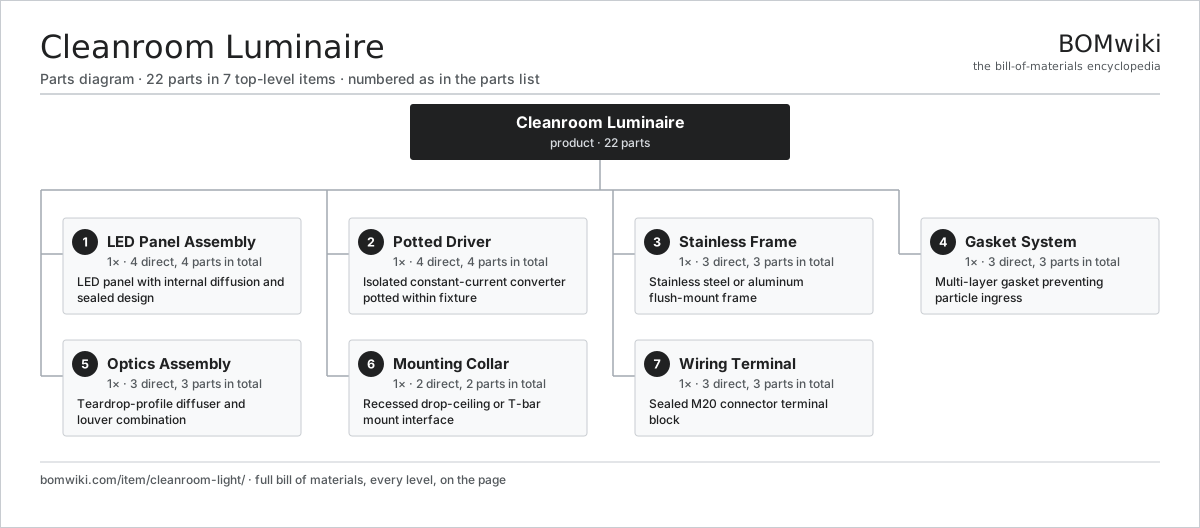
| # | Part | Qty | What it does |
|---|---|---|---|
| 1 | LED Panel Assembly 4 parts | 1× | LED panel with internal diffusion and sealed design |
| 2 | Potted Driver 4 parts | 1× | Isolated constant-current converter potted within fixture |
| 3 | Stainless Frame 3 parts | 1× | Stainless steel or aluminum flush-mount frame |
| 4 | Gasket System 3 parts | 1× | Multi-layer gasket preventing particle ingress |
| 5 | Optics Assembly 3 parts | 1× | Teardrop-profile diffuser and louver combination |
| 6 | Mounting Collar 2 parts | 1× | Recessed drop-ceiling or T-bar mount interface |
| 7 | Wiring Terminal 3 parts | 1× | Sealed M20 connector terminal block |
3D model
No 3D model yet. Have a CAD file of this? Add a 3D model. STL renders right on this page; STEP, FreeCAD, and OpenSCAD sources are welcome too (openly licensed, like all 3D models on BOMwiki).
Build & assembly graph
expand / collapse · shared sub-assemblies converge · links to related products · est. labourTap an assembly to expand/collapse · tap a part to open it · use “Open page” for any node · drag to pan, scroll to zoom.
Bill of materials for Cleanroom Luminaire
7 top-level lines · 29 rows shown · 22 parts total · indented to 3 levels| # | Item / sub-assembly | Part no. | Qty/assy | Ext. qty | Parts | Type |
|---|---|---|---|---|---|---|
| 1 | LED Panel Assembly 4 parts | cleanroom-light-led-panel | 1× | 1 | 4 | assembly |
| 1.1 | LED Array | cleanroom-light-led-array | 1× | 1 | · | part |
| 1.2 | Sealed MCPCB | cleanroom-light-mcpcb | 1× | 1 | · | part |
| 1.3 | Thermal Pad | cleanroom-light-thermal-pad | 1× | 1 | · | part |
| 1.4 | SMD Passive (R/C/L) | smd-passives | 1× | 1 | · | part |
| 2 | Potted Driver 4 parts | cleanroom-light-driver | 1× | 1 | 4 | assembly |
| 2.1 | Driver PCB | cleanroom-light-driver-pcb | 1× | 1 | · | part |
| 2.2 | Potting Compound | cleanroom-light-potting-compound | 1× | 1 | · | part |
| 2.3 | Power Supply | power-supply | 1× | 1 | · | part |
| 2.4 | Output Connector | cleanroom-light-output-connector | 1× | 1 | · | part |
| 3 | Stainless Frame 3 parts | cleanroom-light-frame | 1× | 1 | 3 | assembly |
| 3.1 | Frame Body | cleanroom-light-frame-body | 1× | 1 | · | part |
| 3.2 | Frame Backing | cleanroom-light-frame-backing | 1× | 1 | · | part |
| 3.3 | Radius Bezel | cleanroom-light-corner-radius-bezel | 1× | 1 | · | part |
| 4 | Gasket System 3 parts | cleanroom-light-gasket-system | 1× | 1 | 3 | assembly |
| 4.1 | Primary Gasket | cleanroom-light-primary-gasket | 1× | 1 | · | part |
| 4.2 | Secondary Gasket | cleanroom-light-secondary-gasket | 1× | 1 | · | part |
| 4.3 | Compression Ring | cleanroom-light-gasket-compression-ring | 1× | 1 | · | part |
| 5 | Optics Assembly 3 parts | cleanroom-light-optics-assembly | 1× | 1 | 3 | assembly |
| 5.1 | Diffuser Lens | cleanroom-light-diffuser | 1× | 1 | · | part |
| 5.2 | Internal Louver | cleanroom-light-internal-louver | 1× | 1 | · | part |
| 5.3 | Diffuser Gasket | cleanroom-light-diffuser-gasket | 1× | 1 | · | part |
| 6 | Mounting Collar 2 parts | cleanroom-light-mounting-collar | 1× | 1 | 2 | assembly |
| 6.1 | Mounting Ears | cleanroom-light-mounting-ears | 1× | 1 | · | part |
| 6.2 | Alignment Shim | cleanroom-light-alignment-shim | 1× | 1 | · | part |
| 7 | Wiring Terminal 3 parts | cleanroom-light-wiring-terminal | 1× | 1 | 3 | assembly |
| 7.1 | Cable Gland | cleanroom-light-cable-gland | 1× | 1 | · | part |
| 7.2 | Terminal Block | cleanroom-light-terminal-block | 1× | 1 | · | part |
| 7.3 | Strain Relief | cleanroom-light-strain-relief | 1× | 1 | · | part |
Something wrong in this list? Report a problem with this BOM.
Related products
same domain, ranked by shared parts Aviation Obstruction Light
192 parts · shares 1 with this page
Canopy Light
26 parts · shares 1 with this page
Explosion-Proof Light Fixture
31 parts · shares 1 with this page
Aviation Obstruction Light
192 parts · shares 1 with this page
Canopy Light
26 parts · shares 1 with this page
Explosion-Proof Light Fixture
31 parts · shares 1 with this page
 Heliport Beacon
39 parts · shares 1 with this page
Industrial UV Curing Lamp
300 parts · shares 1 with this page
Landscape Spotlight
44 parts · shares 1 with this page
Heliport Beacon
39 parts · shares 1 with this page
Industrial UV Curing Lamp
300 parts · shares 1 with this page
Landscape Spotlight
44 parts · shares 1 with this page
Sourcing: possible vendors
Browse the supplier directory → Prices, MOQ, and lead times are algorithmic estimates, not quotes, and not claims about these companies. Company mappings are curated by keyword; est. price band $3–$2k. How estimates work| Vendor | HQ | Specialty | MOQ | Lead time |
|---|---|---|---|---|
|
🇳🇱Signify
signify.com ↗
|
Eindhoven, NL | Lighting (Philips Hue) | 2,000 units | 6–10 wks |
| acuitybrands.com ↗ | Atlanta, US | Lighting & controls | 2,000 units | 6–10 wks |
|
🇦🇹Zumtobel
zumtobelgroup.com ↗
|
Dornbirn, AT | Lighting | 2,000 units | 6–10 wks |
| creelighting.com ↗ | Racine, US | LED lighting | 2,000 units | 6–10 wks |
|
🇮🇳Havells
havells.com ↗
|
Noida, IN | Electrical & lighting | 2,000 units | 6–10 wks |
1,481-word article