Clicker Press
ProductOverview
The clicker press is the primary leather-cutting machine in footwear manufacturing, responsible for cutting shoe components (vamps, sides, heel counters, toe boxes) from large tanned hides. The name "clicker" derives from the audible "click" sound of the cutting die striking the bed, a characteristic noise in any footwear factory.
Unlike band knives (which shear continuously) or laser cutters (which melt), a clicker die cuts via shear compression: a hardened steel die with a sharp edge is forced downward under high pressure (200–400 tonnes), shearing leather fibers cleanly at the die edge. The result is a precisely-shaped leather component with minimal waste and maximum accuracy for assembly.
Die Design and Cutting Edge Geometry
A cutting die is a hardened steel stamp shaped to the desired component geometry (e.g., a shoe vamp profile). The die has several critical features:
Cutting Edge Bevel
The die's lower edge is honed to a sharp bevel (typically 20–30° angle to the cutting surface). A sharper edge (<15°) cuts more cleanly but wears faster; a duller edge (>30°) cuts roughly and requires more pressure.
Cutting edge quality is measured by sharpness at the microscopic level. A well-honed die produces clean-cut leather fibers with minimal fraying; a dull die produces fuzzy, torn edges that are unsuitable for visible seams.
Die Hardness
Cutting dies are hardened to 56–62 HRC (Rockwell hardness). This provides:
- Durability: A well-maintained die cuts 500,000–1,000,000 leather pieces before edge dulling becomes noticeable.
- Dimensional stability: Hardened steel resists plastic deformation under the ~200 tonne cutting pressure.
- Edge retention: The hardness edge is stable across thousands of cuts, maintaining geometric accuracy.
Knockout or Support Pins
Dies must include relief mechanisms to prevent leather from sticking to the die and tearing as it retracts. Typical solutions:
- Knockout pins: Small hardened steel pins protruding slightly from the die top surface, engaging the leather back side. As the die retracts upward, the pins push the leather away from the die edge.
- Shear angle: The die bottom surface is angled slightly (1–3°), creating mechanical advantage that helps separate leather as the die rises.
Leather Cutting Physics and Forces
When the swing arm descends, bringing the die downward at 200–400 bar pressure, the cutting edge encounters the leather and initiates shear:
- Pressure ramp: Pressure increases linearly as the die descends, from 0 to maximum over ~2–3 seconds.
- Initial shearing: At ~50 bar, the sharp die edge begins to separate leather fibers. The actual shear zone is only 0.1–0.3 mm thick (width of the die edge bevel).
- Full separation: Once shear reaches leather thickness, fibers are completely severed, and the die continues descending to full depth.
- Pressure hold: Maximum pressure is maintained for 1–2 seconds (dwell) to ensure complete fiber separation, preventing fuzzy or incomplete cuts.
- Retraction: Hydraulic valve reverses, lifting the die upward. Knockout pins push the leather away, and the die returns to rest position.
The total cutting force required depends on:
- Leather thickness: 1 mm leather requires ~2–3 tonnes per mm of cutting edge length.
- Cutting edge length: A large die with 1500 mm perimeter requires proportionally more force (1500 mm × 3 tonnes/mm = 4500 tonnes total).
- Leather type: Tougher hides (oak-tanned, vegetable-tanned) require 20–30% more force than softer chrome-tanned leather.
Industrial clicker presses are typically rated at 200–400 tonnes; most footwear work uses 150–250 tonnes, leaving headroom for tougher materials or large dies.
Die Steel and Wear
Cutting dies are fabricated from high-carbon steel (typically O1, D2, or A2 tool steel grades), hardened and tempered to the specified hardness. During use, the cutting edge gradually dulls due to:
- Microchipping: Tiny carbide particles break away from the edge, widening the shear zone.
- Plastic deformation: The edge surface work-hardens and eventually exceeds the brittle limit, causing grain boundary cracking.
- Corrosion: If leather is stored with salt or moisture, the die edge can oxidize slightly, dulling it.
Typical die lifespan is 500,000–1,000,000 cuts. After that, the die is sent for professional resharpening (100–500 euros depending on die size), which involves:
- Grinding the cutting edge to restore bevel geometry.
- Honing to microscopic sharpness.
- Hardness verification with Rockwell tester.
- Trial cuts to verify performance before return to customer.
A factory with 20 dies in rotation might spend $5,000–15,000 per year on resharpening and maintenance.
Layout Efficiency and Nesting
A key operational concern is hide utilization. A leather hide is an irregular shape (four-legged animal skin) with natural variations in thickness, grain quality, and elasticity. To maximize the number of components cut from each hide, leather experts use computer-aided nesting software to layout die positions:
- Exclude defects: Areas with scars, holes, or thin spots are avoided.
- Grain direction: Component orientation is chosen to align fiber grain (for durability and appearance) or minimize visible grain variation.
- Spacing: Dies are positioned to minimize waste between components.
Well-executed nesting can yield 85–92% hide utilization (the percentage of hide area that becomes usable shoe components). Poor nesting may yield only 70–80%, with excess scrap.
The scrap is not wasted: leather scraps are shredded and used for glue or gelatin manufacture, recovering some material value.
Safety and Die Change Procedures
The clicker press is a heavy, powerful machine with pinch and crush hazards. Industrial standards mandate:
- Guard enclosure: Rigid or interlocked guard around the work area, preventing hand entry during the press stroke.
- Two-hand control: Some jurisdictions require two-hand activation to ensure operator hands are clear of the cutting area.
- Emergency stop buttons: Mounted on both sides of the press, easily reachable.
- Die change safety: Before changing dies, the operator must:
- Turn off the pump motor.
- Manually lower the swing arm fully via hand pump or mechanical crank (in case of hydraulic failure).
- Lock the arm in the down position with a mechanical pin or latch.
- Only then remove the die from the quick-change coupling.
Accidental operation during die change is a leading cause of severe hand injuries in footwear factories.
Cutting Quality and Process Capability
Clicker die cutting quality depends on die sharpness, hide condition, and pressure setpoint. A properly executed cut has:
- Clean edges: No fuzzing or fiber pull.
- Dimensionally accurate: Component shape matches die profile within ±1 mm.
- No cracking: Leather edges are not cracked or delaminated.
Defective cuts (fuzzy edges, off-center components) are typically reworked:
- Light fuzziness: Trimmed by hand knife or belt sander.
- Dimensional error: Rare; usually indicates die wear or misalignment.
- Delamination: Discarded; the component is too weak for assembly.
Rejection rate on a well-maintained clicker press is typically 2–5% of production; excessive rejection (>10%) indicates die wear or pressure calibration issues requiring investigation.
Production Workflow
A typical clicker press operation in a factory follows this rhythm:
- Hide preparation: Hide is cleaned, inspected, and laid flat on the cutting bed.
- Die positioning: Operator positions the appropriate die (pre-nesting coordinates from CAD software guide this).
- Press cycle: Operator activates press via foot pedal or hand lever; swing arm descends, cuts the component, and retracts.
- Component removal: Operator or assistant lifts the cut component from the hide, stacking it in a bin.
- Repeat: Process repeats with next die position until all components are cut from the hide.
A skilled operator can cut 80–150 components per hour depending on hide size and number of components per hide. Larger hides and more components per hide result in faster per-component rates; smaller hides and fewer components per hide (worse utilization) result in slower rates.
Modern factories increasingly use CNC-controlled positioning or robotic die exchange to reduce changeover time and improve consistency, but manual clicker presses remain the economical workhorse for many production volumes.
Clicker Press parts and their functions
7 top-level parts · 26 parts in total · full bill of materials below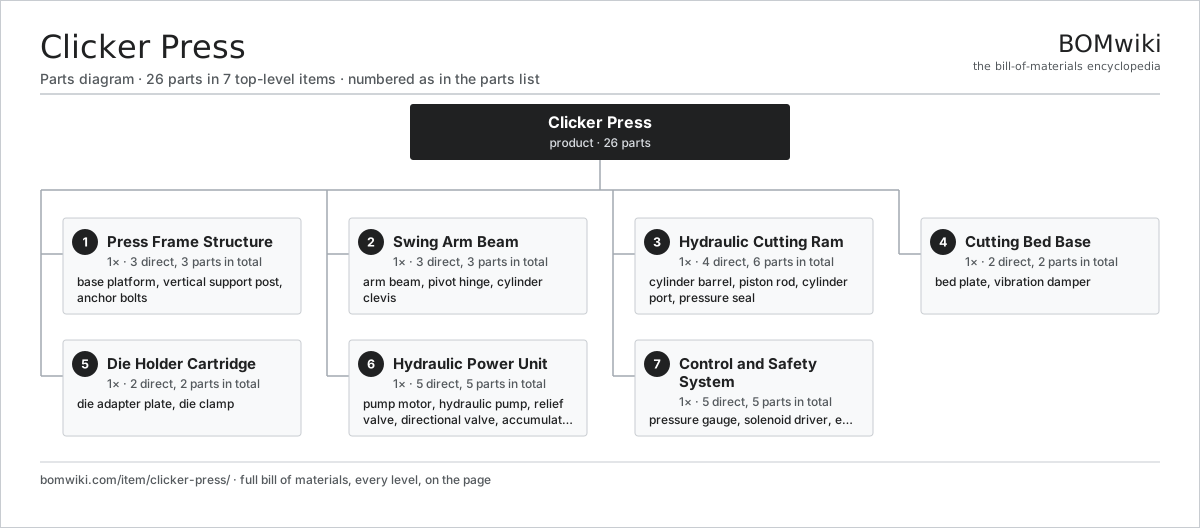
| # | Part | Qty | What it does |
|---|---|---|---|
| 1 | Press Frame Structure 3 parts | 1× | Rigid ductile iron frame supporting swing arm and mounting hydraulic cylinder. |
| 2 | Swing Arm Beam 3 parts | 1× | Articulated arm that swings down to apply cutting die pressure vertically onto leather and cutting bed. |
| 3 | Hydraulic Cutting Ram 4 parts | 1× | Double-rod hydraulic cylinder powered by pump, applying downward force to swing arm for cutting pressure. |
| 4 | Cutting Bed Base 2 parts | 1× | Fixed lower surface supporting leather and cutting die during press stroke, accepting cutting forces. |
| 5 | Die Holder Cartridge 2 parts | 1× | Quick-change mount for cutting dies, allowing rapid die swaps between shoe components. |
| 6 | Hydraulic Power Unit 5 parts | 1× | Pump and motor delivering high-pressure flow to hydraulic cylinder. |
| 7 | Control and Safety System 5 parts | 1× | Electrical enclosure with pressure monitoring, solenoid valve control, and emergency stop. |
3D model
No 3D model yet. Have a CAD file of this? Add a 3D model. STL renders right on this page; STEP, FreeCAD, and OpenSCAD sources are welcome too (openly licensed, like all 3D models on BOMwiki).
Build & assembly graph
expand / collapse · shared sub-assemblies converge · links to related products · est. labourTap an assembly to expand/collapse · tap a part to open it · use “Open page” for any node · drag to pan, scroll to zoom.
Bill of materials for Clicker Press
7 top-level lines · 31 rows shown · 26 parts total · indented to 3 levels| # | Item / sub-assembly | Part no. | Qty/assy | Ext. qty | Parts | Type |
|---|---|---|---|---|---|---|
| 1 | Press Frame Structure 3 parts | clicker-press-frame | 1× | 1 | 3 | assembly |
| 1.1 | Base Platform | clicker-press-base-platform | 1× | 1 | · | part |
| 1.2 | Vertical Support Post | clicker-press-vertical-post | 1× | 1 | · | part |
| 1.3 | Anchor Bolts | clicker-press-anchor-bolts | 1× | 1 | · | part |
| 2 | Swing Arm Beam 3 parts | clicker-press-swing-arm | 1× | 1 | 3 | assembly |
| 2.1 | Arm Beam | clicker-press-arm-beam | 1× | 1 | · | part |
| 2.2 | Pivot Hinge | clicker-press-pivot-hinge | 1× | 1 | · | part |
| 2.3 | Cylinder Clevis | clicker-press-arm-hydraulic-attachment | 1× | 1 | · | part |
| 3 | Hydraulic Cutting Ram 4 parts | clicker-press-hydraulic-cylinder | 1× | 1 | 6 | assembly |
| 3.1 | Cylinder Barrel | clicker-press-cylinder-barrel | 1× | 1 | · | part |
| 3.2 | Piston Rod | clicker-press-piston-rod | 2× | 2 | · | part |
| 3.3 | Cylinder Port | clicker-press-cylinder-port | 2× | 2 | · | part |
| 3.4 | Pressure Seal | clicker-press-pressure-seals | 1× | 1 | · | part |
| 4 | Cutting Bed Base 2 parts | clicker-press-cutting-bed | 1× | 1 | 2 | assembly |
| 4.1 | Bed Plate | clicker-press-bed-plate | 1× | 1 | · | part |
| 4.2 | Vibration Damper | clicker-press-bed-vibration-damper | 1× | 1 | · | part |
| 5 | Die Holder Cartridge 2 parts | clicker-press-die-holder | 1× | 1 | 2 | assembly |
| 5.1 | Die Adapter Plate | clicker-press-die-adapter | 1× | 1 | · | part |
| 5.2 | Die Clamp | clicker-press-die-clamp | 1× | 1 | · | part |
| 6 | Hydraulic Power Unit 5 parts | clicker-press-pump-system | 1× | 1 | 5 | assembly |
| 6.1 | Pump Motor | clicker-press-pump-motor | 1× | 1 | · | part |
| 6.2 | Hydraulic Pump | clicker-press-hydraulic-pump | 1× | 1 | · | part |
| 6.3 | Relief Valve | clicker-press-pressure-relief | 1× | 1 | · | part |
| 6.4 | Directional Valve | clicker-press-directional-valve | 1× | 1 | · | part |
| 6.5 | Accumulator | clicker-press-accumulator | 1× | 1 | · | part |
| 7 | Control and Safety System 5 parts | clicker-press-control-panel | 1× | 1 | 5 | assembly |
| 7.1 | Pressure Gauge | clicker-press-pressure-gauge | 1× | 1 | · | part |
| 7.2 | Solenoid Driver | clicker-press-solenoid-valve-driver | 1× | 1 | · | part |
| 7.3 | E-Stop Button | clicker-press-estop-switch | 1× | 1 | · | part |
| 7.4 | Guard Interlock | clicker-press-guard-interlock | 1× | 1 | · | part |
| 7.5 | Power Supply | power-supply | 1× | 1 | · | part |
Something wrong in this list? Report a problem with this BOM.
Sourcing: possible vendors
Browse the supplier directory → Prices, MOQ, and lead times are algorithmic estimates, not quotes, and not claims about these companies. Company mappings are curated by keyword; est. price band $10k–$1M. How estimates work| Vendor | HQ | Specialty | MOQ | Lead time |
|---|---|---|---|---|
|
🇨🇭Rieter
rieter.com ↗
|
Winterthur, CH | Spinning machinery | 10 units | 14–24 wks |
| truetzschler.com ↗ | Mönchengladbach, DE | Textile machinery | 10 units | 14–24 wks |
|
🇧🇪Picanol
picanol.be ↗
|
Ypres, BE | Weaving machines | 10 units | 14–24 wks |
| karlmayer.com ↗ | Obertshausen, DE | Warp knitting machines | 10 units | 14–24 wks |
|
🇨🇭Saurer
saurer.com ↗
|
Arbon, CH | Spinning & embroidery | 10 units | 14–24 wks |
1,326-word article