Clinker Cooler
ProductOverview
A clinker cooler is a large reciprocating grate device that rapidly reduces the temperature of hot clinker exiting a rotary kiln from 1000–1200°C to 60–100°C, allowing safe handling and storage. Cooling is achieved by passing upward-flowing air through a moving bed of clinker on a reciprocating steel grate. The air absorbs sensible heat from the clinker, raising the air temperature; this hot air is then used to pre-heat combustion air for the kiln, improving overall plant thermal efficiency by 15–25%.
A clinker cooler is an essential component of modern cement plants, coupled with every rotary kiln. Efficient cooling reduces clinker inventory in storage, improves cement strength development (slower cooling of clinker promotes certain mineral phases), and is a major source of waste heat recovery.
How it works
Hot clinker (nodules, 10–50 mm chunks) exits the kiln discharge end at 1000–1200°C and falls onto the reciprocating grate. The grate moves forward and backward at 10–20 cycles per minute, driven by hydraulic cylinders. As the grate oscillates, clinker tumbles and flows downward across the grate length, spending 5–15 minutes in the cooler.
Simultaneously, the cooling fans draw ambient air upward through the grate from below. The air enters the cooler at ~30°C and, as it passes through the hot clinker bed, absorbs heat. Air temperature can rise to 400–500°C by the time it exits the clinker-cooler zone. This hot air is ducted to a heat exchanger, where it pre-heats the kiln's combustion air, improving fuel efficiency.
As clinker cools and solidifies, it may form large agglomerates. A crusher section (roller crusher or hammer mill) positioned mid-cooler or at discharge breaks these agglomerates into fist-size chunks suitable for ball mill feed.
At the discharge end, cooled clinker (~60–100°C) is conveyed to storage or directly to a cement mill. Clinker temperature must be controlled: too-hot clinker can ignite dust in storage; too-cold clinker may develop undesirable mineral phases.
Grate System
The reciprocating grate is the core of the cooler. It consists of parallel steel bars, 20–40 mm diameter, spaced 15–25 mm apart, forming the clinker bed support. Wear liners, composite or steel plates, protect the bars from abrasion and erosion. The entire assembly is housed in a steel frame and moves linearly in both directions via mechanical linkages connected to hydraulic cylinders.
Grate seals at the perimeter prevent air bypass around the edges, ensuring all cooling air passes through the clinker bed. Worn seals reduce cooling efficiency and must be inspected and replaced regularly.
The grate reciprocation rate is critical: slower motion (8–10 cycles/min) allows longer clinker residence and better cooling; faster motion (15–20 cycles/min) increases throughput but reduces cooling effectiveness. The PLC balances these competing demands.
Cooling Air System
The primary cooling fan (100–300 kW, centrifugal design) draws air upward through the grate at a volumetric flow of 100,000–400,000 m³/h, depending on cooler size. Modern coolers are equipped with a secondary fan to increase cooling capacity and reliability.
Fan motors are variable-speed, controlled via VFD, allowing dynamic adjustment of cooling air based on clinker inlet temperature and desired outlet temperature. If kiln discharge temperature spikes (e.g., due to fuel rate increase), the PLC increases fan speed to maintain target outlet temperature.
The ductwork is carefully designed with baffles and zones to distribute air evenly across the grate width and to separate dust and fines from cooled clinker. Large clinker pieces settle out; fines and dust are carried upward in the exhaust air to a dust collection system.
Heat Recovery
The hot exhaust air from the cooler (400–500°C) enters a heat exchanger where it transfers heat to the kiln's combustion air intake. This is a critical efficiency measure:
- Unrecovered cooler air exits at 350–400°C, carrying away ~20–25% of the kiln's fuel energy.
- With heat recovery, pre-heated combustion air enters the kiln at 250–350°C, reducing the fuel needed to reach kiln temperature by a proportional amount.
- For a typical cement plant, this translates to 10–15% reduction in fuel consumption, saving millions annually.
The bypass damper allows partial bypass of air around the heat exchanger; this is adjusted seasonally (higher bypass in summer when pre-heat is less needed) and dynamically (increased bypass if cooler outlet temperature exceeds setpoint).
Dust and Fines Management
Cooling air carries a significant dust load, 500–1000 mg/m³ of fine clinker and grate liner particles. This dust must be removed before exhausting to atmosphere (environmental regulations mandate <50 mg/m³). A fabric filter baghouse captures fines with 99.95% efficiency. Collected dust is recycled back to the kiln inlet (where it reabsorbs) or sent to a cement finish mill.
The baghouse typically houses 100–300 m² of filter area and is pulse-jet cleaned every 10–60 seconds to maintain draft. A small ID fan ensures consistent suction through the filter.
Hydraulic System
The hydraulic system is surprisingly demanding. The grate moves against significant friction (clinker weight, bearing drag) and inertia. A variable displacement pump delivers 50–100 L/min at 250 bar to proportional cylinders. A proportional directional valve controlled by the PLC adjusts stroke length and speed to optimize cooling. A relief valve protects the system from overload if clinker bridges or jamming occurs.
The hydraulic reservoir (2–5 m³) must be sized to dissipate the heat generated by proportional valve throttling and cylinder friction, typically 50–100 kW of heat input during full-load operation.
Control and Optimization
The control system is intelligent:
- A discharge thermocouple measures clinker outlet temperature continuously.
- If outlet temperature drifts above setpoint (e.g., 90°C when setpoint is 80°C), the PLC increases primary and secondary fan speeds.
- A vibration sensor on the grate frame monitors bearing health and detects grate imbalance or jamming.
- The PLC logs performance data (cooling air temperature, grate pressure, fan power) for predictive maintenance.
Advanced plants use model-predictive control to anticipate kiln temperature changes and pre-emptively adjust cooler settings, improving overall plant stability.
Crusher Section
A crusher within or downstream of the cooler breaks large agglomerates and ensures consistent product size for the ball mill. A pair of hardened steel rolls driven by a 30–75 kW motor and gearbox compress and shear clinker. Crusher gap is adjustable to target product size (typically 10–25 mm top size for ball mill feed).
Operational Maintenance
- Grate bars and liners: Replaced every 1–2 years depending on clinker hardness and abrasivity.
- Hydraulic cylinders: Seals wear under thermal cycling; cylinder replacement is typical every 3–5 years.
- Bearings in fan and crusher: Standard maintenance; replaced every 5–7 years.
- Heat exchanger tubes: Cleanings are necessary every 6–12 months if hot spots form; complete replacement every 10–15 years.
- Seals: Critical maintenance; leaking seals reduce cooling efficiency dramatically.
A modern cement plant typically runs clinker coolers at 85–95% uptime, with maintenance and rebuild campaigns scheduled during planned kiln shutdowns.
Clinker Cooler parts and their functions
8 top-level parts · 29 parts in total · full bill of materials below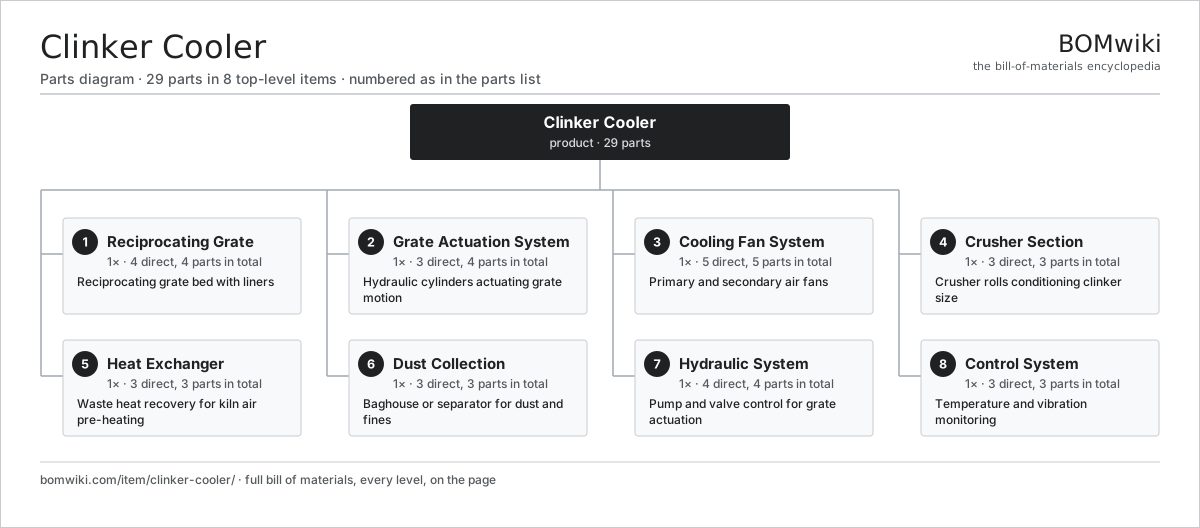
| # | Part | Qty | What it does |
|---|---|---|---|
| 1 | Reciprocating Grate 4 parts | 1× | Reciprocating grate bed with liners |
| 2 | Grate Actuation System 3 parts | 1× | Hydraulic cylinders actuating grate motion |
| 3 | Cooling Fan System 5 parts | 1× | Primary and secondary air fans |
| 4 | Crusher Section 3 parts | 1× | Crusher rolls conditioning clinker size |
| 5 | Heat Exchanger 3 parts | 1× | Waste heat recovery for kiln air pre-heating |
| 6 | Dust Collection 3 parts | 1× | Baghouse or separator for dust and fines |
| 7 | Hydraulic System 4 parts | 1× | Pump and valve control for grate actuation |
| 8 | Control System 3 parts | 1× | Temperature and vibration monitoring |
3D model
No 3D model yet. Have a CAD file of this? Add a 3D model. STL renders right on this page; STEP, FreeCAD, and OpenSCAD sources are welcome too (openly licensed, like all 3D models on BOMwiki).
Build & assembly graph
expand / collapse · shared sub-assemblies converge · links to related products · est. labourTap an assembly to expand/collapse · tap a part to open it · use “Open page” for any node · drag to pan, scroll to zoom.
Bill of materials for Clinker Cooler
8 top-level lines · 36 rows shown · 29 parts total · indented to 3 levels| # | Item / sub-assembly | Part no. | Qty/assy | Ext. qty | Parts | Type |
|---|---|---|---|---|---|---|
| 1 | Reciprocating Grate 4 parts | clinker-cooler-grate-system | 1× | 1 | 4 | assembly |
| 1.1 | Grate Bars | clinker-cooler-grate-bars | 1× | 1 | · | part |
| 1.2 | Grate Liners | clinker-cooler-grate-liners | 1× | 1 | · | part |
| 1.3 | Grate Frame | clinker-cooler-grate-frame | 1× | 1 | · | part |
| 1.4 | Grate Seals | clinker-cooler-grate-seals | 1× | 1 | · | part |
| 2 | Grate Actuation System 3 parts | clinker-cooler-hydraulic-drive | 1× | 1 | 4 | assembly |
| 2.1 | Actuation Cylinder | clinker-cooler-drive-cylinders | 2× | 2 | · | part |
| 2.2 | Linkage Assembly | clinker-cooler-cylinder-mounting | 1× | 1 | · | part |
| 2.3 | Grate Rails | clinker-cooler-grate-guides | 1× | 1 | · | part |
| 3 | Cooling Fan System 5 parts | clinker-cooler-cooling-fans | 1× | 1 | 5 | assembly |
| 3.1 | Primary Cooling Fan | clinker-cooler-primary-fan | 1× | 1 | · | part |
| 3.2 | Secondary Fan | clinker-cooler-secondary-fan | 1× | 1 | · | part |
| 3.3 | Primary Fan Motor | clinker-cooler-fan-motor-1 | 1× | 1 | · | part |
| 3.4 | Secondary Fan Motor | clinker-cooler-fan-motor-2 | 1× | 1 | · | part |
| 3.5 | Air Ductwork | clinker-cooler-air-ductwork | 1× | 1 | · | part |
| 4 | Crusher Section 3 parts | clinker-cooler-crusher | 1× | 1 | 3 | assembly |
| 4.1 | Crusher Rolls | clinker-cooler-crusher-rolls | 1× | 1 | · | part |
| 4.2 | Crusher Motor | clinker-cooler-crusher-motor | 1× | 1 | · | part |
| 4.3 | Crusher Gearbox | clinker-cooler-crusher-gearbox | 1× | 1 | · | part |
| 5 | Heat Exchanger 3 parts | clinker-cooler-heat-exchanger | 1× | 1 | 3 | assembly |
| 5.1 | Heat Exchanger Tubes | clinker-cooler-hx-tubes | 1× | 1 | · | part |
| 5.2 | Bypass Damper | clinker-cooler-hx-bypass-damper | 1× | 1 | · | part |
| 5.3 | Heat Exchanger Insulation | clinker-cooler-hx-insulation | 1× | 1 | · | part |
| 6 | Dust Collection 3 parts | clinker-cooler-dust-collection | 1× | 1 | 3 | assembly |
| 6.1 | Fabric Filter | clinker-cooler-baghouse | 1× | 1 | · | part |
| 6.2 | Baghouse Suction Fan | clinker-cooler-baghouse-fan | 1× | 1 | · | part |
| 6.3 | Dust Collection Bin | clinker-cooler-dust-hopper | 1× | 1 | · | part |
| 7 | Hydraulic System 4 parts | clinker-cooler-hydraulic-system | 1× | 1 | 4 | assembly |
| 7.1 | Hydraulic Pump | clinker-cooler-hydraulic-pump | 1× | 1 | · | part |
| 7.2 | Proportional Valve | clinker-cooler-proportional-valve | 1× | 1 | · | part |
| 7.3 | Pressure Relief Valve | clinker-cooler-pressure-relief | 1× | 1 | · | part |
| 7.4 | Hydraulic Tank | clinker-cooler-hydraulic-tank | 1× | 1 | · | part |
| 8 | Control System 3 parts | clinker-cooler-control-system | 1× | 1 | 3 | assembly |
| 8.1 | Discharge Thermocouple | clinker-cooler-outlet-thermocouple | 1× | 1 | · | part |
| 8.2 | Vibration Sensor | clinker-cooler-vibration-sensor | 1× | 1 | · | part |
| 8.3 | Cooler Controller | clinker-cooler-plc | 1× | 1 | · | part |
Something wrong in this list? Report a problem with this BOM.
Sourcing: possible vendors
Browse the supplier directory → Prices, MOQ, and lead times are algorithmic estimates, not quotes, and not claims about these companies. Company mappings are curated by keyword; est. price band $200k–$5M. How estimates work| Vendor | HQ | Specialty | MOQ | Lead time |
|---|---|---|---|---|
| caterpillar.com ↗ | Irving, US | Construction & mining equipment | made to order | 20–36 wks |
|
🇯🇵Komatsu
komatsu.com ↗
|
Tokyo, JP | Construction & mining equipment | made to order | 20–36 wks |
|
🇸🇪Sandvik
rocktechnology.sandvik ↗
|
Stockholm, SE | Mining & rock technology | made to order | 20–36 wks |
|
🇸🇪Epiroc
epiroc.com ↗
|
Stockholm, SE | Mining & drilling equipment | made to order | 20–36 wks |
|
🇫🇮Metso
metso.com ↗
|
Helsinki, FI | Crushing & minerals processing | made to order | 20–36 wks |
1,326-word article