Clipless Pedal System
ProductOverview
A clipless pedal system mechanically bonds a cyclist's foot to the crank, enabling bidirectional power transfer and preventing foot slipping during intense efforts. Despite its name, clipless pedals use spring-loaded retention (not hand clips like vintage pedals), engaging with a cleat bolted to a cycling shoe sole. The rider twists their foot outward to release, disengaging from the pedal instantaneously.
Clipless pedals became standard equipment on road, gravel, and mountain bikes in the 1990s. They are now universal on performance bikes, offering superior power transfer, better control, and safer foot positioning compared to platform pedals. Professional cyclists consider clipless pedals essential; recreational riders increasingly adopt them for long-distance comfort and efficiency.
Retention mechanism
The pedal body contains two spring-loaded jaws that grip the sides of the cleat blade. The springs are tensioned with an adjustable screw (accessible from outside the pedal), controlling how much force is needed to disengage. Lighter tension (easier release) suits technical riding or riders prone to catching feet; heavier tension suits road cycling and high-power sprints.
The cleat itself is a rigid blade (typically 30–50 mm long) with engagement geometry matched to the pedal. The rear of the cleat has a shaped release lug that engages the pedal's release mechanism. Twisting the foot outward (rotating on the ball of the foot) pushes the cleat's release lug against the pedal release jaw, unlatching the retention springs and freeing the foot.
The lateral release angle (how far you must twist to release) is adjustable via a screw on the pedal body, typically ranging from ±6 to ±9 degrees. Wider angles (e.g., ±9) are safer (harder to accidentally release), while narrow angles (±6) feel tighter and more responsive.
Cleat positioning and biomechanics
Proper cleat position is critical for comfort, efficiency, and injury prevention. The cleat must be positioned so the axle of rotation (ball of the foot) aligns with the pedal axle. This alignment transfers power directly and minimizes stress on the knee and ankle.
Adjustments are made with shim spacers (thin metal or plastic plates under the cleat) for fore-aft and lateral positioning, and by rotating the cleat for angle adjustment (toe-in or toe-out). A typical setup process involves:
- Fore-aft: Position the cleat so the ball of the foot is directly over the pedal axle (or slightly forward, depending on discipline and personal feel).
- Lateral: Align the cleat and foot with the rider's natural knee path during the pedal stroke (Q-factor, the lateral distance between pedals).
- Angle: Rotate the cleat to match the rider's natural foot angle (usually 0–5 degrees toe-out).
Suboptimal cleat position can cause knee pain, lateral ankle stress, or inefficient power transfer. Many riders see professional bike fitters to dial in cleat position.
System variations
Shimano SPD: The original clipless pedal, introduced in 1989. SPD pedals have a two-sided mechanism (cleats engage from either side), making them ideal for commuting and mountain biking. Cleats are smaller (half the area of road cleats), allowing some walking without tripping. Retention force is lower than road systems. SPD pedals typically weigh 250–350 g per pair.
Shimano SPD-SL: Road-specific pedals with larger cleat surface and higher retention force, designed for maximum power transfer. One-sided engagement (cleats only work on one side). Lighter than SPD (160–220 g per pair). Retention angle adjustable. Dominant choice on road and gravel bikes.
Crankbrothers Eggbeater: Open design with minimal cage, exposed springs and release arms. Shedding mud easily (two-sided engagement, works from any angle), making them popular on mountain bikes. Medium retention force. Weight competitive with SPD.
SRAM/Time ATAC: Mountain bike pedals with lower profile and walkable cleat design similar to SPD. Common on cross-country and trail bikes.
Power meter pedals: High-end pedals integrating strain gauges to measure power output (watts) per leg. Used in training and racing. Weight 350–450 g per pair. Cost $1500–$3000.
Cleats are system-specific and not interchangeable (SPD cleats cannot engage with SPD-SL pedals, for example). Cyclists typically own multiple pedals for different shoes and purposes.
Performance and advantages
Power transfer: Clipless pedals allow bidirectional pedaling (pulling up on the backstroke as well as pushing down). This distributes effort across a wider range of muscle groups and can increase efficiency by 5–10% on long climbs.
Foot stability: The cleat-pedal lock prevents foot rotation and lateral slip, improving control during hard sprints or technical terrain. Accidental foot slips (common with platform pedals) are eliminated.
Consistency: Foot position relative to the pedal is repeatable every pedal stroke, reducing micro-adjustments and fatigue.
Clipping in and out: Learning to quickly disengage under stress (e.g., at a red light or during a crash) is a skill but becomes automatic after 20–50 hours of riding.
Disadvantages and learning curve
Installation cost: Cleats and professional fitting add $100–$300 to shoe cost.
Clipping in at stops: Beginners often struggle to clip in smoothly while moving (one-footed starts), or forget to unclip before stopping, leading to falls.
Cleat wear: Cleats wear out and must be replaced every 1500–2500 km, costing $20–$40 per pair.
Unfamiliar rider accommodation: Commuters, tourists, and casual riders may not want the complexity of clip-in systems and prefer platforms.
Adjustments: Cleat position affects comfort and performance. Incorrect setup causes pain and inefficiency.
Maintenance and durability
Pedal bearings: Sealed cartridge bearings should be serviceable or replaceable after 1500–3000 km, depending on conditions. Water and mud can intrude despite seals, requiring flushing and re-lubrication. Cost: $30–$50 per cartridge.
Cleat wear: Cleats eventually wear down, reducing engagement quality. Once worn past a safe limit, they must be replaced. Cost: $20–$40 per pair.
Spring tension: Over time, springs may lose elasticity, requiring replacement. Some pedals allow spring cartridge replacement; others require full pedal replacement.
Release mechanism: The release jaw and lug engagement can become rough or sticky if contaminated. Cleaning with a brush and light oil restores function.
Axle condition: The axle can develop play if bearings are worn. Replacing the bearing cartridge or the entire pedal axle assembly is required.
Standards and compatibility
Platform standards: Most road and gravel bikes use the standard crank arm taper (2-key tapered interface), accepting any compatible pedal axle. Mountain bikes use the same standard or large-platform pedal designs.
Pedal axle diameter: Road pedals typically use 9 mm diameter axles; mountain bike and platform pedals may use 15 mm or 20 mm for increased stiffness. Axles are not interchangeable.
Shoe compatibility: Shoes are designed for specific pedal systems. A shoe with SPD cleat holes cannot use SPD-SL cleats. Some shoes accept multiple cleat standards (e.g., three-hole SPD shoes can accept Crankbrothers pedals with adapters).
Q-factor (pedal-to-pedal distance): Most pedals have Q-factor of 154–170 mm. Wider spacing (170+ mm) can accommodate riders with larger hip width; narrower spacing suits compact frames. Q-factor affects natural knee angle and must be matched to the rider's biomechanics.
Market and adoption
Professional road cycling is 100% clipless. Gravel and mountain biking adoption is ~80–90% (remaining riders use platform pedals for access to single-speed, commuter, or gravity-focused designs).
Recreational cyclists increasingly use clipless pedals, although many casual riders and commuters prefer platforms for convenience.
Cost ranges from $80–$200 for entry-level road pedals to $1500+ for power-meter pedals. High-end pedals offer lower weight, improved bearing longevity, and additional adjustments (e.g., float, lateral play, to ease entry for riders with limited ankle mobility).
Recent innovations include magnetic cleat assistance (easing clip-in) and integrated power measurement, reflecting a trend toward smarter, more measurable cycling systems.
Clipless Pedal System parts and their functions
8 top-level parts · 71 parts in total · full bill of materials below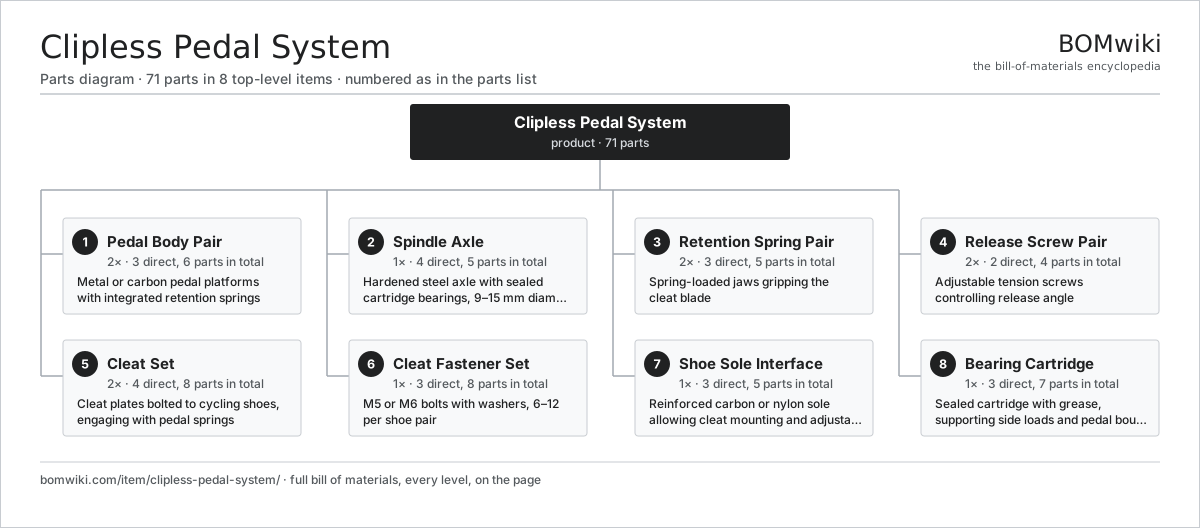
| # | Part | Qty | What it does |
|---|---|---|---|
| 1 | Pedal Body Pair 3 parts | 2× | Metal or carbon pedal platforms with integrated retention springs |
| 2 | Spindle Axle 4 parts | 1× | Hardened steel axle with sealed cartridge bearings, 9–15 mm diameter |
| 3 | Retention Spring Pair 3 parts | 2× | Spring-loaded jaws gripping the cleat blade |
| 4 | Release Screw Pair 2 parts | 2× | Adjustable tension screws controlling release angle |
| 5 | Cleat Set 4 parts | 2× | Cleat plates bolted to cycling shoes, engaging with pedal springs |
| 6 | Cleat Fastener Set 3 parts | 1× | M5 or M6 bolts with washers, 6–12 per shoe pair |
| 7 | Shoe Sole Interface 3 parts | 1× | Reinforced carbon or nylon sole allowing cleat mounting and adjustability |
| 8 | Bearing Cartridge 3 parts | 1× | Sealed cartridge with grease, supporting side loads and pedal bounce |
3D model
No 3D model yet. Have a CAD file of this? Add a 3D model. STL renders right on this page; STEP, FreeCAD, and OpenSCAD sources are welcome too (openly licensed, like all 3D models on BOMwiki).
Build & assembly graph
expand / collapse · shared sub-assemblies converge · links to related products · est. labourTap an assembly to expand/collapse · tap a part to open it · use “Open page” for any node · drag to pan, scroll to zoom.
Bill of materials for Clipless Pedal System
8 top-level lines · 33 rows shown · 71 parts total · indented to 3 levels| # | Item / sub-assembly | Part no. | Qty/assy | Ext. qty | Parts | Type |
|---|---|---|---|---|---|---|
| 1 | Pedal Body Pair 3 parts | clipless-pedal-system-pedal-body-pair | 2× | 2 | 6 | assembly |
| 1.1 | Pedal Platform | clipless-pedal-system-pedal-platform | 2× | 4 | · | part |
| 1.2 | Spring Jaw Assembly | clipless-pedal-system-spring-jaw-assembly | 2× | 4 | · | part |
| 1.3 | Bearing Socket Cup | clipless-pedal-system-bearing-socket-cup | 2× | 4 | · | part |
| 2 | Spindle Axle 4 parts | clipless-pedal-system-spindle-axle | 1× | 1 | 5 | assembly |
| 2.1 | Axle Shaft | clipless-pedal-system-axle-shaft | 1× | 1 | · | part |
| 2.2 | Bearing Cartridge Pair | clipless-pedal-system-bearing-cartridge-pair | 2× | 2 | · | part |
| 2.3 | Crank Interface Cone | clipless-pedal-system-crank-interface-cone | 1× | 1 | · | part |
| 2.4 | Pedal Crank Bolt | clipless-pedal-system-pedal-crank-bolt | 1× | 1 | · | part |
| 3 | Retention Spring Pair 3 parts | clipless-pedal-system-retention-spring-pair | 2× | 2 | 5 | assembly |
| 3.1 | Spring Blade | clipless-pedal-system-spring-blade | 2× | 4 | · | part |
| 3.2 | Jaw Lever | clipless-pedal-system-jaw-lever | 2× | 4 | · | part |
| 3.3 | Spring Preload Adjuster | clipless-pedal-system-spring-preload-adjuster | 1× | 2 | · | part |
| 4 | Release Screw Pair 2 parts | clipless-pedal-system-release-screw-pair | 2× | 2 | 4 | assembly |
| 4.1 | Release Angle Screw | clipless-pedal-system-release-angle-screw | 2× | 4 | · | part |
| 4.2 | Screw Stopper Collar | clipless-pedal-system-screw-stopper-collar | 2× | 4 | · | part |
| 5 | Cleat Set 4 parts | clipless-pedal-system-cleat-set | 2× | 2 | 8 | assembly |
| 5.1 | Cleat Plate | clipless-pedal-system-cleat-plate | 2× | 4 | · | part |
| 5.2 | Cleat Release Lug | clipless-pedal-system-cleat-release-lug | 2× | 4 | · | part |
| 5.3 | Cleat Base Interface | clipless-pedal-system-cleat-base-interface | 2× | 4 | · | part |
| 5.4 | Cleat Position Shim | clipless-pedal-system-cleat-position-shim | 2× | 4 | · | part |
| 6 | Cleat Fastener Set 3 parts | clipless-pedal-system-cleat-fastener-set | 1× | 1 | 8 | assembly |
| 6.1 | Cleat Bolt | clipless-pedal-system-cleat-bolt | 6× | 6 | · | part |
| 6.2 | Cleat Washer Set | clipless-pedal-system-cleat-washer-set | 1× | 1 | · | part |
| 6.3 | Cleat Shim Spacer | clipless-pedal-system-cleat-shim-spacer | 1× | 1 | · | part |
| 7 | Shoe Sole Interface 3 parts | clipless-pedal-system-shoe-sole-interface | 1× | 1 | 5 | assembly |
| 7.1 | Sole Base Material | clipless-pedal-system-sole-base-material | 1× | 1 | · | part |
| 7.2 | Threaded Insert Set | clipless-pedal-system-threaded-insert-set | 3× | 3 | · | part |
| 7.3 | Sole Stiffness Layer | clipless-pedal-system-sole-stiffness-layer | 1× | 1 | · | part |
| 8 | Bearing Cartridge 3 parts | clipless-pedal-system-bearing-cartridge | 1× | 1 | 7 | assembly |
| 8.1 | Ball Bearing | ball-bearing | 4× | 4 | · | part |
| 8.2 | Cartridge Seal | clipless-pedal-system-cartridge-seal | 2× | 2 | · | part |
| 8.3 | Cartridge Grease | clipless-pedal-system-cartridge-grease | 1× | 1 | · | part |
Something wrong in this list? Report a problem with this BOM.
Sourcing: possible vendors
Browse the supplier directory → Prices, MOQ, and lead times are algorithmic estimates, not quotes, and not claims about these companies. Company mappings are curated by keyword; est. price band $200–$12k. How estimates work| Vendor | HQ | Specialty | MOQ | Lead time |
|---|---|---|---|---|
|
🇹🇼Giant
giant-bicycles.com ↗
|
Taichung, TW | Bicycles | 500 units | 6–12 wks |
|
🇺🇸Trek
trekbikes.com ↗
|
Waterloo, US | Bicycles | 500 units | 6–12 wks |
| specialized.com ↗ | Morgan Hill, US | Bicycles | 500 units | 6–12 wks |
|
🇹🇼Merida
merida-bikes.com ↗
|
Yuanlin, TW | Bicycles | 500 units | 6–12 wks |
| cannondale.com ↗ | Wilton, US | Bicycles | 500 units | 6–12 wks |
1,293-word article