Cloth Inspection Machine
ProductOverview
The cloth inspection machine is a quality-assurance system designed for detecting and marking defects in fabric rolls during production or incoming inspection. Quality control is a critical step in textile manufacturing: a single defect in the fabric (tear, hole, stain, color streak, thin spot) that escapes notice can ruin an entire garment later in sewing or customer use. Automated inspection reduces defects reaching the cutting room.
The machine consists of motorized fabric rollers, backlighting, and a viewing screen where a trained inspector visually examines the fabric as it moves past at a controlled speed. When a defect is spotted, the operator presses a button corresponding to the defect type, triggering an automatic Defect Marking System to mark the defect location on the fabric edge. The Fabric Length Counter tracks total fabric length inspected, providing production data.
Backlighting is the key technology: by illuminating fabric from behind, thin spots, fiber breaks, stains, and color inconsistencies become immediately visible. Without backlighting, many defects would be missed entirely. Modern systems integrate computer vision for automated defect detection, but most production environments still rely on skilled human inspection with machine-assisted marking.
How It Works
Fabric Feed and Speed Control
Fabric from a raw-goods roll is loaded onto the Input Drive Roller, a motorized spindle. The operator selects a desired inspection speed (typically 40–80 m/min) via the Speed Control Dial. The Motor Speed Controller (VFD), a variable-frequency drive (VFD), adjusts the motor speed, advancing the fabric smoothly into the inspection zone.
A spring-loaded idler roller maintains constant tension, preventing slack or bunching. The fabric must move at constant speed with consistent tension; any jerking or wavering would cause false observations or missed defects.
Backlighting Illumination
Mounted behind the Inspection Viewing Area, a backlighting system consisting of high-intensity LED arrays or fluorescent tubes produces 1000–2000 lux of even, flicker-free illumination. A Light Diffusion Panel (frosted glass or polycarbonate) spreads the light uniformly, eliminating hot spots or shadows. A Light Reflector bounces light forward, maximizing intensity.
The backlit fabric is now transparent enough to reveal internal defects: a fiber break appears as a thin line or gap; a hole becomes immediately obvious; a thin spot (damaged or worn yarn) appears as a lighter region; a color variation (dye lot mismatch or chemical spill) stands out clearly. This revelation-of-defects-by-backlighting is a fundamental principle.
Inspector Viewing and Defect Identification
The operator sits at the machine, observing the fabric through the Viewing Window Panel as it moves past at the selected speed. Training teaches inspectors to recognize defect types:
- Tears or holes: Open gaps in the fabric weave.
- Stains or discoloration: Chemical marks, dirt, rust.
- Thin spots: Areas where yarns are damaged, increasing transparency.
- Slubs: Thick-and-thin irregularities in yarn.
- Color streaks: Inconsistent dye penetration, uneven coloring.
- Pilling or fuzz: Unwanted fiber balls on the surface.
The inspector's eye is continuously scanning as fabric flows past. Inspection speed (40–80 m/min) is a balance: too fast and defects are missed; too slow and throughput drops unacceptably.
Defect Marking
When a defect is spotted, the operator presses the corresponding Fault Category Button, one button per defect type (tear, stain, hole, color). This signal triggers the Marker Actuation Solenoid, activating the Defect Marking System. A marker pen or pneumatic spray marks the fabric edge at that precise location, creating a visible tag.
The mark color or symbol may vary: a tear might be marked with a red dot, a hole with a blue circle, and a stain with a yellow stripe. This color-coding allows downstream operators (cutting, sewing supervisors) to quickly sort defective fabric away from good fabric, either for scrapping or for directing to a grade lower than premium.
Meter Tracking
The Fabric Length Counter continuously accumulates fabric length. A Position Encoder on the output roller rotates proportionally to linear fabric motion, sending pulses to a Counter Control PCB that increments a Length Display Unit. At the end of a roll, the operator notes the total length inspected and resets the counter for the next roll.
This tracking provides production data: how much fabric was inspected, how many defects were found, and the defect rate (defects per 100 meters). This data is crucial for identifying quality issues upstream (mill process problems, dye lot issues) and trending quality over time.
Inspection Workflow in Production
- Roll receipt: A new fabric roll arrives from the supplier or internal finishing department.
- Load and setup: Operator threads the fabric onto the input roller, selects inspection speed, and resets the meter counter.
- Inspection cycle: Over 1–4 hours (depending on roll length), the operator watches and marks defects.
- Defect tally: At roll end, the operator counts marked defects and records the total length and defect rate.
- Sorting: Marked fabric is cut away at the defect location (losing 1–2 meters per defect), and the roll is classified as "first quality" (few or no defects) or "second quality" (more defects, lower price or downgraded use).
- Downtime: While the operator rests or performs paperwork, the next roll is loaded and inspection continues.
In high-volume mills, multiple cloth inspection machines run simultaneously, with operators rotating to prevent fatigue (eye strain and repetitive stress). A single experienced inspector can detect 95–98% of visible defects, while newer operators might achieve 70–80% until trained.
Automation and Vision Systems
Modern cloth inspection machines integrate computer vision, cameras with machine learning algorithms, to pre-identify defects and alert the operator. Vision systems can detect:
- Holes and tears: Pixel-level gaps in the fabric texture.
- Color anomalies: Significant deviations from the expected color profile.
- Contaminants: Foreign objects (lint, dust, fiber) on the surface.
However, vision systems still require human judgment to rule out false positives (e.g., a wrinkle that isn't actually a defect). Most production environments use vision as a secondary scanner: if a defect is detected, an audible or visual alert (light flash) draws the operator's attention to that specific area, reducing eye-strain fatigue and catching defects the operator might otherwise miss at high speeds.
Applications
Raw fabric receiving: Mills use inspection machines to verify incoming fabric quality from suppliers, establishing baseline data before any processing.
Post-dyeing inspection: After dyeing, knit or woven fabric is inspected for color streaks, uneven dye penetration, or chemical damage.
Post-printing inspection: Printed textiles are inspected for registration errors, color bleeding, or missing prints.
Cut goods sorting: In vertically integrated operations, finished cut pieces are inspected before sewing to reject defective panels early, reducing rework.
Apparel final inspection: Some high-end manufacturers inspect finished garments on a conveyor line, a variant of the cloth inspection principle applied to whole garments.
Quality Metrics
Defects are tracked in defects-per-100-meters (DP100M). For premium fabric:
- First quality: <1 DP100M.
- Second quality: 1–5 DP100M.
- Scrap/rework: >5 DP100M.
These thresholds vary by fabric type and intended use. A polyester suiting fabric might tolerate <0.5 DP100M for suits, while a jersey knit (less formal) might accept 1–2 DP100M.
Maintenance
Daily: Clean the viewing window of dust and lint; check fabric path for snags or wrinkles.
Weekly: Lubricate roller bearings; inspect light diffuser for dust accumulation and clean if needed; test marker pen function.
Monthly: Replace light source if dimmed (LEDs last 20,000+ hours; fluorescent tubes last 8,000–10,000 hours); check roller speed accuracy; verify meter counter calibration.
Quarterly: Inspect all bearings for play; replace marker pen tips if dulled; clean reflector surfaces.
Annually: Professional overhaul; replace all seals and bearings; recalibrate meter counter; replace light diffuser if scratched.
Properly maintained machines operate for 10+ years with minimal downtime, and the modular design allows rapid component replacement.
Cloth Inspection Machine parts and their functions
8 top-level parts · 70 parts in total · full bill of materials below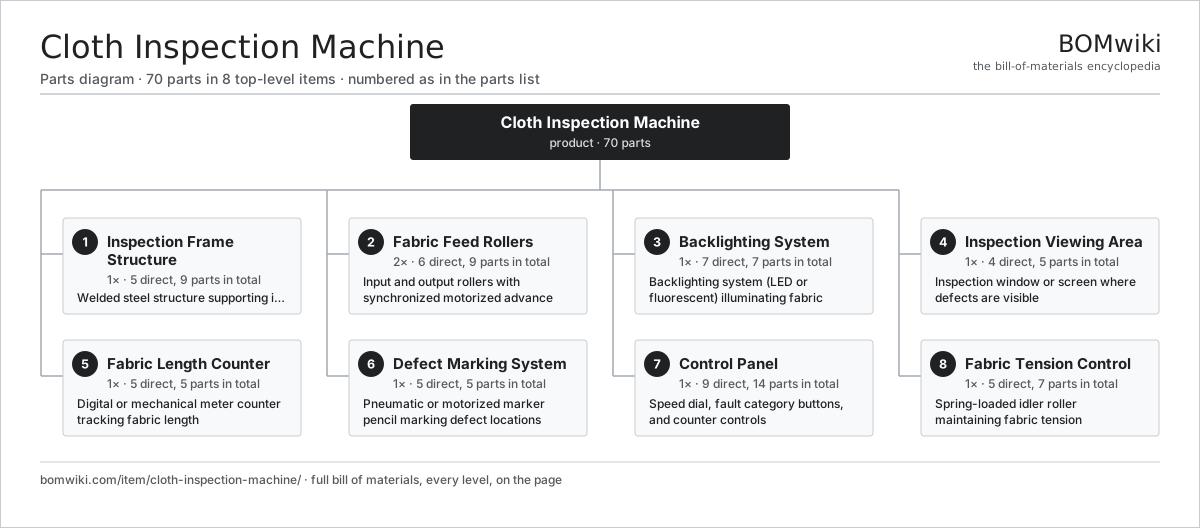
| # | Part | Qty | What it does |
|---|---|---|---|
| 1 | Inspection Frame Structure 5 parts | 1× | Welded steel structure supporting inspection components |
| 2 | Fabric Feed Rollers 6 parts | 2× | Input and output rollers with synchronized motorized advance |
| 3 | Backlighting System 7 parts | 1× | Backlighting system (LED or fluorescent) illuminating fabric |
| 4 | Inspection Viewing Area 4 parts | 1× | Inspection window or screen where defects are visible |
| 5 | Fabric Length Counter 5 parts | 1× | Digital or mechanical meter counter tracking fabric length |
| 6 | Defect Marking System 5 parts | 1× | Pneumatic or motorized marker pencil marking defect locations |
| 7 | Control Panel 9 parts | 1× | Speed dial, fault category buttons, and counter controls |
| 8 | Fabric Tension Control 5 parts | 1× | Spring-loaded idler roller maintaining fabric tension |
3D model
No 3D model yet. Have a CAD file of this? Add a 3D model. STL renders right on this page; STEP, FreeCAD, and OpenSCAD sources are welcome too (openly licensed, like all 3D models on BOMwiki).
Build & assembly graph
expand / collapse · shared sub-assemblies converge · links to related products · est. labourTap an assembly to expand/collapse · tap a part to open it · use “Open page” for any node · drag to pan, scroll to zoom.
Bill of materials for Cloth Inspection Machine
8 top-level lines · 54 rows shown · 70 parts total · indented to 3 levels| # | Item / sub-assembly | Part no. | Qty/assy | Ext. qty | Parts | Type |
|---|---|---|---|---|---|---|
| 1 | Inspection Frame Structure 5 parts | cloth-inspection-machine-frame | 1× | 1 | 9 | assembly |
| 1.1 | Base Frame | cloth-inspection-machine-base-frame | 1× | 1 | · | part |
| 1.2 | Vertical Support Post | cloth-inspection-machine-vertical-post | 2× | 2 | · | part |
| 1.3 | Light Hood Enclosure | cloth-inspection-machine-lighting-hood | 1× | 1 | · | part |
| 1.4 | Vibration Isolator Foot | cloth-inspection-machine-vibration-foot | 4× | 4 | · | part |
| 1.5 | Fastener Set | fastener-set | 1× | 1 | · | part |
| 2 | Fabric Feed Rollers 6 parts | cloth-inspection-machine-feed-roller | 2× | 2 | 9 | assembly |
| 2.1 | Input Drive Roller | cloth-inspection-machine-input-roller | 1× | 2 | · | part |
| 2.2 | Output Wind-Up Roller | cloth-inspection-machine-output-roller | 1× | 2 | · | part |
| 2.3 | Roller Support Bearing | cloth-inspection-machine-roller-bearing | 4× | 8 | · | part |
| 2.4 | Roller Drive Motor | cloth-inspection-machine-roller-motor | 1× | 2 | · | part |
| 2.5 | Drive Belt | drive-belt | 1× | 2 | · | part |
| 2.6 | Fastener Set | fastener-set | 1× | 2 | · | part |
| 3 | Backlighting System 7 parts | cloth-inspection-machine-lighting | 1× | 1 | 7 | assembly |
| 3.1 | Backlighting LED Array | cloth-inspection-machine-light-source | 1× | 1 | · | part |
| 3.2 | Light Diffusion Panel | cloth-inspection-machine-light-diffuser | 1× | 1 | · | part |
| 3.3 | Light Reflector | cloth-inspection-machine-light-reflector | 1× | 1 | · | part |
| 3.4 | Light Hood | cloth-inspection-machine-light-hood | 1× | 1 | · | part |
| 3.5 | Power Supply | power-supply | 1× | 1 | · | part |
| 3.6 | Connector | connector | 1× | 1 | · | part |
| 3.7 | Fastener Set | fastener-set | 1× | 1 | · | part |
| 4 | Inspection Viewing Area 4 parts | cloth-inspection-machine-viewing-screen | 1× | 1 | 5 | assembly |
| 4.1 | Viewing Window Panel | cloth-inspection-machine-screen-window | 1× | 1 | · | part |
| 4.2 | Fabric Center Guide | cloth-inspection-machine-guide-rail | 2× | 2 | · | part |
| 4.3 | Window Frame Mount | cloth-inspection-machine-window-frame | 1× | 1 | · | part |
| 4.4 | Fastener Set | fastener-set | 1× | 1 | · | part |
| 5 | Fabric Length Counter 5 parts | cloth-inspection-machine-meter-counter | 1× | 1 | 5 | assembly |
| 5.1 | Length Display Unit | cloth-inspection-machine-counter-display | 1× | 1 | · | part |
| 5.2 | Position Encoder | cloth-inspection-machine-counter-encoder | 1× | 1 | · | part |
| 5.3 | Counter Control PCB | cloth-inspection-machine-counter-pcb | 1× | 1 | · | part |
| 5.4 | Connector | connector | 1× | 1 | · | part |
| 5.5 | Fastener Set | fastener-set | 1× | 1 | · | part |
| 6 | Defect Marking System 5 parts | cloth-inspection-machine-fault-marker | 1× | 1 | 5 | assembly |
| 6.1 | Defect Marker Pen | cloth-inspection-machine-marker-pen | 1× | 1 | · | part |
| 6.2 | Marker Actuation Solenoid | cloth-inspection-machine-marker-solenoid | 1× | 1 | · | part |
| 6.3 | Marker Air Line | cloth-inspection-machine-marker-air-line | 1× | 1 | · | part |
| 6.4 | Marker Positioning Bracket | cloth-inspection-machine-marker-position | 1× | 1 | · | part |
| 6.5 | Fastener Set | fastener-set | 1× | 1 | · | part |
| 7 | Control Panel 9 parts | cloth-inspection-machine-controls | 1× | 1 | 14 | assembly |
| 7.1 | Control Panel Enclosure | cloth-inspection-machine-control-box | 1× | 1 | · | part |
| 7.2 | Relay | relay | 1× | 1 | · | part |
| 7.3 | Motor Speed Controller (VFD) | cloth-inspection-machine-motor-controller | 1× | 1 | · | part |
| 7.4 | Speed Control Dial | cloth-inspection-machine-speed-potentiometer | 1× | 1 | · | part |
| 7.5 | Counter Reset Button | cloth-inspection-machine-counter-reset-button | 1× | 1 | · | part |
| 7.6 | Fault Category Button | cloth-inspection-machine-fault-button | 4× | 4 | · | part |
| 7.7 | Emergency Stop Button | cloth-inspection-machine-estop-button | 1× | 1 | · | part |
| 7.8 | Connector | connector | 3× | 3 | · | part |
| 7.9 | Fastener Set | fastener-set | 1× | 1 | · | part |
| 8 | Fabric Tension Control 5 parts | cloth-inspection-machine-tensioner | 1× | 1 | 7 | assembly |
| 8.1 | Tension Idler Roller | cloth-inspection-machine-tension-roller | 1× | 1 | · | part |
| 8.2 | Tension Biasing Spring | cloth-inspection-machine-tension-spring | 2× | 2 | · | part |
| 8.3 | Tension Arm Pivot | cloth-inspection-machine-tension-arm | 1× | 1 | · | part |
| 8.4 | Ball Bearing | ball-bearing | 2× | 2 | · | part |
| 8.5 | Fastener Set | fastener-set | 1× | 1 | · | part |
Something wrong in this list? Report a problem with this BOM.
Sourcing: possible vendors
Browse the supplier directory → Prices, MOQ, and lead times are algorithmic estimates, not quotes, and not claims about these companies. Company mappings are curated by keyword; est. price band $10k–$1M. How estimates work| Vendor | HQ | Specialty | MOQ | Lead time |
|---|---|---|---|---|
|
🇨🇭Rieter
rieter.com ↗
|
Winterthur, CH | Spinning machinery | 10 units | 14–24 wks |
| truetzschler.com ↗ | Mönchengladbach, DE | Textile machinery | 10 units | 14–24 wks |
|
🇧🇪Picanol
picanol.be ↗
|
Ypres, BE | Weaving machines | 10 units | 14–24 wks |
| karlmayer.com ↗ | Obertshausen, DE | Warp knitting machines | 10 units | 14–24 wks |
|
🇨🇭Saurer
saurer.com ↗
|
Arbon, CH | Spinning & embroidery | 10 units | 14–24 wks |
1,334-word article