Cloud Chamber
ProductOverview
A cloud chamber, also called a Wilson chamber (after C.T.R. Wilson, inventor in 1911), is a radiation detector that visualizes ionizing particles via cloud formation. When a charged particle (cosmic-ray muon, alpha particle, electron) passes through supersaturated alcohol vapor, it ionizes molecules along its path, creating nanometer-scale droplet nucleation sites. These grow into visible microdroplets, forming a "cloud track" that traces the particle trajectory. The track persists for seconds, long enough to photograph or observe.
Cloud chambers are pedagogical tools for teaching ionization, particle physics, and radioactivity. Modern versions use Peltier cooling for portability and stability, making them popular in museums and schools. A Cloud Chamber produces tracks hours after setup with minimal maintenance, just keep alcohol-saturated felt in contact with a cold plate.
How it works
Vapor Saturation
The Vessel is sealed except for a wick pathway. The Felt Wick, saturated with 99% isopropyl alcohol, wicks vapor from a reservoir at the warm (room-temperature) top down to the Cooling Stage. The Peltier Module (thermoelectric cooler) maintains the base at, say, 10°C while the top stays at ~30°C, creating a steep temperature gradient inside the chamber.
Alcohol vapor pressure depends on temperature. At the cool base, the vapor is supersaturated (pressure exceeds equilibrium); at the warm top, vapor is undersaturated and absorbs back into the wick. This diffusion-driven circulation maintains stable supersaturation in the observation region without requiring external vapor pumps.
Ionization and Track Formation
A cosmic-ray muon (or alpha from a radioactive source placed inside the chamber) ionizes alcohol molecules along its path, producing ions and free electrons. Each ionization event releases ~25 eV of energy, roughly enough to ionize one alcohol molecule or excite many others.
The supersaturated vapor preferentially condenses on these ions, which act as condensation nuclei. Within milliseconds, droplets grow to ~10 µm diameter, large enough to scatter visible light. A LED backlight illuminates the chamber, and the droplet cloud appears as a white track against the dark background.
The track persists for ~1 second as droplets settle and diffuse, then gradually dissipate as unsaturated air re-evaporates them. Fresh alcohol vapor diffuses down from the wick, restoring saturation for the next ionizing event.
Temperature Control
The Temperature Control PID controller stabilizes the cold stage to ±1°C, maintaining constant supersaturation. If temperature drifts, track sensitivity changes (colder → more sensitive, warmer → no tracks). A Temperature Sensor (NTC thermistor or PT100) feeds back to the controller.
The Circulation Fan low-speed fan dissipates waste heat from the Peltier hot side into the ambient air.
Optical Observation
The Viewing Window (usually clear acrylic or glass with Anti-Fog Coating) allows direct observation or photography. A camera on a tripod can capture stills or video of tracks.
Modern chamber designs use a white Light Diffuser behind the chamber and a camera on the opposite side, creating a high-contrast silhouette of each track against the bright background, ideal for scientific observation and education.
Track Characteristics
Track appearance reveals particle type:
- Muons: thin, straight, penetrating tracks (cosmic-ray muons have >10 cm range in air).
- Electrons: thin, curved tracks showing energy loss (bremsstrahlung interactions).
- Alpha particles: thick, short, range-limited (a few cm in air).
- Daughter nuclei (recoil): heavy, short tracks when radioactive alpha decays inside the chamber.
Track direction reveals charge: in a weak magnetic field, positive and negative particles curve oppositely.
Radioactive Sources
Placing a weak alpha source (Am-241, Po-210, or Ra-226) inside or near the chamber triggers many tracks per second. Common observations:
- Alpha tracks forking into recoil-nucleus tracks (conserving momentum).
- Beta-decay electron tracks from contaminated sources.
- Background cosmic-ray muons (always present).
Limitations and Variants
Limitations:
- Low event rate (cosmic background: ~1 track/min).
- No energy measurement (only track length heuristics).
- Poor spatial resolution (~100 µm).
Variants:
- Bubble chamber: superheated liquid; tracks are vapor bubbles (higher sensitivity but more complex).
- Diffusion chamber: continuous operation without pulsing (better statistics).
- Automated scanning: high-speed camera + analysis software counting tracks and measuring ranges automatically.
Educational and Research Use
Cloud chambers remain staples in physics education: students observe ionization and radioactivity firsthand, unlike abstract detector electronics. Some universities use chambers for cosmic-ray muon studies (measuring muon flux, lifetime via decay), demonstrating relativity time dilation at classroom scale.
Cloud Chamber parts and their functions
8 top-level parts · 32 parts in total · full bill of materials below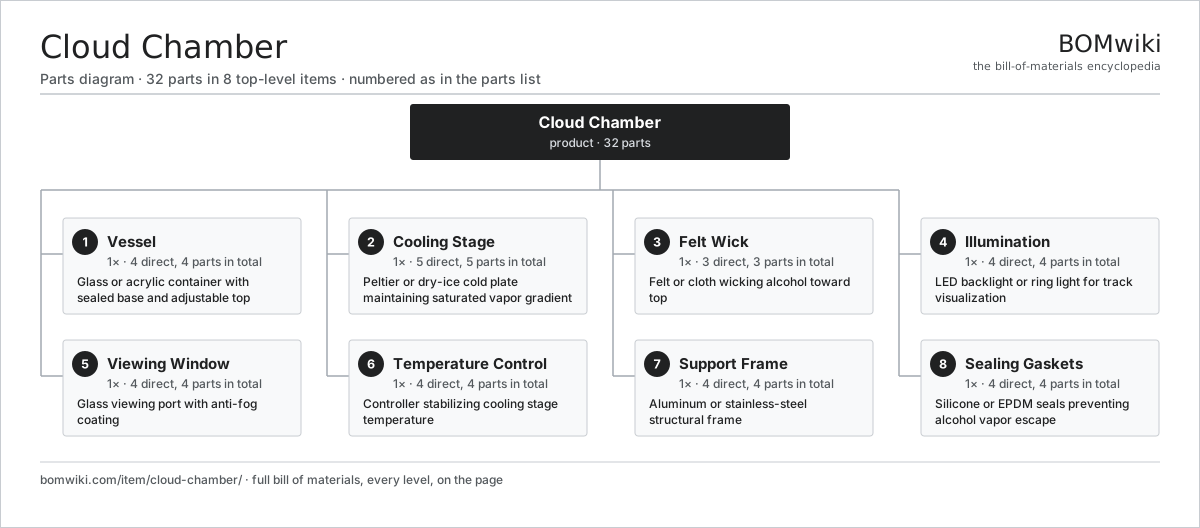
| # | Part | Qty | What it does |
|---|---|---|---|
| 1 | Vessel 4 parts | 1× | Glass or acrylic container with sealed base and adjustable top |
| 2 | Cooling Stage 5 parts | 1× | Peltier or dry-ice cold plate maintaining saturated vapor gradient |
| 3 | Felt Wick 3 parts | 1× | Felt or cloth wicking alcohol toward top |
| 4 | Illumination 4 parts | 1× | LED backlight or ring light for track visualization |
| 5 | Viewing Window 4 parts | 1× | Glass viewing port with anti-fog coating |
| 6 | Temperature Control 4 parts | 1× | Controller stabilizing cooling stage temperature |
| 7 | Support Frame 4 parts | 1× | Aluminum or stainless-steel structural frame |
| 8 | Sealing Gaskets 4 parts | 1× | Silicone or EPDM seals preventing alcohol vapor escape |
3D model
No 3D model yet. Have a CAD file of this? Add a 3D model. STL renders right on this page; STEP, FreeCAD, and OpenSCAD sources are welcome too (openly licensed, like all 3D models on BOMwiki).
Build & assembly graph
expand / collapse · shared sub-assemblies converge · links to related products · est. labourTap an assembly to expand/collapse · tap a part to open it · use “Open page” for any node · drag to pan, scroll to zoom.
Bill of materials for Cloud Chamber
8 top-level lines · 40 rows shown · 32 parts total · indented to 3 levels| # | Item / sub-assembly | Part no. | Qty/assy | Ext. qty | Parts | Type |
|---|---|---|---|---|---|---|
| 1 | Vessel 4 parts | cloud-chamber-vessel | 1× | 1 | 4 | assembly |
| 1.1 | Base Block | cloud-chamber-base-block | 1× | 1 | · | part |
| 1.2 | Cylinder Walls | cloud-chamber-cylinder-walls | 1× | 1 | · | part |
| 1.3 | Top Ring | cloud-chamber-top-ring | 1× | 1 | · | part |
| 1.4 | Fastener Set | fastener-set | 1× | 1 | · | part |
| 2 | Cooling Stage 5 parts | cloud-chamber-cooling-stage | 1× | 1 | 5 | assembly |
| 2.1 | Peltier Module | cloud-chamber-peltier-tec | 1× | 1 | · | part |
| 2.2 | Heatsink | cloud-chamber-heatsink-copper | 1× | 1 | · | part |
| 2.3 | Circulation Fan | cloud-chamber-fan-circulation | 1× | 1 | · | part |
| 2.4 | Temperature Sensor | cloud-chamber-temperature-sensor | 1× | 1 | · | part |
| 2.5 | Power Supply | power-supply | 1× | 1 | · | part |
| 3 | Felt Wick 3 parts | cloud-chamber-felt-wick | 1× | 1 | 3 | assembly |
| 3.1 | Felt Material | cloud-chamber-felt-material | 1× | 1 | · | part |
| 3.2 | Wick Frame | cloud-chamber-wick-frame | 1× | 1 | · | part |
| 3.3 | Fastener Set | fastener-set | 1× | 1 | · | part |
| 4 | Illumination 4 parts | cloud-chamber-illumination | 1× | 1 | 4 | assembly |
| 4.1 | LED Panel | cloud-chamber-led-panel | 1× | 1 | · | part |
| 4.2 | Light Diffuser | cloud-chamber-light-diffuser | 1× | 1 | · | part |
| 4.3 | LED Driver | cloud-chamber-led-driver | 1× | 1 | · | part |
| 4.4 | Power Supply | power-supply | 1× | 1 | · | part |
| 5 | Viewing Window 4 parts | cloud-chamber-viewing-window | 1× | 1 | 4 | assembly |
| 5.1 | Window Glass | cloud-chamber-window-glass | 1× | 1 | · | part |
| 5.2 | Anti-Fog Coating | cloud-chamber-anti-fog-coating | 1× | 1 | · | part |
| 5.3 | Window Gasket | cloud-chamber-window-gasket | 1× | 1 | · | part |
| 5.4 | Fastener Set | fastener-set | 1× | 1 | · | part |
| 6 | Temperature Control 4 parts | cloud-chamber-temperature-control | 1× | 1 | 4 | assembly |
| 6.1 | PID Controller | cloud-chamber-pid-controller | 1× | 1 | · | part |
| 6.2 | Relay Driver | cloud-chamber-relay-driver | 1× | 1 | · | part |
| 6.3 | Display Readout | cloud-chamber-display-readout | 1× | 1 | · | part |
| 6.4 | Power Supply | power-supply | 1× | 1 | · | part |
| 7 | Support Frame 4 parts | cloud-chamber-support-frame | 1× | 1 | 4 | assembly |
| 7.1 | Frame Extrusion | cloud-chamber-frame-extrusion | 1× | 1 | · | part |
| 7.2 | Cable Tray | cloud-chamber-cable-tray | 1× | 1 | · | part |
| 7.3 | Vibration Isolation | cloud-chamber-vibration-isolation | 1× | 1 | · | part |
| 7.4 | Fastener Set | fastener-set | 1× | 1 | · | part |
| 8 | Sealing Gaskets 4 parts | cloud-chamber-sealing-gaskets | 1× | 1 | 4 | assembly |
| 8.1 | Base Gasket | cloud-chamber-gasket-base | 1× | 1 | · | part |
| 8.2 | Top Gasket | cloud-chamber-gasket-top | 1× | 1 | · | part |
| 8.3 | Window Gasket | cloud-chamber-gasket-window | 1× | 1 | · | part |
| 8.4 | Vacuum Grease | cloud-chamber-vacuum-grease | 1× | 1 | · | part |
Something wrong in this list? Report a problem with this BOM.
Related products
same domain, ranked by shared parts Analytical Balance
54 parts · shares 1 with this page
Analytical Balance
54 parts · shares 1 with this page
 Atomic Absorption Spectrometer
648 parts · shares 1 with this page
Autoclave Sterilizer
282 parts · shares 1 with this page
Atomic Absorption Spectrometer
648 parts · shares 1 with this page
Autoclave Sterilizer
282 parts · shares 1 with this page
 Automated Cell Counter
54 parts · shares 1 with this page
Automated Colony Counter
322 parts · shares 1 with this page
Automated Cell Counter
54 parts · shares 1 with this page
Automated Colony Counter
322 parts · shares 1 with this page
 Automated Liquid Handler
817 parts · shares 1 with this page
Automated Liquid Handler
817 parts · shares 1 with this page
Sourcing: possible vendors
Browse the supplier directory → Prices, MOQ, and lead times are algorithmic estimates, not quotes, and not claims about these companies. Company mappings are curated by keyword; est. price band $1k–$500k. How estimates work| Vendor | HQ | Specialty | MOQ | Lead time |
|---|---|---|---|---|
| thermofisher.com ↗ | Waltham, US | Lab instruments | 100 units | 10–18 wks |
|
🇺🇸Agilent
agilent.com ↗
|
Santa Clara, US | Analytical instruments | 100 units | 10–18 wks |
|
🇺🇸Bruker
bruker.com ↗
|
Billerica, US | Scientific instruments | 100 units | 10–18 wks |
|
🇯🇵Shimadzu
shimadzu.com ↗
|
Kyoto, JP | Analytical instruments | 100 units | 10–18 wks |
|
🇺🇸Waters
waters.com ↗
|
Milford, US | Chromatography & MS | 100 units | 10–18 wks |
751-word article