Coordinate Measuring Machine
ProductOverview
A Coordinate Measuring Machine (CMM) is a precision instrument that automatically measures the dimensions and geometric tolerances of manufactured parts. The part sits on a Granite Work Table, and a motorized Air-Bearing Gantry Bridge with a Touch Probe Head moves in three dimensions (XYZ) to systematically touch points on the part surface. Each time the Interchangeable Probe Tips contacts the part, the current axis positions (read from Displacement Measurement System) are recorded. After many probe touches (often 20–500 points, depending on part complexity), the Control System software calculates distances, angles, roundness, flatness, and other geometric tolerances, comparing them to engineering drawings. CMMs are essential in aerospace, automotive, and precision manufacturing, where parts must meet exacting standards and documentation of conformance is required for liability and quality tracking.
Granite reference plane
The Granite Work Table is the dimensional foundation. Black granite, chosen for its thermal stability (minimal expansion and contraction with temperature) and extreme hardness (Mohs 7, resisting scratches from part and tool contact), is lapped flat to within 0.001" over its entire surface. The table is typically 1–3 m in length and width, suspended on Isolation Feet that isolate it from shop vibration and temperature swings. The flatness of the table directly limits CMM accuracy; a warped table introduces systematic errors that no amount of software correction can fully remove. Most metrology labs air-condition their CMM rooms to ±2 °C to prevent thermal growth. Parts are located on the table using Part Clamp Set or precision riser blocks that repeat position accurately.
Air-bearing gantry structure
The Air-Bearing Gantry Bridge is a marvel of mechanical precision. The X-Axis Ground Rail is a precision-ground hardened steel or granite bar running the length of the table. The X-Axis Air Pads, essentially pneumatic levitation pads, float the gantry on a thin film of compressed air (typically 5–15 CFM at 70–90 psi). This eliminates friction entirely, allowing a 500 kg gantry to be moved by hand with fingertip pressure. The gantry carries a Y-Axis Vertical Column that moves the probe assembly transversely, and that column carries a Z-Axis Carriage that moves the probe up and down. The entire structure is welded steel or cast ductile iron, stiffened to minimize deflection under probe contact force (typically 10–50 grams). Thermal growth of the bridge is compensated in software using temperature sensors.
Touch probe system
The Touch Probe Head is elegant in its simplicity. As the probe tip approaches a surface, the operator manually or programmatically advances until contact. The Trigger Mechanism, usually a precision ball resting on three contacts (kinematic suspension), deflects under the slight contact force, triggering either a mechanical switch or an electronic capacitive sensor. The trigger latency (time from contact to signal) is typically 1–2 milliseconds; the software records the XYZ position at trigger time. The Interchangeable Probe Tips, usually a Ruby Probe Ball (hardness 9 Mohs) or Carbide Probe Ball (for abrasive materials), are 0.5–5 mm in diameter depending on feature size and surface finish. A 3 mm ruby ball is common for general-purpose work; smaller balls (0.5 mm) reach into tight pockets; larger balls (5 mm) reduce contact stress on fragile or thin parts.
Measuring scales and position readout
Position measurement is the core of the CMM. Each axis, X, Y, and Z, carries a Displacement Measurement System. The scales are either:
- Glass scales: A precision glass bar with etched lines at 2 µm intervals. A Scale Readhead, an optical coupler, detects the line spacing, giving readout resolution of 0.001" or 2 µm.
- Laser scales: A laser beam directed along the axis, with a moving retroreflector. Interference patterns give sub-micron resolution and are immune to coolant splash.
The scale readheads output digital position data to the Control System, which displays (X, Y, Z) coordinates in real-time. This immediate feedback is invaluable: as the operator moves the probe toward a feature, the software shows the approach, allowing precise engagement.
Measurement software and controller
The Control System is an industrial PC running specialized metrology software (typically proprietary packages like Calypso, PC-DMIS, or Quindos). The Industrial PC has the Motion Control Card to command the XYZ axis motors, and a Probe Input Module to capture probe signals. The software:
- Imports CAD: Reads the part's 3D model.
- Defines measurement plan: User specifies which features to measure (holes, surfaces, edges).
- Executes automatically: Moves the probe to preprogrammed points, recording each touch.
- Calculates tolerance: Computes distances, diameters, angles, flatness, runout, etc., against the CAD model.
- Reports pass/fail: Generates a detailed measurement report for quality control.
Most modern CMMs use stepper or servo motors to position the axes automatically, reducing operator fatigue and improving repeatability. Manual CMMs (where the operator hand-wheels each axis) still exist in smaller shops but are slower and require more skill.
Air supply requirements
The Air Supply System must provide clean, dry, filtered compressed air. Most CMMs connect to the shop's central air compressor line but require a Air Drying & Filtration to remove oil mist and moisture. Wet air corrodes the air bearing pads and causes erratic motion; oil deposits gum up the bearing surfaces. The Air Pressure Regulator maintains pressure at 70–90 psi, and a Air Distribution Manifold distributes air to the bearing pads and, on some models, to a probe air-jet that blows chips away from the contact point.
Typical measurement workflow
An automotive engine block arrives at the metrology lab fresh from the CNC machine. It is located on the Granite Work Table using V-blocks and clamps. The operator (or CMM software) selects the measurement program for that block from a database. The Air-Bearing Gantry Bridge automatically moves the Touch Probe Head to the first specified hole. A probe touch is triggered (manually or by software command), and the software records position. The gantry moves to the next hole, probes, and repeats. After 50 holes, the software generates a report: all holes within tolerance, or a list of out-of-spec holes. The block is marked with the result (pass/fail, serial number) and sent downstream. The data is logged for traceability.
Accuracy and uncertainty
CMM accuracy is stated in the standard ISO 10360-1 as: ±(3 + L/300) µm, where L is the length measured in millimeters. For a 100 mm measurement, this means ±(3 + 0.33) = ±3.33 µm; for a 300 mm measurement, ±(3 + 1) = ±4 µm. This is the 99% confidence interval; typical repeatability (σ, one standard deviation) is better by a factor of 3–5. In practice, a well-maintained CMM in a temperature-controlled room can achieve ±0.5–1 µm repeatability for local measurements.
Applications
- Aerospace: Engine components, landing gear, fuselage panels, dimensional control to ±0.01 mm is common.
- Automotive: Blocks, heads, transmission bodies, high-volume production requires statistical trending.
- Medical: Surgical implants, orthopedic components, biocompatibility and function depend on dimensional accuracy.
- Tooling: Injection molds, forging dies, intricate geometry verification.
- Reverse engineering: Measuring existing parts to create new designs or replacements.
CMMs have largely replaced manual calipers and micrometers for quality assurance, though hand tools remain valuable for operator setup and quick checks.
Coordinate Measuring Machine parts and their functions
8 top-level parts · 48 parts in total · full bill of materials below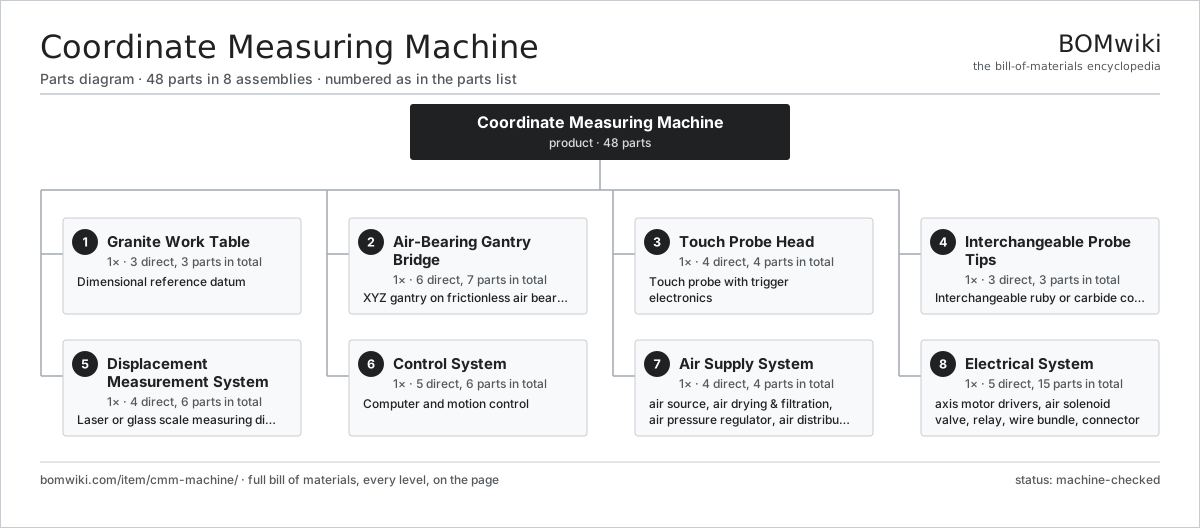
| # | Part | Qty | What it does |
|---|---|---|---|
| 1 | Granite Work Table 3 parts | 1× | Dimensional reference datum |
| 2 | Air-Bearing Gantry Bridge 6 parts | 1× | XYZ gantry on frictionless air bearings |
| 3 | Touch Probe Head 4 parts | 1× | Touch probe with trigger electronics |
| 4 | Interchangeable Probe Tips 3 parts | 1× | Interchangeable ruby or carbide contacts |
| 5 | Displacement Measurement System 4 parts | 1× | Laser or glass scale measuring displacement |
| 6 | Control System 5 parts | 1× | Computer and motion control |
| 7 | Air Supply System 4 parts | 1× | Compressed air filtering and regulation for air bearings and probe. |
| 8 | Electrical System 5 parts | 1× | Motor drivers, probe power, and machine control power. |
3D model
No 3D model yet. Have a CAD file of this? Add a 3D model. STL renders right on this page; STEP, FreeCAD, and OpenSCAD sources are welcome too (openly licensed, like all 3D models on BOMwiki).
Build & assembly graph
expand / collapse · shared sub-assemblies converge · links to related products · est. labourTap an assembly to expand/collapse · tap a part to open it · use “Open page” for any node · drag to pan, scroll to zoom.
Bill of materials for Coordinate Measuring Machine
8 top-level lines · 42 rows shown · 48 parts total · indented to 3 levels| # | Item / sub-assembly | Part no. | Qty/assy | Ext. qty | Parts | Type |
|---|---|---|---|---|---|---|
| 1 | Granite Work Table 3 parts | cmm-machine-granite-table | 1× | 1 | 3 | assembly |
| 1.1 | Granite Slab | cmm-machine-granite-slab | 1× | 1 | · | part |
| 1.2 | Isolation Feet | cmm-machine-table-mounting-feet | 1× | 1 | · | part |
| 1.3 | Part Clamp Set | cmm-machine-part-clamps | 1× | 1 | · | part |
| 2 | Air-Bearing Gantry Bridge 6 parts | cmm-machine-air-bearing-bridge | 1× | 1 | 7 | assembly |
| 2.1 | X-Axis Ground Rail | cmm-machine-x-axis-rail | 1× | 1 | · | part |
| 2.2 | X-Axis Air Pads | cmm-machine-x-bearing-pads | 2× | 2 | · | part |
| 2.3 | Y-Axis Vertical Column | cmm-machine-y-axis-column | 1× | 1 | · | part |
| 2.4 | Z-Axis Carriage | cmm-machine-z-axis-probe-carriage | 1× | 1 | · | part |
| 2.5 | Bridge Frame | cmm-machine-bridge-frame | 1× | 1 | · | part |
| 2.6 | Fastener Set | fastener-set | 1× | 1 | · | part |
| 3 | Touch Probe Head 4 parts | cmm-machine-probe-head | 1× | 1 | 4 | assembly |
| 3.1 | Probe Housing | cmm-machine-probe-housing | 1× | 1 | · | part |
| 3.2 | Trigger Mechanism | cmm-machine-probe-trigger-mechanism | 1× | 1 | · | part |
| 3.3 | Probe Tip Seating | cmm-machine-probe-tip-seat | 1× | 1 | · | part |
| 3.4 | Probe Electronics Module | cmm-machine-probe-electronics | 1× | 1 | · | part |
| 4 | Interchangeable Probe Tips 3 parts | cmm-machine-probe-tips | 1× | 1 | 3 | assembly |
| 4.1 | Ruby Probe Ball | cmm-machine-ruby-sphere-tip | 1× | 1 | · | part |
| 4.2 | Carbide Probe Ball | cmm-machine-carbide-sphere-tip | 1× | 1 | · | part |
| 4.3 | Probe Stem | cmm-machine-tip-stem | 1× | 1 | · | part |
| 5 | Displacement Measurement System 4 parts | cmm-machine-scale-system | 1× | 1 | 6 | assembly |
| 5.1 | X-Axis Scale | cmm-machine-x-scale | 1× | 1 | · | part |
| 5.2 | Y-Axis Scale | cmm-machine-y-scale | 1× | 1 | · | part |
| 5.3 | Z-Axis Scale | cmm-machine-z-scale | 1× | 1 | · | part |
| 5.4 | Scale Readhead | cmm-machine-scale-readhead | 3× | 3 | · | part |
| 6 | Control System 5 parts | cmm-machine-controller | 1× | 1 | 6 | assembly |
| 6.1 | Industrial PC | cmm-machine-main-computer | 1× | 1 | · | part |
| 6.2 | Motion Control Card | cmm-machine-motion-card | 1× | 1 | · | part |
| 6.3 | Probe Input Module | cmm-machine-probe-interface | 1× | 1 | · | part |
| 6.4 | Microcontroller | mcu | 1× | 1 | · | part |
| 6.5 | Power Supply | power-supply | 2× | 2 | · | part |
| 7 | Air Supply System 4 parts | cmm-machine-air-supply | 1× | 1 | 4 | assembly |
| 7.1 | Air Source | cmm-machine-air-compressor-or-line | 1× | 1 | · | part |
| 7.2 | Air Drying & Filtration | cmm-machine-air-filter-dryer | 1× | 1 | · | part |
| 7.3 | Air Pressure Regulator | cmm-machine-air-regulator | 1× | 1 | · | part |
| 7.4 | Air Distribution Manifold | cmm-machine-air-hose-manifold | 1× | 1 | · | part |
| 8 | Electrical System 5 parts | cmm-machine-electrical | 1× | 1 | 15 | assembly |
| 8.1 | Axis Motor Drivers | cmm-machine-motor-drivers | 1× | 1 | · | part |
| 8.2 | Air Solenoid Valve | cmm-machine-solenoid-valve | 1× | 1 | · | part |
| 8.3 | Relay | relay | 2× | 2 | · | part |
| 8.4 | Wire Bundle | wire-bundle | 1× | 1 | · | part |
| 8.5 | Connector | connector | 10× | 10 | · | part |
Something wrong in this list? Report a problem with this BOM.
Sourcing: possible vendors
Browse the supplier directory → Prices, MOQ, and lead times are algorithmic estimates, not quotes, and not claims about these companies. Company mappings are curated by keyword; est. price band $10k–$1M. How estimates work| Vendor | HQ | Specialty | MOQ | Lead time |
|---|---|---|---|---|
|
🇩🇪DMG MORI
dmgmori.com ↗
|
Bielefeld, DE | Machine tools | 5 units | 12–20 wks |
|
🇯🇵Mazak
mazak.com ↗
|
Oguchi, JP | Machine tools | 5 units | 12–20 wks |
| haascnc.com ↗ | Oxnard, US | CNC machine tools | 5 units | 12–20 wks |
|
🇯🇵Okuma
okuma.com ↗
|
Niwa, JP | Machine tools | 5 units | 12–20 wks |
|
🇩🇪Trumpf
trumpf.com ↗
|
Ditzingen, DE | Laser & sheet-metal machines | 5 units | 12–20 wks |
1,251-word article