CNC Tube Bender
ProductOverview
A CNC tube bender turns straight tube into three-dimensional routed shapes, exhaust systems, hydraulic lines, roll cages, furniture frames, aircraft ducting, by rotary draw bending under numeric control. Three programmed axes define any tube shape: feed (Y) sets the straight distance between bends, rotation (B) turns the tube about its own axis to set each bend's plane, and bend (C) wraps the tube around the die to the target angle. A part program is literally a YBC table, one row per bend, and the machine executes the rows in sequence from tube tail to tip.
The machine divides into the Bend Head that forms each bend, the Feed Carriage and Collet and Rotation Unit that position the stock between bends, the Mandrel System that keeps thin-wall tube from collapsing, and the CNC Controls coordinating all of it.
How rotary draw bending works
The tooling stack does the forming. The grooved Bend Die defines the centerline radius (CLR). The Clamp Die presses the tube against the die's straight section so that when the Bend Arm swings, at up to about 120 degrees per second, through as much as 190 degrees, the tube is drawn around the die rather than slipping. The Pressure Die backs the tangent side, reacting the bending force along the unbent tube; on boost-equipped machines it also pushes material forward into the bend to fight wall thinning.
Bending stretches the outer wall and compresses the inner one. Past modest ratios of CLR to diameter, two defects appear: the cross-section ovalizes or collapses, and the compressed inner radius wrinkles. The mandrel and wiper exist to suppress them. The Mandrel Body, a shank with up to five linked ball segments, fills the bore exactly at the bend tangent, held there by the long Mandrel Rod anchored at the machine rear; the feather-edged Wiper Die tucks against the inner radius just behind tangent and physically blocks wrinkle formation. With both fitted and the Mandrel Lubrication system wetting the bore (a starved mandrel galls and tears thin tube), good machines bend down to a CLR of one tube diameter in thin-wall stainless. At bend completion the Mandrel Extractor yanks the mandrel back, often timed slightly early so the extraction helps set the bend.
Between bends, the carriage feeds the tube the programmed straight length along Carriage Rails, and the Rotation Drive turns the Collet Chuck to the next bend plane within ±0.1 degree. The CNC Unit adds springback compensation per material: every bend relaxes a few degrees elastically when the clamp opens, so the machine overbends by a stored, material-specific amount, trimmed after first-article measurement at the Operator Panel. Modern shops close the loop with laser tube-measuring cells that send corrections straight back to the bend table.
Tooling and collision planning
Every tube OD and CLR combination needs its own die set, which makes tooling the dominant setup cost. Multi-stack machines mount two or three complete die stacks on the Bend Head Mount and shift the head between them mid-program, so one part can mix radii or use a dedicated stack for the tight final bend. Collision is the constant planning problem: as bends accumulate, the formed end of the tube sweeps an arc around the machine, a 6 m stick commands a large exclusion zone behind the Safety Fence, and the part can foul the bed or the head. CAM simulation reorders bends and chooses left/right-hand configurations to find a collision-free sequence before any metal is cut.
Actuation
Classic machines are hydraulic: a 7.5–22 kW Hydraulic Pump at 100–200 bar drives clamp, pressure die, collet, and extractor through a proportional Valve Manifold that meters clamp force so soft aluminium is not crushed. The market has been moving to all-electric machines, where servo axes replace each cylinder, quieter, more repeatable die pressures, no oil, and lower idle power, with hydraulics persisting at the large-diameter end where cylinder force density still wins.
Applications
Automotive exhaust and chassis lines run dedicated benders at takt times of seconds; aerospace shops bend titanium and CRES ducting on the same architecture at the other extreme of lot size. Furniture, fitness equipment, boilers, and shipbuilding fill the middle. The process competes with press bending (cruder, cheaper) and roll bending (large radii only); for tight radii in thin wall, mandrel rotary draw is effectively the only option.
CNC Tube Bender parts and their functions
8 top-level parts · 131 parts in total · full bill of materials below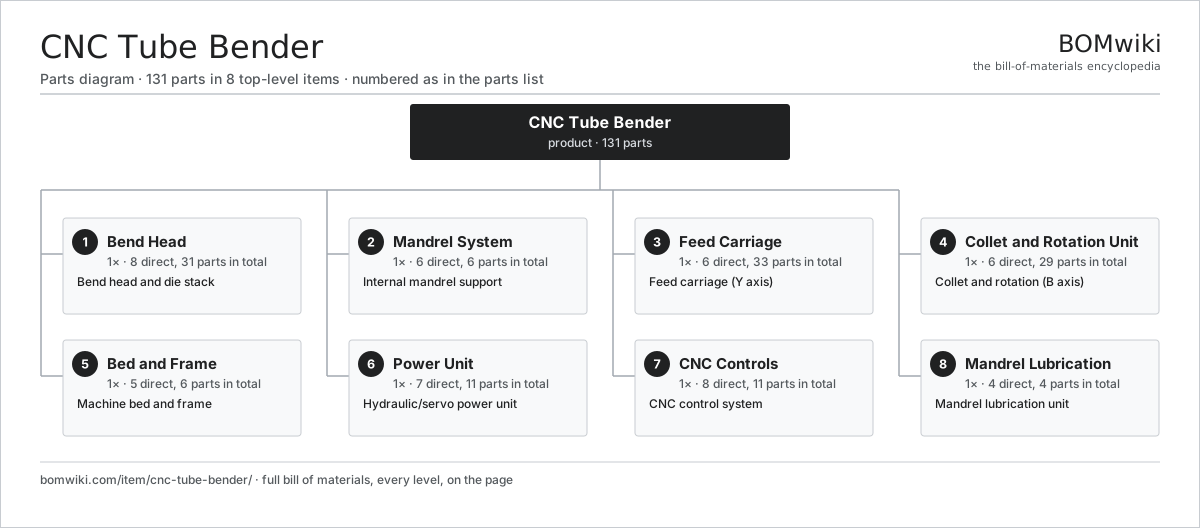
| # | Part | Qty | What it does |
|---|---|---|---|
| 1 | Bend Head 8 parts | 1× | Bend head and die stack |
| 2 | Mandrel System 6 parts | 1× | Internal mandrel support |
| 3 | Feed Carriage 6 parts | 1× | Feed carriage (Y axis) |
| 4 | Collet and Rotation Unit 6 parts | 1× | Collet and rotation (B axis) |
| 5 | Bed and Frame 5 parts | 1× | Machine bed and frame |
| 6 | Power Unit 7 parts | 1× | Hydraulic/servo power unit |
| 7 | CNC Controls 8 parts | 1× | CNC control system |
| 8 | Mandrel Lubrication 4 parts | 1× | Mandrel lubrication unit |
3D model
No 3D model yet. Have a CAD file of this? Add a 3D model. STL renders right on this page; STEP, FreeCAD, and OpenSCAD sources are welcome too (openly licensed, like all 3D models on BOMwiki).
Build & assembly graph
expand / collapse · shared sub-assemblies converge · links to related products · est. labourTap an assembly to expand/collapse · tap a part to open it · use “Open page” for any node · drag to pan, scroll to zoom.
Bill of materials for CNC Tube Bender
8 top-level lines · 70 rows shown · 131 parts total · indented to 3 levels| # | Item / sub-assembly | Part no. | Qty/assy | Ext. qty | Parts | Type |
|---|---|---|---|---|---|---|
| 1 | Bend Head 8 parts | cnc-tube-bender-bend-head | 1× | 1 | 31 | assembly |
| 1.1 | Bend Die | cnc-tube-bender-bend-die | 1× | 1 | · | part |
| 1.2 | Clamp Die | cnc-tube-bender-clamp-die | 1× | 1 | · | part |
| 1.3 | Pressure Die | cnc-tube-bender-pressure-die | 1× | 1 | · | part |
| 1.4 | Wiper Die | cnc-tube-bender-wiper-die | 1× | 1 | · | part |
| 1.5 | Bend Arm | cnc-tube-bender-bend-arm | 1× | 1 | · | part |
| 1.6 | Servo Motor 4 parts | servo-motor | 1× | 1 | 24 | assembly |
| 1.6.1 | Stator Assembly 3 parts + deeper › | stator-assembly | 1× | 1 | 3 | assembly |
| 1.6.2 | Rotor Assembly 4 parts + deeper › | rotor-assembly | 1× | 1 | 19 | assembly |
| 1.6.3 | Encoder | encoder | 1× | 1 | · | part |
| 1.6.4 | Motor Housing | motor-housing | 1× | 1 | · | part |
| 1.7 | Encoder | encoder | 1× | 1 | · | part |
| 1.8 | Helical Gear Pair | gear-pair | 1× | 1 | · | part |
| 2 | Mandrel System 6 parts | cnc-tube-bender-mandrel-system | 1× | 1 | 6 | assembly |
| 2.1 | Mandrel Body | cnc-tube-bender-mandrel-body | 1× | 1 | · | part |
| 2.2 | Mandrel Rod | cnc-tube-bender-mandrel-rod | 1× | 1 | · | part |
| 2.3 | Mandrel Extractor | cnc-tube-bender-mandrel-extractor | 1× | 1 | · | part |
| 2.4 | Rod Steady | cnc-tube-bender-rod-support | 1× | 1 | · | part |
| 2.5 | O-Ring Set | oring-set | 1× | 1 | · | part |
| 2.6 | Pressure Sensor | pressure-sensor | 1× | 1 | · | part |
| 3 | Feed Carriage 6 parts | cnc-tube-bender-carriage | 1× | 1 | 33 | assembly |
| 3.1 | Carriage Body | cnc-tube-bender-carriage-body | 1× | 1 | · | part |
| 3.2 | Ball Screw | ball-screw | 1× | 1 | · | part |
| 3.3 | Servo Motor 4 parts | servo-motor | 1× | 1 | 24 | assembly |
| 3.3.1 | Stator Assembly 3 parts + deeper › | stator-assembly | 1× | 1 | 3 | assembly |
| 3.3.2 | Rotor Assembly 4 parts + deeper › | rotor-assembly | 1× | 1 | 19 | assembly |
| 3.3.3 | Encoder | encoder | 1× | 1 | · | part |
| 3.3.4 | Motor Housing | motor-housing | 1× | 1 | · | part |
| 3.4 | Encoder | encoder | 1× | 1 | · | part |
| 3.5 | Carriage Rails | cnc-tube-bender-carriage-rails | 2× | 2 | · | part |
| 3.6 | Ball Bearing | ball-bearing | 4× | 4 | · | part |
| 4 | Collet and Rotation Unit 6 parts | cnc-tube-bender-collet | 1× | 1 | 29 | assembly |
| 4.1 | Collet Chuck | cnc-tube-bender-collet-chuck | 1× | 1 | · | part |
| 4.2 | Rotation Drive | cnc-tube-bender-rotate-drive | 1× | 1 | · | part |
| 4.3 | Servo Motor 4 parts | servo-motor | 1× | 1 | 24 | assembly |
| 4.3.1 | Stator Assembly 3 parts + deeper › | stator-assembly | 1× | 1 | 3 | assembly |
| 4.3.2 | Rotor Assembly 4 parts + deeper › | rotor-assembly | 1× | 1 | 19 | assembly |
| 4.3.3 | Encoder | encoder | 1× | 1 | · | part |
| 4.3.4 | Motor Housing | motor-housing | 1× | 1 | · | part |
| 4.4 | Encoder | encoder | 1× | 1 | · | part |
| 4.5 | Collet Actuator | cnc-tube-bender-collet-actuator | 1× | 1 | · | part |
| 4.6 | Helical Gear Pair | gear-pair | 1× | 1 | · | part |
| 5 | Bed and Frame 5 parts | cnc-tube-bender-frame | 1× | 1 | 6 | assembly |
| 5.1 | Bed Weldment | cnc-tube-bender-bed-weldment | 1× | 1 | · | part |
| 5.2 | Bend Head Mount | cnc-tube-bender-head-mount | 1× | 1 | · | part |
| 5.3 | Tube Support | cnc-tube-bender-tube-support | 2× | 2 | · | part |
| 5.4 | Safety Fence | cnc-tube-bender-safety-fence | 1× | 1 | · | part |
| 5.5 | Fastener Set | fastener-set | 1× | 1 | · | part |
| 6 | Power Unit 7 parts | cnc-tube-bender-hydraulics | 1× | 1 | 11 | assembly |
| 6.1 | Hydraulic Pump | cnc-tube-bender-hpu-pump | 1× | 1 | · | part |
| 6.2 | Valve Manifold | cnc-tube-bender-valve-manifold | 1× | 1 | · | part |
| 6.3 | Oil Reservoir | cnc-tube-bender-hpu-tank | 1× | 1 | · | part |
| 6.4 | Accumulator | cnc-tube-bender-accumulator | 1× | 1 | · | part |
| 6.5 | Radiator | radiator | 1× | 1 | · | part |
| 6.6 | Oil Seal | oil-seal | 4× | 4 | · | part |
| 6.7 | Pressure Sensor | pressure-sensor | 2× | 2 | · | part |
| 7 | CNC Controls 8 parts | cnc-tube-bender-controls | 1× | 1 | 11 | assembly |
| 7.1 | CNC Unit | cnc-tube-bender-cnc-unit | 1× | 1 | · | part |
| 7.2 | Operator Panel | cnc-tube-bender-teach-panel | 1× | 1 | · | part |
| 7.3 | Power Supply | power-supply | 1× | 1 | · | part |
| 7.4 | IGBT Power Module | igbt-module | 2× | 2 | · | part |
| 7.5 | Relay | relay | 3× | 3 | · | part |
| 7.6 | LCD Panel | lcd-panel | 1× | 1 | · | part |
| 7.7 | Wire Bundle | wire-bundle | 1× | 1 | · | part |
| 7.8 | Microcontroller | mcu | 1× | 1 | · | part |
| 8 | Mandrel Lubrication 4 parts | cnc-tube-bender-lubrication | 1× | 1 | 4 | assembly |
| 8.1 | Lube Metering Pump | cnc-tube-bender-lube-pump | 1× | 1 | · | part |
| 8.2 | Lube Lance | cnc-tube-bender-lube-lance | 1× | 1 | · | part |
| 8.3 | Lubricant Tank | cnc-tube-bender-lube-tank | 1× | 1 | · | part |
| 8.4 | Relay | relay | 1× | 1 | · | part |
Something wrong in this list? Report a problem with this BOM.
Related products
same domain, ranked by shared parts Bevel Gear Generator
201 parts · shares 6 with this page
Centering and Facing Machine
1,419 parts · shares 6 with this page
Cut-to-Length Line
500 parts · shares 6 with this page
Bevel Gear Generator
201 parts · shares 6 with this page
Centering and Facing Machine
1,419 parts · shares 6 with this page
Cut-to-Length Line
500 parts · shares 6 with this page
 Radial Forging Machine
288 parts · shares 6 with this page
Radial Forging Machine
288 parts · shares 6 with this page
 Rotary-Table Surface Grinder
172 parts · shares 6 with this page
Rotary-Table Surface Grinder
172 parts · shares 6 with this page
Sourcing: possible vendors
Browse the supplier directory → Prices, MOQ, and lead times are algorithmic estimates, not quotes, and not claims about these companies. Company mappings are curated by keyword; est. price band $10k–$1M. How estimates work| Vendor | HQ | Specialty | MOQ | Lead time |
|---|---|---|---|---|
|
🇩🇪DMG MORI
dmgmori.com ↗
|
Bielefeld, DE | Machine tools | 5 units | 12–20 wks |
|
🇯🇵Mazak
mazak.com ↗
|
Oguchi, JP | Machine tools | 5 units | 12–20 wks |
| haascnc.com ↗ | Oxnard, US | CNC machine tools | 5 units | 12–20 wks |
|
🇯🇵Okuma
okuma.com ↗
|
Niwa, JP | Machine tools | 5 units | 12–20 wks |
|
🇩🇪Trumpf
trumpf.com ↗
|
Ditzingen, DE | Laser & sheet-metal machines | 5 units | 12–20 wks |
803-word article