CO2 Incubator
ProductOverview
A CO2 incubator is a laboratory chamber maintaining precise temperature, humidity, and carbon dioxide concentration for mammalian cell culture. Cells require 37 °C (human body temperature), 95%+ humidity (prevents evaporation), and 5% CO2 (maintains pH via bicarbonate buffering of culture medium). Unlike freezers or simple ovens, CO2 incubators integrate environmental control and gas mixing to create a stable microclimate for living cells.
CO2 incubators are indispensable in cell biology, virology research, tissue engineering, and pharmaceutical development. A single incubator may house hundreds of culture plates; loss of environmental control causes irreplaceable sample death within hours.
How it works
The Heated Chamber is a double-walled stainless steel vessel insulated to minimize thermal loss. The Outer Jacket circulates heated water or electric current, maintaining the Inner Chamber at 37 °C. The Temperature Control loop monitors a Temperature Sensor (RTD or thermocouple) and energizes the Heating Element when temperature drops below setpoint − deadband (36.75 °C). The PID Controller applies proportional heating, minimizing overshoot. An independent Overshoot Protection thermostat cuts power if temperature exceeds 39 °C, a critical safety feature preventing thermal runaway that could kill samples or damage equipment.
The Gas Injection System supplies bottled CO2 at regulated pressure. The Pressure Regulator reduces high-pressure bottle gas (~2000 psi) to ~20 psi working pressure. The Flowmeter meters CO2 flow, typically 0.5–1 L/min for a 200 L chamber. The Needle Valve allows fine adjustment; 5% CO2 is confirmed by the IR CO2 Sensor (infrared non-dispersive sensor).
The Distribution Manifold diffuses CO2 into the chamber at the base. Without diffusion, CO2 would accumulate at the top; proper mixing ensures uniform concentration throughout. The Circulation Fan (low-speed brushless motor) homogenizes gas and temperature, aided by passive convection from the heating jacket.
The Humidity Reservoir (water pan + evaporation tray) maintains saturation. Evaporated water vapor carries heat away from the evaporation surface; the Outer Jacket must supply enough heat to maintain 37 °C despite evaporative cooling. The HEPA Circulation filter prevents airborne contamination.
The Monitoring Sensor continuously displays CO2, temperature, and humidity via Sensor Display. The Alarm System triggers alarms if:
- Temperature rises >38.5 °C (heating malfunction or setpoint too high)
- Temperature drops <36 °C (chamber cooling or heating element failure)
- CO2 <4% (bottle empty or regulator leaking)
- CO2 >6% (needle valve stuck open)
- Humidity <80% (water pan empty)
- Chamber Door opened >2 minutes (risk of culture contamination)
pH Control via CO2 Buffering
Most mammalian cell culture media use bicarbonate buffering: H2O + CO2 ⇌ H2CO3 ⇌ H+ + HCO3−
At equilibrium: pH = pKa + log([HCO3−] / [H2CO3]) ≈ 6.35 + log([HCO3−] / [H2CO3])
For 5% CO2 in air (partial pressure ~38 mmHg in equilibrium), and typical [HCO3−] = 25 mM: pH ≈ 7.2–7.4
Deviation in CO2 (e.g., 3% or 8%) shifts pH by ±0.3 units, acidifying or alkalinizing the medium. Cells detect pH <7.0 or >7.6 as osmotic stress, reducing viability and gene expression.
Humidity Control and Evaporation
Cells in culture plates lose water by evaporation. In an unhumidified incubator, a 10 cm² dish loses ~0.1 mL/day; over weeks, medium osmolality rises and cells desiccate. Saturation (100% RH) prevents net evaporation; slight supersaturation causes condensation on the chamber ceiling and culture plates (contamination risk).
The Humidity Reservoir maintains 95–98% RH passively:
- Large surface area (expanded stainless mesh) increases evaporation rate.
- Water temperature ~37 °C (same as chamber) provides consistent vapor saturation.
- Circulation Fan distributes humid air uniformly.
The Humidity Sensor (capacitive probe) confirms saturation; if RH <90%, Alarm System alerts the operator to refill the water pan.
Temperature Stability and Thermal Lag
The chamber exterior is not thermally insulated; heat dissipates to the room. Thermal mass (the chamber weight, ~300 kg for steel and water) resists rapid temperature changes. The response time (time to reach 63.2% of setpoint change after a step input) is typically 30–60 minutes. Thus, opening the door causes a slow temperature drop; recovery takes time.
The PID Controller proportionally heats to reduce overshoot. A proportional-only controller would undershoot and then oscillate. The integral term corrects steady-state offset; the derivative term dampens oscillations. Tuning (adjusting P, I, D gains) is typically done at the factory.
Door Design and Contamination Prevention
The Chamber Door must minimize thermal mass (to reduce temperature swing when opened) while maintaining insulation. Typical doors are thin aluminum or stainless steel with foam gasket (low thermal conductivity). The Door Gasket (silicone rubber) seals the perimeter; poor gasket condition causes temperature loss and CO2 escape.
Cell culture is sterile work. The chamber door is not a HEPA barrier; proper aseptic technique (70% ethanol wipes, laminar flow workbench for plate transfers) is essential.
Gas Supply Architecture
A single CO2 bottle (K-size, ~30 kg) at ~2000 psi supplies an incubator at 20 psi. With a typical flow of 0.5 L/min (30 L/hr), a full bottle provides ~40 hours of continuous operation, equivalent to ~1 week of intermittent use. Many labs have spare bottles and a wall-mounted manifold with check valves for automatic switchover when a bottle empties.
HEPA Filtration
The HEPA Circulation filter (high-efficiency particulate air, 99.97% efficiency for 0.3 µm particles) prevents bacteria and fungi from entering the chamber via ambient air drawn in during door openings or CO2 injection. HEPA filters are autoclavable (121 °C, 15 min) and must be replaced annually or quarterly depending on lab air quality.
Shelving and Plate Organization
The Shelf Assembly holds standard culture plates (96-well, 24-well, 6-well) or cell flasks. Typical incubators accommodate 6–12 standard-format plates per shelf level and 3–4 shelf levels, totaling 24–48 plates. Plates are not stacked directly; each sits on a shelf. This organization minimizes temperature gradients (uniform heating from jacket) and prevents cross-contamination via condensate dripping.
Alarms and Safety Shutdown
If CO2 drops critically (bottle empty), or temperature exceeds 40 °C, the Shutdown Solenoid may automatically shut off the CO2 supply and/or stop the Circulation Fan. Manual override options must exist so operators can clear faults. Critical alarms always require human intervention; automated shutdown prevents cascading failures but risks trapping alarms in a dead state.
Applications
- Mammalian cell culture (tissue engineering, vaccine production, drug testing)
- Bacterial and fungal fermentation (with external gas supply control)
- Embryo and stem cell culture (very strict environmental control required)
- Viral propagation (BSL-2+ containment, often integrated with biosafety cabinets)
- Organ-on-a-chip and 3D tissue models (specialized CO2 mixing and humidity)
Maintenance and Sanitation
The Inner Chamber and Shelf Assembly are cleaned weekly with 70% ethanol and allowed to dry. The Water Pan is emptied, cleaned, and refilled weekly with distilled or ultra-pure water (prevents mineral buildup and bacterial contamination). The HEPA Filter is inspected monthly and replaced quarterly or annually. The Temperature Sensor is verified annually by placing a certified thermometer probe in the chamber and comparing readings.
Multiparametric Control
Modern incubators add oxygen (hypoxic culture, 1–5% O2) via nitrogen stripping and oxygen injection, or by vacuum + gas mixing modules. Advanced models add pCO2 and pO2 sensors for real-time closed-loop control, especially for organ-on-a-chip applications. Standard incubators rely on passive CO2 injection and do not control O2 (ambient ~21%).
CO2 Incubator parts and their functions
8 top-level parts · 46 parts in total · full bill of materials below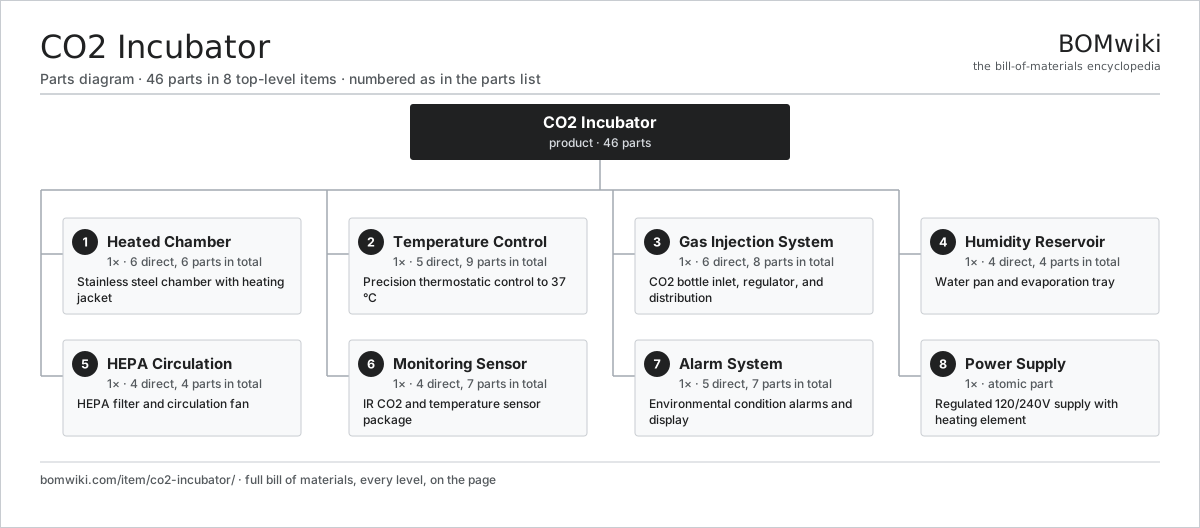
| # | Part | Qty | What it does |
|---|---|---|---|
| 1 | Heated Chamber 6 parts | 1× | Stainless steel chamber with heating jacket |
| 2 | Temperature Control 5 parts | 1× | Precision thermostatic control to 37 °C |
| 3 | Gas Injection System 6 parts | 1× | CO2 bottle inlet, regulator, and distribution |
| 4 | Humidity Reservoir 4 parts | 1× | Water pan and evaporation tray |
| 5 | HEPA Circulation 4 parts | 1× | HEPA filter and circulation fan |
| 6 | Monitoring Sensor 4 parts | 1× | IR CO2 and temperature sensor package |
| 7 | Alarm System 5 parts | 1× | Environmental condition alarms and display |
| 8 | Power Supply | 1× | Regulated 120/240V supply with heating element |
3D model
No 3D model yet. Have a CAD file of this? Add a 3D model. STL renders right on this page; STEP, FreeCAD, and OpenSCAD sources are welcome too (openly licensed, like all 3D models on BOMwiki).
Build & assembly graph
expand / collapse · shared sub-assemblies converge · links to related products · est. labourTap an assembly to expand/collapse · tap a part to open it · use “Open page” for any node · drag to pan, scroll to zoom.
Bill of materials for CO2 Incubator
8 top-level lines · 42 rows shown · 46 parts total · indented to 3 levels| # | Item / sub-assembly | Part no. | Qty/assy | Ext. qty | Parts | Type |
|---|---|---|---|---|---|---|
| 1 | Heated Chamber 6 parts | co2-incubator-heated-chamber | 1× | 1 | 6 | assembly |
| 1.1 | Inner Chamber | co2-incubator-inner-chamber | 1× | 1 | · | part |
| 1.2 | Outer Jacket | co2-incubator-outer-jacket | 1× | 1 | · | part |
| 1.3 | Chamber Door | co2-incubator-chamber-door | 1× | 1 | · | part |
| 1.4 | Shelf Assembly | co2-incubator-shelf-assembly | 1× | 1 | · | part |
| 1.5 | Door Gasket | co2-incubator-door-gasket | 1× | 1 | · | part |
| 1.6 | Drain Plug | co2-incubator-drain-plug | 1× | 1 | · | part |
| 2 | Temperature Control 5 parts | co2-incubator-temperature-control | 1× | 1 | 9 | assembly |
| 2.1 | Heating Element | co2-incubator-heating-element | 1× | 1 | · | part |
| 2.2 | Temperature Sensor | co2-incubator-temperature-sensor | 1× | 1 | · | part |
| 2.3 | PID Controller | co2-incubator-pid-controller | 1× | 1 | · | part |
| 2.4 | Overshoot Protection | co2-incubator-overshoot-protection | 1× | 1 | · | part |
| 2.5 | SMD Passive (R/C/L) | smd-passives | 5× | 5 | · | part |
| 3 | Gas Injection System 6 parts | co2-incubator-gas-injection-system | 1× | 1 | 8 | assembly |
| 3.1 | CO2 Inlet | co2-incubator-co2-inlet | 1× | 1 | · | part |
| 3.2 | Pressure Regulator | co2-incubator-pressure-regulator | 1× | 1 | · | part |
| 3.3 | Flowmeter | co2-incubator-flowmeter | 1× | 1 | · | part |
| 3.4 | Needle Valve | co2-incubator-needle-valve | 1× | 1 | · | part |
| 3.5 | Distribution Manifold | co2-incubator-distribution-manifold | 1× | 1 | · | part |
| 3.6 | SMD Passive (R/C/L) | smd-passives | 3× | 3 | · | part |
| 4 | Humidity Reservoir 4 parts | co2-incubator-humidity-reservoir | 1× | 1 | 4 | assembly |
| 4.1 | Water Pan | co2-incubator-water-pan | 1× | 1 | · | part |
| 4.2 | Evaporation Tray | co2-incubator-evaporation-tray | 1× | 1 | · | part |
| 4.3 | Water Inlet | co2-incubator-water-inlet | 1× | 1 | · | part |
| 4.4 | Drain Tube | co2-incubator-drain-tube | 1× | 1 | · | part |
| 5 | HEPA Circulation 4 parts | co2-incubator-hepa-circulation | 1× | 1 | 4 | assembly |
| 5.1 | Circulation Fan | co2-incubator-circulation-fan | 1× | 1 | · | part |
| 5.2 | HEPA Filter | co2-incubator-hepa-filter | 1× | 1 | · | part |
| 5.3 | Filter Housing | co2-incubator-filter-housing | 1× | 1 | · | part |
| 5.4 | Air Return Manifold | co2-incubator-air-return | 1× | 1 | · | part |
| 6 | Monitoring Sensor 4 parts | co2-incubator-monitoring-sensor | 1× | 1 | 7 | assembly |
| 6.1 | IR CO2 Sensor | co2-incubator-ir-co2-sensor | 1× | 1 | · | part |
| 6.2 | Humidity Sensor | co2-incubator-humidity-sensor | 1× | 1 | · | part |
| 6.3 | Sensor Display | co2-incubator-sensor-display | 1× | 1 | · | part |
| 6.4 | SMD Passive (R/C/L) | smd-passives | 4× | 4 | · | part |
| 7 | Alarm System 5 parts | co2-incubator-alarm-system | 1× | 1 | 7 | assembly |
| 7.1 | Alarm Controller | co2-incubator-alarm-controller | 1× | 1 | · | part |
| 7.2 | Alarm Buzzer | co2-incubator-alarm-buzzer | 1× | 1 | · | part |
| 7.3 | Alarm Light | co2-incubator-alarm-light | 1× | 1 | · | part |
| 7.4 | Shutdown Solenoid | co2-incubator-shutdown-solenoid | 1× | 1 | · | part |
| 7.5 | SMD Passive (R/C/L) | smd-passives | 3× | 3 | · | part |
| 8 | Power Supply | power-supply | 1× | 1 | · | part |
Something wrong in this list? Report a problem with this BOM.
Related products
same domain, ranked by shared parts Analytical Balance
54 parts · shares 1 with this page
Analytical Balance
54 parts · shares 1 with this page
 Atomic Absorption Spectrometer
648 parts · shares 1 with this page
Autoclave Sterilizer
282 parts · shares 1 with this page
Atomic Absorption Spectrometer
648 parts · shares 1 with this page
Autoclave Sterilizer
282 parts · shares 1 with this page
 Automated Cell Counter
54 parts · shares 1 with this page
Automated Colony Counter
322 parts · shares 1 with this page
Automated Cell Counter
54 parts · shares 1 with this page
Automated Colony Counter
322 parts · shares 1 with this page
 Automated Liquid Handler
817 parts · shares 1 with this page
Automated Liquid Handler
817 parts · shares 1 with this page
Sourcing: possible vendors
Browse the supplier directory → Prices, MOQ, and lead times are algorithmic estimates, not quotes, and not claims about these companies. Company mappings are curated by keyword; est. price band $1k–$500k. How estimates work| Vendor | HQ | Specialty | MOQ | Lead time |
|---|---|---|---|---|
| thermofisher.com ↗ | Waltham, US | Lab instruments | 100 units | 10–18 wks |
|
🇺🇸Agilent
agilent.com ↗
|
Santa Clara, US | Analytical instruments | 100 units | 10–18 wks |
|
🇺🇸Bruker
bruker.com ↗
|
Billerica, US | Scientific instruments | 100 units | 10–18 wks |
|
🇯🇵Shimadzu
shimadzu.com ↗
|
Kyoto, JP | Analytical instruments | 100 units | 10–18 wks |
|
🇺🇸Waters
waters.com ↗
|
Milford, US | Chromatography & MS | 100 units | 10–18 wks |
1,280-word article