Coffee Urn
ProductOverview
The coffee urn is a large-capacity percolating brewer designed for institutional and commercial settings: hotels, churches, convention centers, and catering operations. It brews 10–40 gallons of coffee in one cycle, providing a single source for large group service. The urn combines two heating zones, a powerful lower element for bringing water to brewing temperature, and a milder upper element for holding brewed coffee at safe serving temperature.
The system operates on the percolation principle: cold water in the tank bottom is heated by the lower heater element. As the water warms, it rises through a vertical tube into a basket filled with ground coffee, where it extracts flavor. The brewed coffee then falls back into the tank, mixing with water below. This cycle repeats, with each pass increasing extraction strength.
The gauge glass on the tank side shows the operator the current water level and brewed coffee volume. A gravity-fed spigot at the base allows operators to fill cups on demand. Two independent heating elements and thermostats control the brewing and holding phases, allowing the urn to transition seamlessly from heating phase to serving phase.
How It Works
To begin brewing, the operator fills the tank with cold water via the fill opening until the gauge glass reaches the desired volume (marked in gallons or liters). Ground coffee is placed in a disposable paper filter, the filter is set into the coffee basket, and the basket is installed into the percolator tube.
The operator sets the brew switch to on. The lower heater element energizes at full power, heating the water in the tank bottom. The brew thermostat monitors the water temperature.
As the water heats, dissolved minerals and air pockets form. When the water temperature reaches approximately 180°F, the water column inside the percolator tube becomes less dense and begins rising. This is the start of percolation. The rising water carries heat to the surface, and the cooler water below heats further. A cycle ensues: water rises, cools at the top, and falls back down, all the while passing through the coffee filter and ground coffee in the basket.
Percolation continues as long as the lower heater maintains a temperature above approximately 180°F. The brew thermostat allows the heater to cycle on and off, maintaining steady temperature. Brewing typically takes 45–60 minutes for a full tank, depending on the tank size and water hardness.
Once the desired brewing time has elapsed (usually when the color in the spreading dome or the glass above the tube appears dark), the operator switches the brew switch to off. The lower heater element de-energizes.
The operator then activates the keep-warm switch to a position (typically "low" or "high" setting). The upper heater element, positioned higher in the tank, now controls temperature. The warm-holding thermostat cycles the upper heater to maintain 170–180°F, hot enough for safe serving without causing off-flavors or bitterness.
Operators fill cups by opening the spigot valve at the tank base. Gravity pressure from the tank height delivers coffee into the cup. The drip guard catches spills. As the tank empties, the gauge glass level drops, showing the operator remaining volume. Once the gauge reaches "empty" or near-empty (typically 1–2 gallons remaining), the operator refills.
The upper heater element continues cycling, keeping the remaining coffee in the tank at serving temperature. A well-maintained urn can keep coffee hot and fresh for 4–6 hours if the keep-warm element is set correctly.
Percolation Brewing
Percolation differs from immersion or pour-over brewing. As water repeatedly passes through ground coffee, extraction is cumulative. After 15–20 minutes of percolation, the coffee is flavorful. After 45–60 minutes, it is fully extracted. Continuing to percolate beyond this point does not improve flavor; instead, the extended heat causes bitterness and burnt notes.
The brew thermostat is critical for timing. If it cycles too aggressively (raising and lowering temperature), percolation may stall or race. A well-tuned thermostat maintains steady 180–200°F, producing consistent percolation speed. Most institutional users rely on operator judgment: visual inspection of the spreading dome or the color through the glass shows when to stop brewing.
Maintenance
Daily cleaning involves draining the tank completely at shift end via the bottom drain valve. The coffee basket and filter are removed and discarded (filters are disposable). The interior of the tank is rinsed with hot water and wiped clean of coffee residue. Mineral buildup can slow percolation, so a weekly soak in white vinegar and water (1:1 ratio) is recommended.
The gauge glass and shutoff valves are checked monthly. If the glass is cloudy or the float sticks, the gauge should be flushed and serviced. The spigot valve is cleaned and lubricated quarterly to ensure smooth operation.
The lower heater element and upper heater element are replaced every 12–24 months as they scale or fail. Both are field-replaceable. The brew thermostat and warm thermostat may drift with age and may require recalibration or replacement every 18–36 months.
Water Quality
Hard water (high mineral content) is the enemy of coffee urns. Minerals accumulate on heater surfaces, reducing heat transfer and slowing percolation. In hard-water areas, weekly vinegar descaling is essential. Some operators use bottled or filtered water to reduce mineral buildup.
If percolation becomes sluggish despite proper water level and heater function, the percolator tube may be partially clogged with mineral scale. Disassembling the tube and soaking it in vinegar for several hours typically restores full percolation.
Safety
The coffee urn operates at high temperature (200°F) and pressure (from steam and water column). The shutoff valves on the level gauge are critical safety devices. If a gauge glass cracks, the shutoff valves isolate the gauge from the pressurized tank, preventing boiling water from spraying out.
Never close the fill opening while the urn is heating; steam buildup can pressure the tank dangerously. Always ensure the spigot is closed before moving the urn, as gravity from the full tank can cause sudden leakage if opened accidentally.
All heating elements, thermostats, and electrical components comply with UL 197 (food service equipment) and NSF/ANSI 4 (sanitation). A ground-fault circuit interrupter (GFCI) is required on the electrical supply for personnel safety.
Coffee Urn parts and their functions
8 top-level parts · 34 parts in total · full bill of materials below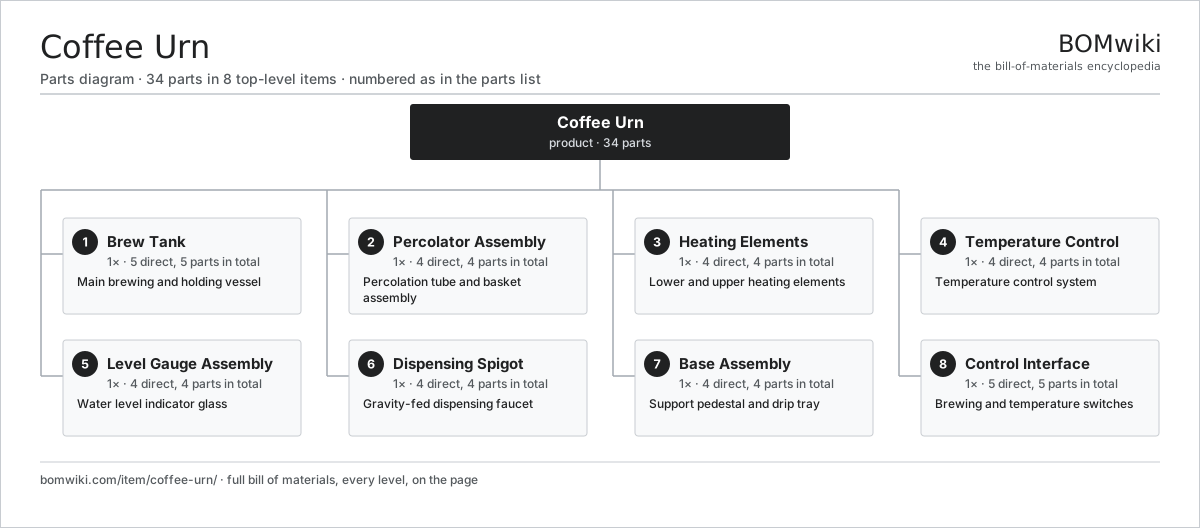
| # | Part | Qty | What it does |
|---|---|---|---|
| 1 | Brew Tank 5 parts | 1× | Main brewing and holding vessel |
| 2 | Percolator Assembly 4 parts | 1× | Percolation tube and basket assembly |
| 3 | Heating Elements 4 parts | 1× | Lower and upper heating elements |
| 4 | Temperature Control 4 parts | 1× | Temperature control system |
| 5 | Level Gauge Assembly 4 parts | 1× | Water level indicator glass |
| 6 | Dispensing Spigot 4 parts | 1× | Gravity-fed dispensing faucet |
| 7 | Base Assembly 4 parts | 1× | Support pedestal and drip tray |
| 8 | Control Interface 5 parts | 1× | Brewing and temperature switches |
3D model
No 3D model yet. Have a CAD file of this? Add a 3D model. STL renders right on this page; STEP, FreeCAD, and OpenSCAD sources are welcome too (openly licensed, like all 3D models on BOMwiki).
Build & assembly graph
expand / collapse · shared sub-assemblies converge · links to related products · est. labourTap an assembly to expand/collapse · tap a part to open it · use “Open page” for any node · drag to pan, scroll to zoom.
Bill of materials for Coffee Urn
8 top-level lines · 42 rows shown · 34 parts total · indented to 3 levels| # | Item / sub-assembly | Part no. | Qty/assy | Ext. qty | Parts | Type |
|---|---|---|---|---|---|---|
| 1 | Brew Tank 5 parts | coffee-urn-tank | 1× | 1 | 5 | assembly |
| 1.1 | Tank Body | coffee-urn-tank-body | 1× | 1 | · | part |
| 1.2 | Tank Bottom | coffee-urn-tank-bottom | 1× | 1 | · | part |
| 1.3 | Tank Top | coffee-urn-tank-top | 1× | 1 | · | part |
| 1.4 | Tank Inlet | coffee-urn-tank-inlet | 1× | 1 | · | part |
| 1.5 | Tank Drain | coffee-urn-tank-drain | 1× | 1 | · | part |
| 2 | Percolator Assembly 4 parts | coffee-urn-percolator | 1× | 1 | 4 | assembly |
| 2.1 | Percolator Tube | coffee-urn-percolator-tube | 1× | 1 | · | part |
| 2.2 | Coffee Basket | coffee-urn-percolator-basket | 1× | 1 | · | part |
| 2.3 | Coffee Filter | coffee-urn-percolator-filter | 1× | 1 | · | part |
| 2.4 | Spreading Dome | coffee-urn-percolator-dome | 1× | 1 | · | part |
| 3 | Heating Elements 4 parts | coffee-urn-heating | 1× | 1 | 4 | assembly |
| 3.1 | Brew Heater | coffee-urn-heating-lower | 1× | 1 | · | part |
| 3.2 | Keep-Warm Heater | coffee-urn-heating-upper | 1× | 1 | · | part |
| 3.3 | Brew Switch | coffee-urn-heating-lower-switch | 1× | 1 | · | part |
| 3.4 | Keep-Warm Switch | coffee-urn-heating-upper-switch | 1× | 1 | · | part |
| 4 | Temperature Control 4 parts | coffee-urn-thermostat | 1× | 1 | 4 | assembly |
| 4.1 | Brew Thermostat | coffee-urn-thermostat-brew | 1× | 1 | · | part |
| 4.2 | Warm Thermostat | coffee-urn-thermostat-warm | 1× | 1 | · | part |
| 4.3 | Thermostat Probe | coffee-urn-thermostat-probe | 1× | 1 | · | part |
| 4.4 | Control Contactor | coffee-urn-thermostat-contactor | 1× | 1 | · | part |
| 5 | Level Gauge Assembly 4 parts | coffee-urn-gauge | 1× | 1 | 4 | assembly |
| 5.1 | Gauge Glass | coffee-urn-gauge-glass | 1× | 1 | · | part |
| 5.2 | Level Float | coffee-urn-gauge-float | 1× | 1 | · | part |
| 5.3 | Gauge Fittings | coffee-urn-gauge-fitting | 1× | 1 | · | part |
| 5.4 | Gauge Shutoff | coffee-urn-gauge-shutoff | 1× | 1 | · | part |
| 6 | Dispensing Spigot 4 parts | coffee-urn-spigot | 1× | 1 | 4 | assembly |
| 6.1 | Spigot Valve | coffee-urn-spigot-valve | 1× | 1 | · | part |
| 6.2 | Spigot Nozzle | coffee-urn-spigot-nozzle | 1× | 1 | · | part |
| 6.3 | Spigot Bracket | coffee-urn-spigot-bracket | 1× | 1 | · | part |
| 6.4 | Drip Guard | coffee-urn-spigot-drip-guard | 1× | 1 | · | part |
| 7 | Base Assembly 4 parts | coffee-urn-base | 1× | 1 | 4 | assembly |
| 7.1 | Base Legs | coffee-urn-base-legs | 1× | 1 | · | part |
| 7.2 | Base Platform | coffee-urn-base-platform | 1× | 1 | · | part |
| 7.3 | Drip Pan | coffee-urn-base-drip-pan | 1× | 1 | · | part |
| 7.4 | Adjustable Feet | coffee-urn-base-feet | 1× | 1 | · | part |
| 8 | Control Interface 5 parts | coffee-urn-controls | 1× | 1 | 5 | assembly |
| 8.1 | Control Panel | coffee-urn-controls-panel | 1× | 1 | · | part |
| 8.2 | Brew Switch | coffee-urn-controls-brew-switch | 1× | 1 | · | part |
| 8.3 | Warm Switch | coffee-urn-controls-warm-switch | 1× | 1 | · | part |
| 8.4 | Indicator Lights | coffee-urn-controls-lights | 1× | 1 | · | part |
| 8.5 | Control Wiring | coffee-urn-controls-wiring | 1× | 1 | · | part |
Something wrong in this list? Report a problem with this BOM.
Sourcing: possible vendors
Browse the supplier directory → Prices, MOQ, and lead times are algorithmic estimates, not quotes, and not claims about these companies. Company mappings are curated by keyword; est. price band $1k–$500k. How estimates work| Vendor | HQ | Specialty | MOQ | Lead time |
|---|---|---|---|---|
| gea.com ↗ | Düsseldorf, DE | Process technology | 20 units | 12–20 wks |
| buhlergroup.com ↗ | Uzwil, CH | Food & materials processing | 20 units | 12–20 wks |
| tetrapak.com ↗ | Pully, CH | Food packaging & processing | 20 units | 12–20 wks |
| jbtc.com ↗ | Chicago, US | Food processing equipment | 20 units | 12–20 wks |
| alfalaval.com ↗ | Lund, SE | Heat transfer & separation | 20 units | 12–20 wks |
1,278-word article