Column Formwork
ProductOverview
Column formwork is a panelized system for casting vertical reinforced concrete columns of predetermined cross-section and height. Unlike wall formwork (which is often continuous and very tall), column systems are modular: each panel is a self-contained unit that is bolted together with its three neighbors to form a complete column mold. The economy of column formwork derives from high reuse (30–50+ times per kit) across the many columns in a building, with rapid assembly and stripping cycles (2–4 hours to set, 18–24 hours to cure and strip).
The system consists of four main subsystems: Side Panels & Liners forming the concrete-contact surfaces, Corner Clamps & Alignment maintaining alignment under lateral pressure, Form Ties & Cross-Bracing preventing cross-sectional bulge, and external External Support Props providing temporary bracing. All components are designed for rapid bolted assembly, no on-site welding, and for straightforward removal without damage to the concrete or formwork.
Panel Design & Concrete-Contact Surfaces
The Side Panels & Liners are the critical load-bearing members, resisting lateral pressure from fresh concrete. Each panel consists of:
Panel Frame: A welded or bolted steel backing structure, typically formed from 75×50 mm or 100×50 mm angles or channels, arranged in a grid. The frame provides structural stiffness and attachment points for corner clamps and form ties. Typical panel dimensions are 2.5–4.0 m tall (one floor height or more) and 0.5–1.0 m wide (one column face).
Plywood Facing: Okoume or birch plywood, 18–25 mm thick, glued to the steel frame with waterproof adhesive and mechanically fastened with nails or bolts. The plywood is the direct concrete-contact surface and is selected for hardness and durability. Under 40 kPa concrete pressure (typical for 0.5 m wide columns with 3 m/hour pour rate), 18 mm plywood is adequate; wider columns (0.7–1.0 m) or higher pressure requires 25 mm plywood.
Internal Stiffening: Internal ribs or X-bracing within the panel frame, resisting deflection under concrete load. Without stiffeners, a 2.5 m tall, 0.8 m wide panel under 40 kPa would deflect 15–20 mm (L/125 to L/167), creating a wavy concrete surface. Stiffeners reduce deflection to <L/400, ensuring flat, true concrete surfaces.
The four panels of a column are typically identical (for square columns) or in two pairs (for rectangular columns), enabling high production efficiency. A single formwork kit might contain 4–12 columns' worth of panels, reusable across 30–50 buildings.
Corner Clamps & Lateral Load Transfer
The Corner Clamps & Alignment are critical load-transfer devices, compressing the four panels together and transferring the lateral concrete pressure outward through the panel frames. Each column has typically four corner clamps (one per corner), positioned at equal heights (e.g., at 0.75, 1.5, 2.25, and 3.0 m).
Each Corner Clamp Assembly is a wedge or screw-type clamp with:
- Input: A torque wrench or manual handle, applied to a threaded mechanism or wedge.
- Action: Compressing the two adjacent panels against each other with a force of 20–50 kN per clamp (depending on clamp size and concrete pressure).
- Verification: Tightened to a consistent torque (100–150 Nm) using a torque wrench, ensuring even pressure distribution across all corners.
Without adequate corner clamp pressure, panels can separate slightly during pour, allowing concrete to seep between panels and creating joint lines or surface defects. Over-tightening, conversely, can crush the plywood or bend the frame, requiring repair.
Form Ties & Cross-Sectional Stability
The Form Ties & Cross-Bracing are rods spanning across the column's interior cross-section, anchored to opposite panels. They prevent the panels from bulging outward under concrete pressure, a critical function because uninhibited bulging can increase column dimensions by 10–20 mm, ruining subsequent connections and joints.
The form tie system comprises:
Tie Rods: Steel rods, typically M16 or M20 (16 mm or 20 mm diameter), threaded and torqued to 50–100 Nm. For a 0.5 m wide column under 40 kPa pressure, a form tie experiences approximately 50–80 kN of tensile load; M16 grade-8 steel is rated for 100+ kN, providing ample safety margin.
Tie Spreaders & Spacing Blocks: Rubber or PVC blocks spaced at regular intervals (typically every 0.2–0.3 m vertically and horizontally) along each tie rod, maintaining exact column width and preventing concrete from flowing around the rod. These spreaders also centralize rebar within the column cross-section.
Tie Anchor Assemblies: Nuts and plates on each panel face, distributing the tie rod load over 0.1–0.2 m² of plywood to prevent crushing. Typical anchor details are M16 through-rods with 50×50 mm steel plates and locking nuts.
Form tie removal is handled in two ways: either the rods are left embedded in the concrete (and the exposed ends ground flush, common in precast plants and factory-like conditions), or they are partially embedded and fully removed by pulling or heating, leaving small holes that must be grouted. Most building construction uses partially embedded removal, with holes grouted after formwork is removed.
External Support Props & Lateral Bracing
Freshly cast columns can be weak and susceptible to tilt if subjected to lateral loads (wind, vibrator impact, or uneven concrete placement). The External Support Props provide temporary external bracing:
Support Prop Members: Steel tubes, 48–60 mm diameter, bolted between the column formwork and nearby fixed structure (typically the slab below or completed adjacent columns). Props are typically installed at two or three points along the column height, at 45–60° angles to provide lateral load resistance without interfering with rebar placement or concrete access.
Prop Connection Hardware: Welded or bolted brackets on the formwork and structure, designed for 10–20 kN lateral load (typical wind load on a 0.5 m × 3 m column face). Props are torqued to ~50 Nm and checked daily during the cure period.
Props are typically removed after 3–7 days (after concrete reaches 7–10 MPa and can resist tilt on its own). They are not part of the "formwork kit" proper, but are often included in rental packages.
Pour Windows & Access Openings
The Pour Windows & Access Holes enable concrete placement, rebar verification, and compaction without relying on vibrators alone. They typically include:
Pour Window: A bolted or hinged opening, typically 0.4–0.6 m tall and 0.3–0.4 m wide, positioned at mid-height of the column. This is where the concrete pump hose is inserted, and where a vibrator can be inserted for compaction. After placement, the window is often left open for 24 hours to allow initial surface bleed-off and curing.
Inspection Holes: Smaller apertures (0.15–0.20 m diameter) near the top and bottom of the column, allowing visual inspection of concrete flow and detection of trapped air. These are often sealed with rubber stoppers until needed.
Pour windows must be sealed carefully before striking to prevent rain infiltration during cure. A rubber or foam gasket and threaded frame are typical.
Assembly & Striking Sequence
A typical column formwork erection and striking sequence unfolds as follows:
Frame preparation (30 min): The four panels are cleaned, release agent is applied to the plywood, and the panels are brought to the work area.
Panel assembly (45 min): Panels are stood vertically on the slab, roughly positioned around the column location. Corner clamps are hand-tightened to hold panels roughly square, then torqued to full specification (100–150 Nm each).
Form tie installation (30 min): Threaded tie rods are inserted horizontally through pre-drilled holes in the panels, with spacer blocks placed at the halfway point. Nuts are tightened to full torque (50–100 Nm).
Prop installation (20 min): External props are bolted between the formwork and the structure.
Rebar inspection & final check (15 min): Rebar cage is visually inspected through pour windows to ensure it is centered and undamaged.
Concrete placement (1–6 hours): Concrete is pumped and vibrated. Pour rate is typically 0.5–1.0 m per hour, with vibrator inserted through the pour window for 10–20 seconds at multiple heights. After pour completion, the surface is finished and left to cure.
Initial cure (18–24 hours): Concrete is protected from rain and direct sun. Props are left in place. Covers may be added to accelerate strength gain (heat lamps or curing blankets).
Striking (1–2 hours): After 24 hours, form ties are unbolted and removed (or the exposed ends are heated and the rods pulled out). Corner clamps are loosened sequentially (always removing one corner at a time to prevent sudden panel movement). Props are removed. Finally, panels are gently pried away from the concrete using wooden or rubber spreaders, leaving the column standing.
Cleanup & reuse (1–2 hours): Panels are cleaned (concrete residue is wire-brushed off), release agent is reapplied, and the formwork is ready for the next column.
Total cycle time is typically 2–3 days per column (including placement, cure, and stripping), with a skilled crew of 4–6 people capable of handling 5–8 columns per week.
Variants & Specialized Formwork
- Adjustable panel systems: Panels with sliding frames that allow width adjustment (0.3–0.8 m) without swapping entire panels, reducing inventory.
- Large-format panels: Single-panel formwork for very tall columns (8–12 m) or square columns (0.8–1.2 m × 0.8–1.2 m), reducing assembly complexity but increasing handling requirements.
- Column heads/drops: Specialized formwork for thickened column heads or drop panels, often integrated with slab formwork systems.
- Spiral/helical columns: Custom formwork for non-rectangular cross-sections, requiring curved panels and special tie arrangements.
Column formwork remains one of the highest-reuse formwork categories, with good quality kits achieving 50–100+ pours over their service life, making the per-pour cost extremely economical, often under USD 5–10 per column.
Column Formwork parts and their functions
7 top-level parts · 23 parts in total · full bill of materials below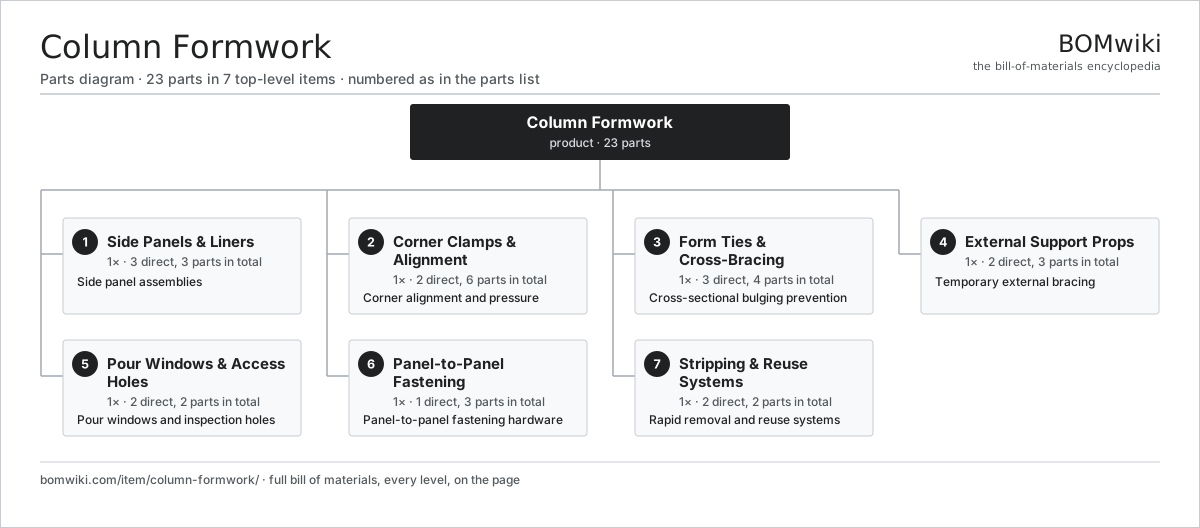
| # | Part | Qty | What it does |
|---|---|---|---|
| 1 | Side Panels & Liners 3 parts | 1× | Side panel assemblies |
| 2 | Corner Clamps & Alignment 2 parts | 1× | Corner alignment and pressure |
| 3 | Form Ties & Cross-Bracing 3 parts | 1× | Cross-sectional bulging prevention |
| 4 | External Support Props 2 parts | 1× | Temporary external bracing |
| 5 | Pour Windows & Access Holes 2 parts | 1× | Pour windows and inspection holes |
| 6 | Panel-to-Panel Fastening 1 parts | 1× | Panel-to-panel fastening hardware |
| 7 | Stripping & Reuse Systems 2 parts | 1× | Rapid removal and reuse systems |
3D model
No 3D model yet. Have a CAD file of this? Add a 3D model. STL renders right on this page; STEP, FreeCAD, and OpenSCAD sources are welcome too (openly licensed, like all 3D models on BOMwiki).
Build & assembly graph
expand / collapse · shared sub-assemblies converge · links to related products · est. labourTap an assembly to expand/collapse · tap a part to open it · use “Open page” for any node · drag to pan, scroll to zoom.
Bill of materials for Column Formwork
7 top-level lines · 22 rows shown · 23 parts total · indented to 3 levels| # | Item / sub-assembly | Part no. | Qty/assy | Ext. qty | Parts | Type |
|---|---|---|---|---|---|---|
| 1 | Side Panels & Liners 3 parts | column-formwork-panels | 1× | 1 | 3 | assembly |
| 1.1 | Panel Frame | column-formwork-frame | 1× | 1 | · | part |
| 1.2 | Plywood Facing | column-formwork-plywood-liner | 1× | 1 | · | part |
| 1.3 | Internal Stiffening | column-formwork-frame-stiffeners | 1× | 1 | · | part |
| 2 | Corner Clamps & Alignment 2 parts | column-formwork-corner-clamps | 1× | 1 | 6 | assembly |
| 2.1 | Corner Clamp Assembly | column-formwork-corner-clamp-units | 4× | 4 | · | part |
| 2.2 | Fastener Set | fastener-set | 2× | 2 | · | part |
| 3 | Form Ties & Cross-Bracing 3 parts | column-formwork-form-ties | 1× | 1 | 4 | assembly |
| 3.1 | Tie Rods | column-formwork-tie-rods | 2× | 2 | · | part |
| 3.2 | Tie Spreaders & Spacing Blocks | column-formwork-tie-spreaders | 1× | 1 | · | part |
| 3.3 | Tie Anchor Assemblies | column-formwork-tie-anchors | 1× | 1 | · | part |
| 4 | External Support Props 2 parts | column-formwork-adjustable-props | 1× | 1 | 3 | assembly |
| 4.1 | Support Prop Members | column-formwork-prop-tubes | 2× | 2 | · | part |
| 4.2 | Prop Connection Hardware | column-formwork-prop-connections | 1× | 1 | · | part |
| 5 | Pour Windows & Access Holes 2 parts | column-formwork-access-openings | 1× | 1 | 2 | assembly |
| 5.1 | Pour Window | column-formwork-pour-window | 1× | 1 | · | part |
| 5.2 | Inspection Holes | column-formwork-inspection-holes | 1× | 1 | · | part |
| 6 | Panel-to-Panel Fastening 1 parts | column-formwork-connections | 1× | 1 | 3 | assembly |
| 6.1 | Fastener Set | fastener-set | 3× | 3 | · | part |
| 7 | Stripping & Reuse Systems 2 parts | column-formwork-stripping-aids | 1× | 1 | 2 | assembly |
| 7.1 | Release Coating | column-formwork-release-coating | 1× | 1 | · | part |
| 7.2 | Stripping Wedges & Spreaders | column-formwork-stripping-wedges | 1× | 1 | · | part |
Something wrong in this list? Report a problem with this BOM.
Sourcing: possible vendors
Browse the supplier directory → Prices, MOQ, and lead times are algorithmic estimates, not quotes, and not claims about these companies. Company mappings are curated by keyword; est. price band $15k–$2M. How estimates work| Vendor | HQ | Specialty | MOQ | Lead time |
|---|---|---|---|---|
| caterpillar.com ↗ | Irving, US | Construction & mining equipment | made to order | 16–28 wks |
|
🇯🇵Komatsu
komatsu.com ↗
|
Tokyo, JP | Construction & mining equipment | made to order | 16–28 wks |
|
🇸🇪Volvo CE
volvoce.com ↗
|
Gothenburg, SE | Construction equipment | made to order | 16–28 wks |
|
🇨🇭Liebherr
liebherr.com ↗
|
Bulle, CH | Cranes & heavy equipment | made to order | 16–28 wks |
|
🇨🇳XCMG
xcmg.com ↗
|
Xuzhou, CN | Construction machinery | made to order | 16–28 wks |
1,685-word article