Combination Padlock
ProductOverview
A combination padlock is a mechanical lock that requires dialing a secret three-digit code to open. The Dial Assembly on the outside connects to a series of Cam Wheel Stack wheels hidden inside; when the Cam Wheels are correctly aligned, the Locking Pawl Assembly releases and the Shackle Assembly can be lifted.
The beauty of a combination lock is its simplicity: no keys to lose or duplicate, no batteries to replace. Turn the dial 3–4 times to clear it, then dial your numbers and lift the shackle. It is reliable enough to secure a bicycle, locker, or toolbox for decades. However, the mechanical nature means the lock is vulnerable to expert manipulation, security experts and thieves have documented techniques to "feel" the cam notches and crack the combination without knowing it.
For everyday casual security (deterring casual theft or keeping honest people out of a shared space), a combination padlock is adequate. For valuable items or high-security applications, it is insufficient.
How it works
The Dial Wheel on the outside is a plastic disc with numbers 0–39 printed around its edge. Beneath it, inside the Body Casing, sits the Dial Post spindle that the dial rotates around. The spindle is connected to the Cam Wheel Stack, three Cam Wheels that are separated by Cam Spacers.
Each Cam Wheel is a metal disc about 3–5 mm thick. It rotates freely on the Cam Pin that anchors it to the spindle. One side of each wheel has a Cam Tab Notch, a small cutout or groove at a specific angle. When the correct number is dialed, that wheel's notch aligns with a fixed position.
The Locking Pawl Assembly is a spring-loaded metal bar that sits beside the Cam Wheel Stack. When the three cams are all misaligned, the Pawl Blade points into a solid part of the stack, physically blocking the Shackle Assembly from moving up. But when all three Cam Tab Notches align vertically, the Pawl Tooth can slot into them, rotating the Locking Pawl Assembly away from the shackle.
Once the pawl is rotated away (by dialing the correct combination), you can pull the Shackle Assembly upward. The shackle is U-shaped; its two Left Shackle Pin and Right Shackle Pin rotate freely through holes in the Body Casing until you pull. When pulled upward, the shackle rotates to vertical and the lock is open.
To re-lock, you lower the shackle, and the Pawl Spring and Shackle Spring push the pawl back into the solid part of the cam stack, locking the shackle down again.
Dialing procedure
Most combination locks operate as follows: turn the dial right (clockwise) three or four full rotations to clear it, then dial the first number, turn left one full rotation and dial the second number, then turn right and dial the third number. This sequence ensures the cams are positioned correctly.
Some locks use a different procedure (e.g., no clearing rotation, or a different number of rotations between digits). This variation is to prevent casual guessing; if every lock used the same procedure, it would be easier to brute-force.
The dial Dial Spring provides a small amount of friction and detenting, so the dial stops crisply at each number. This tactile feedback helps the user dial accurately.
Security weaknesses
A skilled manipulator can feel the Cam Tab Notch resistance through the dial and estimate the cam positions. This technique, called "shimming" or "feeling" the lock, can narrow the possible combinations from 64,000 down to a few dozen without knowing the combination.
Additionally, a combination lock can be opened by cutting the Shackle Bar with bolt cutters or an angle grinder. The shackle, while hardened, is typically only 5–8 mm diameter and made from steel alloy; hardened steel up to ~50 HRC is hard to cut by hand but yields to powered tools in seconds.
For maximum security, the Body Casing must be made of hardened steel; cheaper locks use aluminum alloys that are easier to drill or grind through.
Manufacturing and tolerance
The alignment of the Cam Wheel Stack wheels is critical. Each Cam Wheel must be positioned so its Cam Tab Notch is exactly at the correct angle relative to the others. This requires precision molding and assembly; cheap locks may have wheels that are slightly misaligned, causing the lock to open for nearby numbers (a security flaw) or stick and require excessive force to turn.
The Dial Post must be perfectly centered on the Cam Wheel Stack spindle, or the dial will rub and wear. High-tolerance spindles are turned on precision lathes; budget spindles are stamped and may have runout (wobble) that wears the dial quickly.
The Locking Pawl Assembly blade must be hardened to avoid deformation, yet the Pawl Tooth point must remain sharp to fit precisely into the Cam Tab Notches. This balance is achieved through differential hardening (hardening only the tooth while leaving the blade slightly softer for flexibility).
Combination Padlock parts and their functions
6 top-level parts · 27 parts in total · full bill of materials below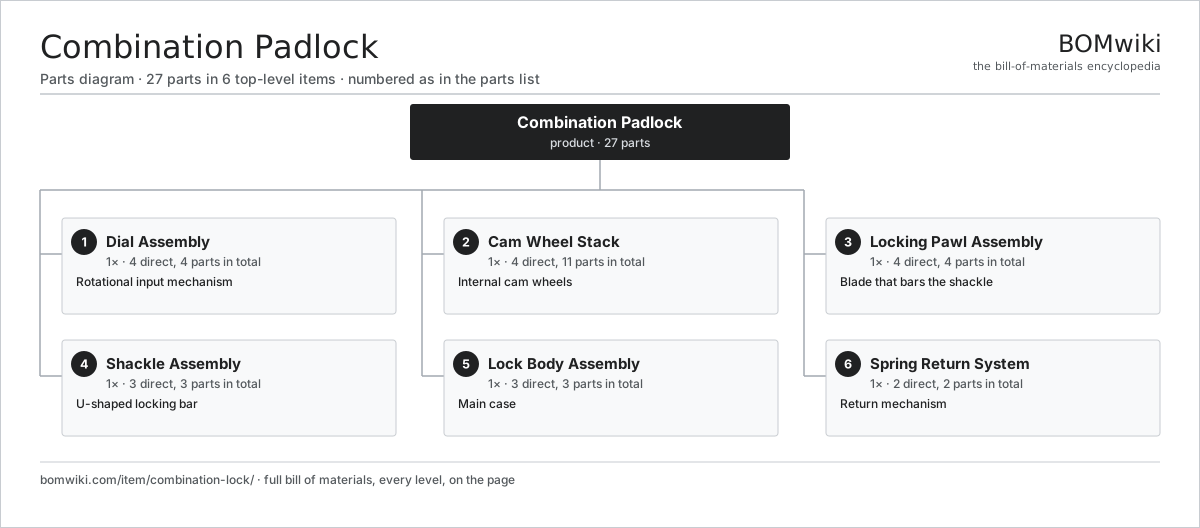
| # | Part | Qty | What it does |
|---|---|---|---|
| 1 | Dial Assembly 4 parts | 1× | Rotational input mechanism |
| 2 | Cam Wheel Stack 4 parts | 1× | Internal cam wheels |
| 3 | Locking Pawl Assembly 4 parts | 1× | Blade that bars the shackle |
| 4 | Shackle Assembly 3 parts | 1× | U-shaped locking bar |
| 5 | Lock Body Assembly 3 parts | 1× | Main case |
| 6 | Spring Return System 2 parts | 1× | Return mechanism |
3D model
No 3D model yet. Have a CAD file of this? Add a 3D model. STL renders right on this page; STEP, FreeCAD, and OpenSCAD sources are welcome too (openly licensed, like all 3D models on BOMwiki).
Build & assembly graph
expand / collapse · shared sub-assemblies converge · links to related products · est. labourTap an assembly to expand/collapse · tap a part to open it · use “Open page” for any node · drag to pan, scroll to zoom.
Bill of materials for Combination Padlock
6 top-level lines · 26 rows shown · 27 parts total · indented to 3 levels| # | Item / sub-assembly | Part no. | Qty/assy | Ext. qty | Parts | Type |
|---|---|---|---|---|---|---|
| 1 | Dial Assembly 4 parts | combination-lock-dial-asm | 1× | 1 | 4 | assembly |
| 1.1 | Dial Wheel | combination-lock-dial-wheel | 1× | 1 | · | part |
| 1.2 | Dial Post | combination-lock-dial-post | 1× | 1 | · | part |
| 1.3 | Dial Washer | combination-lock-dial-washer | 1× | 1 | · | part |
| 1.4 | Dial Spring | combination-lock-dial-spring | 1× | 1 | · | part |
| 2 | Cam Wheel Stack 4 parts | combination-lock-cam-stack | 1× | 1 | 11 | assembly |
| 2.1 | Cam Wheel | combination-lock-cam-wheel | 3× | 3 | · | part |
| 2.2 | Cam Spacer | combination-lock-cam-spacer | 2× | 2 | · | part |
| 2.3 | Cam Pin | combination-lock-cam-pin | 3× | 3 | · | part |
| 2.4 | Cam Tab Notch | combination-lock-cam-notch | 3× | 3 | · | part |
| 3 | Locking Pawl Assembly 4 parts | combination-lock-locking-pawl | 1× | 1 | 4 | assembly |
| 3.1 | Pawl Blade | combination-lock-pawl-blade | 1× | 1 | · | part |
| 3.2 | Pawl Spring | combination-lock-pawl-spring | 1× | 1 | · | part |
| 3.3 | Pawl Pivot | combination-lock-pawl-pivot | 1× | 1 | · | part |
| 3.4 | Pawl Tooth | combination-lock-pawl-tooth | 1× | 1 | · | part |
| 4 | Shackle Assembly 3 parts | combination-lock-shackle | 1× | 1 | 3 | assembly |
| 4.1 | Shackle Bar | combination-lock-shackle-bar | 1× | 1 | · | part |
| 4.2 | Left Shackle Pin | combination-lock-shackle-pin-left | 1× | 1 | · | part |
| 4.3 | Right Shackle Pin | combination-lock-shackle-pin-right | 1× | 1 | · | part |
| 5 | Lock Body Assembly 3 parts | combination-lock-body | 1× | 1 | 3 | assembly |
| 5.1 | Body Casing | combination-lock-body-casing | 1× | 1 | · | part |
| 5.2 | Bottom Plate | combination-lock-body-bottom | 1× | 1 | · | part |
| 5.3 | Body Finish | combination-lock-body-finish | 1× | 1 | · | part |
| 6 | Spring Return System 2 parts | combination-lock-springs | 1× | 1 | 2 | assembly |
| 6.1 | Shackle Spring | combination-lock-shackle-spring | 1× | 1 | · | part |
| 6.2 | Dial Reset Spring | combination-lock-dial-reset-spring | 1× | 1 | · | part |
Something wrong in this list? Report a problem with this BOM.
Sourcing: possible vendors
Browse the supplier directory → Prices, MOQ, and lead times are algorithmic estimates, not quotes, and not claims about these companies. Company mappings are curated by keyword; est. price band $50–$10k. How estimates work| Vendor | HQ | Specialty | MOQ | Lead time |
|---|---|---|---|---|
| assaabloy.com ↗ | Stockholm, SE | Locks & access | 1,000 units | 8–12 wks |
|
🇺🇸Allegion
allegion.com ↗
|
Dublin, US | Security products (Schlage) | 1,000 units | 8–12 wks |
| dormakaba.com ↗ | Rümlang, CH | Access & door systems | 1,000 units | 8–12 wks |
| honeywell.com ↗ | Charlotte, US | Building & safety tech | 1,000 units | 8–12 wks |
| hikvision.com ↗ | Hangzhou, CN | Surveillance & security | 1,000 units | 8–12 wks |
900-word article