Combination Safety Shower & Eyewash
ProductOverview
Emergency safety showers and eyewash stations are critical life-safety devices installed in laboratories, chemical plants, manufacturing facilities, and medical centers. They provide immediate decontamination for workers exposed to hazardous chemicals, caustic liquids, or biological agents. This combination unit integrates both a full-body overhead shower and a dual-eyecup eyewash system, mounted on a stainless steel frame with audible alarm and floor drainage.
The Shower Head delivers 60–80 gallons per minute of water in a soft rain pattern to drench the entire body. The Eyewash Bowl dual eyecups provide targeted washing of both eyes simultaneously at a gentle 0.4 gpm flow. Both are activated by a single yellow Pull-Down Valve pull-down rod; a facility worker simply pulls downward hard to latch the valve open, allowing water to flow for as long as needed. A Alarm System solenoid alarm horn automatically sounds, alerting others that an emergency wash is in progress.
Activation and Valve Design
The Pull-Down Valve assembly is the critical user interface. A bright yellow 50 mm diameter pull rod with an ergonomic handle is mounted at chest height (~1.5 meters). When pulled downward with 25+ N force over 75 mm travel, the Lever Linkage mechanical linkage triggers a Diverter Valve 3-way solenoid valve.
The solenoid has three positions:
- OFF (Spring Return): Water supply blocked. No flow.
- SHOWER Mode: Water diverted to Shower Head (operator-selectable via lever).
- EYEWASH Mode: Water diverted to Eyewash Bowl (operator-selectable via lever).
A Latching Mechanism mechanical latch holds the solenoid energized after the pull rod is released, allowing the worker to use both hands to wash. To stop flow, the worker must reach a reset lever (typically an ergonomic handle) and turn it to de-energize the solenoid.
The system includes a manual Solenoid Coil override button: if electrical power is lost, a worker can still manually depress this button to open the valve mechanically, ensuring the shower functions even during a facility power outage.
Water Supply and Temperature Control
Safety shower water MUST be lukewarm, not ice-cold or scalding. A Mixing Valve thermostatic mixing valve blends hot (from facility boiler) and cold (from main line) water to a setpoint of 15–38°C (60–100°F). The mixing valve has a bimetallic spring that responds to water temperature; if the supply temperature drifts, the mixing valve automatically adjusts the hot/cold ratio to maintain the setpoint.
A critical safety feature is the Thermal Cutoff fusible link valve placed on the hot water supply immediately upstream. If a boiler malfunction or line break causes scalding water (>49°C) to flow toward the shower, the fusible cartridge melts and blocks hot water flow within 5 seconds. This prevents serious burn injuries to workers already distressed from chemical exposure.
Check valves on both hot and cold supplies prevent backflow of contaminated water into the facility's potable water system, a requirement of plumbing codes and medical facility regulations.
Shower Head and Flow Pattern
The Shower Head is a horizontally-mounted Spray Arm 1 inch stainless steel pipe arm with 12 individual spray Spray Nozzle nozzles arranged in a circular pattern. Each nozzle has a 1/8 inch orifice that produces a fan spray 45 degrees wide.
At the design flow rate of 70 gpm distributed across 12 nozzles, each nozzle delivers ~5.8 gpm. The overlapping fan patterns create a "rain shower" effect, continuous coverage across the user's head, torso, and legs when standing directly under the head. An adjustable Flow Control restrictor valve allows on-site technicians to set flow between 60–80 gpm to match facility water pressure.
The shower head is mounted at 2.1 meters (7 feet) above the floor, high enough for an adult to walk completely under without ducking, yet low enough for children or shorter workers to use effectively.
Eyewash System
The Eyewash Bowl is a critical component for chemical splash injuries. Two contoured polycarbonate Left Eyecup and Right Eyecup eyecups are mounted at ~1.4 meters (4.6 feet) height, side-by-side, 6 inches apart to accommodate the distance between a person's eyes.
Each eyecup has a Eyewash Nozzle soft-spray nozzle delivering a gentle stream of water at 0.4 gpm (total 0.8 gpm for both eyes). The stream flows directly into the eye, rinsing away particulates and chemical residue. The eyecups are designed to hold water while the worker's eye is immersed, amplifying the rinsing action.
Removable Left Debris Shield and Right Debris Shield hinged dust covers keep the eyecups clean between uses. When a worker's face contacts the cups, the covers snap open and are held aside by the flow of water. Once flow stops, gravity and springs return the covers to closed position.
The eyewash design allows a solo worker (no buddy required) to flush both eyes simultaneously. ANSI Z358.1 specifies that eyewash nozzles must deliver at least 0.4 gpm per eye at 25 psi; this design exceeds that requirement.
Drainage and Floor Protection
Water exiting the shower and eyewash stations flows to a Floor Grating stainless steel expanded metal floor plate (1200 × 1200 mm / 3.9 × 3.9 feet) sloped at 2% toward the center. A Drain Pan catch basin underneath with 1:10 slope directs all water to a Drain Pipe 3 inch PVC drain line that slopes to the facility's floor drain or a sump pit.
The drain is sized for 120 gpm continuous flow, sufficient for simultaneous shower + eyewash operation plus some margin. In a busy facility, the drain must be sized even larger; preliminary site calculation is required before installation.
The grating prevents standing water that could create slip hazards. The expanded metal pattern (32 mm × 10 mm apertures) allows water to drain quickly while supporting worker weight without gaps that could catch footwear.
Alarm and Notification System
The Alarm System assembly consists of a Flow Switch turbine-type flow sensor in the main water supply line. When water flow exceeds 5 gpm (indicating shower or eyewash activation), the flow switch closes a contact, energizing a Alarm Solenoid 24V DC solenoid. The solenoid has a spring-loaded striker that repeatedly strikes a Alarm Bell 6-inch brass bell, producing a loud ringing at ~100 dB sound pressure.
A Alarm Timer latching relay holds the alarm energized for a minimum of 5 minutes after activation. This ensures:
- Other workers in the facility hear the alarm and respond to assist the affected worker.
- The worker does not inadvertently turn off the alarm prematurely while still contaminated.
The alarm can only be silenced after the 5-minute timer expires, or manually by pressing a reset button on the timer.
Signage and Location Visibility
A Sign and Post overhead post near the shower carries an illuminated Sign Enclosure hazard warning sign (1200 × 600 mm) with ANSI Z535.3 compliant emergency shower symbol. The sign is backlit with LED Light Strip warm white LEDs (3000K color temperature, 24V DC powered) to ensure visibility even in low-light conditions or power-emergency scenarios when facility lighting may be compromised.
The sign is mounted 2.5 meters above the floor, visible from anywhere in the chemical storage or hazardous area, so workers in distress can quickly locate the nearest shower.
Maintenance and Inspection
ANSI Z358.1 requires that showers be inspected weekly and flushed monthly to ensure:
- Water flow rate is adequate (≥0.4 gpm eyewash, ≥60 gpm shower)
- Water temperature is correct (15–38°C / 60–100°F)
- Nozzles are not clogged
- Alarm solenoid functions
- Pull rod and lever mechanisms move freely
The Supply Filter 100 µm mesh strainer cartridge should be replaced annually in hard-water areas to prevent calcium buildup in nozzles. The Mixing Valve thermostatic cartridge and Thermal Cutoff fusible link should be replaced every 3 years as part of routine maintenance, even if not activated.
Regulatory and Standards Compliance
Emergency showers fall under ANSI Z358.1 (American National Standard for Emergency Eyewash and Shower Equipment) and CSA B2125 (Canadian equivalent). OSHA 1910.151(c) requires that facilities with hazardous chemicals provide emergency washing facilities within 10 seconds' travel distance from the hazard. This is typically interpreted as <50 meters horizontal distance and same floor level.
Lab accreditation bodies (AAALAC, CAP) mandate emergency showers for any facility handling hazardous substances. Medical device manufacturers (FDA) require them for any area with biological or chemical exposure.
A combination unit like this satisfies multiple facility requirements with one installation, making it cost-effective for multi-hazard areas (chemistry labs, hazmat storage, medical device manufacturing).
Combination Safety Shower & Eyewash parts and their functions
8 top-level parts · 84 parts in total · full bill of materials below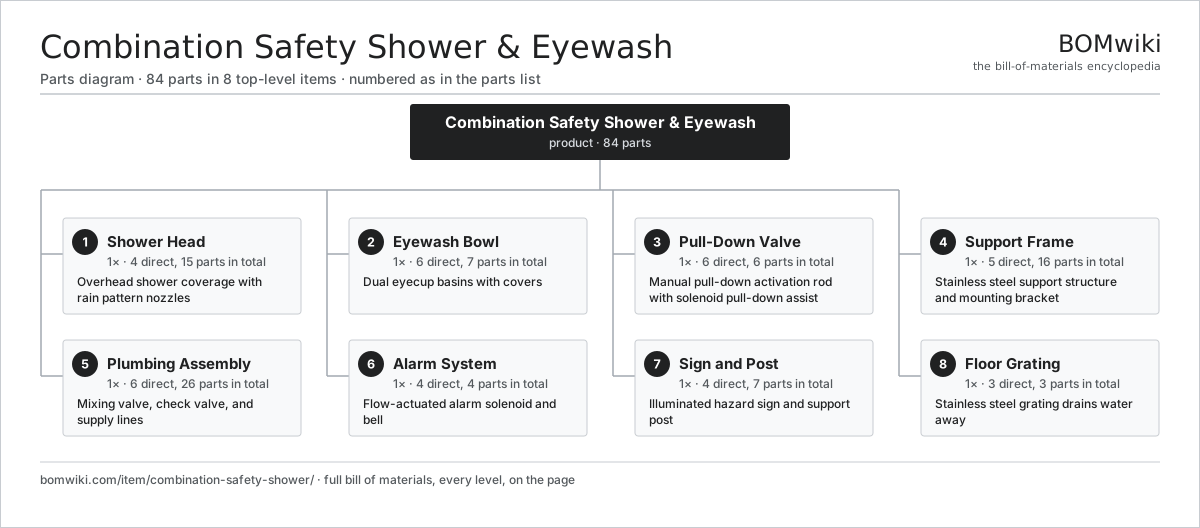
| # | Part | Qty | What it does |
|---|---|---|---|
| 1 | Shower Head 4 parts | 1× | Overhead shower coverage with rain pattern nozzles |
| 2 | Eyewash Bowl 6 parts | 1× | Dual eyecup basins with covers |
| 3 | Pull-Down Valve 6 parts | 1× | Manual pull-down activation rod with solenoid pull-down assist |
| 4 | Support Frame 5 parts | 1× | Stainless steel support structure and mounting bracket |
| 5 | Plumbing Assembly 6 parts | 1× | Mixing valve, check valve, and supply lines |
| 6 | Alarm System 4 parts | 1× | Flow-actuated alarm solenoid and bell |
| 7 | Sign and Post 4 parts | 1× | Illuminated hazard sign and support post |
| 8 | Floor Grating 3 parts | 1× | Stainless steel grating drains water away |
3D model
No 3D model yet. Have a CAD file of this? Add a 3D model. STL renders right on this page; STEP, FreeCAD, and OpenSCAD sources are welcome too (openly licensed, like all 3D models on BOMwiki).
Build & assembly graph
expand / collapse · shared sub-assemblies converge · links to related products · est. labourTap an assembly to expand/collapse · tap a part to open it · use “Open page” for any node · drag to pan, scroll to zoom.
Bill of materials for Combination Safety Shower & Eyewash
8 top-level lines · 46 rows shown · 84 parts total · indented to 3 levels| # | Item / sub-assembly | Part no. | Qty/assy | Ext. qty | Parts | Type |
|---|---|---|---|---|---|---|
| 1 | Shower Head 4 parts | combination-safety-shower-shower-head | 1× | 1 | 15 | assembly |
| 1.1 | Spray Arm | combination-safety-shower-shower-spray-arm | 1× | 1 | · | part |
| 1.2 | Spray Nozzle | combination-safety-shower-nozzle-cluster | 12× | 12 | · | part |
| 1.3 | Nozzle Ring | combination-safety-shower-spray-ring | 1× | 1 | · | part |
| 1.4 | Flow Control | combination-safety-shower-flow-control | 1× | 1 | · | part |
| 2 | Eyewash Bowl 6 parts | combination-safety-shower-eyewash-bowl | 1× | 1 | 7 | assembly |
| 2.1 | Left Eyecup | combination-safety-shower-eyecup-left | 1× | 1 | · | part |
| 2.2 | Right Eyecup | combination-safety-shower-eyecup-right | 1× | 1 | · | part |
| 2.3 | Eyewash Nozzle | combination-safety-shower-eyewash-nozzle | 2× | 2 | · | part |
| 2.4 | Left Debris Shield | combination-safety-shower-debris-shield-left | 1× | 1 | · | part |
| 2.5 | Right Debris Shield | combination-safety-shower-debris-shield-right | 1× | 1 | · | part |
| 2.6 | Eyewash Drain | combination-safety-shower-eyewash-drain | 1× | 1 | · | part |
| 3 | Pull-Down Valve 6 parts | combination-safety-shower-pull-valve | 1× | 1 | 6 | assembly |
| 3.1 | Pull Rod | combination-safety-shower-pull-rod | 1× | 1 | · | part |
| 3.2 | Lever Linkage | combination-safety-shower-lever-linkage | 1× | 1 | · | part |
| 3.3 | Diverter Valve | combination-safety-shower-diverter-valve | 1× | 1 | · | part |
| 3.4 | Solenoid Coil | combination-safety-shower-solenoid-coil | 1× | 1 | · | part |
| 3.5 | Return Spring | combination-safety-shower-return-spring | 1× | 1 | · | part |
| 3.6 | Latching Mechanism | combination-safety-shower-latching-mechanism | 1× | 1 | · | part |
| 4 | Support Frame 5 parts | combination-safety-shower-frame | 1× | 1 | 16 | assembly |
| 4.1 | Frame Upright | combination-safety-shower-frame-uprights | 2× | 2 | · | part |
| 4.2 | Crossbar | combination-safety-shower-frame-crossbar | 1× | 1 | · | part |
| 4.3 | Base Plate | combination-safety-shower-frame-base-plate | 1× | 1 | · | part |
| 4.4 | Anchor Bolt | combination-safety-shower-frame-bolts | 8× | 8 | · | part |
| 4.5 | Vibration Isolator | combination-safety-shower-vibration-isolator | 4× | 4 | · | part |
| 5 | Plumbing Assembly 6 parts | combination-safety-shower-plumbing | 1× | 1 | 26 | assembly |
| 5.1 | Mixing Valve | combination-safety-shower-mixing-valve | 1× | 1 | · | part |
| 5.2 | Thermal Cutoff | combination-safety-shower-thermal-cutoff | 1× | 1 | · | part |
| 5.3 | Check Valve | combination-safety-shower-check-valve | 2× | 2 | · | part |
| 5.4 | Supply Hose | combination-safety-shower-hose-supply | 20× | 20 | · | part |
| 5.5 | Pressure Regulator | combination-safety-shower-pressure-regulator | 1× | 1 | · | part |
| 5.6 | Supply Filter | combination-safety-shower-filter | 1× | 1 | · | part |
| 6 | Alarm System 4 parts | combination-safety-shower-alarm | 1× | 1 | 4 | assembly |
| 6.1 | Flow Switch | combination-safety-shower-flow-switch | 1× | 1 | · | part |
| 6.2 | Alarm Solenoid | combination-safety-shower-alarm-solenoid | 1× | 1 | · | part |
| 6.3 | Alarm Bell | combination-safety-shower-alarm-bell | 1× | 1 | · | part |
| 6.4 | Alarm Timer | combination-safety-shower-alarm-timer | 1× | 1 | · | part |
| 7 | Sign and Post 4 parts | combination-safety-shower-sign-frame | 1× | 1 | 7 | assembly |
| 7.1 | Sign Enclosure | combination-safety-shower-sign-enclosure | 1× | 1 | · | part |
| 7.2 | Sign Graphic | combination-safety-shower-sign-graphic | 1× | 1 | · | part |
| 7.3 | Sign Post | combination-safety-shower-sign-post | 1× | 1 | · | part |
| 7.4 | LED Light Strip | combination-safety-shower-sign-light | 4× | 4 | · | part |
| 8 | Floor Grating 3 parts | combination-safety-shower-floor-grating | 1× | 1 | 3 | assembly |
| 8.1 | Grating Panel | combination-safety-shower-grating-panel | 1× | 1 | · | part |
| 8.2 | Drain Pan | combination-safety-shower-drain-pan | 1× | 1 | · | part |
| 8.3 | Drain Pipe | combination-safety-shower-drain-pipe | 1× | 1 | · | part |
Something wrong in this list? Report a problem with this BOM.
Used in 1 assembly
Sourcing: possible vendors
Browse the supplier directory → Prices, MOQ, and lead times are algorithmic estimates, not quotes, and not claims about these companies. Company mappings are curated by keyword; est. price band $50–$10k. How estimates work| Vendor | HQ | Specialty | MOQ | Lead time |
|---|---|---|---|---|
| assaabloy.com ↗ | Stockholm, SE | Locks & access | 1,000 units | 8–12 wks |
|
🇺🇸Allegion
allegion.com ↗
|
Dublin, US | Security products (Schlage) | 1,000 units | 8–12 wks |
| dormakaba.com ↗ | Rümlang, CH | Access & door systems | 1,000 units | 8–12 wks |
| honeywell.com ↗ | Charlotte, US | Building & safety tech | 1,000 units | 8–12 wks |
| hikvision.com ↗ | Hangzhou, CN | Surveillance & security | 1,000 units | 8–12 wks |
1,537-word article