Commercial Wok Range
ProductOverview
A commercial wok range is a specialized cooking station designed for high-heat stir-frying, a cooking technique that demands rapid and intense heat. The equipment pairs multiple high-BTU gas burners with a water-cooled collar that stabilizes the wok and manages radiant heat, allowing chefs to toss ingredients confidently while the wok itself stays cool enough to handle.
The wok is a shaped steel vessel, typically 14–20 inches in diameter, with sloped sides that funnel ingredients toward the hottest center area. In a traditional home kitchen, the wok sits on a ring burner over a residential gas stove; in a commercial kitchen, it sits in a Wok Chamber, a heavy cast-iron or steel shell that directs intense flame upward and confines the heat. The shape of the chamber guides the flame to wrap around the sides and bottom of the wok, creating a uniform, brutal radiant environment, often reaching 1000 °F or higher at the wok surface.
A Water Cooling System circulates cold water through a ring around the Wok Chamber, protecting the stand structure and nearby equipment from excessive heat. This cooling ring is essential in a crowded kitchen: without it, the station would be intolerable to work near for more than a few minutes.
The Burner System sits beneath the wok chamber, typically two or three individual Main Jet Burner units that can be controlled independently. This allows the chef to vary the heat intensity across different zones of the wok, low and medium flames for some items, high flame for others, all within a single dish's cooking sequence.
How it works
A cook fills the wok with oil and sets it on the collar. The commercial-wok-range-pilot-burner is already lit and glowing. When the chef turns the main burner valve, gas flows to the Main Jet Burner, where it mixes with air drawn in through the Air Intake. The fuel-air mixture ignites at the pilot, and a tall, bright flame rises into the Chamber Body, a cast-iron bowl.
The cast-iron absorbs the flame's heat and begins to radiate it back, creating a roughly uniform heat field that surrounds the wok. The wok itself, sitting in the Wok Collar, is exposed to this intense radiation from all sides. The sloped shape of the wok concentrates the hottest zone at the center bottom.
Oil in the wok heats to 350–400 °F in seconds. The chef tosses in prepared ingredients, sliced protein, vegetables, aromatics, and immediately begins tossing and stirring using a long-handled spatula or the wok's rim itself. The high heat sears the outside of the ingredients while the constant motion ensures even exposure and prevents sticking. Liquid ingredients vaporize quickly, creating a turbulent, aromatic environment. The entire cooking process, from oil-hot to finished dish, often takes 2–4 minutes.
The Water Cooling System continuously circulates cool water through the jacket around the wok chamber. This keeps the stand temperature low (typically 140–180 °F) and protects nearby work surfaces and the chef's forearm from radiant burn. The water inlet and outlet are usually 1/2 inch NPT threaded connections fed from a facility water line.
The chef controls the burner intensity by turning the Control Knob or pulling the control valve lever. The commercial-wok-range-thermostatic-cartridge inside the control valve senses the temperature of the wok chamber and automatically adjusts the fuel flow to maintain roughly constant radiant temperature, compensating for changes in incoming gas pressure.
Stir-frying is one of the fastest and most theatrical cooking methods, and the commercial wok range is its perfect vessel, simple, robust, and capable of delivering the intense, sustained heat required for professional-level execution.
Commercial Wok Range parts and their functions
5 top-level parts · 24 parts in total · full bill of materials below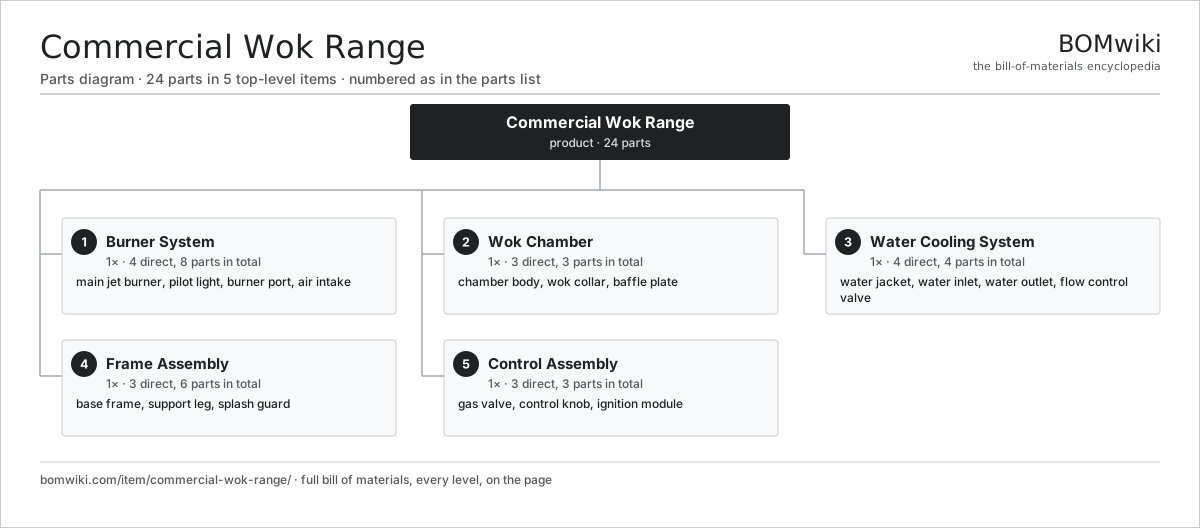
| # | Part | Qty | What it does |
|---|---|---|---|
| 1 | Burner System 4 parts | 1× | Multiple high-BTU jet burners that deliver intense, turbulent flame into the wok chamber. |
| 2 | Wok Chamber 3 parts | 1× | Heat-resistant chamber that seats the wok and directs flame upward while containing splatter. |
| 3 | Water Cooling System 4 parts | 1× | Jacket around the wok chamber that circulates cool water to prevent overheating and protect operators. |
| 4 | Frame Assembly 3 parts | 1× | Steel structural base that supports the wok chamber and burner system. |
| 5 | Control Assembly 3 parts | 1× | Gas valve and manual control knob that regulate flame intensity and heat output. |
3D model
No 3D model yet. Have a CAD file of this? Add a 3D model. STL renders right on this page; STEP, FreeCAD, and OpenSCAD sources are welcome too (openly licensed, like all 3D models on BOMwiki).
Build & assembly graph
expand / collapse · shared sub-assemblies converge · links to related products · est. labourTap an assembly to expand/collapse · tap a part to open it · use “Open page” for any node · drag to pan, scroll to zoom.
Bill of materials for Commercial Wok Range
5 top-level lines · 22 rows shown · 24 parts total · indented to 3 levels| # | Item / sub-assembly | Part no. | Qty/assy | Ext. qty | Parts | Type |
|---|---|---|---|---|---|---|
| 1 | Burner System 4 parts | commercial-wok-range-burner-system | 1× | 1 | 8 | assembly |
| 1.1 | Main Jet Burner | commercial-wok-range-main-burner | 2× | 2 | · | part |
| 1.2 | Pilot Light | commercial-wok-range-pilot-light | 1× | 1 | · | part |
| 1.3 | Burner Port | commercial-wok-range-burner-port | 4× | 4 | · | part |
| 1.4 | Air Intake | commercial-wok-range-air-intake | 1× | 1 | · | part |
| 2 | Wok Chamber 3 parts | commercial-wok-range-wok-chamber | 1× | 1 | 3 | assembly |
| 2.1 | Chamber Body | commercial-wok-range-chamber-body | 1× | 1 | · | part |
| 2.2 | Wok Collar | commercial-wok-range-wok-collar | 1× | 1 | · | part |
| 2.3 | Baffle Plate | commercial-wok-range-baffle-plate | 1× | 1 | · | part |
| 3 | Water Cooling System 4 parts | commercial-wok-range-cooling-system | 1× | 1 | 4 | assembly |
| 3.1 | Water Jacket | commercial-wok-range-water-jacket | 1× | 1 | · | part |
| 3.2 | Water Inlet | commercial-wok-range-water-inlet | 1× | 1 | · | part |
| 3.3 | Water Outlet | commercial-wok-range-water-outlet | 1× | 1 | · | part |
| 3.4 | Flow Control Valve | commercial-wok-range-flow-control | 1× | 1 | · | part |
| 4 | Frame Assembly 3 parts | commercial-wok-range-frame | 1× | 1 | 6 | assembly |
| 4.1 | Base Frame | commercial-wok-range-base-frame | 1× | 1 | · | part |
| 4.2 | Support Leg | commercial-wok-range-legs | 4× | 4 | · | part |
| 4.3 | Splash Guard | commercial-wok-range-splash-guard | 1× | 1 | · | part |
| 5 | Control Assembly 3 parts | commercial-wok-range-controls | 1× | 1 | 3 | assembly |
| 5.1 | Gas Valve | commercial-wok-range-gas-valve | 1× | 1 | · | part |
| 5.2 | Control Knob | commercial-wok-range-control-knob | 1× | 1 | · | part |
| 5.3 | Ignition Module | commercial-wok-range-ignition-module | 1× | 1 | · | part |
Something wrong in this list? Report a problem with this BOM.
Sourcing: possible vendors
Browse the supplier directory → Prices, MOQ, and lead times are algorithmic estimates, not quotes, and not claims about these companies. Company mappings are curated by keyword; est. price band $1k–$500k. How estimates work| Vendor | HQ | Specialty | MOQ | Lead time |
|---|---|---|---|---|
| gea.com ↗ | Düsseldorf, DE | Process technology | 20 units | 12–20 wks |
| buhlergroup.com ↗ | Uzwil, CH | Food & materials processing | 20 units | 12–20 wks |
| tetrapak.com ↗ | Pully, CH | Food packaging & processing | 20 units | 12–20 wks |
| jbtc.com ↗ | Chicago, US | Food processing equipment | 20 units | 12–20 wks |
| alfalaval.com ↗ | Lund, SE | Heat transfer & separation | 20 units | 12–20 wks |
653-word article