Compound Bow
ProductOverview
A compound bow is a bow with a mechanical advantage stage between the archer and the limbs. Eccentric pulleys, cams, on the limb tips change their effective radius as they rotate through the draw, so the force the archer feels follows a designed curve: it climbs quickly to the peak weight, holds there through the middle of the stroke where energy storage is cheapest, then falls off steeply to a holding weight of 10–20% of peak. An archer drawing 70 lb holds about 12 lb at full draw, can aim for half a minute without trembling, and launches the arrow at 330+ fps, roughly 100 fps faster than a recurve of the same peak weight, because the flat-topped force curve stores far more area under it.
Force path
Energy storage happens in the Limb Set, not the cams. Each Limb is a unidirectional fiberglass/epoxy leaf spring; modern bows use short, nearly parallel limbs in pairs (split limbs), so the two limb tips kick in opposite directions on release and the recoil largely cancels at the Riser. The limbs seat in pivoting Limb Pockets on hardened Pivot Rockers, and the Limb Bolts preload them, backing the bolts out evenly drops peak weight through its 10–15 lb adjustment range.
The riser between them is the machine frame: a CNC-machined 6061 or 7075 aluminum Riser Frame (carbon on flagship models) whose cutouts are tuned for stiffness per gram. It is deliberately reflexed, the grip sits behind the limb pockets, which is what buys a short 6.5 in brace height and its speed. The narrow Grip puts hand pressure on the centerline because at full draw the system is a loaded spring of ~85 J, and a few degrees of hand torque shows up as inches at 60 yards.
The cam system
The Cam System is where the design lives. Each cam carries two tracks of different, varying radii: the string track pays out the Bowstring while the cable track winds in a Control Cable. The instantaneous ratio of the two radii sets the mechanical advantage at that point of the draw; the cam profile is literally the force-draw curve made into hardware. At full draw the cam rotates past its peak-ratio point and the ratio collapses, that is let-off. The archer holds 12 lb while the cables hold the limbs at nearly 300 lbf, the load simply having moved from the archer's fingers into the Cam Axles and Ball Bearings.
In a binary system the Top Cam and Bottom Cam are slaved to each other by the cables, so they cannot rotate out of phase and nock travel stays level without tuning. Draw Length Modules, interchangeable or rotating inserts on the cam, set draw length in half-inch steps, and Cam Spacers center each cam between the split limbs so the string tracks straight.
Because the cables must cross the bow's midplane where the arrow flies, the Cable Guard Assembly pulls them aside: the Cable Guard Rod cantilevers from the riser and the cables run through a Cable Slide. The side load this creates is the main source of cam lean, which is why many guards now flex on purpose, relaxing the offset as the draw progresses.
String system
The Bowstring is ~24 strands of HMPE fiber, prestretched so it will not creep under the permanent preload; on a compound the string and cables are structural members holding the cams in time, and 1/8 in of cable stretch changes draw length, peak weight, and cam synchronization at once. The Center Serving jackets the nocking area, the D-Loop gives the mechanical release a sacrificial grip point, and the Peep Sight served into the strands forms the rear sight. After release the String Stop arrests the string at brace, with String Silencers, Limb Dampers, and the Vibration Damping Set set turning residual oscillation into heat, on a hunting bow, the noise budget matters because a whitetail can react to the shot sound before a 340 fps arrow covers 30 yards.
Efficiency and accessories
A tuned compound delivers 80–87% of stored energy to the arrow, against ~70% for a good recurve, because the heavy string travel happens while the cams are unloading rather than fighting limb-tip inertia. The remainder becomes the vibration the damper system exists to absorb.
The bare bow is completed through the Accessory Interface: sight on the Sight Mount, drop-away rest in the Arrow Rest Mount Berger hole, stabilizer in the Stabilizer Bushing (decoupled through the Stabilizer Damper), and quiver on the Quiver Mount. Unlike a recurve, almost nothing on a compound is serviced by hand, replacing a string or cable means a bow press to relax the ~300 lbf the String and Cable Set carry at brace.
Compound Bow parts and their functions
8 top-level parts · 50 parts in total · full bill of materials below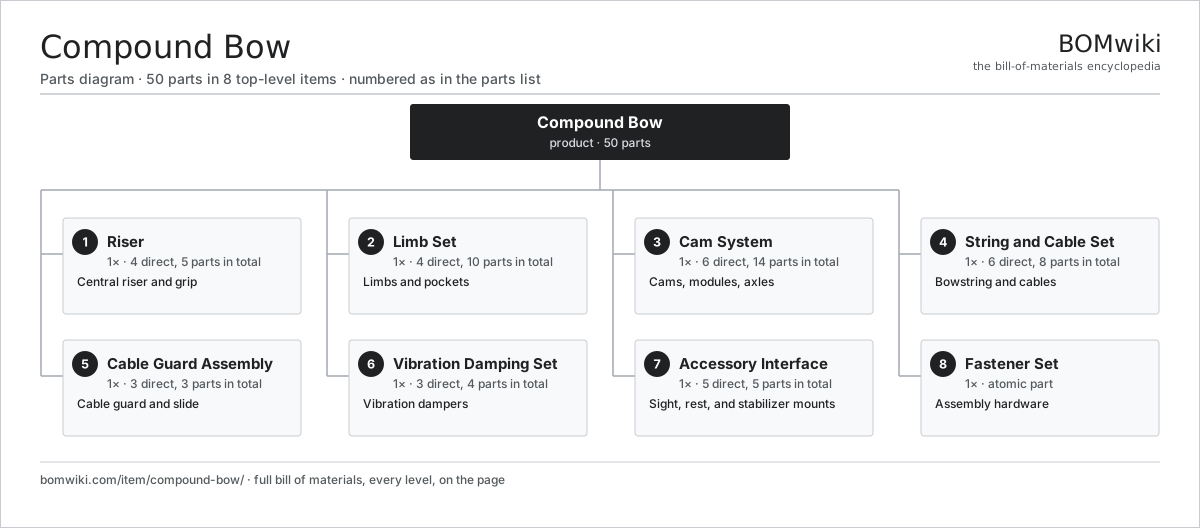
| # | Part | Qty | What it does |
|---|---|---|---|
| 1 | Riser 4 parts | 1× | Central riser and grip |
| 2 | Limb Set 4 parts | 1× | Limbs and pockets |
| 3 | Cam System 6 parts | 1× | Cams, modules, axles |
| 4 | String and Cable Set 6 parts | 1× | Bowstring and cables |
| 5 | Cable Guard Assembly 3 parts | 1× | Cable guard and slide |
| 6 | Vibration Damping Set 3 parts | 1× | Vibration dampers |
| 7 | Accessory Interface 5 parts | 1× | Sight, rest, and stabilizer mounts |
| 8 | Fastener Set | 1× | Assembly hardware |
3D model
No 3D model yet. Have a CAD file of this? Add a 3D model. STL renders right on this page; STEP, FreeCAD, and OpenSCAD sources are welcome too (openly licensed, like all 3D models on BOMwiki).
Build & assembly graph
expand / collapse · shared sub-assemblies converge · links to related products · est. labourTap an assembly to expand/collapse · tap a part to open it · use “Open page” for any node · drag to pan, scroll to zoom.
Bill of materials for Compound Bow
8 top-level lines · 39 rows shown · 50 parts total · indented to 3 levels| # | Item / sub-assembly | Part no. | Qty/assy | Ext. qty | Parts | Type |
|---|---|---|---|---|---|---|
| 1 | Riser 4 parts | compound-bow-riser | 1× | 1 | 5 | assembly |
| 1.1 | Riser Frame | compound-bow-riser-frame | 1× | 1 | · | part |
| 1.2 | Grip | compound-bow-grip | 1× | 1 | · | part |
| 1.3 | Limb Bolt | compound-bow-limb-bolt | 2× | 2 | · | part |
| 1.4 | String Stop | compound-bow-string-stop | 1× | 1 | · | part |
| 2 | Limb Set 4 parts | compound-bow-limb-set | 1× | 1 | 10 | assembly |
| 2.1 | Limb | compound-bow-limb | 4× | 4 | · | part |
| 2.2 | Limb Pocket | compound-bow-limb-pocket | 2× | 2 | · | part |
| 2.3 | Pivot Rocker | compound-bow-pivot-rocker | 2× | 2 | · | part |
| 2.4 | Limb Damper | compound-bow-limb-damper | 2× | 2 | · | part |
| 3 | Cam System 6 parts | compound-bow-cam-system | 1× | 1 | 14 | assembly |
| 3.1 | Top Cam | compound-bow-top-cam | 1× | 1 | · | part |
| 3.2 | Bottom Cam | compound-bow-bottom-cam | 1× | 1 | · | part |
| 3.3 | Draw Length Module | compound-bow-draw-module | 2× | 2 | · | part |
| 3.4 | Cam Axle | compound-bow-axle | 2× | 2 | · | part |
| 3.5 | Cam Spacer | compound-bow-cam-spacer | 4× | 4 | · | part |
| 3.6 | Ball Bearing | ball-bearing | 4× | 4 | · | part |
| 4 | String and Cable Set 6 parts | compound-bow-string-cables | 1× | 1 | 8 | assembly |
| 4.1 | Bowstring | compound-bow-bowstring | 1× | 1 | · | part |
| 4.2 | Control Cable | compound-bow-control-cable | 2× | 2 | · | part |
| 4.3 | Center Serving | compound-bow-center-serving | 1× | 1 | · | part |
| 4.4 | D-Loop | compound-bow-d-loop | 1× | 1 | · | part |
| 4.5 | Peep Sight | compound-bow-peep-sight | 1× | 1 | · | part |
| 4.6 | String Silencer | compound-bow-string-silencer | 2× | 2 | · | part |
| 5 | Cable Guard Assembly 3 parts | compound-bow-cable-guard | 1× | 1 | 3 | assembly |
| 5.1 | Cable Guard Rod | compound-bow-guard-rod | 1× | 1 | · | part |
| 5.2 | Cable Slide | compound-bow-cable-slide | 1× | 1 | · | part |
| 5.3 | Guard Mount | compound-bow-guard-mount | 1× | 1 | · | part |
| 6 | Vibration Damping Set 3 parts | compound-bow-dampers | 1× | 1 | 4 | assembly |
| 6.1 | Riser Damper | compound-bow-riser-damper | 2× | 2 | · | part |
| 6.2 | String Stop Tip | compound-bow-string-stop-tip | 1× | 1 | · | part |
| 6.3 | Stabilizer Damper | compound-bow-stabilizer-damper | 1× | 1 | · | part |
| 7 | Accessory Interface 5 parts | compound-bow-accessory-interface | 1× | 1 | 5 | assembly |
| 7.1 | Sight Mount | compound-bow-sight-mount | 1× | 1 | · | part |
| 7.2 | Arrow Rest Mount | compound-bow-rest-mount | 1× | 1 | · | part |
| 7.3 | Stabilizer Bushing | compound-bow-stabilizer-bushing | 1× | 1 | · | part |
| 7.4 | Quiver Mount | compound-bow-quiver-mount | 1× | 1 | · | part |
| 7.5 | Fastener Set | fastener-set | 1× | 1 | · | part |
| 8 | Fastener Set | fastener-set | 1× | 1 | · | part |
Something wrong in this list? Report a problem with this BOM.
Related products
same domain, ranked by shared parts Baitcasting Reel
51 parts · shares 2 with this page
Clay Pigeon Thrower
47 parts · shares 2 with this page
Baitcasting Reel
51 parts · shares 2 with this page
Clay Pigeon Thrower
47 parts · shares 2 with this page
 Power Ice Auger
37 parts · shares 2 with this page
Power Ice Auger
37 parts · shares 2 with this page
 Rappel Descender
26 parts · shares 2 with this page
Rappel Descender
26 parts · shares 2 with this page
 Rope Ascender
29 parts · shares 2 with this page
Rope Ascender
29 parts · shares 2 with this page
 Spinning Fishing Reel
44 parts · shares 2 with this page
Spinning Fishing Reel
44 parts · shares 2 with this page
Sourcing: possible vendors
Browse the supplier directory → Prices, MOQ, and lead times are algorithmic estimates, not quotes, and not claims about these companies. Company mappings are curated by keyword; est. price band $20–$2k. How estimates work| Vendor | HQ | Specialty | MOQ | Lead time |
|---|---|---|---|---|
|
🇺🇸Coleman
coleman.com ↗
|
Chicago, US | Camping gear | 1,000 units | 6–10 wks |
| thenorthface.com ↗ | Denver, US | Outdoor apparel & gear | 1,000 units | 6–10 wks |
|
🇺🇸YETI
yeti.com ↗
|
Austin, US | Coolers & drinkware | 1,000 units | 6–10 wks |
| decathlon.com ↗ | Villeneuve-d'Ascq, FR | Sporting goods | 1,000 units | 6–10 wks |
|
🇺🇸Garmin
garmin.com ↗
|
Olathe, US | GPS & wearables | 1,000 units | 6–10 wks |
870-word article