Concrete Batch Plant
ProductOverview
A stationary concrete batch plant produces ready-mix concrete by proportioning aggregates (coarse stone and fine sand), Portland cement, water, and optional admixtures, then mixing them thoroughly. Unlike asphalt plants, concrete plants must maintain strict accuracy in proportioning, typically ±1–2% by weight, because concrete strength and workability are highly sensitive to water-cement ratio and air content. Batch plants are the dominant technology for ready-mix concrete supply, operating at construction sites, quarries, and dedicated batch facilities.
How it works
Operators input a mix design recipe (e.g., 3-inch slump, 3000 psi 28-day strength) into the plant's programmable logic controller (PLC). Cold aggregates (coarse and fine) are vibrated from storage bins onto weigh scales, accumulating the correct weight for one batch, typically 2–4 tons of concrete. Simultaneously, Portland cement is discharged from a sealed silo via an auger, and water is metered from a tank using a flow meter and solenoid valve. Liquid admixtures (plasticizers, retarders, air-entrainment agents) are also injected at precise volumes.
All materials are discharged into a rotating drum mixer, which blends them for 60–90 seconds. The mixer tilts or opens, releasing the finished concrete down a conveyor belt into a ready-mix truck (typically a rotating drum truck). The truck carries the concrete to the construction site, where it is pumped or poured into formwork. The mixer cycle repeats, a modern plant can produce 30–60 m³/hour.
Components and subsystems
Aggregate Storage System
Multiple large hoppers store coarse aggregate (10–20 mm stone) and fine aggregate (0–5 mm sand). These are typically divided into two bins, though some recipes may specify three fractions for tighter gradation control. Each bin is fitted with a vibrating feeder that discharges material onto a weigh scale. The scale is a platform equipped with load cells that measure weight continuously. Once the target weight is reached, the feeder stops, and the material is held in a weigh hopper above the mixer.
Cement Storage Silo
Portland cement is stored in a sealed cylindrical silo (40–100 ton capacity, 8–12 m tall) to protect it from moisture. A screw auger at the silo base rotates and discharges cement into the weigh hopper at a controlled rate. A load cell under the weigh hopper measures cement weight. A vent filter (pulse-jet baghouse) on top of the silo prevents dust escape during truck unloading while allowing pressure relief during discharge.
Weigh Batchers
All four material streams (coarse aggregate, fine aggregate, cement, water) converge at a set of weigh hoppers. These hoppers are suspended on load cells that send signals to the PLC. The operator specifies target weights for each material; the PLC controls each feeder or pump until the target is reached. Once all materials are weighed and confirmed, pneumatic gates release them simultaneously into the mixer drum. This all-at-once discharge ensures uniform mixing.
Concrete Mixer Drum
The heart of the plant. A rotating drum (1.5–3 m³ capacity) is fitted with fixed helical blades welded to the interior. As the drum rotates at 30–50 rpm, the blades lift and cascade the concrete, blending all components uniformly. Mixing time is typically 60–90 seconds; the PLC controls when the mixer stops and discharges. The drum is often tilted or pivots to empty the concrete. Some mixers are heated (jacketed with steam) to warm concrete in cold weather.
Water Metering System
Water is stored in a large tank (10–20 m³) and pressurized by an electric pump (3–5 kW). A flow meter (turbine or ultrasonic) measures water volume, and a solenoid valve controls the injection point and duration. The nozzle sprays water into the mixer, ensuring even distribution. Water temperature affects concrete setting time; modern plants may include a heater for winter operation.
Admixture Injection System
Liquid admixtures are injected to modify concrete properties: air-entrainment agents improve freeze-thaw resistance, plasticizers increase workability, retarders slow setting (useful in hot weather). Each admixture type has its own tank, pump, flow meter, solenoid valve, and injection nozzle. The PLC controls injection timing and volume independently for each admixture.
Discharge Conveyor
A steeply inclined belt conveyor (15–20° slope) carries fresh concrete from the mixer discharge chute into the ready-mix truck. The conveyor is typically 8–15 m long and moves at slow speed (0.3–0.5 m/s) to minimize segregation. Impact idlers at the load point absorb the shock of concrete landing on the belt.
Control System
The PLC is programmed with multiple concrete recipes, each specifying exact weights of coarse, fine, cement, water, and each admixture. The operator selects a recipe on a color touchscreen HMI, presses "Start," and the PLC sequences all feeders and pumps. Sensors (load cells, flow meters, timers) provide feedback, ensuring each material is dispensed accurately. When the batch is complete, the system prints a "batch ticket" showing all weights and admixtures, this is used for traceability and quality assurance at the construction site.
Engineering considerations
Proportioning accuracy: Concrete strength depends critically on water-cement ratio (typically 0.40–0.55 by weight). A ±2% error in cement or water can reduce 28-day strength by 5–10%. Modern load cells and digital weighing systems achieve ±0.5% accuracy, meeting industry standards (ASTM C94).
Segregation: If mixing time is too short, or if the drum rotates too slowly, large aggregates can separate from the paste. Conversely, overmixing can damage the air-void structure in air-entrained concrete. Optimal mixing time is typically 60–90 seconds for a 1.5–3 m³ mixer.
Ready-mix truck time: Concrete must remain workable during transport to the site, typically 90–120 minutes. Hot weather or long haul distances may require retarders or cooling (ice water). Segregation also increases with transport time, so drum speed (usually 2–3 rpm transit) is slow to maintain homogeneity.
Cement hydration: Portland cement begins hydrating as soon as water is added, so the window for mixing, transport, and placement is finite. In hot weather, concrete "slumps" (loses workability) faster, necessitating retarder admixtures and reduced water.
Water-cement ratio and durability: While 3000 psi strength might require w/c = 0.50, long-term durability (especially in freeze-thaw or salt exposure) may require w/c = 0.45 or lower. Architects and engineers specify both strength and durability requirements; the batch plant operator ensures the recipe meets both.
Comparison to continuous systems
Some very large facilities use continuous mixers (e.g., belt or drum conveyors fitted with mixing paddles), which eliminate the weighing/batching cycle and allow truly continuous flow. However, continuous systems are harder to control (difficult to change recipes mid-stream) and are used only in very high-volume operations (>200 m³/hour). Most concrete production uses batch plants for flexibility and simplicity.
Maintenance and wear
The main wear items are mixer drum liners (replaced every 2–5 years), auger tips, and rubber conveyor belts. Load cells and solenoid valves require periodic calibration and testing. A well-maintained plant can operate 5000+ hours per year with <5% downtime.
Concrete Batch Plant parts and their functions
9 top-level parts · 76 parts in total · full bill of materials below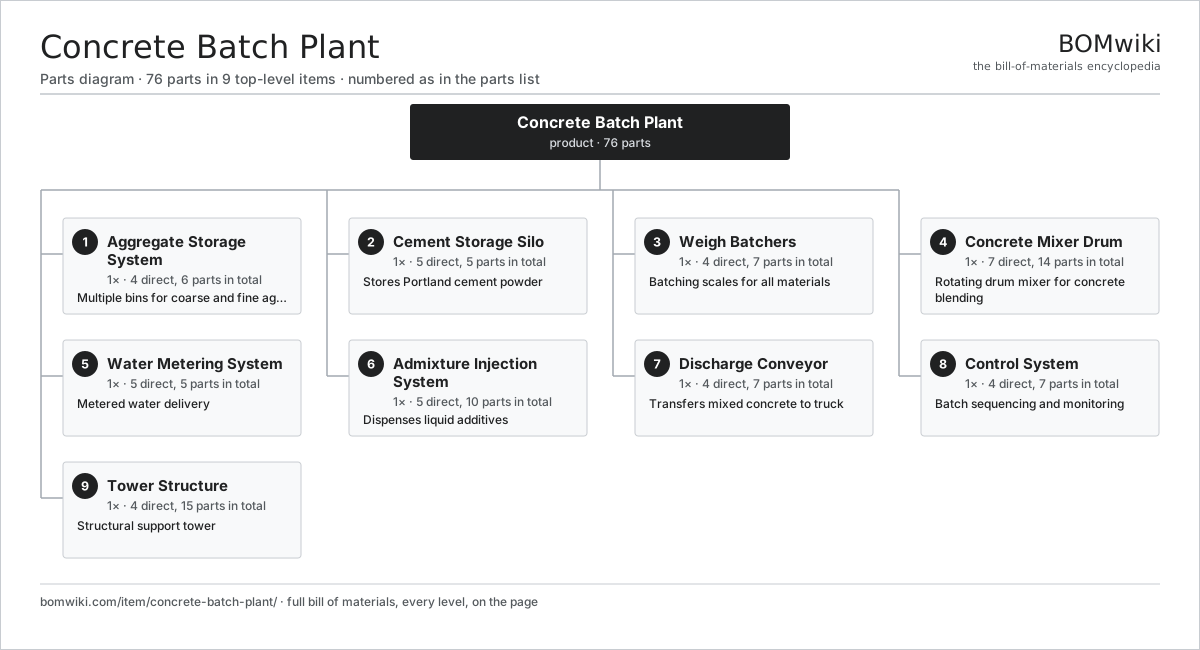
| # | Part | Qty | What it does |
|---|---|---|---|
| 1 | Aggregate Storage System 4 parts | 1× | Multiple bins for coarse and fine aggregate |
| 2 | Cement Storage Silo 5 parts | 1× | Stores Portland cement powder |
| 3 | Weigh Batchers 4 parts | 1× | Batching scales for all materials |
| 4 | Concrete Mixer Drum 7 parts | 1× | Rotating drum mixer for concrete blending |
| 5 | Water Metering System 5 parts | 1× | Metered water delivery |
| 6 | Admixture Injection System 5 parts | 1× | Dispenses liquid additives |
| 7 | Discharge Conveyor 4 parts | 1× | Transfers mixed concrete to truck |
| 8 | Control System 4 parts | 1× | Batch sequencing and monitoring |
| 9 | Tower Structure 4 parts | 1× | Structural support tower |
3D model
No 3D model yet. Have a CAD file of this? Add a 3D model. STL renders right on this page; STEP, FreeCAD, and OpenSCAD sources are welcome too (openly licensed, like all 3D models on BOMwiki).
Build & assembly graph
expand / collapse · shared sub-assemblies converge · links to related products · est. labourTap an assembly to expand/collapse · tap a part to open it · use “Open page” for any node · drag to pan, scroll to zoom.
Bill of materials for Concrete Batch Plant
9 top-level lines · 51 rows shown · 76 parts total · indented to 3 levels| # | Item / sub-assembly | Part no. | Qty/assy | Ext. qty | Parts | Type |
|---|---|---|---|---|---|---|
| 1 | Aggregate Storage System 4 parts | concrete-batch-plant-aggregate-storage | 1× | 1 | 6 | assembly |
| 1.1 | Coarse Aggregate Bin | concrete-batch-plant-coarse-bin | 1× | 1 | · | part |
| 1.2 | Fine Aggregate Bin | concrete-batch-plant-fine-bin | 1× | 1 | · | part |
| 1.3 | Vibrating Aggregate Feeder | concrete-batch-plant-aggregate-feeder | 2× | 2 | · | part |
| 1.4 | Aggregate Weighing Scale | concrete-batch-plant-aggregate-scales | 2× | 2 | · | part |
| 2 | Cement Storage Silo 5 parts | concrete-batch-plant-cement-silo | 1× | 1 | 5 | assembly |
| 2.1 | Cement Silo | concrete-batch-plant-silo-shell | 1× | 1 | · | part |
| 2.2 | Cement Auger Conveyor | concrete-batch-plant-silo-auger | 1× | 1 | · | part |
| 2.3 | Auger Drive Motor | concrete-batch-plant-silo-auger-motor | 1× | 1 | · | part |
| 2.4 | Cement Weigh Scale | concrete-batch-plant-cement-scale | 1× | 1 | · | part |
| 2.5 | Silo Vent Filter | concrete-batch-plant-vent-filter | 1× | 1 | · | part |
| 3 | Weigh Batchers 4 parts | concrete-batch-plant-weigh-system | 1× | 1 | 7 | assembly |
| 3.1 | Weigh Hopper Frame | concrete-batch-plant-hopper-frame | 1× | 1 | · | part |
| 3.2 | Aggregate Weigh Hopper | concrete-batch-plant-aggregate-hopper | 1× | 1 | · | part |
| 3.3 | Weigh Hopper Discharge Gate | concrete-batch-plant-hopper-gates | 4× | 4 | · | part |
| 3.4 | Scale Signal Combiner | concrete-batch-plant-scale-junction-box | 1× | 1 | · | part |
| 4 | Concrete Mixer Drum 7 parts | concrete-batch-plant-mixer | 1× | 1 | 14 | assembly |
| 4.1 | Mixer Drum Shell | concrete-batch-plant-mixer-drum-shell | 1× | 1 | · | part |
| 4.2 | Mixer Drum Liner Plate | concrete-batch-plant-mixer-drum-liners | 1× | 1 | · | part |
| 4.3 | Mixer Blade | concrete-batch-plant-mixer-blades | 8× | 8 | · | part |
| 4.4 | Mixer Rotating Shaft | concrete-batch-plant-mixer-shaft | 1× | 1 | · | part |
| 4.5 | Mixer Drive Motor | concrete-batch-plant-mixer-motor | 1× | 1 | · | part |
| 4.6 | Mixer Gearbox | concrete-batch-plant-mixer-gearbox | 1× | 1 | · | part |
| 4.7 | Mixer Discharge Chute | concrete-batch-plant-discharge-chute | 1× | 1 | · | part |
| 5 | Water Metering System 5 parts | concrete-batch-plant-water-system | 1× | 1 | 5 | assembly |
| 5.1 | Water Storage Tank | concrete-batch-plant-water-tank | 1× | 1 | · | part |
| 5.2 | Water Supply Pump | concrete-batch-plant-water-pump | 1× | 1 | · | part |
| 5.3 | Water Flow Meter | concrete-batch-plant-water-meter | 1× | 1 | · | part |
| 5.4 | Water Solenoid Valve | concrete-batch-plant-solenoid-valve | 1× | 1 | · | part |
| 5.5 | Water Spray Nozzle | concrete-batch-plant-spray-nozzle | 1× | 1 | · | part |
| 6 | Admixture Injection System 5 parts | concrete-batch-plant-admixture-system | 1× | 1 | 10 | assembly |
| 6.1 | Admixture Tank | concrete-batch-plant-admix-tank | 2× | 2 | · | part |
| 6.2 | Admixture Pump | concrete-batch-plant-admix-pump | 2× | 2 | · | part |
| 6.3 | Admixture Flow Meter | concrete-batch-plant-admix-meter | 2× | 2 | · | part |
| 6.4 | Admixture Solenoid Valve | concrete-batch-plant-admix-valve | 2× | 2 | · | part |
| 6.5 | Admixture Nozzle | concrete-batch-plant-admix-nozzle | 2× | 2 | · | part |
| 7 | Discharge Conveyor 4 parts | concrete-batch-plant-conveyor | 1× | 1 | 7 | assembly |
| 7.1 | Discharge Conveyor Belt | concrete-batch-plant-conveyor-belt | 1× | 1 | · | part |
| 7.2 | Conveyor Motor | concrete-batch-plant-conveyor-motor | 1× | 1 | · | part |
| 7.3 | Conveyor Frame | concrete-batch-plant-conveyor-frame | 1× | 1 | · | part |
| 7.4 | Impact Idler Roller | concrete-batch-plant-impact-idlers | 4× | 4 | · | part |
| 8 | Control System 4 parts | concrete-batch-plant-control-system | 1× | 1 | 7 | assembly |
| 8.1 | PLC Controller | concrete-batch-plant-plc-controller | 1× | 1 | · | part |
| 8.2 | Operator HMI Panel | concrete-batch-plant-operator-panel | 1× | 1 | · | part |
| 8.3 | Load Cell Sensor | concrete-batch-plant-load-cell | 4× | 4 | · | part |
| 8.4 | Batch Printer | concrete-batch-plant-printer | 1× | 1 | · | part |
| 9 | Tower Structure 4 parts | concrete-batch-plant-frame | 1× | 1 | 15 | assembly |
| 9.1 | Support Column | concrete-batch-plant-column-post | 4× | 4 | · | part |
| 9.2 | Horizontal Beam | concrete-batch-plant-horizontal-beam | 8× | 8 | · | part |
| 9.3 | Access Platform | concrete-batch-plant-platform | 2× | 2 | · | part |
| 9.4 | Fastener Set | fastener-set | 1× | 1 | · | part |
Something wrong in this list? Report a problem with this BOM.
Sourcing: possible vendors
Browse the supplier directory → Prices, MOQ, and lead times are algorithmic estimates, not quotes, and not claims about these companies. Company mappings are curated by keyword; est. price band $15k–$2M. How estimates work| Vendor | HQ | Specialty | MOQ | Lead time |
|---|---|---|---|---|
| caterpillar.com ↗ | Irving, US | Construction & mining equipment | made to order | 16–28 wks |
|
🇯🇵Komatsu
komatsu.com ↗
|
Tokyo, JP | Construction & mining equipment | made to order | 16–28 wks |
|
🇸🇪Volvo CE
volvoce.com ↗
|
Gothenburg, SE | Construction equipment | made to order | 16–28 wks |
|
🇨🇭Liebherr
liebherr.com ↗
|
Bulle, CH | Cranes & heavy equipment | made to order | 16–28 wks |
|
🇨🇳XCMG
xcmg.com ↗
|
Xuzhou, CN | Construction machinery | made to order | 16–28 wks |
1,195-word article