Concrete Floor Grinder
ProductOverview
The concrete floor grinder is a walk-behind planetary grinding machine designed for surface preparation, terrazzo polishing, and epoxy removal on concrete and stone floors. The machine features a rotating Planetary Head Assembly assembly equipped with three or four diamond grinding stones mounted on eccentric arms. This planetary arrangement causes each stone to rotate on its own axis while also orbiting around a central fixed ring gear, creating multiple simultaneous grinding paths. The dual rotation, local pad rotation plus orbital motion of the grinding head, smooths out surface marks and prevents chatter patterns that would occur with single-axis rotation.
Power is delivered by a 2.5–3.5 HP electric motor with belt drive and gearbox reduction, bringing the grinding head to 150–300 RPM. Adjustable downward pressure from 50–200 lbs is applied through a rotating counterweight system synchronized to grinding head motion, allowing variable pressure without operator fatigue. Dust extraction is integral; a separate 1.5 HP vacuum pump unit pulls 150–200 CFM through the Dust Shroud Assembly, capturing concrete particles before they become airborne.
The machine is positioned between handheld grinders (used for edges and corners) and large floor-grinding equipment. A single operator can manage grinding jobs from 500 to 3000 square feet without fatigue, moving the 240-pound machine at 3–5 mph across the floor. Typical applications include preparation of new concrete slabs (removing surface laitance), polishing of existing concrete or terrazzo, and removal of adhesive residue from flooring removal.
Planetary grinding mechanism
The heart of the grinder is the Planetary Head Assembly assembly, consisting of a fixed Ring Gear mounted inside the shroud, three Planet Gears riding on a rotating Planet Carrier driven by the motor, and four Diamond Stone segments mounted on Stone Mount Block carriers bolted to the planet gears.
As the motor spins the planet carrier, each planet gear orbits inside the ring gear while also rolling against it. This rolling contact forces each planet gear to rotate at its own speed, and consequently each Diamond Stone orbits while spinning. The stone rotation speed is determined by the mechanical advantage of the planetary ratio; typical designs achieve stone peripheral speeds of 8000–12000 RPM at the 150–300 RPM head speed, providing efficient cutting action.
The orbital motion of the grinding head (each stone tracing a circular path) eliminates the straight-line grinding patterns that single-axis machines produce. Instead of parallel scratch marks from a stationary grinding pad, the planetary path creates a distributed, nearly uniform finish across the floor. Operators make overlapping passes across the floor surface, with the planetary motion naturally blending adjacent passes.
Pressure and vibration control
The Counterweight System uses a rotating eccentric rotor synchronized to the planetary head. As the rotor spins, a Cam Follower tracking its profile converts the rotating offset mass into a varying vertical force. This force is transmitted through the Linkage Rod to the operator's control handles and the grinding head itself.
The primary advantage of the rotating counterweight is that pressure varies sinusoidally over the grinding cycle, reducing shock loading compared to fixed pressure. The variable pressure also helps prevent the grinding head from "catching" on surface irregularities, which can cause sudden jerks. An operator can adjust the base pressure level via a lever on the handle, setting pressure from 50 lbs (light polishing) to 200 lbs (aggressive material removal).
Vibration isolation is critical for operator comfort and control. The Handle Frame Assembly is mounted to the base via elastomer Vibration Isolator bushings that absorb high-frequency grinding vibrations. Without damping, 150–300 RPM grinding action would translate to significant vibration felt by the operator, causing fatigue and loss of control.
Diamond stone grades and surface finish
Concrete floor grinders use bonded diamond stones rather than natural abrasives. Diamond segments are classified by grit size (30–80 being typical for floor work), bond hardness (soft, medium, hard), and concentration. Softer bonds wear faster, exposing fresh diamond crystals continuously; harder bonds last longer but may glaze (lose cutting action) on certain concrete types.
Grit selection depends on surface condition and desired finish:
- 30–50 grit: Aggressive removal of sealers, epoxy, thin-set mortar, or laitance on new concrete.
- 60–80 grit: Final polishing to a smooth, relatively flat surface suitable for coatings or further finishing.
Each Diamond Stone lasts approximately 500–2000 square feet depending on concrete hardness, epoxy thickness, and operator technique. Replacement stones cost $40–$80 each and are installed by unbolting the Stone Mount Block and threading in a new cup. No special tooling is required.
Dust extraction and containment
Concrete dust is extremely fine (< 10 microns) and remains airborne for hours in still air. Long-term inhalation exposure causes silicosis and other lung disease. The Dust Shroud Assembly assembly encloses the grinding head and direct collection port, pulling air through a cyclone pre-filter and HEPA cartridge before exhausting to atmosphere.
The Cyclone Pre-filter removes coarse material (> 10 microns), protecting the HEPA cartridge from premature clogging. The HEPA Cartridge (H13 grade) captures fine dust, achieving 99.95% collection efficiency at 0.3 microns. The vacuum system maintains 150–200 CFM and 8–10 inches H2O, creating slight negative pressure inside the shroud that pulls air into the collection port.
Effective dust control requires proper shroud seal between the grinding head and vacuum inlet. Gaps or loose-fitting components reduce collection efficiency to 70–80%. Some models include a water mist system that wets concrete dust at the source, preventing airborne spread; water-based grinding is common in polishing work where excessive dust would obscure surface clarity.
Maintenance and operational life
The Blower Motor and Vacuum Pump are the primary mechanical-wear components. Motor bearings typically endure 3000–5000 hours; the vacuum pump's vane cartridge lasts 1500–3000 hours. Both are user-replaceable modules costing $200–$400 each.
The gearbox Gearbox is sealed and lubricated for life; no maintenance is required. The belt Primary Belt stretches over time and should be tensioned every 100 hours of operation, and replaced after 500–1000 hours.
The diamond stones themselves dictate grinding intervals. Most contractors replace all four or three stones simultaneously when wear becomes uneven, ensuring balanced planetary head rotation. Mixed stone wear can cause vibration or uneven floor finish.
Safety considerations
The rotating Planetary Head Assembly at full speed presents significant pinch and entanglement hazards. Operators must never reach under the shroud while running. The Emergency Stop button on the control panel provides immediate shutdown.
Concrete dust inhalation is the primary occupational hazard. OSHA regulations require enclosed shrouds (not open collection) and respiratory protection when dust cannot be adequately controlled. The vacuum system reduces airborne dust to acceptable levels but does not eliminate the need for operator respiratory protection on longer jobs.
Noise levels typically reach 85–92 dB during operation, requiring hearing protection. The rotating counterweight and dual-rotation grinding action amplify noise compared to single-axis machines.
The machine is relatively mobile but weighs 240–280 lbs and has significant momentum. Operators cannot stop the machine instantly; sudden direction changes at full speed can destabilize the machine or cause operator loss of control. Training emphasizes smooth, deliberate movements and full-speed operation only on flat, unobstructed floors.
Concrete Floor Grinder parts and their functions
8 top-level parts · 69 parts in total · full bill of materials below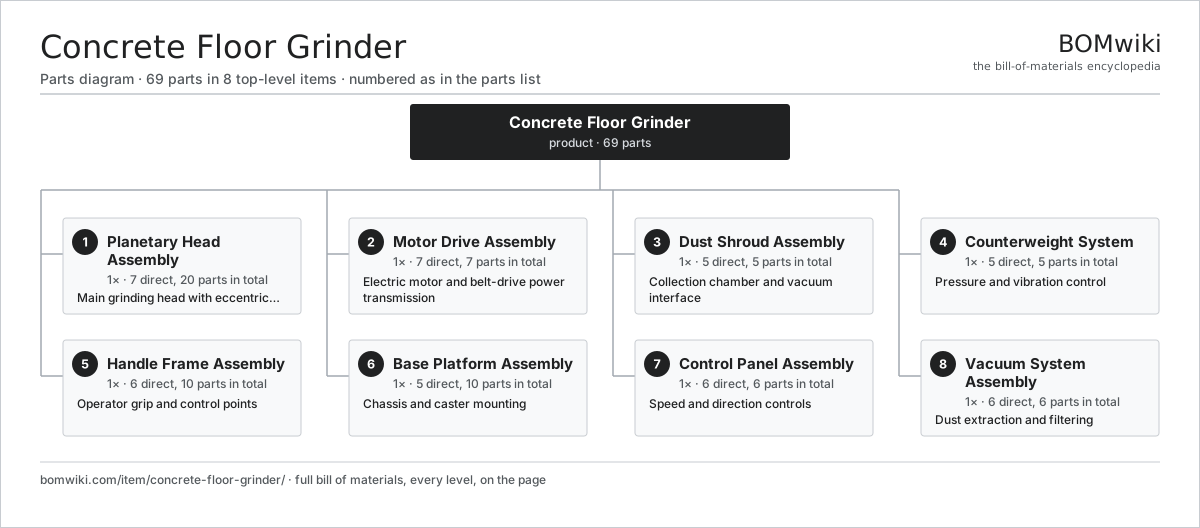
| # | Part | Qty | What it does |
|---|---|---|---|
| 1 | Planetary Head Assembly 7 parts | 1× | Main grinding head with eccentric rotation |
| 2 | Motor Drive Assembly 7 parts | 1× | Electric motor and belt-drive power transmission |
| 3 | Dust Shroud Assembly 5 parts | 1× | Collection chamber and vacuum interface |
| 4 | Counterweight System 5 parts | 1× | Pressure and vibration control |
| 5 | Handle Frame Assembly 6 parts | 1× | Operator grip and control points |
| 6 | Base Platform Assembly 5 parts | 1× | Chassis and caster mounting |
| 7 | Control Panel Assembly 6 parts | 1× | Speed and direction controls |
| 8 | Vacuum System Assembly 6 parts | 1× | Dust extraction and filtering |
3D model
No 3D model yet. Have a CAD file of this? Add a 3D model. STL renders right on this page; STEP, FreeCAD, and OpenSCAD sources are welcome too (openly licensed, like all 3D models on BOMwiki).
Build & assembly graph
expand / collapse · shared sub-assemblies converge · links to related products · est. labourTap an assembly to expand/collapse · tap a part to open it · use “Open page” for any node · drag to pan, scroll to zoom.
Bill of materials for Concrete Floor Grinder
8 top-level lines · 55 rows shown · 69 parts total · indented to 3 levels| # | Item / sub-assembly | Part no. | Qty/assy | Ext. qty | Parts | Type |
|---|---|---|---|---|---|---|
| 1 | Planetary Head Assembly 7 parts | concrete-floor-grinder-planetary-head | 1× | 1 | 20 | assembly |
| 1.1 | Ring Gear | concrete-floor-grinder-ring-gear | 1× | 1 | · | part |
| 1.2 | Planet Carrier | concrete-floor-grinder-planet-carrier | 1× | 1 | · | part |
| 1.3 | Planet Gears | concrete-floor-grinder-planet-gears | 3× | 3 | · | part |
| 1.4 | Diamond Stone | concrete-floor-grinder-diamond-stone | 4× | 4 | · | part |
| 1.5 | Stone Mount Block | concrete-floor-grinder-stone-mount-block | 4× | 4 | · | part |
| 1.6 | Ball Bearing | ball-bearing | 6× | 6 | · | part |
| 1.7 | Fastener Set | fastener-set | 1× | 1 | · | part |
| 2 | Motor Drive Assembly 7 parts | concrete-floor-grinder-motor-drive | 1× | 1 | 7 | assembly |
| 2.1 | Blower Motor | blower-motor | 1× | 1 | · | part |
| 2.2 | Motor Shaft | concrete-floor-grinder-motor-shaft | 1× | 1 | · | part |
| 2.3 | Primary Belt | concrete-floor-grinder-primary-belt | 1× | 1 | · | part |
| 2.4 | Drive Coupling | concrete-floor-grinder-drive-coupling | 1× | 1 | · | part |
| 2.5 | Gearbox | concrete-floor-grinder-gearbox | 1× | 1 | · | part |
| 2.6 | Motor Mount | concrete-floor-grinder-motor-mount | 1× | 1 | · | part |
| 2.7 | Fastener Set | fastener-set | 1× | 1 | · | part |
| 3 | Dust Shroud Assembly 5 parts | concrete-floor-grinder-dust-shroud | 1× | 1 | 5 | assembly |
| 3.1 | Shroud Casting | concrete-floor-grinder-shroud-casting | 1× | 1 | · | part |
| 3.2 | Baffle Insert | concrete-floor-grinder-baffle-insert | 1× | 1 | · | part |
| 3.3 | Vacuum Port | concrete-floor-grinder-vacuum-port | 1× | 1 | · | part |
| 3.4 | Shroud Gasket | concrete-floor-grinder-shroud-gasket | 1× | 1 | · | part |
| 3.5 | Fastener Set | fastener-set | 1× | 1 | · | part |
| 4 | Counterweight System 5 parts | concrete-floor-grinder-counterweight-system | 1× | 1 | 5 | assembly |
| 4.1 | Weight Rotor | concrete-floor-grinder-weight-rotor | 1× | 1 | · | part |
| 4.2 | Cam Follower | concrete-floor-grinder-cam-follower | 1× | 1 | · | part |
| 4.3 | Linkage Rod | concrete-floor-grinder-linkage-rod | 1× | 1 | · | part |
| 4.4 | Spring Cartridge | concrete-floor-grinder-spring-cartridge | 1× | 1 | · | part |
| 4.5 | Fastener Set | fastener-set | 1× | 1 | · | part |
| 5 | Handle Frame Assembly 6 parts | concrete-floor-grinder-handle-frame | 1× | 1 | 10 | assembly |
| 5.1 | Frame Tube | concrete-floor-grinder-frame-tube | 1× | 1 | · | part |
| 5.2 | Handle Grip | concrete-floor-grinder-handle-grip | 2× | 2 | · | part |
| 5.3 | Vibration Isolator | concrete-floor-grinder-vibration-isolator | 4× | 4 | · | part |
| 5.4 | Direction Lever | concrete-floor-grinder-direction-lever | 1× | 1 | · | part |
| 5.5 | Pressure Handle | concrete-floor-grinder-pressure-handle | 1× | 1 | · | part |
| 5.6 | Fastener Set | fastener-set | 1× | 1 | · | part |
| 6 | Base Platform Assembly 5 parts | concrete-floor-grinder-base-platform | 1× | 1 | 10 | assembly |
| 6.1 | Platform Deck | concrete-floor-grinder-platform-deck | 1× | 1 | · | part |
| 6.2 | Platform Stiffener | concrete-floor-grinder-platform-stiffener | 2× | 2 | · | part |
| 6.3 | Caster Bearing | concrete-floor-grinder-caster-bearing | 4× | 4 | · | part |
| 6.4 | Motor Boss | concrete-floor-grinder-motor-boss | 2× | 2 | · | part |
| 6.5 | Fastener Set | fastener-set | 1× | 1 | · | part |
| 7 | Control Panel Assembly 6 parts | concrete-floor-grinder-control-panel | 1× | 1 | 6 | assembly |
| 7.1 | Power Switch | concrete-floor-grinder-power-switch | 1× | 1 | · | part |
| 7.2 | Speed Control Dial | concrete-floor-grinder-speed-control-dial | 1× | 1 | · | part |
| 7.3 | Emergency Stop | concrete-floor-grinder-emergency-stop | 1× | 1 | · | part |
| 7.4 | Direction Selector | concrete-floor-grinder-direction-selector | 1× | 1 | · | part |
| 7.5 | Enclosure Box | concrete-floor-grinder-enclosure-box | 1× | 1 | · | part |
| 7.6 | Fastener Set | fastener-set | 1× | 1 | · | part |
| 8 | Vacuum System Assembly 6 parts | concrete-floor-grinder-vacuum-system | 1× | 1 | 6 | assembly |
| 8.1 | Vacuum Pump | concrete-floor-grinder-vacuum-pump | 1× | 1 | · | part |
| 8.2 | Cyclone Pre-filter | concrete-floor-grinder-cyclone-pre-filter | 1× | 1 | · | part |
| 8.3 | HEPA Cartridge | concrete-floor-grinder-hepa-cartridge | 1× | 1 | · | part |
| 8.4 | Filter Housing | concrete-floor-grinder-filter-housing | 1× | 1 | · | part |
| 8.5 | Hose Assembly | concrete-floor-grinder-hose-assembly | 1× | 1 | · | part |
| 8.6 | Fastener Set | fastener-set | 1× | 1 | · | part |
Something wrong in this list? Report a problem with this BOM.
Related products
same domain, ranked by shared parts Artificial Turf Groomer
63 parts · shares 1 with this page
Artificial Turf Groomer
63 parts · shares 1 with this page
 Carpet Blower/Dryer Stack
69 parts · shares 1 with this page
Carpet Blower/Dryer Stack
69 parts · shares 1 with this page
 Concrete Polisher
57 parts · shares 1 with this page
Escalator Step Cleaner
124 parts · shares 1 with this page
Concrete Polisher
57 parts · shares 1 with this page
Escalator Step Cleaner
124 parts · shares 1 with this page
 Floor Shot Blaster
72 parts · shares 1 with this page
Marble Crystallization Machine
48 parts · shares 1 with this page
Floor Shot Blaster
72 parts · shares 1 with this page
Marble Crystallization Machine
48 parts · shares 1 with this page
Sourcing: possible vendors
Browse the supplier directory → Prices, MOQ, and lead times are algorithmic estimates, not quotes, and not claims about these companies. Company mappings are curated by keyword; est. price band $50–$1.5k. How estimates work| Vendor | HQ | Specialty | MOQ | Lead time |
|---|---|---|---|---|
| sharkninja.com ↗ | Needham, US | Floorcare & kitchen | 1,000 units | 8–12 wks |
|
🇬🇧Dyson
dyson.com ↗
|
Malmesbury, GB | Vacuums & hair care | 1,000 units | 8–12 wks |
|
🇺🇸Bissell
bissell.com ↗
|
Grand Rapids, US | Floorcare | 1,000 units | 8–12 wks |
|
🇺🇸iRobot
irobot.com ↗
|
Bedford, US | Robot vacuums | 1,000 units | 8–12 wks |
|
🇩🇪Kärcher
karcher.com ↗
|
Winnenden, DE | Cleaning equipment | 1,000 units | 8–12 wks |
1,273-word article