Concrete Polisher
ProductOverview
The concrete polisher is a variable-speed walk-behind floor polishing machine designed to progressively refine concrete surfaces to high gloss finish through sequential diamond pad stages. The machine applies a rotating Polishing Head Assembly with bonded diamond pads and wet water film to concrete, gradually transitioning from coarse 200-grit abrasive (material removal and scratch elimination) through fine 3000-grit diamond (gloss development).
The wet-polishing approach is essential: water serves as a lubricant, reducing heat generation and pad wear, while simultaneously flushing away fine concrete dust particles. This dust, an extremely fine calcium silicate powder, combines with water to form a slurry that reacts chemically with the concrete surface, filling micro-pores and hardening into a durable protective coating.
Applications include polishing of new concrete slabs to pristine gloss for retail or institutional floors, refinishing of aged concrete that has lost gloss due to traffic wear, and preparation of concrete for epoxy or polyurethane coatings. A single operator can polish 200–500 square feet per hour depending on concrete age and pad sequence used.
Diamond pad technology and grinding action
The Polishing Head Assembly features a rotating Backing Plate (14-inch diameter steel) onto which a sequence of Diamond Pad Set pads are mounted. Each pad is 12 inches in diameter and consists of synthetic diamond grains bonded in a resin matrix, available in standard grit sizes:
- 200 grit: Coarse abrasive, removes 1–2 mm of material per pass, eliminates saw marks and embedded contaminants.
- 400 grit: Medium-coarse, removes 0.2–0.5 mm per pass, refines surface texture.
- 800 grit: Medium-fine, produces intermediate gloss (60–70% reflectance).
- 1500 grit: Fine, achieves 75–85% reflectance, suitable for sealed floors or interim stages.
- 3000 grit: Ultra-fine, produces mirror gloss (85–95% reflectance), final polishing stage.
Diamond pads are specified by grit size (FEPA standard), bond type (soft, medium, hard), and concentration. Soft bonds wear quickly but continuously expose fresh diamond; hard bonds last longer but may glaze (lose cutting action) if overheated. Water cooling prevents glazing by carrying away heat and fines, extending pad life to 500–1500 square feet per pad depending on concrete hardness.
The polishing action is mechanical abrasion combined with chemical hardening. As the diamond pad grinds the concrete surface at 150–400 RPM, the fine dust created is immediately suspended in the water film. This slurry permeates micro-pores in the concrete, and the calcium silicate reacts with atmospheric CO₂ and dissolved silicates, hardening into a protective crystalline layer. This chemical reaction (similar to concrete cure hardening) creates both a glossy appearance and increased surface hardness and durability against future scratching.
Water system and wet polishing
Wet polishing requires continuous water supply at 2–5 GPM delivered via Water System Assembly. Most entry-level machines use gravity-fed Water Tank (5–10 gallon capacity) positioned on the machine frame; the operator manually refills the tank when empty (typically every 30–60 minutes of operation).
Pressurized water delivery via optional Water Pump (0.5 HP centrifugal pump) is preferred for demanding jobs. The pump delivers 5–10 PSI through a Water Distribution Ring (circular header surrounding the polishing head) with four Nozzle Set directing water onto the pad periphery. Pressurized delivery ensures consistent water flow and prevents water starvation during rapid forward motion.
The water-diamond pad interaction is critical. Insufficient water allows the pad to overheat (surface temperature > 100°C), melting the resin bond and destroying the pad. Excessive water (> 8 GPM) floods the polishing area, reducing traction and creating cleanup challenges. Optimal water flow is 3–5 GPM at 0–5 PSI gravity-fed, or 5–7 GPM at 5–10 PSI pressurized.
Dust collection and slurry management
The Dust Shroud Assembly encloses the polishing head and directs most of the fine slurry downward. A Vacuum Port Union (2–3 inch connection) can be plumbed to an external vacuum system (150–200 CFM capacity), though many operators rely on gravity drainage and manual squeegee or pump-out of pooled slurry.
Concrete polishing creates a large volume of fine slurry (typically 40–60% solids by weight). If not removed during operation, the slurry dries into a hard residue that dulls gloss and is difficult to remove. Professional polishers use simultaneous wet-vacuum recovery: as water and slurry pool under the Shroud Housing, vacuum suction captures the slurry and deposits it in a separate collection container for disposal.
The collected slurry is classified as mineral waste and is disposed of in accordance with local regulations. Some contractors filter and recycle the water, disposing only of the collected fine concrete powder. Others pump slurry directly to a settling tank, allowing the powder to settle overnight, then decant the clarified water for reuse.
Variable-speed drive and pad selection strategy
The Drive Motor Assembly is a 1.5–2 HP single-phase AC motor reduced via Gearbox Assembly to 150–400 RPM at the polishing head. A VFD Controller variable frequency drive allows the operator to adjust speed via Speed Potentiometer dial without stopping the machine.
Slower speeds (150–200 RPM) are used with coarse pads (200–400 grit) on heavily worn or contaminated concrete, maximizing material removal. Faster speeds (300–400 RPM) with fine pads (1500–3000 grit) are used for final gloss development on relatively clean surfaces.
The complete polishing sequence typically progresses as follows:
- 200-grit pass: 1–2 passes at 150 RPM, removes saw marks and contaminants, achieves 10–20% reflectance.
- 400-grit pass: 1 pass at 200 RPM, removes 200-grit scratch patterns, achieves 30–40% reflectance.
- 800-grit pass: 1 pass at 250 RPM, visible gloss emergence, 50–60% reflectance.
- 1500-grit pass: 1 pass at 300 RPM, fine scratch elimination, 70–80% reflectance.
- 3000-grit pass: 2 passes at 350–400 RPM, mirror finish, 85–95% reflectance.
This sequence requires 5–8 hours of polishing per 1000 square feet, depending on concrete condition. Heavily worn or stained concrete requires additional passes or intermediate grits (600, 1000 grit pads available separately).
Pressure adjustment and load control
The Downforce Lever adjusts Pad Retainer Spring preload, controlling downward pressure on the diamond pad from 20 to 40 lbs. Higher pressure increases material removal and cutting speed but accelerates pad wear and generates heat. Lower pressure extends pad life but reduces cutting efficiency on hard or contaminated concrete.
Manual pressure adjustment requires operator judgment. Most polishers start with 30 lbs on the final-gloss pass and reduce to 20 lbs if excessive heat or slurry generation occurs. On coarse-grit removal passes, pressure is typically increased to 35–40 lbs to maximize productivity.
Experienced operators develop a feel for optimal pressure through sound and vibration feedback. A faint, continuous grinding sound indicates proper load; loud squealing suggests glazing (too much heat, insufficient water); and sudden vibration indicates pad catching on surface irregularities (excessive pressure or speed).
Safety and maintenance
The rotating Polishing Head Assembly at 400 RPM presents minor hazard due to soft diamond pads, but foot contact should be avoided. The Dust Shroud Assembly and water spray provide incidental protection. Most manufacturers include no mechanical interlock; operator training emphasizes shutting down before inspecting or adjusting pads or water nozzles.
Concrete dust inhalation, even wet-polished dust, poses respiratory hazard. The fine particles (< 5 microns) are respirable and contain crystalline silica, which causes silicosis and lung disease with chronic exposure. Although wet polishing eliminates airborne dust, slurry handling (pump-out, disposal) creates some dust. Operators should wear P100 or respiratory cartridge (P3 minimum) during cleanup and disposal phases.
The Diamond Pad Set pads cost $30–$60 each and typically last 300–800 square feet before requiring replacement. Pad selection is critical: attempting to polish a 600-grit finish with 200-grit pads will create excessively coarse scratches; conversely, overusing fine pads on contaminated concrete will glaze and stop cutting.
The Blower Motor endures 3000–5000 hours; replacement cost is $300–$500. The Gearbox Assembly is sealed and lubricated for life. The Water Pump (if pressurized system is used) lasts 1000–2000 hours; replacement cost is $200–$400.
Chemical hardeners and sealers
Professional-grade concrete polishing often includes topical hardeners, sodium or potassium silicate solutions applied during or after polishing, that chemically bond with the concrete surface to increase hardness and gloss. These hardeners are distinct from sealers (acrylic, polyurethane, epoxy) applied post-polishing for water and stain resistance.
The combination of mechanical diamond polishing plus chemical hardener plus topical sealer produces concrete floors with durability equivalent to natural stone and gloss comparable to polished granite or marble. Maintenance of polished and sealed concrete requires periodic resealing (annually or biannually depending on traffic) but minimal additional polishing.
Concrete Polisher parts and their functions
8 top-level parts · 57 parts in total · full bill of materials below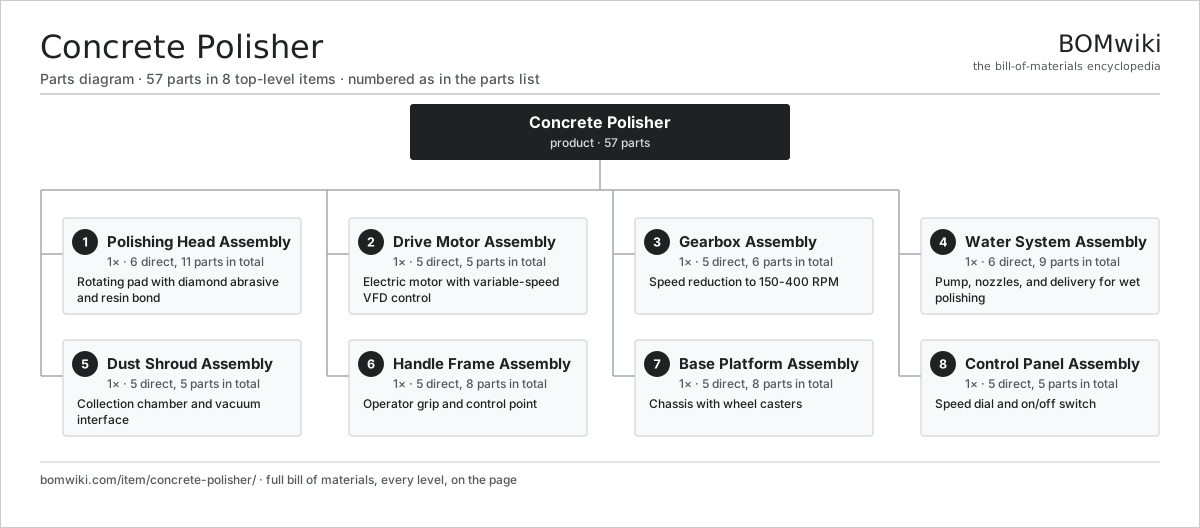
| # | Part | Qty | What it does |
|---|---|---|---|
| 1 | Polishing Head Assembly 6 parts | 1× | Rotating pad with diamond abrasive and resin bond |
| 2 | Drive Motor Assembly 5 parts | 1× | Electric motor with variable-speed VFD control |
| 3 | Gearbox Assembly 5 parts | 1× | Speed reduction to 150-400 RPM |
| 4 | Water System Assembly 6 parts | 1× | Pump, nozzles, and delivery for wet polishing |
| 5 | Dust Shroud Assembly 5 parts | 1× | Collection chamber and vacuum interface |
| 6 | Handle Frame Assembly 5 parts | 1× | Operator grip and control point |
| 7 | Base Platform Assembly 5 parts | 1× | Chassis with wheel casters |
| 8 | Control Panel Assembly 5 parts | 1× | Speed dial and on/off switch |
3D model
No 3D model yet. Have a CAD file of this? Add a 3D model. STL renders right on this page; STEP, FreeCAD, and OpenSCAD sources are welcome too (openly licensed, like all 3D models on BOMwiki).
Build & assembly graph
expand / collapse · shared sub-assemblies converge · links to related products · est. labourTap an assembly to expand/collapse · tap a part to open it · use “Open page” for any node · drag to pan, scroll to zoom.
Bill of materials for Concrete Polisher
8 top-level lines · 50 rows shown · 57 parts total · indented to 3 levels| # | Item / sub-assembly | Part no. | Qty/assy | Ext. qty | Parts | Type |
|---|---|---|---|---|---|---|
| 1 | Polishing Head Assembly 6 parts | concrete-polisher-polishing-head | 1× | 1 | 11 | assembly |
| 1.1 | Backing Plate | concrete-polisher-backing-plate | 1× | 1 | · | part |
| 1.2 | Diamond Pad Set | concrete-polisher-diamond-pad-set | 5× | 5 | · | part |
| 1.3 | Spindle Bearing | concrete-polisher-spindle-bearing | 2× | 2 | · | part |
| 1.4 | Spindle Shaft | concrete-polisher-spindle-shaft | 1× | 1 | · | part |
| 1.5 | Pad Retainer Spring | concrete-polisher-pad-retainer-spring | 1× | 1 | · | part |
| 1.6 | Fastener Set | fastener-set | 1× | 1 | · | part |
| 2 | Drive Motor Assembly 5 parts | concrete-polisher-drive-motor | 1× | 1 | 5 | assembly |
| 2.1 | Blower Motor | blower-motor | 1× | 1 | · | part |
| 2.2 | VFD Controller | concrete-polisher-vfd-controller | 1× | 1 | · | part |
| 2.3 | Motor Mount | concrete-polisher-motor-mount | 1× | 1 | · | part |
| 2.4 | Thermal Overload | concrete-polisher-thermal-overload | 1× | 1 | · | part |
| 2.5 | Fastener Set | fastener-set | 1× | 1 | · | part |
| 3 | Gearbox Assembly 5 parts | concrete-polisher-gearbox | 1× | 1 | 6 | assembly |
| 3.1 | Gearbox Unit | concrete-polisher-gearbox-unit | 1× | 1 | · | part |
| 3.2 | Input Coupling | concrete-polisher-input-coupling | 1× | 1 | · | part |
| 3.3 | Output Shaft | concrete-polisher-output-shaft | 1× | 1 | · | part |
| 3.4 | Shaft Bearing | concrete-polisher-shaft-bearing | 2× | 2 | · | part |
| 3.5 | Fastener Set | fastener-set | 1× | 1 | · | part |
| 4 | Water System Assembly 6 parts | concrete-polisher-water-system | 1× | 1 | 9 | assembly |
| 4.1 | Water Tank | concrete-polisher-water-tank | 1× | 1 | · | part |
| 4.2 | Water Pump | concrete-polisher-water-pump | 1× | 1 | · | part |
| 4.3 | Pump Motor | concrete-polisher-pump-motor | 1× | 1 | · | part |
| 4.4 | Water Distribution Ring | concrete-polisher-water-distribution-ring | 1× | 1 | · | part |
| 4.5 | Nozzle Set | concrete-polisher-nozzle-set | 4× | 4 | · | part |
| 4.6 | Fastener Set | fastener-set | 1× | 1 | · | part |
| 5 | Dust Shroud Assembly 5 parts | concrete-polisher-dust-shroud | 1× | 1 | 5 | assembly |
| 5.1 | Shroud Housing | concrete-polisher-shroud-housing | 1× | 1 | · | part |
| 5.2 | Baffle Plate | concrete-polisher-baffle-plate | 1× | 1 | · | part |
| 5.3 | Vacuum Port Union | concrete-polisher-vacuum-port-union | 1× | 1 | · | part |
| 5.4 | Shroud Seal | concrete-polisher-shroud-seal | 1× | 1 | · | part |
| 5.5 | Fastener Set | fastener-set | 1× | 1 | · | part |
| 6 | Handle Frame Assembly 5 parts | concrete-polisher-handle-frame | 1× | 1 | 8 | assembly |
| 6.1 | Column Tube | concrete-polisher-column-tube | 1× | 1 | · | part |
| 6.2 | Handle Grip | concrete-polisher-handle-grip | 1× | 1 | · | part |
| 6.3 | Vibration Isolator | concrete-polisher-vibration-isolator | 4× | 4 | · | part |
| 6.4 | Downforce Lever | concrete-polisher-downforce-lever | 1× | 1 | · | part |
| 6.5 | Fastener Set | fastener-set | 1× | 1 | · | part |
| 7 | Base Platform Assembly 5 parts | concrete-polisher-base-platform | 1× | 1 | 8 | assembly |
| 7.1 | Frame Base | concrete-polisher-frame-base | 1× | 1 | · | part |
| 7.2 | Frame Stiffener | concrete-polisher-frame-stiffener | 1× | 1 | · | part |
| 7.3 | Caster Swivel | concrete-polisher-caster-swivel | 4× | 4 | · | part |
| 7.4 | Motor Boss | concrete-polisher-motor-boss | 1× | 1 | · | part |
| 7.5 | Fastener Set | fastener-set | 1× | 1 | · | part |
| 8 | Control Panel Assembly 5 parts | concrete-polisher-control-panel | 1× | 1 | 5 | assembly |
| 8.1 | Power Switch | concrete-polisher-power-switch | 1× | 1 | · | part |
| 8.2 | Speed Potentiometer | concrete-polisher-speed-potentiometer | 1× | 1 | · | part |
| 8.3 | Pump Switch | concrete-polisher-pump-switch | 1× | 1 | · | part |
| 8.4 | Enclosure Box | concrete-polisher-enclosure-box | 1× | 1 | · | part |
| 8.5 | Fastener Set | fastener-set | 1× | 1 | · | part |
Something wrong in this list? Report a problem with this BOM.
Related products
same domain, ranked by shared parts Artificial Turf Groomer
63 parts · shares 1 with this page
Artificial Turf Groomer
63 parts · shares 1 with this page
 Carpet Blower/Dryer Stack
69 parts · shares 1 with this page
Carpet Blower/Dryer Stack
69 parts · shares 1 with this page
 Concrete Floor Grinder
69 parts · shares 1 with this page
Escalator Step Cleaner
124 parts · shares 1 with this page
Concrete Floor Grinder
69 parts · shares 1 with this page
Escalator Step Cleaner
124 parts · shares 1 with this page
 Floor Shot Blaster
72 parts · shares 1 with this page
Marble Crystallization Machine
48 parts · shares 1 with this page
Floor Shot Blaster
72 parts · shares 1 with this page
Marble Crystallization Machine
48 parts · shares 1 with this page
Sourcing: possible vendors
Browse the supplier directory → Prices, MOQ, and lead times are algorithmic estimates, not quotes, and not claims about these companies. Company mappings are curated by keyword; est. price band $50–$1.5k. How estimates work| Vendor | HQ | Specialty | MOQ | Lead time |
|---|---|---|---|---|
| sharkninja.com ↗ | Needham, US | Floorcare & kitchen | 1,000 units | 8–12 wks |
|
🇬🇧Dyson
dyson.com ↗
|
Malmesbury, GB | Vacuums & hair care | 1,000 units | 8–12 wks |
|
🇺🇸Bissell
bissell.com ↗
|
Grand Rapids, US | Floorcare | 1,000 units | 8–12 wks |
|
🇺🇸iRobot
irobot.com ↗
|
Bedford, US | Robot vacuums | 1,000 units | 8–12 wks |
|
🇩🇪Kärcher
karcher.com ↗
|
Winnenden, DE | Cleaning equipment | 1,000 units | 8–12 wks |
1,488-word article