Ride-On Concrete Saw
ProductOverview
Ride-on concrete saws cut control joints and crack isolation lines in newly poured concrete pavements. These machines operate immediately after concrete placement (while curing but before surface hardening), cutting narrow slots (3 mm wide) 25–100 mm deep across the full pavement width at planned joint spacing (typically 4–12 feet). The Gasoline Prime Mover small gasoline engine powers the Diamond Blade Assembly diamond blade and drive wheels, allowing the operator to guide the saw in straight lines while standing on the Operator Platform platform.
Control joints relieve internal concrete stresses (thermal contraction, concrete shrinkage) by controlling where cracks form. Uncontrolled cracks appear randomly, creating irregular patterns and potential pavement failure (cracking reduces load distribution, allowing corner breaks and progressive spalling). Sawed joints with sharp 90° edges guide crack propagation downward, creating straight, uniform control joints that preserve pavement integrity.
Cutting mechanism
The Segmented Diamond Blade diamond blade consists of a steel core with arc-welded diamond segments brazed onto the periphery. The segments (each ~25 mm × 12 mm × 5 mm) contain industrial-grade diamonds (Bort, crushed diamond particles bonded in metal matrix) suspended in a copper or nickel binder. The diamonds protrude slightly from the binder matrix, continuously exposing fresh cutting points as the binder wears away during cutting.
At Diamond Blade Assembly 3,600 RPM rotation (0.4 inch × 16 inch = 400 mm blade), the blade's peripheral speed is ~50 m/sec (~160 ft/sec), causing the diamond particles to abrade concrete at high speed. The concrete surface directly under the blade is progressively worn away as the saw advances. The Water Delivery System water delivery system continuously cools the blade (preventing thermal expansion and micro-fracture) and suppresses dust, reducing airborne respirable particulate.
Concrete properties and cutting rate
Cutting rate varies with concrete strength and age:
6–12 hours post-placement (still plastic, not fully cured): 300–400 mm/min advance rate. Concrete is weakest; the saw cuts cleanly without chipping or spalling. The depth control prevents overcut (excessive depth), which weakens the concrete section. Most contractors saw within 6 hours of placement to take advantage of soft-curing concrete.
12–24 hours post-placement (curing, developing strength): 150–250 mm/min advance rate. Concrete has partially hardened; cutting rate slows as concrete strength increases.
24–48 hours post-placement (cured, reached 50+ strength): 50–150 mm/min advance rate. Fully hardened concrete significantly slows cutting; additional heat and blade wear increase, reducing blade life.
Concrete with high aggregate (coarse gravel, river rock) cuts slower than fine sand/cement mixes. Air-entrained concrete (small voids for freeze-thaw durability) cuts smoothly; non-air-entrained concrete spalls more readily.
Depth and alignment control
The Depth Adjustment Mechanism screw-driven depth mechanism allows precise setting of cut depth via Depth Indicator Scale calibrated scale (0–100 mm range). The operator rotates Depth Handwheel handwheel, lowering the Diamond Blade Assembly blade assembly. A Depth Limit Stop mechanical stop pin prevents overcut beyond the set depth. Standard control joints are 25 mm (1 inch) deep for 4 inch thick slabs and 30–40 mm (1.25–1.5 inches) for thicker sections; the rule of thumb is 1/3 to 1/4 of slab thickness.
Alignment control is manual: the operator guides the Rear Drive Wheels rear wheels along a stringline or marked chalk line, maintaining straight cut. Front Front Caster Wheels castor wheels provide steering response; the operator applies gentle pressure to the handlebar to steer left/right. Uneven steering produces wavy cuts, which are cosmetically unacceptable and may not provide full load transfer.
Blade cooling and dust control
The concrete-saw-ride-out-water-system water system is critical for three reasons:
Blade cooling: Diamond saws generate heat (~200–400°C at blade surface). Water contact cools the blade to ~100–150°C, preventing thermal fracture of the diamond segments and binder matrix. Overheating causes the binder to soften and release diamonds prematurely, shortening blade life from 8–10 hours (normal) to 2–3 hours (overheated).
Concrete cooling: Rapid cooling of the cut surface can cause micro-cracking if water application is excessive. Optimal practice is light continuous misting, not drenching.
Dust suppression: The cut produces fine concrete dust (respirable particles <5 microns). Water capture and settling in the supply line converts dry dust cloud into wet slurry that drops to the pavement, reducing airborne respirable exposure from 200+ mg/m³ (dry cutting) to <10 mg/m³ (with water).
The operator controls Water Flow Control water flow via manual ball valve; typical flow is 10–20 GPM, consuming 0.1–0.2 gallons per linear foot of cut. The Water Tank tank holds 30 liters (8 gallons); a typical job cuts 500–1,000 linear feet, requiring 50–200 gallons of water total (multiple tank refills).
Operational workflow
The concrete contractor schedules sawing when concrete has cured 6–12 hours post-placement (typically the morning after overnight placement). The saw operator marks joint locations using chalk lines or stringlines (pre-marked via survey or machine positioning laser). The Depth Handwheel depth adjustment is set to the design depth (typically 25–40 mm for control joints).
The operator starts the Gasoline Prime Mover engine (pull-cord or recoil start), engages the Centrifugal Clutch centrifugal clutch (automatically engaging at ~1,500 RPM), and positions the Diamond Blade Assembly blade on the concrete surface at the first joint line. Water flow is turned on via the Water Flow Control valve. The operator walks backward slowly, guiding the rear wheels along the marked line, maintaining constant forward speed (~150–300 mm/min) for uniform cutting.
For a 1,000 linear foot section with joints at 12-foot spacing (2,500 feet of cuts), the operator requires ~2–3 hours of actual cutting time. Total time including setup, travel, refueling, and blade changes is 4–5 hours per 1,000 linear feet.
Joint spacing and load transfer
Control joint spacing is designed based on concrete thickness and thermal conditions:
Standard spacing: 12 feet (3.6 m) apart transversely, creating 12 ft × width rectangular panels. Each panel is independent, free to expand/contract with temperature changes without excessive stress.
Short spacing (6–8 feet): used in cold climates or high-traffic areas where crack control is critical. Reduces panel stress but increases cost (more sawing).
Longitudinal joints: parallel to traffic flow, spaced every 2–4 lanes (at lane centerlines and edges), relieving lateral thermal stress.
Joint dimensions affect load transfer between panels: wide, shallow joints reduce load transfer capability (adjacent panels move independently, causing faulting, differential elevation between panels). Narrow, deep joints allow more aggregate interlock, improving load transfer. Standard joint design uses 3 mm width × (1/3 thickness) depth, achieving ~40–50% load transfer via aggregate interlock.
Blade maintenance and replacement
Diamond blades typically provide 8–10 hours of cutting before requiring replacement; cost is $200–500 per blade. Blade life is reduced by:
- Overheating: insufficient water, excessive depth, or prolonged operation without rest; life reduces to 2–4 hours
- Hitting reinforcing steel: embedded rebar or wire quickly dulls the blade; specialized carbide-grit blades are used for reinforced concrete but at higher cost (~$800–1,200) and slightly slower cutting rate
- Poor blade quality: off-spec diamond concentration or binder formulation causes premature segment loss
- Concrete variation: abrasive granite aggregates wear blades faster than limestone; design life may reduce from 10 hours to 6 hours
Operators inspect blades visually for segment loss (missing or broken segments, visible gaps around blade periphery) and reduced cutting rate as signs of blade wear; replacement is economically justified when cutting rate drops below 100 mm/min (inefficiency costs in time exceed blade replacement cost).
Safety and occupational health
Concrete saw operators are exposed to noise (90–95 dB) requiring hearing protection (earplugs, earmuffs). Respirable silica dust from concrete cutting is a significant occupational health hazard: concrete contains ~50% silica (SiO₂) by weight; inhalation of crystalline silica particles causes silicosis (lung fibrosis, irreversible lung damage) with prolonged exposure. OSHA standards limit respirable crystalline silica exposure to 50 micrograms per cubic meter (time-weighted average, 8-hour shift).
Proper dust control is essential: water suppression (reducing respirable dust from 200+ to <10 mg/m³ as noted above) is the most effective control. Respiratory protection (P100 particulate respirator) is secondary control for operators unable to use water suppression. Work rotation (alternating saw operators, limiting individual exposure to 4 hours per day) reduces cumulative exposure.
Blade contact injury risk is high: if an operator stumbles and falls forward, contact with the spinning blade causes severe lacerations or partial amputation. Modern saws include Engine Kill Switch engine kill switches mounted on the handlebar; if the operator releases grip, the engine shuts off within 1 second. Protective leg gaiters (leather chaps) are standard PPE on some jurisdictions.
Modern refinements
Laser-guided control saws with automatic steering are becoming available, using a laser stripe projected on the pavement and photocell tracking to steer the saw automatically. These systems reduce operator fatigue and maintain tighter alignment tolerances (±0.25 inches vs. ±1 inch manual sawing), improving finished appearance and load transfer.
Ride-On Concrete Saw parts and their functions
8 top-level parts · 39 parts in total · full bill of materials below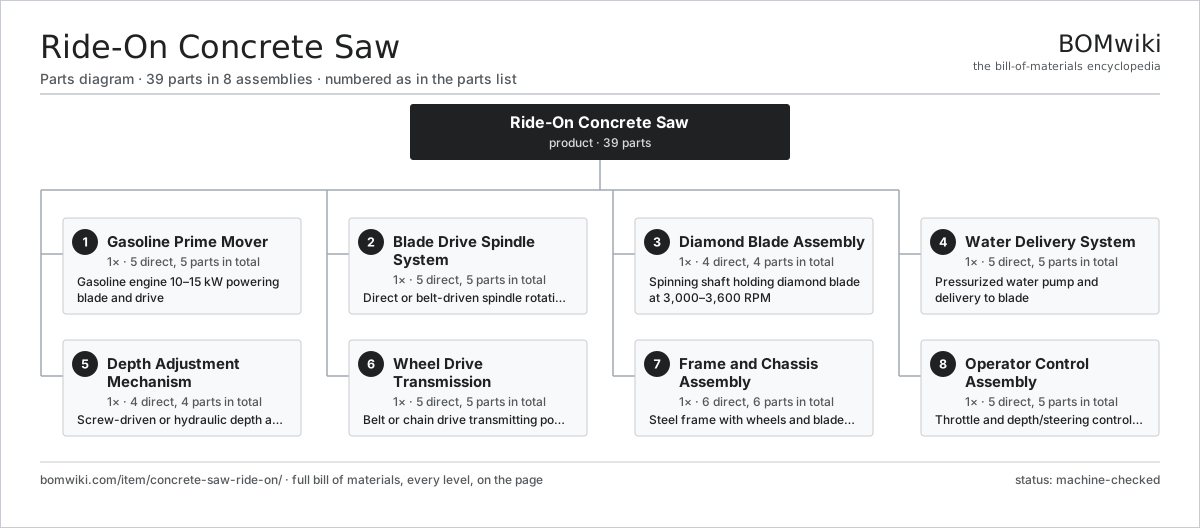
| # | Part | Qty | What it does |
|---|---|---|---|
| 1 | Gasoline Prime Mover 5 parts | 1× | Gasoline engine 10–15 kW powering blade and drive |
| 2 | Blade Drive Spindle System 5 parts | 1× | Direct or belt-driven spindle rotating diamond blade |
| 3 | Diamond Blade Assembly 4 parts | 1× | Spinning shaft holding diamond blade at 3,000–3,600 RPM |
| 4 | Water Delivery System 5 parts | 1× | Pressurized water pump and delivery to blade |
| 5 | Depth Adjustment Mechanism 4 parts | 1× | Screw-driven or hydraulic depth adjustment mechanism |
| 6 | Wheel Drive Transmission 5 parts | 1× | Belt or chain drive transmitting power to wheels |
| 7 | Frame and Chassis Assembly 6 parts | 1× | Steel frame with wheels and blade guard |
| 8 | Operator Control Assembly 5 parts | 1× | Throttle and depth/steering controls for operator |
3D model
No 3D model yet. Have a CAD file of this? Add a 3D model — STL renders right on this page; STEP, FreeCAD, and OpenSCAD sources are welcome too (openly licensed, like all 3D models on BOMwiki).
Build & assembly graph
expand / collapse · shared sub-assemblies converge · links to related products · est. labourTap an assembly to expand/collapse · tap a part to open it · use “Open page” for any node · drag to pan, scroll to zoom.
Bill of materials for Ride-On Concrete Saw
8 top-level lines · 47 rows shown · 39 parts total · indented to 3 levels| # | Item / sub-assembly | Part no. | Qty/assy | Ext. qty | Parts | Type |
|---|---|---|---|---|---|---|
| 1 | Gasoline Prime Mover 5 parts | concrete-saw-ride-on-gasoline-engine | 1× | 1 | 5 | assembly |
| 1.1 | Engine Block Assembly | concrete-saw-ride-on-engine-block | 1× | 1 | · | part |
| 1.2 | Fuel Carburetor | concrete-saw-ride-on-carburetor | 1× | 1 | · | part |
| 1.3 | Ignition System | concrete-saw-ride-on-ignition-system | 1× | 1 | · | part |
| 1.4 | Centrifugal Clutch | concrete-saw-ride-on-clutch | 1× | 1 | · | part |
| 1.5 | Air Filter Element | concrete-saw-ride-on-air-filter | 1× | 1 | · | part |
| 2 | Blade Drive Spindle System 5 parts | concrete-saw-ride-on-blade-drive | 1× | 1 | 5 | assembly |
| 2.1 | Spindle Bearing Assembly | concrete-saw-ride-on-spindle-bearing | 1× | 1 | · | part |
| 2.2 | Belt Drive | concrete-saw-ride-on-drive-belt | 1× | 1 | · | part |
| 2.3 | Spindle Drive Pulley | concrete-saw-ride-on-spindle-pulley | 1× | 1 | · | part |
| 2.4 | Blade Mounting Arbor | concrete-saw-ride-on-blade-arbor | 1× | 1 | · | part |
| 2.5 | Blade Guard Housing | concrete-saw-ride-on-spindle-guard | 1× | 1 | · | part |
| 3 | Diamond Blade Assembly 4 parts | concrete-saw-ride-on-blade-shaft | 1× | 1 | 4 | assembly |
| 3.1 | Segmented Diamond Blade | concrete-saw-ride-on-diamond-blade | 1× | 1 | · | part |
| 3.2 | Blade Support Flange | concrete-saw-ride-on-blade-flange | 1× | 1 | · | part |
| 3.3 | Blade Retention Nut | concrete-saw-ride-on-blade-nut | 1× | 1 | · | part |
| 3.4 | Blade Spacing Ring | concrete-saw-ride-on-blade-spacer | 1× | 1 | · | part |
| 4 | Water Delivery System 5 parts | concrete-saw-ride-on-water-system | 1× | 1 | 5 | assembly |
| 4.1 | Water Tank | concrete-saw-ride-on-water-tank | 1× | 1 | · | part |
| 4.2 | Water Delivery Pump | concrete-saw-ride-on-water-pump | 1× | 1 | · | part |
| 4.3 | Water Nozzle | concrete-saw-ride-on-delivery-nozzle | 1× | 1 | · | part |
| 4.4 | Water Flow Control | concrete-saw-ride-on-flow-valve | 1× | 1 | · | part |
| 4.5 | Tank Inlet Strainer | concrete-saw-ride-on-suction-strainer | 1× | 1 | · | part |
| 5 | Depth Adjustment Mechanism 4 parts | concrete-saw-ride-on-depth-control | 1× | 1 | 4 | assembly |
| 5.1 | Depth Lead Screw | concrete-saw-ride-on-depth-screw | 1× | 1 | · | part |
| 5.2 | Depth Adjustment Nut | concrete-saw-ride-on-depth-nut | 1× | 1 | · | part |
| 5.3 | Depth Indicator Scale | concrete-saw-ride-on-depth-scale | 1× | 1 | · | part |
| 5.4 | Depth Limit Stop | concrete-saw-ride-on-limit-switch | 1× | 1 | · | part |
| 6 | Wheel Drive Transmission 5 parts | concrete-saw-ride-on-drive-transmission | 1× | 1 | 5 | assembly |
| 6.1 | Engine Drive Sprocket | concrete-saw-ride-on-drive-sprocket | 1× | 1 | · | part |
| 6.2 | Roller Chain Drive | concrete-saw-ride-on-transmission-chain | 1× | 1 | · | part |
| 6.3 | Wheel Drive Sprocket | concrete-saw-ride-on-wheel-sprocket | 1× | 1 | · | part |
| 6.4 | Chain Idler Tensioner | concrete-saw-ride-on-chain-tensioner | 1× | 1 | · | part |
| 6.5 | Chain Guard Cover | concrete-saw-ride-on-transmission-guard | 1× | 1 | · | part |
| 7 | Frame and Chassis Assembly 6 parts | concrete-saw-ride-on-chassis | 1× | 1 | 6 | assembly |
| 7.1 | Main Frame | concrete-saw-ride-on-frame | 1× | 1 | · | part |
| 7.2 | Rear Drive Wheels | concrete-saw-ride-on-rear-wheels | 1× | 1 | · | part |
| 7.3 | Front Caster Wheels | concrete-saw-ride-on-front-wheels | 1× | 1 | · | part |
| 7.4 | Operator Platform | concrete-saw-ride-on-operator-platform | 1× | 1 | · | part |
| 7.5 | Blade Shroud Guard | concrete-saw-ride-on-blade-guard | 1× | 1 | · | part |
| 7.6 | Engine Mount | concrete-saw-ride-on-engine-mount | 1× | 1 | · | part |
| 8 | Operator Control Assembly 5 parts | concrete-saw-ride-on-controls | 1× | 1 | 5 | assembly |
| 8.1 | Throttle Control | concrete-saw-ride-on-throttle-lever | 1× | 1 | · | part |
| 8.2 | Depth Handwheel | concrete-saw-ride-on-depth-handwheel | 1× | 1 | · | part |
| 8.3 | Water Flow Lever | concrete-saw-ride-on-flow-control | 1× | 1 | · | part |
| 8.4 | Engine Kill Switch | concrete-saw-ride-on-kill-switch | 1× | 1 | · | part |
| 8.5 | Handlebar Assembly | concrete-saw-ride-on-handlebar-grip | 1× | 1 | · | part |
Sourcing: possible vendors
Prices, MOQ, and lead times are algorithmic estimates, not quotes, and not claims about these companies. Company mappings are curated by keyword; est. price band $15k–$2M. How estimates work| Vendor | HQ | Specialty | MOQ | Lead time |
|---|---|---|---|---|
| caterpillar.com ↗ | Irving, US | Construction & mining equipment | made to order | 16–28 wks |
|
🇯🇵Komatsu
komatsu.com ↗
|
Tokyo, JP | Construction & mining equipment | made to order | 16–28 wks |
|
🇸🇪Volvo CE
volvoce.com ↗
|
Gothenburg, SE | Construction equipment | made to order | 16–28 wks |
|
🇨🇭Liebherr
liebherr.com ↗
|
Bulle, CH | Cranes & heavy equipment | made to order | 16–28 wks |
|
🇨🇳XCMG
xcmg.com ↗
|
Xuzhou, CN | Construction machinery | made to order | 16–28 wks |
1,589-word article