Conveyor Toaster
ProductOverview
A commercial conveyor toaster is a high-volume bread toaster that uses a moving stainless-steel wire belt to carry bread continuously through an infrared heating chamber. Unlike a pop-up toaster, which grips bread in fixed slots, a conveyor toaster can handle any bread shape and thickness, sliced bread, bagels, buns, specialty rolls, at high volume. A bakery or café can toast 300–500 slices per hour.
The core heating system consists of multiple Top Heating Element, typically 4 quartz infrared lamps mounted above the belt, and an equal number Bottom Heating Element mounted below. Each lamp is a sealed tube filled with an inert gas and a tungsten filament. When powered, the filament glows to 3000+ Kelvin, emitting visible light and intense infrared radiation. The radiant energy passes through the bread's surface and is absorbed by sugars, proteins, and moisture, causing the Maillard reaction, the browning and flavor development that is the whole point of toasting.
A Power Controller (an SCR dimmer circuit or variable autotransformer) adjusts the voltage supplied to the heating elements. Lower voltage = dimmer, cooler light and less radiant power; higher voltage = brighter, hotter. This is how the toasting darkness is controlled.
The Conveyor Belt System consists of a Wire Belt, typically 18–24 inches wide, driven by a Drive Pulley at one end and supported by a Return Pulley at the far end. A Motor Drive Assembly with variable-speed control powers the drive pulley. By slowing the belt, bread spends more time in the heating chamber and toasts darker; by speeding the belt, bread toasts lighter. Together, the heating element power and belt speed give the operator two controls for toasting darkness.
How it works
When the toaster is switched on, the AC Motor begins to run and the Wire Belt starts to move. The Top Heating Element and Bottom Heating Element begin to glow orange-red, reaching operating temperature within 5–10 minutes. A Indicator Lamp illuminates to indicate that the heating elements are ready.
The operator places a slice or multiple slices of bread on the Wire Belt, which grips the bread gently via friction. The belt carries the bread through the Heating Chamber, a box lined with the heating lamps.
As the bread travels through the chamber, it experiences radiant heat from both above and below. The surface in contact with the lamp above receives the most intense heating and browns first. The opposite surface, facing the lower lamps, also browns but is partially shaded by the bread itself, so it browns slightly less, this asymmetry is why the top of toasted bread often looks more golden than the bottom. The time spent in the chamber determines the final toast color: 30 seconds yields very light toast, 60 seconds yields medium toast, 90–120 seconds yields dark or burnt toast.
The radiant energy penetrates the bread surface to a depth of 2–3 mm, where moisture evaporates and the Maillard reaction occurs. The interior of thick slices stays relatively cool (around 150–170 °F) even as the surface reaches 300+ °F. This gradient, hot surface, cool interior, is ideal for toast: a crispy exterior and soft, steamy interior.
The operator controls toasting darkness by adjusting the Speed Potentiometer, which changes belt speed. A dial marked LIGHT to DARK adjusts the Power Controller, regulating heating element power. Newer models have a digital timer display: set it to 45 seconds for light toast, 75 seconds for medium, etc.
As bread exits the far end of the heating chamber, it drops onto a warmed output tray or directly into a waiting basket. A Crumb Tray beneath the chamber catches crumbs and charred debris. At the end of the day, the tray is pulled out and emptied.
The Belt Guard protects the operator from touching the moving belt. The belt itself is removable for cleaning; it must be drained of crumbs and any buildup that would affect its smooth motion.
Conveyor toasters are found in diners, bagel shops, cafés, and any high-volume breakfast operation. Their speed, consistency, and ability to toast different bread types without adjustment make them far superior to pop-up toasters for commercial use. The simplicity and robustness of quartz infrared heating mean the toasters often run 12+ hours a day, five days a week, for decades with minimal maintenance beyond occasional belt cleaning and crumb tray emptying.
Conveyor Toaster parts and their functions
6 top-level parts · 34 parts in total · full bill of materials below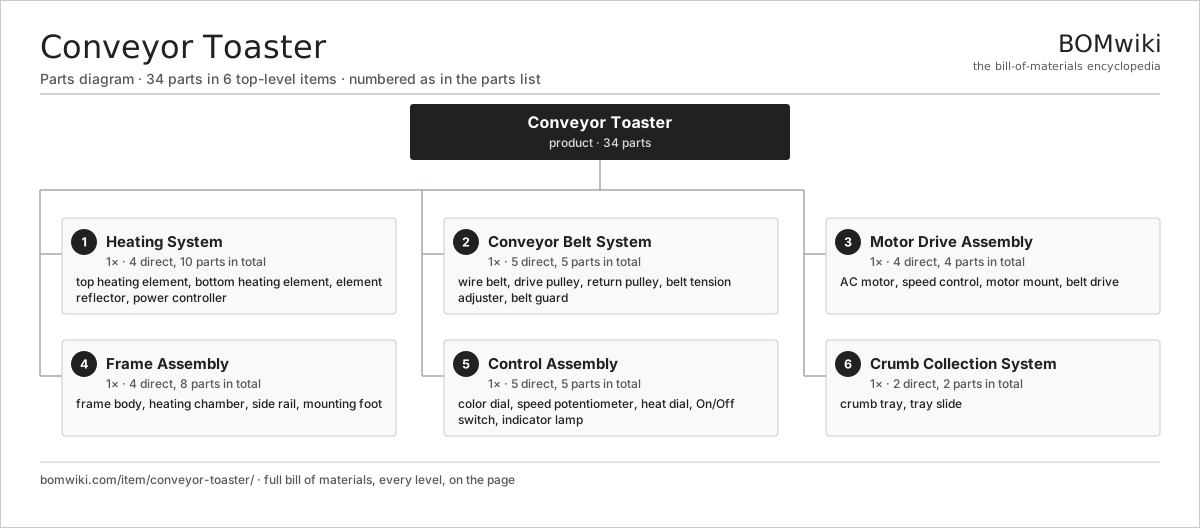
| # | Part | Qty | What it does |
|---|---|---|---|
| 1 | Heating System 4 parts | 1× | Multiple infrared heating elements mounted above and below the conveyor belt that radiate heat onto bread. |
| 2 | Conveyor Belt System 5 parts | 1× | Wire mesh belt that moves continuously to carry bread through the heating chamber. |
| 3 | Motor Drive Assembly 4 parts | 1× | Variable-speed electric motor that drives the conveyor belt, controlling bread residence time. |
| 4 | Frame Assembly 4 parts | 1× | Stainless-steel structural frame that supports the heating chamber, pulleys, and motor. |
| 5 | Control Assembly 5 parts | 1× | Dial or digital display that sets toasting color, belt speed, and heating element temperature. |
| 6 | Crumb Collection System 2 parts | 1× | Tray below the conveyor that collects crumbs and debris for easy removal. |
3D model
No 3D model yet. Have a CAD file of this? Add a 3D model. STL renders right on this page; STEP, FreeCAD, and OpenSCAD sources are welcome too (openly licensed, like all 3D models on BOMwiki).
Build & assembly graph
expand / collapse · shared sub-assemblies converge · links to related products · est. labourTap an assembly to expand/collapse · tap a part to open it · use “Open page” for any node · drag to pan, scroll to zoom.
Bill of materials for Conveyor Toaster
6 top-level lines · 30 rows shown · 34 parts total · indented to 3 levels| # | Item / sub-assembly | Part no. | Qty/assy | Ext. qty | Parts | Type |
|---|---|---|---|---|---|---|
| 1 | Heating System 4 parts | conveyor-toaster-heating-system | 1× | 1 | 10 | assembly |
| 1.1 | Top Heating Element | conveyor-toaster-heating-element-top | 4× | 4 | · | part |
| 1.2 | Bottom Heating Element | conveyor-toaster-heating-element-bottom | 4× | 4 | · | part |
| 1.3 | Element Reflector | conveyor-toaster-element-reflector | 1× | 1 | · | part |
| 1.4 | Power Controller | conveyor-toaster-power-controller | 1× | 1 | · | part |
| 2 | Conveyor Belt System 5 parts | conveyor-toaster-conveyor-belt-system | 1× | 1 | 5 | assembly |
| 2.1 | Wire Belt | conveyor-toaster-wire-belt | 1× | 1 | · | part |
| 2.2 | Drive Pulley | conveyor-toaster-drive-pulley | 1× | 1 | · | part |
| 2.3 | Return Pulley | conveyor-toaster-return-pulley | 1× | 1 | · | part |
| 2.4 | Belt Tension Adjuster | conveyor-toaster-belt-tension | 1× | 1 | · | part |
| 2.5 | Belt Guard | conveyor-toaster-belt-guard | 1× | 1 | · | part |
| 3 | Motor Drive Assembly 4 parts | conveyor-toaster-motor-drive | 1× | 1 | 4 | assembly |
| 3.1 | AC Motor | conveyor-toaster-ac-motor | 1× | 1 | · | part |
| 3.2 | Speed Control | conveyor-toaster-speed-control | 1× | 1 | · | part |
| 3.3 | Motor Mount | conveyor-toaster-motor-mount | 1× | 1 | · | part |
| 3.4 | Belt Drive | conveyor-toaster-belt-drive | 1× | 1 | · | part |
| 4 | Frame Assembly 4 parts | conveyor-toaster-frame | 1× | 1 | 8 | assembly |
| 4.1 | Frame Body | conveyor-toaster-frame-body | 1× | 1 | · | part |
| 4.2 | Heating Chamber | conveyor-toaster-heating-chamber | 1× | 1 | · | part |
| 4.3 | Side Rail | conveyor-toaster-side-rails | 2× | 2 | · | part |
| 4.4 | Mounting Foot | conveyor-toaster-mounting-feet | 4× | 4 | · | part |
| 5 | Control Assembly 5 parts | conveyor-toaster-controls | 1× | 1 | 5 | assembly |
| 5.1 | Color Dial | conveyor-toaster-color-dial | 1× | 1 | · | part |
| 5.2 | Speed Potentiometer | conveyor-toaster-speed-potentiometer | 1× | 1 | · | part |
| 5.3 | Heat Dial | conveyor-toaster-heat-dial | 1× | 1 | · | part |
| 5.4 | On/Off Switch | conveyor-toaster-on-off-switch | 1× | 1 | · | part |
| 5.5 | Indicator Lamp | conveyor-toaster-indicator-lamp | 1× | 1 | · | part |
| 6 | Crumb Collection System 2 parts | conveyor-toaster-crumb-system | 1× | 1 | 2 | assembly |
| 6.1 | Crumb Tray | conveyor-toaster-crumb-tray | 1× | 1 | · | part |
| 6.2 | Tray Slide | conveyor-toaster-tray-slide | 1× | 1 | · | part |
Something wrong in this list? Report a problem with this BOM.
Sourcing: possible vendors
Browse the supplier directory → Prices, MOQ, and lead times are algorithmic estimates, not quotes, and not claims about these companies. Company mappings are curated by keyword; est. price band $1k–$500k. How estimates work| Vendor | HQ | Specialty | MOQ | Lead time |
|---|---|---|---|---|
| gea.com ↗ | Düsseldorf, DE | Process technology | 20 units | 12–20 wks |
| buhlergroup.com ↗ | Uzwil, CH | Food & materials processing | 20 units | 12–20 wks |
| tetrapak.com ↗ | Pully, CH | Food packaging & processing | 20 units | 12–20 wks |
| jbtc.com ↗ | Chicago, US | Food processing equipment | 20 units | 12–20 wks |
| alfalaval.com ↗ | Lund, SE | Heat transfer & separation | 20 units | 12–20 wks |
768-word article